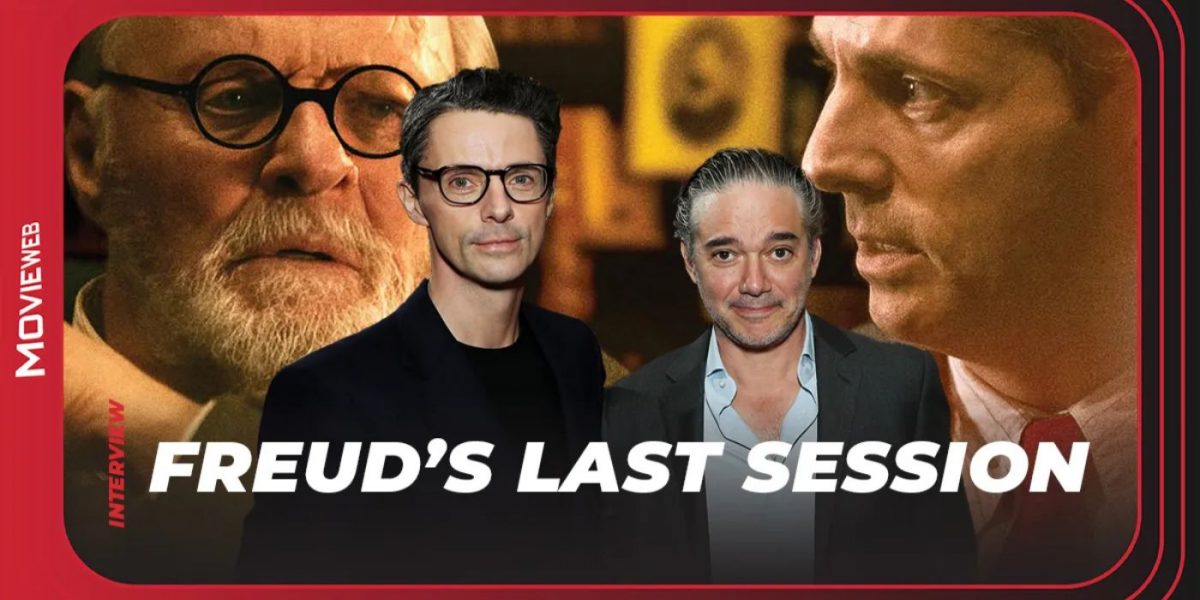
Freud’s Last Session Star Matthew Goode and Director Matthew Brown Interview
Dec 21, 2023
Freud’s Last Session, adapted from the play by Mark St. Germain, posits a fictional 1939 meeting between the renowned psychoanalyst Sigmund Freud and author C.S. Lewis (Matthew Goode) in London shortly after Germany invaded Poland. Freud (Anthony Hopkins), dying of oral cancer, wanted to meet the Oxford professor famed for his religious beliefs. Freud was an unabashed atheist who mocked the concept of God as pure fiction manifested by foolish humans. Freud debates a nervous Lewis as England prepares for war and his obsessed daughter, Anna (Liv Lisa Fries), a prominent academic in the study of child psychology, desperately searches for morphine to please him.
Matthew Goode and director/co-writer Matthew Brown (The Man Who Knew Infinity) discuss working with an acting legend while portraying notable 20th century figures. Goode “didn’t know a huge amount about this period of his life [but] shaped” his performance from Narnia and Christian author C.S. Lewis’ 1955 memoir. He had “bags of material” to work with but thinks “you also have to throw it all away because I’m in a room with Freud.” Goode calls Hopkins “one of the greatest actors of all time” and “a joy.”
Brown recalls “months of discussions” with Hopkins, who “spent a lot of time preparing” and was “engaged heavily” in the process. Brown believes that Hopkins was “drawing on his own life in many ways.” They “talked about mortality” at “this moment” for Hopkins, who plays Freud with surprising levity despite facing imminent death. Brown says, “Tony drew on the humor and craziness of what it would be to face the end.” Freud and Lewis develop a bond throughout the film. Goode states the “two men had differing opinions, but with respect.” He admires Lewis as a “Christian [with] incredible humanity” and embraced “the challenge to get that across.” Read on for our complete interview with Matthew Goode and Matthew Brown, or check out the video interview above.
Freud’s Mortality
Sony Pictures Classics
MovieWeb: I found your film to be fascinating. These are such densely layered characters. Let’s start with the preparation for portraying two of the 20th century’s most notable figures. How did you inhabit C. S. Lewis and develop his personality for this role?
Matthew Goode: I didn’t know a huge amount about this period of his life. One of the gifts about playing someone who’s that famous is that their life tends to be quite documented, so you know where certain things have happened. But one of the gifts for me was the fact that he wrote in 1955, Surprised By Joy, which was a memoir of his early life. These experiences in childhood shape who you were meant to be when you’re older, and it helped us. I just love history. I love history as much as you can build up playing someone and how much you should be thinking about their life. I had bags of material. But then you also have to throw it all away because I’m in a room with Freud. I’m in a room with one of the greatest actors of all time, which is just a joy.
MW: Mr. Brown, can you please speak to Anthony Hopkins’ preparation for Sigmund Freud? He’s kind of a jerk and vain, but also funny and humorous. I didn’t expect that from his performance.
Matthew Brown: Anthony spent a lot of time preparing. It was months of discussions. He was engaged heavily in this. I think he was drawing on his own life in many ways. We talked about mortality a lot and at this moment for him, that’s right before the end; as you get older, everybody’s thinking about it more. Freud had a great sense of humor, which was something I didn’t know. Hopkins, in this performance, he’s curious about his own mortality. Is there a possibility that there could be something else? […] I think Tony drew on the humor and craziness of what it would be to face the end, knowing it’s coming.
Matthew Goode: My father never had any interest in church. But when he was dying, the vicar came around, because it’s a scary concept, isn’t it? It’s something that’s universal for anybody who’s sitting in the audience. They might be sitting there thinking, you’ve got to kind of square the books a bit at the end. It’s totally sad, we don’t know. Nobody knows. They haven’t died and come back.
Related: Best Anthony Hopkins Movies, Ranked
MW: That’s one of the film’s great strengths. We’ll never know. The characters have this verbal sparring competition and theological discourse in confined spaces. They’re going up the stairs, kitchen, arguing in the parlor. The blocking is sublime. Mr. Brown, can you elaborate on staging their intricate movements?
Matthew Brown: One of the great things about Tony was he did have that idea of, “I’m going to constantly get back up.” There’s this moment where he lies down on the couch, but he forces himself back up. He’s not willing to die. He’s not willing to go down. I think that comes into the sort of manic state of his character. It manifests itself in the blocking. Tony was the driving force moving around. Matthew was incredible in terms of going along for that ride with this madman who’s about to die. It was fun. It made it much more engaging to me as a filmmaker to be able to create movement in space. I wanted the film to have movement. It felt more interesting to come out of the actors than just moving the camera. That was great. Most of that was done in preparation before we were shooting. We didn’t have a lot of rehearsal, but we were talking about it a lot among ourselves.
The Rapport Between Anthony Hopkins and Matthew Goode
Sony Pictures Classics
MW: When you first meet Freud, he’s very condescending. But you gain his trust. He’s a guy who has a terminal ailment. You start to physically touch him, tying his apron, and then fixing his teeth. Talk about developing the rapport with Hopkins that grows over the film.
Matthew Goode: Yes, at one point there’s a sort of hug as well. I think that shows these two men had differing opinions, but with respect. That’s what you see in the end. They’re quite big topics. They often lead to warfare in the real world. But there’s great compassion; [C.S. Lewis] is a Christian after all. He’s got an incredible humanity. I suppose that was the challenge for me, to try to get that across.
Related: What Happened to The Chronicles of Narnia Film Series?
MW: What was the best and worst day for you both working on Freud’s Last Session?
Matthew Goode: Every day was best, and the worst is when it’s finished.
Matthew Brown: The saddest day for me was also the best day. It was the day we left the studio. We had three weeks in the studio together with Matthew and Tony. They built this closeness and we accomplished it. We were doing about seven pages a day at times. That was miraculous. There was a sense of joy at that. But then it was really sad because we knew that was over.
The results of that are in. Freud’s Last Session will be released theatrically on December 22nd from Sony Pictures Classics.
Publisher: Source link






HBO’s Harry Potter Reboot Is Officially Ditching the Most Iconic Part of Daniel Radcliffe’s Era
This December, audiences will be transported back to the Wizarding world of Harry Potter. Of course, those born in the mid-to-late '90s will have fond memories of the movie franchise. Starring Daniel Radcliffe, Emma Watson, and Rupert Grint as Harry,…
Sep 20, 2026

‘Tracker’ Season 4 Officially Puts Its Biggest Mystery on Hold Despite Major Cast Comeback
Our fictional missing persons expert, Colter Shaw (Justin Hartley), has kept audiences happily on the edge of their seats ever since Tracker debuted two years ago, and Season 3 in particular left audiences with quite a major cliffhanger — all…
Sep 19, 2026

‘Reacher’s Action Thriller Spin-Off Gets Major Season 2 Update Following Premiere
For four seasons, Reacher has been one of the biggest TV shows on Prime Video. Based on the novels by Lee Child, the series follows former military police officer Jack Reacher (Alan Ritchson) as he wanders from place to place,…
Sep 18, 2026

One of CBS’ Longest-Running & Highest Rated TV Shows Is Coming To End After 30 Years
Along with countless scripted dramas, comedies, and action shows, CBS is well known for its impressive run of unscripted programs over the last 50 years. More recent years have included major competition shows like Survivor and The Amazing Race, along…
Sep 17, 2026