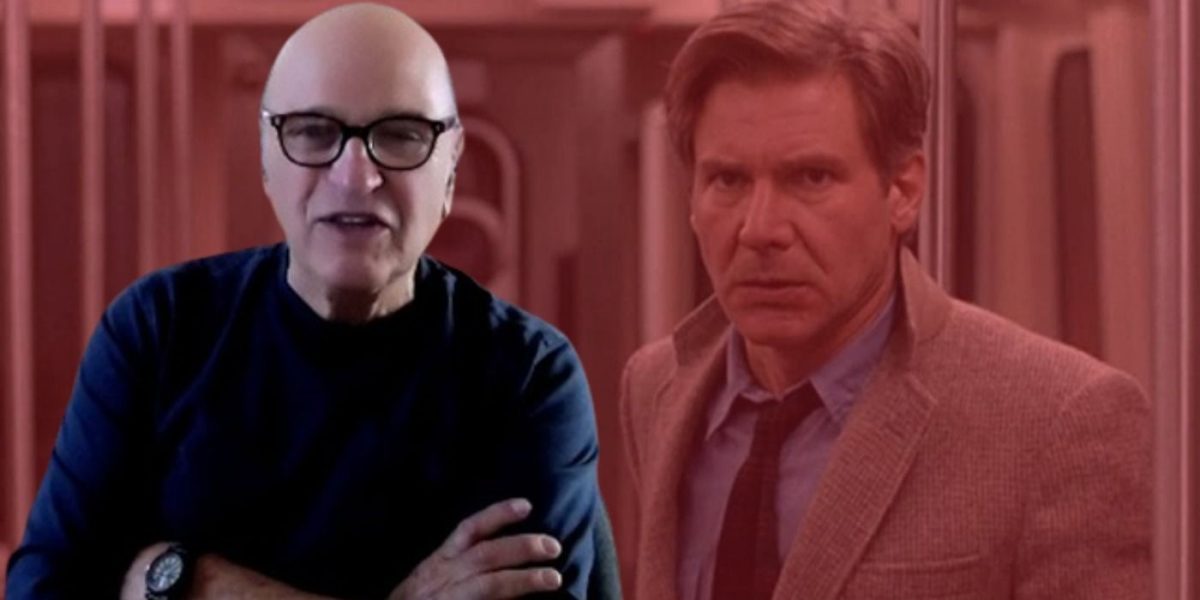
The Fugitive Director Andrew Davis Goes Behind the Scenes on the Harrison Ford Film and His Debut, Stony Island
Dec 24, 2023
This year marks three significant anniversaries for director Andrew Davis. The acclaimed filmmaker burst onto the scene 45 years ago in 1978, making an impressive directorial debut with Stony Island, which recently marked its VOD release after all these years. The inviting film revolved around two friends who attempt to launch an R&B band. Then there’s the 30th anniversary of The Fugitive, which has been fully restored in 4K ultra high-definition format. The Harrison Ford-starring action picture stunned audiences in 1993 with its gripping drama and masterful action sequences. The story drew from the classic 1960s television series about a man wrongly accused of murdering his wife, and also starred Tommy Lee Jones. Finally, there’s the 20-year anniversary of Holes, starring a young Shia LaBeouf.
Davis has been prolific in between, of course. His other films, Code of Silence (with Chuck Norris), Above the Law, and Chain Reaction paved the way for The Fugitive, an intense cat-and-mouse drama that garnered stellar reviews, a great box office haul, and even seven Oscar nominations, including one for Best Picture. Jones took home the gold for Best Supporting Actor. To celebrate these three big anniversaries, Andrew Davis took time to discuss Stony Island and The Fugitive, his career path, and much more in this exclusive MovieWeb interview. Dive into our video footage above and the interview excerpts below.
Making The Fugitive
The Fugitive was one of those films that surpassed expectations. Like The Untouchables, directed by Brian De Palma before it, it became the film to see — a rare cinematic experience all around. But nobody expected that to be the case. Davis is the first to admit there were challenges in the creative process.
You know what, when I got the script, it didn’t make much sense to me, and the dynamics of who was killing who for what reason were all off the charts, you know? And so I said to my sister, who was a nurse, what could get a doctor in trouble? And she came up, she said, ‘I’ll get back to you in a couple of days.’
“And she spoke to a young resident at Cedars Sinai in LA, and he said, ‘What if there’s this drug protocol that the doctor thinks is really damaging people, and they’ve tried to shut him up?’ And that became the basis of the drug Provasic and [the character] Devlin-MacGregor, which is named after my dear partner, Peter MacGregor-Scott. That’s really where that came from,” continued Davis. “Oh, there were a lot of articles about how everybody thought this film was going to be a disaster. Nobody knew what was going to happen to it, and then all these Academy Award nominations and awards start coming out.”
Working With Harrison Ford
Warner Bros.
Harrison Ford delivers a commanding performance in the film, playing Dr. Richard Kimble, a successful vascular surgeon wrongly accused of murdering his wife (played by Sela Ward). “Harrison was very easy to work with and very collaborative,” Davis told MovieWeb. “He cared a lot about the process, which he does on every movie.” He elaborated:
“For example, when we were trying to figure out who this doctor was and what he looked like and what his life was like, we actually went to a restaurant one night and one of my assistants, Teresa Tucker Davies, knew this doctor who was in this restaurant, and we got to talking and he invited us back to his house. And Harris said, ‘This is the doctor I want to model my life after [in the movie]. He had this beautiful wife, he had all this great art around him.’ He literally copied the interior of his apartment.”
Related: Best Harrison Ford Movies, Ranked
As with many other elements in the iconic film, screenwriters Jeb Stuart and David Twohy did a fine job bringing audiences into the upscale lifestyle of Dr. Kimble. But that luminous sparkle quickly dims once Kimble is suspected of murder and the man realizes he’s been framed.
On That Unforgettable Train Wreck Scene
Warner Bros.
Some films are blessed with powerful scenes that go down in history. Ghost has that sexy pottery scene, Pulp Fiction has John Travolta and Uma Thurman dancing in Jack Rabbit Slims. All iconic. And of course, The Fugitive has that WTF-is-happening train wreck scene, one of the most breathtaking action sequences in cinematic history. Of those well-orchestrated scenes, Davis said:
“Once again, I had great partners, Peter McGregor-Scott and Roy Arbogast. Peter was my producing partner, and we had just done Under Siege together, and I had witnessed his ability to create pieces of sets — we built our own submarine for Under Siege. When we talked about this, we found a piece of [railroad] track in North Carolina. The only things not shot in Chicago were the train crash and the chase after the dam. Peter and Roy figured out how to get this dead piece of track, get a locomotive, and push it from behind.”
Related: Here Are 5 of the Best American Action Sequences of All Time
The team removed the engine from the real locomotive, so it had more flexibility in terms of how they could engineer it to go over the edge of the track. “We were shooting a bus action scene that happens just before that,” David added, “and we had 15 cameras already placed that I positioned with everybody, and they just said, ‘Roll it.’ And all the cameras turned on.” He continued:
“The great part of that was not only the impact of that crash and how we were able to use that material for Harrison later with some late shots, but the fact that the next day the train was laying there on the ground, and it was a remembrance of the night before for the Marshals — for Tommy’s character — for that investigation to come out and say, you know, ‘What are you thinking?’ [And Jones says], ‘Well, think me up a cup of coffee and a donut with sprinkles on top.’”
Watch The Fugitive for Free on Pluto TV
How Stony Island Paved the Way for Andrew Davis
Stony Island, Holes, and The Fugitive have both withstood the test of time. They hold up to this day. But Stony Island is where it all began. Davis opens up in-depth about his directorial debut in our featured video, noting, among other things, how much he values that Stony Island is now being seen by a new generation of viewers.
“I was inspired by Scorsese and Lucas with Mean Streets and American Graffiti. They made films about their growing up. And I thought that my growing up was pretty interesting — growing up on the south side of Chicago in an industrial working class, sort of tough neighborhood,” said Davis. “My brother grew up as a white kid in a Black neighborhood, and he was a young musician. I thought that was an interesting story, about a white kid making it in this community with music as a common language.” The result is a funky classic with some incredible music sessions interspersed throughout.
“I was working as a cameraman and I couldn’t get the union; they wouldn’t let the young guys get into the union,” he went on to say. “I had a commercial reel that won awards at that point, and I didn’t want to go back to being an assistant cameraman. So I said, it’s easier to be a director. And it wasn’t easier, but we made it.” Davis immediately credits the film’s writer, Tamar Hoffs, with whom he’d worked with on a Tony Curtis movie called Lepke, noting:
“She and I had brothers who had grown up on the South Side of Chicago who fell in love with the blues, and who followed Muddy Waters and Howlin’ Wolf. Stony Island was about culture going from one generation to another. We decided to write this movie together, and it was a labor of love. I mean, we had no money at all. We were grabbing shots left and right. The crew — the grip crew, the electric crew — was four people, and we were able to put together this movie with sweat and love, and it got tremendous reviews.” Davis continued about the unique history of the film:
But when Black kids started going into white theaters, because of the racism at the time, white theater owners said, ‘No, we don’t want Black kids coming to the theater,’ and they dropped the picture. And they renamed it My Main Man from Stony Island and tried to sell it as a Black exploitation film, which it wasn’t. It’s a film about heart and soul and getting along. And so it sort of disappeared, but it launched my career.
Thank goodness for that. The Fugitive is available to stream for free through the Pluto TV link above, is streaming on Paramount+ here, and is available to rent or buy on various digital platforms. Stony Island is available on demand, and you can rent or purchase it on any digital platform, such as YouTube through the link below.
Rent or Buy Stony Island
Publisher: Source link



HBO’s Harry Potter Reboot Is Officially Ditching the Most Iconic Part of Daniel Radcliffe’s Era
This December, audiences will be transported back to the Wizarding world of Harry Potter. Of course, those born in the mid-to-late '90s will have fond memories of the movie franchise. Starring Daniel Radcliffe, Emma Watson, and Rupert Grint as Harry,…
Sep 20, 2026
‘Tracker’ Season 4 Officially Puts Its Biggest Mystery on Hold Despite Major Cast Comeback
Our fictional missing persons expert, Colter Shaw (Justin Hartley), has kept audiences happily on the edge of their seats ever since Tracker debuted two years ago, and Season 3 in particular left audiences with quite a major cliffhanger — all…
Sep 19, 2026
‘Reacher’s Action Thriller Spin-Off Gets Major Season 2 Update Following Premiere
For four seasons, Reacher has been one of the biggest TV shows on Prime Video. Based on the novels by Lee Child, the series follows former military police officer Jack Reacher (Alan Ritchson) as he wanders from place to place,…
Sep 18, 2026

One of CBS’ Longest-Running & Highest Rated TV Shows Is Coming To End After 30 Years
Along with countless scripted dramas, comedies, and action shows, CBS is well known for its impressive run of unscripted programs over the last 50 years. More recent years have included major competition shows like Survivor and The Amazing Race, along…
Sep 17, 2026