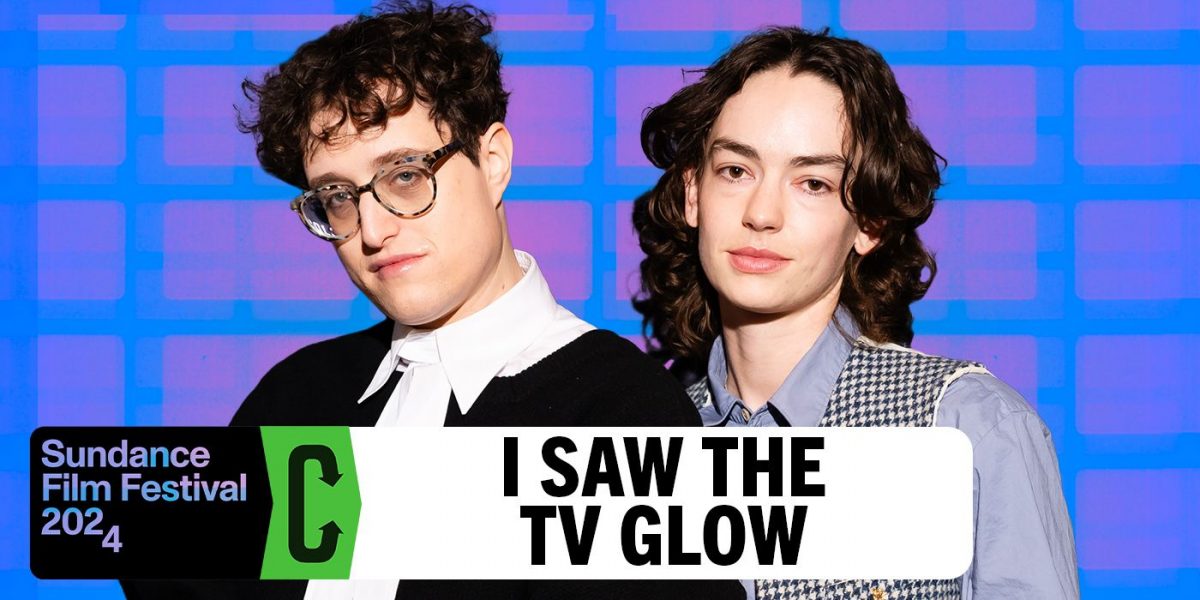
‘I Saw the TV Glow’ Director’s Dream Came True with A24
Jan 31, 2024
The Big Picture
Collider’s Perri Nemiroff sits down with the team behind I Saw the TV Glow at the 2024 Sundance Film Festival. Director Jane Schoenbrun and stars Brigette Lundy-Paine and Lindsey Jordan discuss making the highly anticipated A24 film. I Saw the TV Glow focuses on a teenager named Owen whose world is rocked when his classmate introduces him to a mysterious late-night TV show.
Jane Schoenbrun’s narrative directorial debut, We’re All Going to the World’s Fair, premiered at the Sundance Film Festival, but that happened in 2021 when the festival was entirely virtual. A huge achievement nonetheless, but one that didn’t give Schoenbrun the opportunity they had while in Park City for the festival this year — the opportunity to celebrate their latest film, I Saw the TV Glow, with a wildly enthusiastic crowd that made the debut screening a truly unforgettable shared experience.
Ian Foreman and Justice Smith lead the film as Owen — Forman in his younger years and Smith as a young adult. Owen’s a “conflicted and deeply repressed” kid just trying to make it through growing up in the suburbs. However, everything changes when Owen meets Brigette Lundy-Paine’s Maddy, a “cooler older girl” who’s extremely into the late-night TV show, The Pink Opaque. As described by Schoenbrun, The Pink Opaque “is maybe a little too scary for kids and teenagers, and that’s why they like it.” As Owen’s own obsession with the show grows, his view of reality cracks more and more.
Soon after I Saw the TV Glow’s world premiere at the 2024 Sundance Film Festival, Schoenbrun, Lundy-Paine, and Lindsey Jordon swung by the Collider interview studio brought to you by Film.io to discuss their experience bringing this one-of-a-kind vision to life on screen. Check out the video above or the interview transcript below to learn about Schoenbrun’s journey from first narrative feature to sophomore effort, Lundy-Paine and Jordon’s biggest burning questions for Schoenbrun after reading the script for the first time, and loads more.
I Saw the TV Glow Follows two teenage who bond over their shared love of a scary television show, but the show gets mysteriously cancelled. Release Date January 18, 2024 Director Jane Schoenbrun Runtime 100 minutes Main Genre Drama Writers Jane Schoenbrun
PERRI NEMIROFF: Jane, I’m gonna give you the first question. It’s the synopsis question because a lot of our audience is first going to learn about your film via Sundance. Would you mind giving a brief synopsis of I Saw the TV Glow?
JANE SCHOENBRUN: I Saw the TV Glow is a movie about two lonely teenagers who find each other through their shared love of a strange, kind of scary, kind of sweet TV show. They get together every week to watch it together, but when their obsession kind of gets out of hand, their entire sense of reality gets called into question.
A question about making the move from first feature to second feature because I feel like there’s a lot about that process that needs to be demystified. What is something that you would say is a misconception about what it takes to get a second feature off the ground after a successful first feature? But then I also want to know, what’s something about your first feature that helped you get this movie made, and made the way you wanted?
SCHOENBRUN: I think that most people don’t really understand the strategy of the behind-the-curtains of the film industry, and so I think it’s all misconception. Like when I went to film school, I didn’t learn about how to get a movie made. I learned maybe how to make a movie, kind of, but I didn’t quite learn anything about the entire commercial, capitalist infrastructure built around filmmakers and moviemakers. I think there’s really no difference between the first short film you make, the tenth short film you make, the first feature you make, the second feature you make, because I think in all cases, you are interacting with a for-profit commercial industry, and you, as an artist, are choosing how how to engage with that towards whatever ends you might have.
I chose to make my first feature for almost no money, so I could have complete artistic freedom, and that helped me get a second movie made that also, I think, I had an unusual amount of artistic freedom to make this movie because I had sort of proven my voice with the first feature. But I think there are a million ways to make movies, you know? I know people who make a movie every year for no money. So, to me, the most important question, rather than waiting for a green light, is just finding your voice and what you need to say if you’re an artist and then figuring out how to sort of be a spy to the gatekeepers who hold the power to get cool shit made.
Related ‘We’re All Going to the World’s Fair’ Review: An Uncomfortable and Captivating Coming-of-Age Online Horror Story Jane Schoenbrun’s story of online communities effectively blurs the line between reality and fiction.
A24 Movies Are “Defined By Their Difference”
Image via Photagonist at the Collider Media Studio
I’ll build on that briefly because you mentioned last night how great it was having A24 as a partner and them giving you the opportunity to make the movie that you wanted to make. What is something about the way they collaborate with their artists that you really appreciated that you’re excited for more up-and-coming filmmakers with bold visions to be able to experience when they work with them in the future?
SCHOENBRUN: I just think that A24 has managed to brand themselves as the place where, at least in America, you’re going to see something that you don’t expect. You’re gonna see something that’s defined by its difference from the mainstream. I think it’s become colloquial in Hollywood, right? Where people are sort of like, “I want to be in an A24-type movie.” And so, that kind of power of the quote-unquote brand signifying something new or something different or something a little bit transgressive, is obviously really exciting when you’re an artist trying to do exactly that. So, after my first film, which again was a very microbudget, very small film, did pretty well here at Sundance a few years ago, I knew that the dream-come-true would be getting to make my sophomore feature with a company like A24.
Brigette and Jordan, I’m sure the script for this movie was wonderful, but when I watch something with such distinct atmosphere, vibes, colors and then some, it makes me think it might be difficult to fully picture what this world is going to look and feel like based on the page and the page alone. So, what were some of your biggest burning questions for Jane when the script first came your way?
LINDSEY JORDAN: I had a bunch. I read it a few times through before I felt like I really got it all the way. I would say I was hounding you a little bit for answers. [Laughs] To answer the question about the atmosphere part, I do feel like I could not have realized what I was walking into when I got on set and there was the ice cream truck with the pink smoke and all that stuff, but the script was pretty descriptive. There was a lot of that visual stuff already there, which is cool. But yeah, I had a lot of questions. I don’t want to give anything away about the movie, but deeper meaning questions.
Brigette Lundy-Paine Was Thrilled By the Parts of ‘I Saw the TV Glow’ That Didn’t “Make Sense”
Image via Sundance Institute
Even after watching it, I still have a lot of questions and I think that’s one of the most exciting things in the world, being left with questions, wanting to revisit it again and getting deeper and deeper with every re-watch.
BRIGETTE LUNDY-PAINE: I feel when I read it I knew that it was something that had so many questions in it, but I didn’t feel any need to ask Jane those questions because I knew that the questions would be answered by meditating on the script and figuring out how to believe in the world of the script and the characters, and figuring out the different worlds within it and how I could make those worlds real in my body. So even though there were things that maybe don’t “make sense,” I was thrilled by the parts that didn’t make sense because I’m always so tired of scripts that try to make sense out of fear and embarrassment. And I was really glad that Jane was so bold, and not trying to explain what really comes down to very complex and nuanced feelings that we can all relate to. So I knew that they would be in me if I just looked for them.
Given how you approached the work here, when you first signed on, what quality of Maddy’s were you most looking forward to getting to explore, but then can you also pinpoint a quality that you found along the way that wound up being more creatively fulfilling to play with than you could have imagined at the start?
LUNDY-PAINE: I think I felt in Maddy’s journey in this film that there was a point where she got to let out an expression of pure rage, but also pure bliss at being alive, and getting to connect with other people and getting to understand yourself as this always-moving and changing bundle of ferocity, and I was excited to get to that point. But along the way, there were so many moments of, I don’t know, this shy but kind of silly feeling, like the moments when Maddy really opens up, like when she starts talking about The Pink Opaque to Owen, these moments of wonder that come over her. I didn’t expect those. And then when we got to set and when I was working with both Ian [Foreman] and Justice [Smith], those moments felt really alive.
I have to let you all go in a moment, so I’ll wrap with our Film.io question. It’s a company that specializes in putting the greenlight power in the hands of the creators, so can you each recall a time when someone gave you creative control when maybe you didn’t think you were gonna get it, even though you deserved it?
JORDAN: There’s, I guess, a weird conversation with music where, I mean, I didn’t sign to a label that was evil bigwigs or anything, but people talk about losing creative control as a thing in music a lot. And yeah, I guess working with a label that is creative and cool kind of exceeded my expectations about what the content has to be, what it has to sound like, how many songs there has to be. They kind of just let me run wild. My impression of the music industry before was that that’s not a thing that happens, so it’s a nice surprise.
Image via Photagonist at the Collider Media Studio
I’m glad you have that.
JORDAN: Thanks!
LUNDY-PAINE: I did a shoot for Puss Puss Magazine, my friend Mina [Walker] and I, and we got to play these characters that we perform live as, Silver and Smoke. They’re a ghost punk duo, and we wear long blonde wigs, and they’re, like, really mean girls, and we got to do the whole shoot as them and really be, like, very demanding about everything we wanted, and so that was cool.
[Laughs] I like that.
SCHOENBRUN: I think the god thing is what I would go with. I feel like when I realized I could just build my life the way I wanted to build it, I gave myself the green light and here we are at the Collider Studio.
Special thanks to our 2024 partners at Sundance including presenting partner Film.io and supporting partners Pressed Juicery and DragonFly Coffee Roasters.
Publisher: Source link




Alan Ritchson’s New 8-Part Action Thriller Lands Solid RT Score While Dominating Streaming
Alan Ritchson has, somewhat quietly, become one of streaming's more dependable stars, which is not necessarily where you would have expected his career to land back when he was doing Smallville supporting work and Blue Mountain State. Reacher turned him…
Sep 21, 2026
HBO’s Harry Potter Reboot Is Officially Ditching the Most Iconic Part of Daniel Radcliffe’s Era
This December, audiences will be transported back to the Wizarding world of Harry Potter. Of course, those born in the mid-to-late '90s will have fond memories of the movie franchise. Starring Daniel Radcliffe, Emma Watson, and Rupert Grint as Harry,…
Sep 20, 2026
‘Tracker’ Season 4 Officially Puts Its Biggest Mystery on Hold Despite Major Cast Comeback
Our fictional missing persons expert, Colter Shaw (Justin Hartley), has kept audiences happily on the edge of their seats ever since Tracker debuted two years ago, and Season 3 in particular left audiences with quite a major cliffhanger — all…
Sep 19, 2026
‘Reacher’s Action Thriller Spin-Off Gets Major Season 2 Update Following Premiere
For four seasons, Reacher has been one of the biggest TV shows on Prime Video. Based on the novels by Lee Child, the series follows former military police officer Jack Reacher (Alan Ritchson) as he wanders from place to place,…
Sep 18, 2026