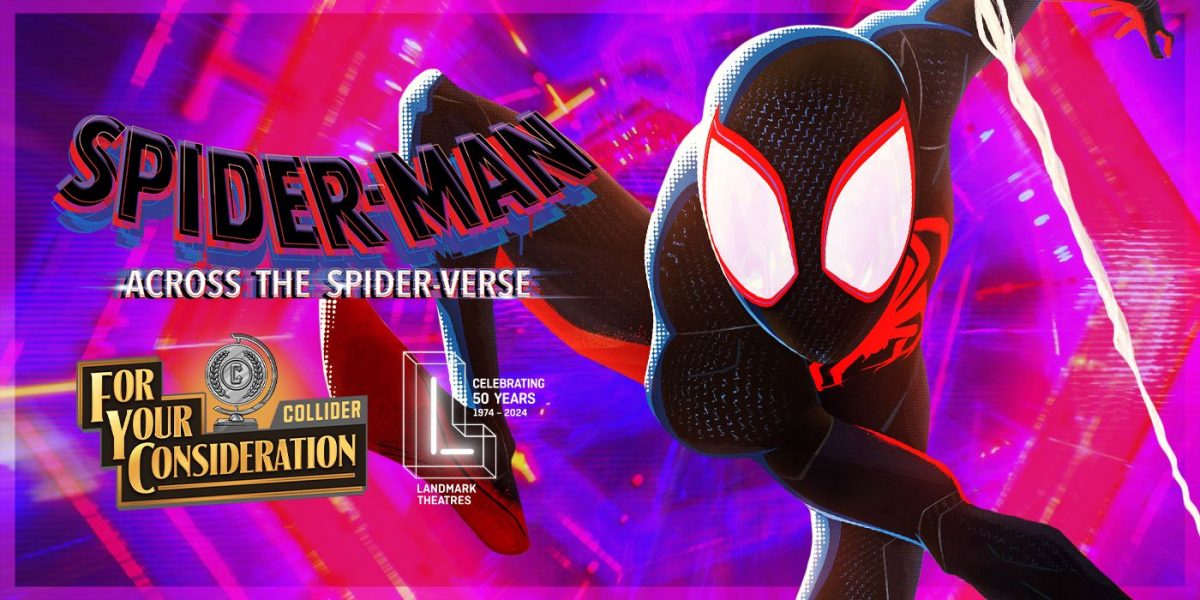
‘Across the Spider-Verse’s Miguel O’Hara Was Designed To Be a Thirst Trap
Feb 25, 2024
The Big Picture
Sequel to the Academy Award-winning Spider-Verse shows a deeper journey for Miles and his spider friends.
Filmmakers reveal the challenges behind last-minute changes and additions like Donald Glover’s cameo.
Personal favorite scenes include the clock tower moment, surprising intensity between Miguel and Miles, and the meaningful final scene.
Leading up to the Oscars, Collider was thrilled to be able to screen this year’s Best Animated Feature nominee, Spider-Man: Across the Spider-Verse, for our FYC series with Landmark Theatres. It’s little wonder this sequel spun its way into the Academy Awards after its predecessor, Into the Spider-Verse, took home the very same achievement in 2019. To celebrate their nomination, directing trio Justin K. Thompson, Kemp Powers, and Joaquim Dos Santos joined us for an exclusive Q&A after the movie to discuss just how much work and passion was poured into this project.
Across the Spider-Verse continues Miles Morales’ (Shameik Moore) journey to becoming his Earth’s friendly neighborhood Spider-Man. Thanks to Gwen Stacy (Hailee Steinfeld), who comes back to retrieve Miles, we’re introduced to the multiverse of Spider-People, which allowed the crew of 1,000 animators to flex their skills in each and every scene. With the largest team of any animated feature ever working on the second of three films, Thomspon, Powers, and Dos Santos had their work cut out for them, and that work didn’t stop until right up to the film’s official release. According to Powers, “It was never too late to make it better.”
During their conversation with Collider’s Steve Weintraub, the trio talk about their whirlwind production from last-minute additions and changes, like Donald Glover’s cameo and Miles as the Prowler, to pivoting after disheartening test screenings. They talk about how The Empire Strikes Back inspired a new ending, which scenes meant the most to them, spending two years on the counselor scene, and reveal that Miguel O’Hara (Oscar Isaac) was designed to be a thirst trap. Check out the full interview in the video above, or you can read the transcript below for tons more.
Spider-Man: Across the Spider-Verse Miles Morales catapults across the Multiverse, where he encounters a team of Spider-People charged with protecting its very existence. When the heroes clash on how to handle a new threat, Miles must redefine what it means to be a hero.
COLLIDER: What has this journey been like for the three of you? When did you realize that you made something that really resonated with people, and that you didn’t strike out after the first one being a homerun?
JOAQUIM DOS SANTOS: I mean, I think once it came out. We’re just like you guys, we’re waiting to see what the reactions are when the thing drops. We definitely got some positive feedback as we screened it, we got some negative feedback as we screened it, but we were sort of left with a film that I think we knew we were into. That was, I think, the best estimate is, like, you make something for yourself that you know you like and you hope that other people are along for the journey.
JUSTIN THOMPSON: And I think, also, when we were wrapping the film up, when we were done and we started getting our presales, I started going, “People might actually go see this movie.” Like, “I think people might actually want to see this movie, guys.” And then it kept happening. It kept being wave after wave of people going to the theater. Thank you all for going to the theater to see it, and for those of you even coming to see it for the first time. You make these movies and you just hope that they land, and the fact that it did wasn’t just that it landed, like, at the box office and that was amazing, it was that audiences were coming up to us afterwards. That’s when I knew we had made something, maybe, cool, because audiences were coming up to us afterwards saying, “Wow,” and, “Thank you for making that movie,” and telling us how much it meant to them. I think we were just trying to make a film that meant something to us, so the fact that they were able to feel that and come back to us and tell us that they felt what we were trying to build, that’s when we kind of knew, “Maybe this is something good.”
Maybe it was also when you were nominated for Best Animated Feature at the Academy Awards.
Donald Glover’s ‘Spider-Man: Across the Spider-Verse’ Cameo Was Recorded Weeks Before Release
Image via Sony Pictures Animation
KEMP POWERS: It’s interesting because we do screen it a lot for preview audiences, and when we’re screening it, it’s in different levels of completion, meaning very incomplete, and the first couple were pretty rough. It was encouraging to hear from the guys on the first film how rough some of their audience previews were. But I think it was, like, one of the last one or two previews where the story was kind of really locked in, and even though it wasn’t animated yet, you could see that people were emotionally getting into it. Because the irony is animation can’t save animation. The story and the emotion has to be there in 2D. You can’t just be like, “Oh, well, this isn’t good, but when it’s pretty it’s gonna work.” No, it’s just gonna be pretty and not work. So it was one of the last previews we did where I think people really leaned in and got emotional.
There were several things in those previews that we hadn’t really sorted out yet, like you guys probably remember the Donald Glover cameo — he hadn’t agreed to do it yet. So in the preview, we had, like, a South Park-style cardboard cutout of Donald Glover. He was like, “Hai, I’m Donald Glover,” and he was just like a flappy head, and everyone was cracking up. I’m like, “Is anyone gonna call Donald Glover and see if he’s gonna do this cameo?” We recorded him just a few weeks before the film came out, so it was kind of crazy because it was like, the film still wasn’t quite all there, but it was there. That was a story we knew we were trying to tell, so I started feeling pretty good about it then.
Miles Wasn’t Originally the Prowler at the End of ‘Spider-Man: Across the Spider-Verse’
Image via Sony Pictures
So this audience is made up of a lot of fans of this movie and people that just saw it. You mentioned something right now with Donald Glover and how you filmed it a few weeks before it came out. What other things do you think would surprise fans of this movie to learn about the making of the film?
DOS SANTOS: Wow, that’s a big question.
POWERS: It’s a lot, because that’s the thing, making this movie, it’s a living thing. It’s not done until it’s out in theaters, so we were making changes until the very last minute. And again, we tweaked it. Like, initially in Earth 42 at the end, that Miles wasn’t the Prowler, remember? We had even designed the character quite differently, and it was fairly late in the game and we were kind of doing an audience review and we started texting one another during the review, and I felt so guilty because it was like, “Oh my god, the character designers are gonna have to redo this character because wouldn’t it be great if he was the Prowler in this universe?” [Laughs]
DOS SANTOS: And that was Kemp’s pitch.
POWERS: And that was the thing, it was never too late to make it better. So, I mean, if you gave me time to think about it, it would be a lot of things like that, like the Donald Glover moment, Prowler Miles, all these things that were not in the film for years.
DOS SANTOS: And we cut and recut the beginning of that film with Gwen. It’s one of the first things we worked on, it’s one of the last things that was worked on. That thing was huge, that thing was really small. It was all shapes and sizes.
THOMPSON: I think another one that would probably surprise you is the ending that you just watched, where Spider-Gwen goes out and gathers Peter B. and Mayday and Peni and Noir and Ham, and she kind of gets the band back together to go save Miles, and you’re filled with hope and excitement that, “Oh, they’re gonna go back,” and, “Oh, it’s coming! They’re gonna get the band back together,” — that wasn’t there until about six weeks before the film wrapped. We actually had a screening and it just ended with Miles on the bag, and everybody was just like, “Boo!” And we went, “Oh god, what are we gonna do? We gotta do something.” We ran back and we quickly scrambled and brainstormed and realized. We went back and watched The Empire Strikes Back again, and said, “How did Empire Strikes Back do it?” And we realized, “Oh, they gave you hope at the end.”
POWERS: “We’re gonna go rescue Han, guys. Got my new hand!” [Laughs]
THOMPSON: “Okay, we need our Go Rescue Han moment.” So we boarded it, animated it, put it all together within six weeks, and then screened it again. The audience went through the roof, and we went, “Okay!”
Image via 20th Century Studios
POWERS: And the reason that happened, too, is because we already had the very next scene worked on, so in our minds, we had the continuity, like we knew where the story was going. So we were like, “Okay, this is fine because we know where it’s gonna pick up.”
DOS SANTOS: It’s a cliffhanger.
POWERS: It’s a cliffhanger for a reason. But we didn’t know until we put it in front of an audience how it kind of came across like a snuff film.
DOS SANTOS: Well, it’s little things, too, right? So, it’s like the difference of Miles being in this really bad position, and it looks grim for him, versus a little character modulation, like him starting to touch the chain and the sparks coming through his hands, and that glint in his eye. It’s really, really subtle, but you can see the Prowler’s Gauntlet there, and it starts dimming a little bit because he’s drawing power from the gauntlet. So those little things, it’s almost subconscious, but it really does help you feel like Miles has some agency in the scene.
POWERS: There are some lessons to learn in storytelling in this. I was actually having a really interesting conversation with a screenwriter a couple of weeks ago about how you can have a dark ending, and all you have to do is give a little hint of hope for the audience to fill in the blanks and know that it’s gonna get worked out. We were talking about a TV series I’d only seen recently called Beef, and I don’t know if anyone’s seen it, but it ends, like, hella dark. Spoiler alert, I’m gonna ruin Beef for you guys, but at the end, the dude gets shot and he’s in a coma and she’s laying on him, and days go by, and the very last shot is just him moving his arm to hug her back, and you go, “He’s gonna be alright.” You don’t have to give people too much, but you just gotta give them a little bit of hope so that they know it’s gonna work out in the end.
One of the things about animation is every frame costs a lot of money, and I’m curious, what shots are surprisingly more money than you think they would be?
THOMPSON: Oh, the counselor’s office. That’s, like, the most expensive counselor scene in any movie ever made. It is, without a doubt, one of the scenes we worked on the hardest, the longest, and started first and ended last. Because honestly, it’s all story in this case, but we were just trying to get the rhythm of that scene, and what it’s setting up is actually so important. It’s setting up so much for the movie. Miles is wanting to leave the nest, his parents, we’re finding out his parents have these big expectations for him. She doesn’t want him to leave Brooklyn even to go to school next door, even that’s too far. We realize he feels kind of cramped and unable to express himself, and he wants to go out and spread his wings. We’re feeling what he’s saying at the start of his journey.
It was so important to get the messaging of that right, and set up that, “Just remember, we built all this for you. We’ve done all this for you. You kind of owe us.” And he’s saying, “Yeah, but I can’t do that if I’m here with you. If I stay here, I can’t be who I am meant to be.” He’s saying in that scene what he’s about to do, which is leave and go be who he is meant to be and discover what real life is really all about, and who his real friends are, and test all the things, all the lessons that his parents have given him, like, “Don’t let anybody tell you that you don’t belong.” He’s about to go test what that all means. So that scene, to modulate it and get it all right, believe me, we probably animated it, relit it, reblocked it, reshot it, redid the lensing on it probably for two years.
POWERS: I would say that rooftop barbecue, that damn food… Flan might be cheap in real life, it’s not cheap to put into an animated film and have it look nice and shiny on the top. But figuring out the food in the rooftop barbecue, which actually changed a lot. The other thing is, pretty much any shot that had Spider-Punk in it because he was like a special effect unto himself.
DOS SANTOS: He was like a special effect within a special effect.
POWERS: Yeah, there was a discussion about, like, “This character is expensive.” Like visibly seeing the character is an expensive choice because of all that went into him. So any time you see Spider-Punk, it was just like, “Cha-ching!”
THOMPSON: There’s like a national debt meter when he’s on screen.
DOS SANTOS: One you wouldn’t think is a simple act, like Gwen putting up her hair. I remember riggers going, like, “Please, dude. No, no, no, no. Not the hair. Don’t do the hair!”
THOMPSON: “You can’t touch the hair.”
POWERS: The other thing is masks, right? Taking on and off masks is, like, ridiculous.
Related ‘Spider-Man: Across the Spider-Verse’ Almost Didn’t Include Spider-Punk No Spider-Punk? No thank you.
I have to interrupt you guys — was there anything that was cheap in this movie?
POWERS: Us.
THOMPSON: Yeah, that’s about it.
Every frame in this movie is like a painting. It’s amazing. I think everyone in this audience feels that way. Now that the movie’s been out, and you can go frame by frame if you want, are there any frames or scenes that you strongly recommend people pay attention to, pushing pause at a certain point? Or maybe there are things that animators put in that you don’t even know?
DOS SANTOS: There were some of those. I think the animators snuck in a bunch of stuff that we don’t know about.
POWERS: They put us in it.
DOS SANTOS: Yeah, we didn’t know.
POWERS: We’re in the background when he’s fighting with the Spot. The three of us are next to the chess players, and I was like, “Oh, shit, that’s us.”
THOMPSON: And I’m sitting there with a fine-tooth comb going over every picture, like, “Okay, the color here, that needs to be darker, and maybe the lights need to move around,” and I’m watching that scene… We probably see every scene, every shot, every frame 3,000 times before you’ve seen it, and I never even noticed it. It’s sort of like a gorilla walks through the room but you’re paying attention to everything else and you don’t see the gorilla in the crowd.
POWERS: Because it’s, like, BG. You forget. BG characters start blending into one another, so they could do something like put us in with the BG characters and it might get past us. We have bigger things to be concerned about.
Miguel Was an Intentional Thirst Trap in ‘Spider-Man: Across the Spider-Verse’
Image via Sony
What was the biggest surprise in terms of fan reactions to this film? Did fans pick up on something that you were like, “Wow, I didn’t realize they were gonna love this the way that they loved it?”
DOS SANTOS: Miguel’s butt. [Laughs]
THOMPSON: I’ve got to push back on that. I actually feel a little offended because I put myself in charge of making Miguel the thirst trap.
DOS SANTOS: That is true.
THOMPSON: From day one, I said, “I’m on butt duty. I wanna make sure his butt is as tight as possible. I want close-ups. I wanna get the camera there, and I want him to turn. I want his back to the camera when we first introduce him, so you can really appreciate it.” So, no, I was not surprised.
DOS SANTOS: Alright, well, you took it in stride, but I was very surprised.
THOMPSON: I was surprised by how far it went, though.
DOS SANTOS: I will say, we did struggle with having a character as physically robust as Miguel. That was a thing because I think Phil [Lord], especially, has sort of an aversion to, like, overly muscular characters. We were like, “This Spider-Person is different. He’s not like the gymnast, he’s like the bodybuilder. He’s got to be big.”
THOMPSON: I think Phil must have been picked on by bodybuilders at some point because, like, we had to convince him it’s okay for him to have muscles.
You guys are up here because you’re the directors, but there are so many people that worked on this movie. For each of you, who is an unsung hero that you want to shine a light on to just thank them for their contributions to the film that perhaps people might not think about?
DOS SANTOS: For me, I’m gonna keep it a little personal because this is sort of like the background that I came from, but the story artists are usually the first people that get a hold of a film and start to really visualize it and put a lens on it. Our story department was phenomenal. One artist in particular, her name is Sarah Partington, she just absolutely was such a pro the entire way. She was on from the very beginning of the film to the very end of the film, which doesn’t usually happen on a feature film. People sort of come and go, and take other gigs. She was incredibly dedicated, and she always, always, always brought new ideas and cool ideas and fresh ideas.
POWERS: For me, I think for unsung I’d have to give it to Melanie Duke, who was our script coordinator, because, man, this film got rewritten so much, often while we were in recording sessions, and it was really Melanie’s job to make sure the script was always conformed. That can be difficult when you have pages coming in from four or five different people at the same time. So you would have pages coming in from Phil and Chris [Miller], and Dave Callaham and me. We were, like, firing pages at her, sometimes at the same time while we were doing a recording session…
DOS SANTOS: Over text, by the way.
POWERS: And she had to conform all of this and make sure that the script was the most updated version of it. It’s the kind of thing that, honestly, if I’d had to do her job, I’d have probably had a panic attack.
DOS SANTOS: I will say, it got so bad sometimes, these rewrites, that we’d be in virtual records and I would just pretend my phone broke. I’d be like, “I’m out. Sorry, my phone’s not working. Computer just went down.” I couldn’t take it because they were coming in so fast and furious.
Melanie did it with a smile on her face the whole time.
POWERS: She really deserves it. Like, a real unsung hero pretty much. She never missed a line of dialogue, she never missed an alt, because we would all have different ideas, like, “Oh, make sure they tried this and this, and that,” and she would, in real time, be updating it all. So, yeah, Melanie Duke.
THOMPSON: We hear a lot about, and he deserves every bit of praise, Michael Lasker, our visual effects supervisor, but then there’s two other names, Bret St. Clair and Pawel Grochola, who are our look-of-picture supervisors. They are the people who, working with Michael Lasker, our visual effects supervisor, those two guys, I’ve worked with them now for 18 years at Imageworks. They are the geniuses who write all the software, who create all the tools. They’re what I call the wizards who really create all these magical tools that enable all the texture artists, the lighting artists, the animators, all the line work you see on the characters, the paint that’s dripping on the walls behind Gwen — they’re the ones that are creating all this technology. Whenever we, in a room, are sitting there going, “Could Hobie’s arm be one color and then his head be another color? And could his other arm be, like, black and white, like newspaper, and then can this leg be red and yellow, and it’s moving at a different frame rate? And then maybe his body is moving at a different frame rate, and then maybe when he’s moving around…?” They just look at us and go, “Yeah, we can figure that out.” They really are geniuses who make it possible. They are developing the tools that the 1,000 artists — you’ve heard it before, a crew of 1,000 people — they’re the ones making all those tools or supervising all that. So they were Bret St. Clair and Powel Grochola, for sure.
Related ‘Spider-Man: Across the Spider-Verse’ Co-Director Joaquim Dos Santos Talks Cameos, Easter Eggs, & Animation in Exclusive IMAX Q&A He also discusses ‘Beyond the Spider-Verse,’ the live-action Spider-Man, which sequence took four years to develop, and tons more.
So the three of you made this film, and it’s not usual for three people to work on a movie. For the people out there, can you explain how you each took point on this movie?
DOS SANTOS: We had the benefit of, like, for the first year-and-a-half that we were working on it, we were across every meeting together, meeting with every artist, looking at the same screen, and we really got to know each other as people. We got to understand each other’s tastes. We sort of became psychically linked after that year.
POWERS: Think of Pacific Rim. Two guys running a Jaeger.
DOS SANTOS: [Laughs] That’s right.
POWERS: We were the three-person Jaeger.
DOS SANTOS: We drank some Jäger, too. What ends up happening is that we each sort of have our specialty that we came from. Justin was a production designer on the first Spider-Verse film, Kemp’s an amazing playwright, and he’s just an amazing writer and he works with actors like nobody that I know, and I came from the world of storyboarding and thinking about camera and stuff. So once the real production machine started going, we got to sort of dip back into our specialties, and then we would have these moments where we would have to interface. Sometimes that’s a quick passing in the halls, “Did you see that scene? Did you see that scene? What do you think? Yes?” And then when we didn’t have opportunities to see each other, we sort of knew each other’s tastes at that point. So again, that’s where the sort of piloting the Jaeger part came in.
And Justin is like the super pro — I’ve said it a million times. He will pause a meeting that’s been going on for, like, 45 minutes, it’s really jamming, and he’ll say, like, “You know what we need? All three of us in the room right now.” And he’ll just give us a call and say, “Come in.” It’s two minutes.. We look at the thing, sign off, and everybody goes back.
‘Spider-Man: Across the Spider-Verse’ Directors Share Their Favorite Scenes
This movie has so many things that I would consider my favorite part of the film, so for each of you, is there a scene or sequence that you are especially proud of, something you’ll always cherish about this film?
THOMPSON: For me, I would say every part of this film is amazing, and was amazing to work on and to be a part of and develop with these guys and with our crew. But on a personal level, there’s this scene where Miles is fighting Miguel on this train and they’re going up to the moon, and then at one point, Gwen’s like, “Guess what? We lied to you.” And he’s like, “I don’t like you,” and he jumps off and he goes back to headquarters. He’s sneaking around, invisible, and there’s this weird spider thing that comes out and it weaves this laser web around him and it’s sending him back home. Then there’s this moment where he’s connecting with Margo, Spider-Byte, and there’s that eye contact, and she’s trying to decide, “Do I shut it down or do I let this kid go?” And she sees the rage in Miguel’s face when he’s ripping the thing apart. That whole scene for me was kind of like a childhood… There’s a reference there.
That spider is a reference to…. There’s a movie — this gonna be really dorky, but have you guys ever seen a movie called Krull? If you’ve never seen a movie called Krull, I’m sorry, if you go see it now, it’s terrible. But there’s a stop-motion spider in there, Ynyr is what that spider’s called, and that stop-motion spider that’s in this movie Krull was amazing to me when I was like seven, eight, nine, 10-years-old. It changed my life. It made me want to make stop-motion films. So getting, for me personally, to make that and have a reason, and have a really fitting moment where we needed something really weird that Miles would be like, “I don’t know what’s going on,” and the audience doesn’t really know what’s going on, and it’s this weird, awkward sort of strange moment that could be magical and beautiful at the same time, it was like the feeling that I had as a kid from watching that movie. Being able to put it in this was kind of amazing for me.
POWERS: For me, I think Miles and Gwen under the clock tower was a really pivotal scene for me. It was personal for a couple of reasons. First, because I was really inspired by some of the films of Cameron Crowe, like Say Anything, like the teen romances. I wanted to really have that quiet moment. Another reason was because throughout this process, we always said we weren’t trying to do what they did on the first film, but bigger. We wanted to do something different. And a question people would often ask us is, “What’s gonna be the leap-of-faith moment?” Into the Spider-Verse has this great moment, the leap-of-faith moment where you guys probably remember he leaps off the building. It’s an incredible moment. We all love it, and it was like, “Our leap-of-faith moment is gonna be something subtle and quiet.” And that clock tower scene, it was so awesome when the film came out how them sitting upside down, quietly, became like the most iconic image of our entire film.
Because, truth be told, that scene really had to earn its way into the movie. It’s the type of moment, a quiet conversation that you often don’t get to do in animated films because, as you said, it all has to be built. It’s expensive. You’re often cutting for efficiency, so long pauses and close-ups and gestures and exchanges don’t get to happen that often in animated films. So the fact that not only did it earn its way into the film, but it kind of became, like, the defining image of our film, and it’s not the leap-of-faith, it’s just a quiet moment that feels really personal and almost like a double win.
DOS SANTOS: And I’m just gonna say, Gwen’s hair, upside down in that one. A lot of money. For me, there’s again, so many moments, but I think one of the things that I was really proud of, and you don’t usually get to see it in Spider-films, but it was the escalation and the intensity between Miguel and Miles when they’re on the train. That sort of ferocious stuff, it plays well because you’ve been on the journey with the characters. We had a moment, and I can remember we sort of turned into a joke because we watched these films, like, 100 times in editorial, but there’s a moment where Miguel slams Miles into this one train and Miles elbows him like three times in the head before he takes off. We were like, “It’s gotta be three times.” Kemp went full bloodlust and was like, “It has to be three times.”
POWERS: They wanted it to be one elbow. I was like, “No, three. He’s got to get licks in, too.”
DOS SANTOS: I boarded it as three and then you held the line, man. And it’s not action for action’s sake. All that stuff when he’s got Miles pinned to the train and he’s in his face, every step of production accentuated that scene and added to that scene. It started with the idea that we’re gonna see Spider-People do action that feels more intense, because usually it’s flipping and it’s very balletic, and you see a lot of cool gymnast-type moves. This was not about that. This was about being in each other’s face and being very intense.
One of the things I wanted to touch on is the runtime, which the movie is about two hours, 20 minutes. Did you ever have any sort of feedback from the studio about, “Can we get this to two hours? Can we get it even shorter?” How much debate is there on a runtime, because also, every minute costs money?
THOMPSON: Yeah, it does, but obviously in the beginning, the studio is like, “What do you mean it’s gonna be super long? What do you mean?” Honestly, we were just trying to make a great movie, and sometimes for something to get better, it does have to get longer, as we like to say. In editorial, we would add those kinds of quiet moments that Kemp is referring to and it would stretch out, and to make the pacing of this film feel right we had to give it breathing room. We had to let some scenes be quiet and be longer and let you feel the space between things, and then also that would help make those more action-y sequences that you’re just talking about feel faster and feel more frenetic because we had those quiet moments. And at first, yeah, they were like, “Why is it so long?” But then we started having audience screenings and they started seeing the reaction, and seeing that it didn’t feel like that long. “Are you sure? How long was it? Because it didn’t feel long.”
We had, like, 10, 11 screenings of this movie, and when we would have audience screenings, the studio kept waiting, like, “Watch, they’re all gonna hate how long this is.” Consistently they were saying, “No, we want more,” because they were so engaged and they were so involved the whole time. That was our goal: make sure that the audience was engaged, make sure that they’re tracking Miles and they’re staying with him emotionally through the whole film. And once they saw that the audiences were willing to go with it, they kind of backed off, and they let us just finish it.
Related ‘Spider-Man: Beyond the Spider-Verse’: Release Date Delay, Cast, Plot, and Everything We Know So Far “Alright, let’s do this one last time.”
The titles of these movies are very literal. You have Spider-Man: Into the Spider-Verse and you have Spider-Man: Across the Spider-Verse. We all know what these two mean. So what exactly does Spider-Man: Beyond the Spider-Verse mean?
THOMPSON: It means it will be totally unexpected.
DOS SANTOS: There is your answer.
Spider-Man: Across the Spider-Verse is available to stream on Netflix now. For more on this Academy Award nominee, check out Collider’s interview with writers Phil Lord and Chris Miller below.
Watch on Netflix
Publisher: Source link





Alan Ritchson’s New 8-Part Action Thriller Lands Solid RT Score While Dominating Streaming
Alan Ritchson has, somewhat quietly, become one of streaming's more dependable stars, which is not necessarily where you would have expected his career to land back when he was doing Smallville supporting work and Blue Mountain State. Reacher turned him…
Sep 21, 2026
HBO’s Harry Potter Reboot Is Officially Ditching the Most Iconic Part of Daniel Radcliffe’s Era
This December, audiences will be transported back to the Wizarding world of Harry Potter. Of course, those born in the mid-to-late '90s will have fond memories of the movie franchise. Starring Daniel Radcliffe, Emma Watson, and Rupert Grint as Harry,…
Sep 20, 2026
‘Tracker’ Season 4 Officially Puts Its Biggest Mystery on Hold Despite Major Cast Comeback
Our fictional missing persons expert, Colter Shaw (Justin Hartley), has kept audiences happily on the edge of their seats ever since Tracker debuted two years ago, and Season 3 in particular left audiences with quite a major cliffhanger — all…
Sep 19, 2026
‘Reacher’s Action Thriller Spin-Off Gets Major Season 2 Update Following Premiere
For four seasons, Reacher has been one of the biggest TV shows on Prime Video. Based on the novels by Lee Child, the series follows former military police officer Jack Reacher (Alan Ritchson) as he wanders from place to place,…
Sep 18, 2026