Only The Animated ‘Lord of the Rings’ Gets Frodo Right
Apr 10, 2024
The Big Picture
Ralph Bakshi’s animated
Lord of the Rings
film revolutionized battle scenes and stayed true to Tolkien’s world vision.
Frodo’s portrayal in Bakshi’s film showcases his intelligence and leadership qualities.
Bakshi’s version of Frodo maintains his agency, contrasting with Jackson’s more passive portrayal.
In 1978, legendary animator Ralph Bakshi released an animated adaptation of The Lord of the Rings by J. R. R. Tolkien. Using extensive rotoscoping over live-action footage, Bakshi created a gritty and stylistic take on Middle Earth that covered the events of the first two books in the trilogy, The Fellowship of the Ring and The Two Towers, in only two hours. Though not without flaws, Bakshi’s film revolutionized battle scenes in animated films and stuck very true to the look and feel of Tolkien’s world. Unfortunately, though it was a financial success, behind-the-scenes issues, and a troubled production meant that no sequel was ever made, which left many Tolkien fans embittered. However, the film left a lasting impression on a young Peter Jackson, who drew inspiration from it when creating his own Middle Earth trilogy.
While nobody is saying that Bakshi’s film is near the caliber of Jackson’s trilogy, there is a lot to love. The rotoscoping allows the characters to move in a way that wasn’t seen in animated films then. They mostly lack exaggerated and cartoonish expressions, moving in a more subdued yet powerful manner that makes them and the world feel grounded. While a lot had to be condensed to fit the limited run time, the film made good use of what time it had to get across important exposition and personality for the characters. Many scenes were directly re-created by Jackson in his trilogy, such as the Hobbits hiding from one of the Nazgûl after leaving Hobbiton and ending The Two Towers with the battle at Helm’s Deep rather than the Hobbit’s meeting with the giant spider, Sheelob. Because of this dedication to Tolkien’s vision, it can even be argued that a few aspects were done better than Jackson’s trilogy, such as with the protagonist, Frodo Baggins (Christopher Guard).
The Lord of the Rings (1978) The Fellowship of the Ring embark on a journey to destroy the One Ring and end Sauron’s reign over Middle-earth.Release Date November 15, 1978 Director Ralph Bakshi Runtime 132 Minutes Budget $4 Million Studio(s) Fantasy Films , Saul Zaentz Film Productions Distributor(s) United Artists
Who is Frodo Baggins in ‘The Lord of the Rings’?
Frodo Baggins is a Hobbit from a green, pleasant section of Middle Earth called the Shire. He is the nephew of Bilbo Baggins (Norman Bird), with whom he shares a birthday. Following the death of Frodo’s parents in a boating accident, Bilbo adopts Frodo and makes him his chosen heir. He adopts many of Bilbo’s tendencies, such as a love for the world beyond the Shire’s borders and a fascination with Elvish culture, but prefers to stay closer to home than go on adventures. This changes on his uncle’s 111th birthday when Bilbo leaves the Shire and passes to Frodo a magic ring that can turn its wearer invisible. It’s later revealed to be the One Ring, created by the Dark Lord, Sauron, and unless it can be destroyed in the fires of Mount Doom, Sauron will eventually reclaim it and use its power to dominate Middle Earth. To prevent this, Frodo takes on the arduous task of carrying the Ring to Mount Doom, thanks, in part, to Hobbits being naturally resilient against the Ring’s corrupting influence.
Frodo is the archetypical reluctant hero forced out of his life of comfort by the call to adventure. Though he has a Fellowship made up of some of the greatest heroes in Middle Earth, including the true king of men, Aragorn (Sir John Hurt), the wizard Gandalf (William Squire), and the elvish prince, Legolas (Anthony Daniels), Frodo ends up being the most heroic of them all. This is thanks in large part to his humility and selflessness. Frodo is always one to think about the needs of others above his own. During the trek to Mount Doom, he knows there is a strong chance he won’t come back alive, but Frodo goes anyway because doing nothing allows evil to grow in power.
How Do Bakshi and Jackson Portray Frodo Differently?
In Jackson’s trilogy, Frodo, played by Elijah Wood, and like the rest of the cast, he is perfectly chosen. Wood does a phenomenal job of capturing Frodo’s innocence and depicting the physical and mental anguish he experiences due to his burden. Unfortunately, one of the ways Jackson chose to do this was by taking away a lot of Frodo’s agency. Sure, he still selflessly offers to take the Ring to Mordor, but through Fellowship of the Ring, it is the other characters who take action rather than Frodo. Part of this is due to some of the changes made to the timeline in Jackson’s films, such as removing the seventeen years between Bilbo and Frodo’s departures from the Shire, which makes Frodo younger in his films than in the book. The final result is a version of Frodo, who is innocent and compassionate but, ultimately, too passive.
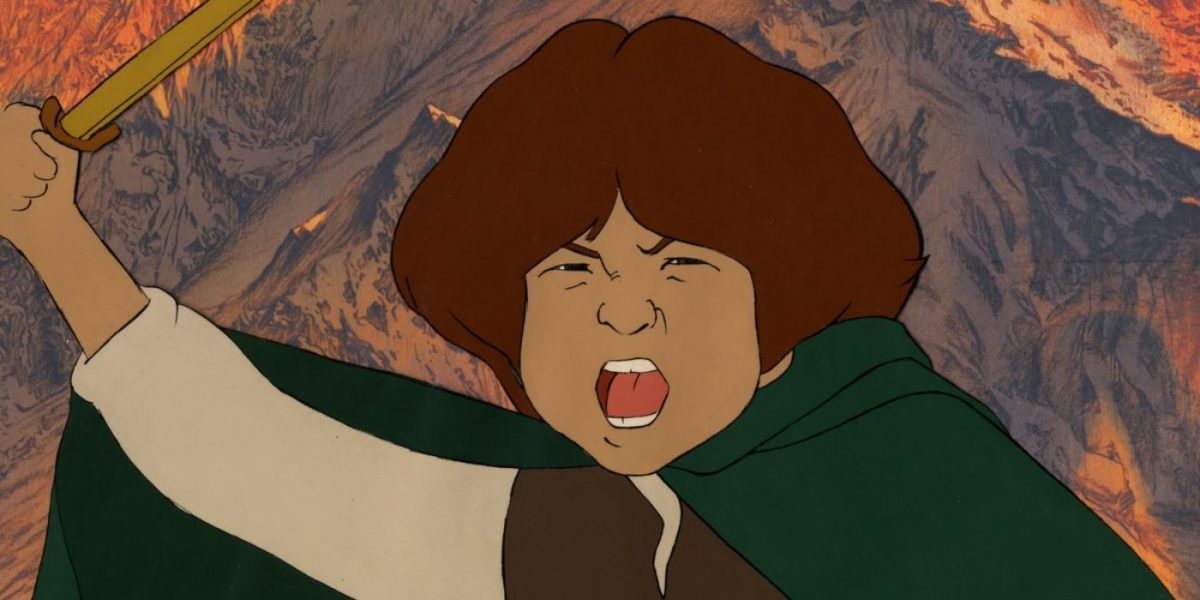
Meanwhile, Bakshi’s version retains the best qualities of the character without taking away his agency. He’s still a Hobbit who has never left home, and there are plenty of times he needs help from some of the more experienced members of the Fellowship, but he feels more confident and in control of most situations. Though not a warrior, he still attempts to defend himself from the Nazgûl when they ambush the group at Weathertop, and during the battle against the orcs in the Mines of Moria, Frodo bravely stabs the orc’s cave troll through the foot to drive it off. When he and his friend Samwise Gamgee (Michael Scholes) encounter the Ring’s previous owner, Gollum (Peter Woodthorpe), Frodo takes charge of subduing Gollum and forcing him to aid in the quest to Mount Doom. He demonstrates more intelligence and leadership qualities while not going too far to make him outshine the better-equipped members of the Fellowship.
Perhaps the best scene that showcases the difference between the two versions of Frodo is the chase to Rivendell, where Frodo, injured by a morgul blade, must escape the nine Nazgûl before they can claim him and the Ring. In the Jackson film, Frodo is close to death and thus has to be carried across the Ford of Bruinen by Arwen (Liv Tyler), Aragorn’s love interest. While this allowed Jackson to introduce Arwen’s character early, it again forces Frodo into a passive role where others further the quest to destroy the Ring. In Bakshi’s film, Frodo, despite his injury, flees the Nazgûl on his own. Upon crossing the ford, he even has a moment of defiance against the Nine, raising his sword and declaring, “By all the Shire, you shall have neither the Ring nor me!”
Ultimately, Jackson’s trilogy has earned its spot in popular culture, but it’s important to remember the other adaptations of Tolkien’s beautiful works that came before it. Bakshi’s film might feel condensed in places, and some artistic decisions are questionable, but his film captured the heart and soul of the books, especially with Frodo.
The Lord of the Rings is streaming on CraveTV in the U.S.
Watch on CraveTV
Publisher: Source link


Netflix’s 100% Rated Sci-Fi Action Series Returns in First Look at Season 2
One of the best video game adaptations of all time is officially back. Netflix is hard at work on a second season of its most critically acclaimed sci-fi action series, and fans can now get a sneak peek at one…
Jun 24, 2026
Prime Video Cancels Star-Studded, R-Rated Sitcom ‘Kevin’ After One Season
Amazon Prime Video Amazon has canceled Kevin, an adult animated sitcom about a neurotic tuxedo cat (Jason Schwartzman) who moves out on his own after the human couple who takes care of him breaks up. Finding life on the streets…
Jun 23, 2026
HBO Slashes Subscription Costs For New & Existing Users
Over the last few years, Warner Bros. Discovery has held a spot amongst the biggest streamers in the world with its work on HBO Max, even considering the litany of changes that have been made. Famously, this service has switched…
Jun 22, 2026
Why Netflix Canceled Sci-Fi Hit ‘The Boroughs’ After One Season
Streaming hits don't usually get canceled mid-victory lap. A show lands, the reviews glow, it climbs the Nielsen charts, and a renewal starts to feel like a formality, right up until the studio makes a decision. That's what just happened…
Jun 21, 2026