Ultraman Rising Review: Big Screen Fun
Jul 3, 2024
Introduced on Japanese television in 1966, Ultraman went on to not only become a hugely recognizable icon in its native land, but transcend borders and cultures, becoming an international pop culture phenomenon in his own right. It’s not hard to see why, given that the character is driven by a strong, unwavering sense of duty and justice — traits that also power an awful lot of Western superheroes.
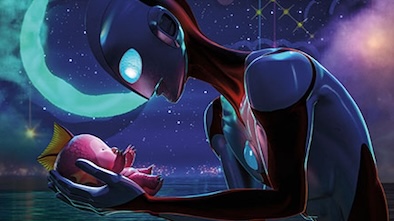
Now, with the new animated feature Ultraman: Rising, the character is finally coming to big screens (and, yes, Netflix) in a way that’s more overtly geared toward international audiences. Co-written and directed by Shannon Tindle, the driving creative force behind the Emmy-winning limited series Lost Ollie, the film is built around a simple yet playfully inventive premise: what if a giant, towering superhero was forced to raise the needy, orphaned child of one of his more fearsome enemies?
Set in Odaiba, Japan, Ultraman: Rising aims for universality, but also straddles other, more culturally specific worlds. After a cold open in which some domestic tranquility is upset by an urgent call to action, we flash forward two decades.
While Ultraman (voiced by Christopher Sean) battles Godzilla-style kaiju that sporadically appear, he’s a bit weary of this whole gig, and has somewhat mentally checked out. One can forgive this distractedness, however, because in reality Ultraman is Ken Sato (voiced by Sean as well), a hugely famous but equally egotistical baseball star who has just recently made a return to his homeland after years abroad in Los Angeles.
Ken, you see, has inherited the mantle of Ultraman from his professor father (voiced by Gedde Watanabe), from whom he is estranged. He still bears a heavy grudge, though, for his father’s abandonment of him and his mother, choosing superhero duty over their shared family life.
One evening, in the course of a messy metropolitan defense, a kaiju hatchling sees Ken as Ultraman and “imprints” upon him, believing him to be her parent. While dogged reporter and single mother Ami Wakita (voiced by Julia Harriman) pursues multiple interviews with Ken for her stories on his baseball exploits, Ken must juggle his newfound, unwanted responsibilities as a caregiver with high-pressure, high-stakes athletic superstardom.
Assisted by a floating orb robotic assistant named Mina (voiced by Tamlyn Tomita), Ken slowly comes to value his relationship with the kaiju creature who comes to be named Emi, even as she suffers from fiery acid reflux and a monstrous case of rampaging toddler syndrome. Ken’s protective instincts put him increasingly at odds with the Kaiju Defense Force, headed up by the stern and uncompromising Dr. Onda (voiced by Keone Young).
Ultraman: Rising taps into easily relatable, cross-cultural themes (that the world is a more complicated place for adults than kids, but sometimes adults overthink things and need to actually be reminded in simple and direct fashion of what’s most important), as well as “misunderstood monster” tropes that have for generations powered certain science-fiction sub-genres.
Featuring animation by Industrial Light & Magic, the world-famous visual effects house George Lucas founded to virtualize his imagination for Star Wars, Ultraman: Rising embraces a kinetic visual style that melds the looks of Japanese anime, American comic books, tokusatsu cinema, and more. Shades of purple and grey are effectively used throughout, and among the most lastingly memorable images is a stylized sequence involving a churning sea tide. Its baseball action sequences are quite well done,
The characters, of course, are also appealing, in an admittedly easy-on-the-eyes way. With her stumpy legs, pink coloring, and big, blinking eyes, Emi is expressive and cute in a conventional manner (not necessarily resembling her biological mother) that feels like a rather bald commercial play. Ultraman, meanwhile, will remind viewers of a certain age and inclination of the Iron Giant (who of course, chronologically, actually took his inspiration from Ultraman) and also maybe the Rocketeer, another flying descendent.
Director Tindle, along with co-director John Aoshima, aims pretty transparently for “four-quadrant” family entertainment, even (maybe especially) if you’ve never heard of Ultraman. Tindle and co-screenwriter Marc Haimes bite off a lot in their efforts to achieve this, and sometimes the movie comes across as a bit manic and scattershot. At times, it feels like one big “proof of concept” test, with every possible notion thrown into the mix, even if not quite fully fleshed out or paid off.
Owing to this abundance of narrative threads, Ultraman: Rising is basically 107 minutes (its credit sequence extends the runtime roughly 10 more minutes), which will feel slightly too long for a lot of kid viewers. Of course, for a certain audience, the action is the big selling point of a movie like this, and it’s here that Ultraman: Rising delivers fairly nicely. Some of these sequences occasionally indulge in the type of slow-motion that fetishizes comic book panels, though not quite successfully enough to really be called a device. One particular scene will recall, for many viewers, the live-action strike and destruction of Iron Man’s compound, but not in a way that is necessarily disagreeable. Other segments also summon trace memories of influences like Pacific Rim and the recent Spider-Man animated flicks.
Overall, for those predisposed to have an interest or at least an open mind, Ultraman: Rising connects as a story about the difficulty, but value, of passing along hard-earned memories, and striving to make the world a better place — both inside and outside of one’s family unit.
Our Rating
Summary
For those keeping score at home (and/or just well-trained by superhero franchises of late), yes… there is a mid-credits scene which teases the possibility of a sequel, while offering a potential reversal of something firmly established in the film. Does that undercut Ultraman: Rising? No, not really. It merely confirms that all superhero stories, regardless of the story they’re telling in the moment, are also aiming for a perpetually open wallet.
Publisher: Source link






Forget ‘Lioness,’ Paramount’s 114-Episode Non-Stop Action Thriller Is One of the Biggest Shows on Streaming
Taylor Sheridan's hit action thriller, Spec Ops: Lioness, is nearly back with its third season. Season 3 of Lioness debuts on Aug. 2, dropping a new episode each week. While Taylor Sheridan fans are re-watching the series (and Sheridan's other…
Aug 3, 2026
Long-Awaited DCU Superhero Series No Longer Moving Forward After 3 Years
Another day, another superhero project canceled. Despite the box office success of Marvel Studios' Spider-Man: Brand New Day, it was sandwiched between the cancellation of Wonder Man Season 2 and Mahershala Ali confirming he is no longer attached to star…
Aug 2, 2026
Marvel Star & Creator Officially Address Shocking Series Cancellation
In a disappointing turn of events, one of the MCU's most-acclaimed shows has been cancelled shortly after it was confirmed for a second-season run. Featuring quirky and relatable characters, the series gained quite a following for its meta commentary on…
Aug 1, 2026
‘The Rookie’ Already Filmed a Series Finale To Prepare For Its Cancellation
The Rookie is one of the most popular procedurals ABC has aired over the past eight years. It was unsurprising that after ABC's highly popular series Castle ended in 2016, the network wanted to continue its working relationship with the…
Jul 31, 2026