A Jarring Attempt to Combine Fiction and History
Jan 20, 2025
Life often imitates art, and art is often inspired by life, and finding a balance between the two is one of the great challenges of any great filmmaker. This is true regardless of a feature film’s format or genre, be it a fictional narrative or a non-fictional documentation. In the case of Grand Tour, Portugal’s official submission for the 2025 Academy Awards, it attempts to combine both. It’s a very similar vein that Chloé Zhao and Frances McDormand’s Best Picture-winning hit Nomadland tapped into, but Grand Tour takes a far more experimental approach.
Directed by Miguel Gomes, the same filmmaker behind 2015’s Arabian Nights trilogy, Grand Tour depicts three narratives at once. One is the tale of a man trying to escape his life commitments, the other is about a woman who wants to convince said man of the error of his ways, and a variety of miniature stories about real-life people in Asia. It’s trying to do all of this in just over two hours, and while the film’s goals are no doubt ambitious, these stories just don’t come together as cohesively as one would hope.
What Is ‘Grand Tour’ About?
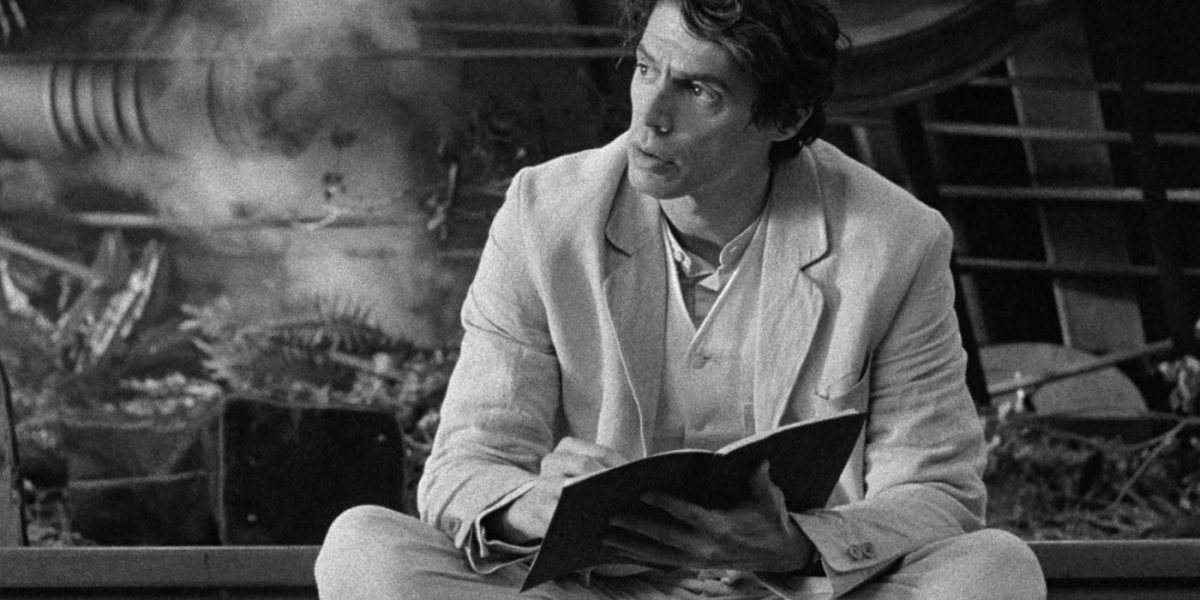
Grand Tour is named after the real-life route that travels to some of the most significant landmarks in Asia, such as Singapore, Hong Kong, Japan, and more. However, the film’s first major character, Edward (Gonçalo Waddington), hasn’t come to Asia for a pleasure cruise. He’s trying to escape a marriage to a woman named Molly (Crista Alfaiate), as he doesn’t feel like he is quite ready for such a commitment. Molly disagrees, and she decides to go on the Grand Tour herself so she can find her fiancé, and they can have an adult conversation throughout all of this. The stories of Edward and Molly take place during the early 1900s, but the majority of this story features footage from present-day Asia, all while various narrators recount their tales.
One-third of Grand Tour is engaging, while the other two are far more perplexing. Certainly, the most engaging character in the movie is Molly, who doesn’t even make an appearance in the film until the halfway point. She’s the polar opposite of her fiancé, being a bubbly and carefree spirit determined to see the best in the world. The film even has a running gag where she is constantly giving this greatly unserious giggle and it’s hilarious every time.
‘Grand Tour’s Three Narratives Aren’t Consistent
Image via The Match Factory
Until that halfway point, Edward is the main character we follow, who isn’t quite as interesting. He’s not a horrendous character, but he’s also fairly dry, as events just tend to happen around him. Compared to the significant other that he’s fleeing from, Edward doesn’t have much to add to this world, and his ending overall feels very aimless and overly ambiguous.
Though perhaps the most curious element of Grand Tour is the non-fiction elements. The aforementioned parts featuring Edward and Molly only account for about 25-30% of the entire film. The remaining 70% is dedicated almost entirely to footage of modern-day Asia, as a cast of disembodied narrators detail the events not seen in Edward and Molly’s respective journeys. These aren’t just random bumps in the road either, but crucial story events that really should have been showcased instead of entirely sidelined.
‘Grand Tour’s Non-Fiction Elements Feel Very Out of Place
Image via The Match Factory
In between the story of Edward and Molly, there are gigantic stretches of time where we’re essentially viewing stock footage from modern-day Asian locales like China and Japan. These scenes are admittedly beautiful looks into expansive and diverse cultures, and in one or two sequences, there’s a smaller story being told. A fine example features a bar patron singing a karaoke version of Frank Sinatra’s “My Way,” and the man becomes so emotional during the song that he begins to sob. There may not be a ton of context, but there’s clearly a history and story that we’re being given just a brief snapshot of.
Sadly, those moments are far and few between in Grand Tour. The vast majority of the time is instead given to expansive wide shots and depictions of day-to-day activities. What makes these sequences even more frustrating is that the majority of these non-fiction sequences have virtually nothing to do with the main fictionalized plot. This creates a problem, as the audience now has to read the subtitles (which are all in different languages depending on which part of Asia is being depicted) and see the admittedly well-shot footage that has little to no relevance to what is being said. Reading subtitles, of course, is not an issue in of itself, but when we not only have a relevant visual stimulus to attach to, but also have a bunch of footage that seems entirely irrelevant to Edward and Molly, it can make things feel like there’s just too much going on.
Overall, it’s just very difficult to decipher what exactly Grand Tour is trying to say with these documentary sequences. It doesn’t seem to be drawing any sort of meaningful comparison between what life was like in the early 1900s to what it’s like now. It all just feels very random and disjointed, without much subtext to keep things afloat. Grand Tour’s attempt to combine a fictional narrative with non-fictional documentary elements just doesn’t work, and Miguel Gomes feels like he’s trying to make two different movies.
With the beautiful cinematography, solid performances from the cast of the fictionalized elements, and some rich imagery from the non-fictional ones, Grand Tour is a stylishly admirable movie at the very least. However, any attempts at a compelling core narrative are lost through the lack of emphasis on Edward and Molly’s stories and an overemphasis on the trips to these locales. The film does show that Gomes is capable of making an authentic period piece and a stunning documentary, but the attempt of trying to do both at the same time has led to an unusual experiment that will leave one scratching their head.
Miguel Gomes’ trip through Asia has some great style, but lacks substance in it’s experimental merge of fiction and non-fiction.
Pros
Molly’s story is a cinematic highlight.
Some stunning cinematography.
Some great views of modern day Asia…
Cons
…that feel entirely disjointed from the rest of the film.
Edward’s half of the story is a bit of a drag.
Release Date
November 27, 2024
Director
Miguel Gomes
Cast
Gonçalo Waddington
, Crista Alfaiate
, Cláudio da Silva
, Lang Khê Tran
, Jorge Andrade
, João Pedro Vaz
, João Pedro Bénard
, Teresa Madruga
, Joana Bárcia
, Diogo Dória
, Jani Zhao
, Manuela Couto
, Américo Silva
Runtime
129 minutes
Publisher: Source link






‘Baywatch’ Reboot Officially Confirms Streaming Release Details
When Baywatch signed off in 2001, it had already spent the better part of a decade as the most-watched show on the planet, airing in more than 200 countries and reaching over a billion viewers a week at its peak.…
Aug 5, 2026
Origins’ Sets Return Date With Mark Harmon Getting a Season-Long Arc
Mark Harmon played special agent Leroy Jethro Gibbs for 18 seasons of NCIS before leaving in Season 19. The original show has soldiered on without him — it will soon be back for its 24th season — but the franchise…
Aug 4, 2026

Forget ‘Lioness,’ Paramount’s 114-Episode Non-Stop Action Thriller Is One of the Biggest Shows on Streaming
Taylor Sheridan's hit action thriller, Spec Ops: Lioness, is nearly back with its third season. Season 3 of Lioness debuts on Aug. 2, dropping a new episode each week. While Taylor Sheridan fans are re-watching the series (and Sheridan's other…
Aug 3, 2026

Long-Awaited DCU Superhero Series No Longer Moving Forward After 3 Years
Another day, another superhero project canceled. Despite the box office success of Marvel Studios' Spider-Man: Brand New Day, it was sandwiched between the cancellation of Wonder Man Season 2 and Mahershala Ali confirming he is no longer attached to star…
Aug 2, 2026