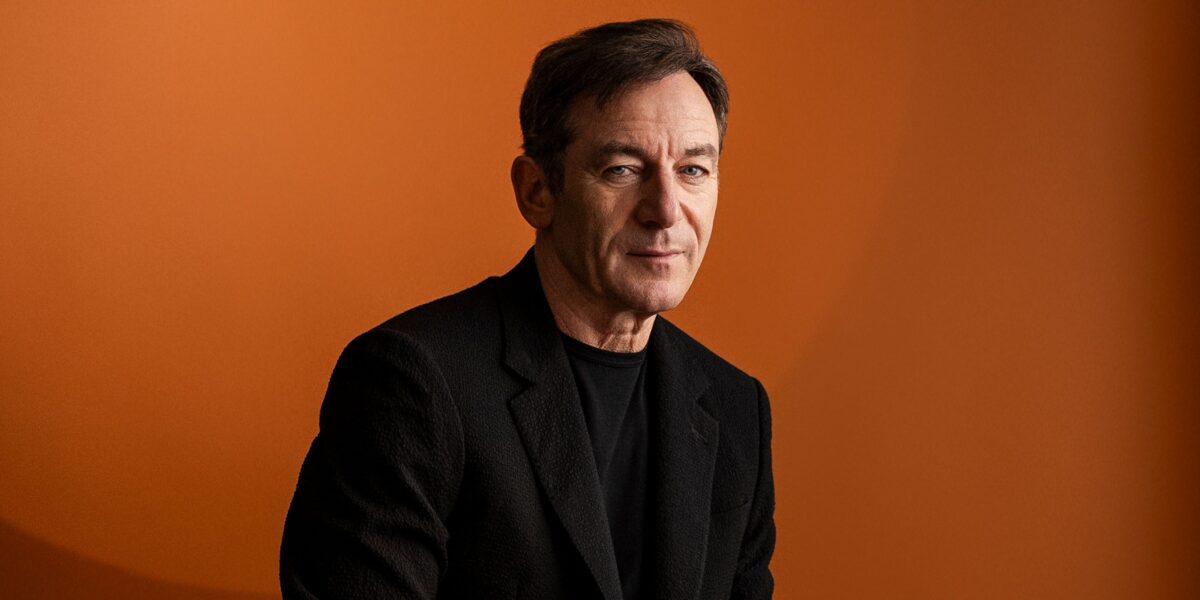
Jason Isaacs Is Ready to Psychoanalyze You
Mar 28, 2025
Jason Isaacs is incredibly consistent. Not just because he has consistently been on-screen for 40 years. He is consistent in the way he talks about his past and his love for the craft. He is also consistently gracious and one of the best conversationalists you will ever encounter. The first time I met Isaacs, he was days away from flying halfway around the world to film The White Lotus in Thailand. A tea in hand, glasses perched on his nose, and ready to start his morning with a deluge of fan questions about his impressive body of work, mostly Harry Potter, with a few OA and Baldur’s Gate 3 questions thrown in. He can’t offer much of an answer when one fan asks him about The White Lotus, but it’s evident that he is excited about what lies ahead.
A year later, sitting before him over Zoom, I’m ready to pathologize the inner workings of Timothy Ratliff—the embattled North Carolinian businessman he plays in Mike White’s critically acclaimed series. But Isaacs would rather pathologize my self-professed love for Captain Hook (we’ll get to that). He is also incredibly guarded about revealing too much about where things are headed in the final few episodes of the season. While we aren’t looking to spoil anything, he has a point: “People aren’t watching streaming things now on the day that it’s broadcast.”
Born in Liverpool to Jewish parents who lived through World War II, Isaacs never had an inkling that he might become an actor someday. “Much too young, I knew about these terrible things and picked up the sense from them that you might be kicked out of any country at any time,” he says. “Professions are things that give you some ballast against that.” So he went to Bristol University to become a lawyer but became an actor instead. The very thing that he jokes seemed like an occupation for people who “came from different planets, different gene pools.” Despite spending all of his time directing and producing plays with the university’s theatre club, Isaacs did graduate with a law degree — something he remarks was done simply to keep a failure off their books. “When I went to take the exams, instead of knowing any of the questions about the law, I’d write what I thought the law ought to be or what I’d seen in a film, or sketch, or doodle, or pretend I’d lost the paper.”
While barristers do perform in the courtroom, Isaacs’ continued theatrical studies at London’s prestigious Royal Central School of Speech and Drama helped shape him as a person. “I had to learn how to switch my brain off and switch off my rational, analytical side and see if I could relax and allow something more animalistic and instinctive to come through. It’s taken years to do it, and I still struggle with it sometimes.” We talk about method — not capital M Method — but more so about our shared inability to remember exactly what was done during a take. “I’ve ended up part man, part goldfish,” he jokes. “Every time they say action, it’s all new to me. Every time.”
His commentary has me nodding along, engaged by every astute word — aware of how effortlessly he holds attention. “It’s always about what you’re trying to do to the other person, which is why the best performances I’ve ever seen are, mostly, at least, off-camera.” Isaacs has seen me, like he has every other journalist he’s sat down with. “You’re thinking about what I’m thinking about now, which is, I’m trying to get you to nod or, on some level, maybe I’m trying to get you to think I’m clever or wise or whatever it is. My energy is about what I want to be happening inside your head, not what I’m doing.”
I had to learn how to switch my brain off and switch off my rational, analytical side and see if I could relax and allow something more animalistic and instinctive to come through.
We pivot to discussing his aspirations beyond acting, or rather lack thereof. When Isaacs was at Bristol University, he directed a number of the theater club’s productions, and in recent years, he directed an episode of the short-lived medical drama he also starred in, Good Sam. Isaacs notes that he feels content with the creative input that comes with executive producing projects (Archie, Case Histories), and reveals that he has also provided creative input on scripts, though not in any paid capacity. “I’ve written some things. I’ve worked on scripts, often uncredited. I like all aspects of the creative [process]. To make a movie, you’ve got to give up a year and a half or two years of your life, and I would happily do that for something I thought would break even and get the investors their money back, because it’s really hard to do an indie film, and I don’t want to presume upon my friends or other people.” It would have to be a very special script or something he has written himself to get him behind the camera, and, as he jokes, “The fridge and the tennis court are too big an attraction to me to sit down and write.”
“I love rewriting scenes. I love rewriting sequences. I love working with writers. But to sit down and create a world from scratch, I find not just intimidating, but the time and effort. I’m more admiring of the work ethic of many of the writers that I love than the talent. The talent is in many places, but they use their talent. They sit down, and they switch the internet off, and they write the bad draft first that they’re prepared to show to people and make it better. There’s a humility in that which I’m in awe of.” I try to dig deeper and uncover if Isaacs is a secret script doctor, quietly improving projects that we’re all binge-watching, but he’s shrewd about it, and cautious about drawing clear delineations between his unofficial work and the work of members of the Writers Guild. Whatever script doctoring he is doing, he’s doing it for the love of the game.
Isaacs explains that some of his work is on scenes he is in, while others are “scenes that friends are doing that they’re having trouble cracking, and stuff that comes to me that I’m not going to do. I get a lot of scripts early on that I’ll try and raise money for or have them raise money, or ask people, ‘What do you think of this? Let’s try and develop it together.’ All those discussions are, even if they never end up on a screen or anywhere on a camera, I find very fulfilling.”
Jason Isaacs Is Known for Playing Villains, but He’s the One Used to Getting Bullied
Photography by Yellowbelly for Collider
Isaacs has had a very fulfilling acting career as well. He’s known around the world for portraying Lucius Malfoy in Warner Bros.’ decade-spanning Harry Potter franchise, but I’m less concerned with his top-line projects—I want to know about his first on-set experiences fresh out of drama school. Isaacs is extremely forthcoming with stories that could fill up the entirety of our time together if I let him. “They’re all traumatic experiences. I remember them so vividly, all of them,” he reveals, and he’s telling the truth.
He paints a picture so vivid, I feel transported back to the 1980s. Looking at his expansive list of credits on IMDb, his first credited role is Dr. Guy Chadbot on This is David Lander, but Isaacs isn’t certain if that was his first one-day job. It’s between The Tall Guy or a movie called Dangerous Love (later The Lady and the Highwayman). “I was wearing those jeans with my ass hanging out and some baggy pants,” Isaacs recalls of the audition process. “I went and all the people were incredibly handsome and with beautiful bodies, in my memory, at least, and they were wearing these glamorous clothes. They were auditioning for some version of Prince Charming in some romantic tale.”
The made-for-television film was based on Barbara Cartland’s beloved 1952 novel Cupid Rides Pillion. The leading role — ironically named Lucius — went to Hugh Grant, who has recently voiced his desire to remove the film from his list of credits. After Isaacs’ audition, he recalls telling his agent, “I don’t ever want to go in for people like that again. Don’t send me alongside all these Adonis-like men. That’s not the part I want to play.” He didn’t book the lead, but he did get offered the role of Man with Pike, which he was initially going to reject until he found out how much he was going to be paid for a single day of work: £691. “Which is a fortune in 1988 — I mean, it’s a fortune now. I went, ‘Oh no, I’ll do it. Of course, I’ll do it.’”
Isaacs lights up as he tells me about his disastrous first day on set. After spending the morning enjoying breakfast and commiserating with the actors in the tent, things fell apart when his name wasn’t called to be seen for costuming. But his role wasn’t cut, as he first feared. He had been mistakenly sent to the extras tent. So he scurried over to the actors’ trailers, where he met his scene partner. “I’d already been put in my chainmail armor, so I could barely bend, and I sat in the chair and in comes the actor next to me who was playing the sergeant. I said, ‘Oh, we’re in a scene together.’ He went, ‘What?’ It was morning, he hadn’t had his coffee.” Fresh out of drama school and eager to apply all of the important lessons one learns about building connections between characters, Isaacs found an unwilling actor instead. “I said, ‘What’s our history? We were coachmen together?’ And he went, ‘I don’t fucking know,’ and then just didn’t talk to me again. And I went, ‘Well, okay.’” The day turned even worse when Isaacs wasn’t used at all, leading to him having to return the following day to finally shoot his short scene.
I think I give out a please-bully-me vibe, or so I used to.
“Eventually, they get to the scene,” Isaacs recalls. “I’m standing in the doorway, and the director goes, ‘Action!’ I’m about to say my one line and this fucker goes, ‘Keep your eyes to the front, you horrible little dwarf!’ He cuts my line. Just cuts it.” I’m almost surprised he hasn’t risen from his seat to fully reenact the scene. “So, the camera’s looking at me, and I’ve got half a second left to try and salvage something, so I start mouthing at him, ‘You horrible little dwarf.’ The director goes, ‘Cut. What was that you were doing?’ I said, ‘I was just making fun of him.’ He goes, ‘Don’t do that.’ I said, ‘By the way, sorry, mate, I think I’ve actually got a line before that.’ And he said, very loudly to embarrass me in front of the whole crew, ‘Straight out of drama school, are we, love? Maybe you should get your cues in quickly.’”
Instead of backing down, Isaacs explains that he pointed out that if they spoke over each other, it would ruin the take, effectively putting the seasoned actor in his place. “I got my one line in, and I wish I hadn’t because for decades afterward I get phone calls going, ‘Did I just see you with a pike in a doorway?’ I should have shut my mouth.” Even as a young actor, it’s hard to imagine anyone trying to bully Isaacs. He’s intense and confident, and so well-spoken, but he reveals that this was neither the first nor last time someone has tried to bully him. “He tried to humiliate me on set, and I wasn’t going to put up with that shit. I have been bullied many times on set, subsequently, by many people. I think I give out a please-bully-me vibe, or so I used to. I have different moods on different days, but that was a day I wasn’t going to put up with that shit.”
Jason Isaacs Was the Second Pick for One of His Most Iconic Roles
Image by Columbia Pictures
Isaacs is no stranger to playing the bad guy now, but that wasn’t always the trajectory of his career, and he has Jude Law to thank for it. This year marks the 25th anniversary of Roland Emmerich’s American Revolutionary War epic The Patriot, which Isaacs starred in as the dastardly Colonel William Tavington. “It was a courageous thing to do to kill the romantic hero two-thirds [of] the way through the film,” he says, referencing Tavington killing Gabriel (Heath Ledger), which cemented him as one of the most hated villains in film history.
“And great storytelling in the days before Alan Rickman had completely changed villains forever. He stole Robin Hood: Prince of Thieves and Die Hard from Kevin Costner and Bruce Willis [so badly] that some mandate went around—I don’t know if it was a secret memo or just an instinct—to never let a villain steal a film again.” Isaacs also reveals that after The Patriot, he was offered all sorts of “bad guy” roles opposite “alpha male” types, “but they were morons, and the heroes were never scared.”
The Patriot was lightning in a bottle in terms of the dynamic between its hero and villain. As Isaacs notes, it worked because Mel Gibson “plays scared.” The audience understands the stakes because the main character has the odds stacked against him. “I remember there was a bit in the middle of the film where we meet face to face. He comes and gets his son back, and as scripted, he steps up to me and says, ‘Before this war is over, I’m going to kill you.’ In the script, it said, ‘For the first time, you see Tavington scared. He steps back.’ But I went to Roland, and I went, ‘Why am I doing that? Why am I scared?’ The film is over if the villain is scared at that point. The whole film’s over. And he goes, ‘Okay, do something else.’ I go, ‘Should I tell Mel?’ He goes, ‘No, no, no.’” Isaacs’ recollection is such a clear example of why people come to him for script notes. His keen observations elevate the scene into one of the film’s most memorable moments.
“So Mel steps up to me, and he goes, ‘Before this war’s over, I’m going to kill you.’ I took my sword out, I turned it around, I offered him the handle, and I said, ‘Why wait?’ He looked absolutely furious. Mel’s eyes went electric. I thought, ‘I’ve really crossed a line here. It’s a terrible mistake. I better grovel.’ He just looked around. I thought he looked over at Roland at the camera, but he looked all around, and he said, ‘Soon.’ And he walked off, and Roland called cut. I ran up to Mel, and I said, ‘Look, I’m really sorry. I wanted to do something, but I didn’t want to tell you.’ He grabbed me, and he went, ‘I fucking loved it! It was electric, man.’ Because he’s a proper actor. So, it was a great part, and I didn’t do any of the villains after, which my bank account would have been far fatter for. But I went off and played a drag queen and did a couple of plays because they don’t come like that very often.”
“By the way,” Isaacs says coolly before delivering a piece of movie trivia that has seemingly never been uttered before. “The Patriot wasn’t my part. Many of the best parts I’ve ever played, I was not the first choice for it. It was on offer to Jude Law, and Jude hadn’t given them an answer yet.” He explains that he was asked to submit a self-tape for the role (an emerging concept at the time), but was cautioned by his agent that he would not get the job. His audition was simply meant to pressure Law into accepting the role. Even after Isaacs was asked to fly out to Los Angeles to meet with the creative team, he was told it was “just to shake Jude’s tree.”
His meeting with Emmerich and Dean Devlin was a success, but still, he was being told to lower his expectations. And then, he booked it. “Weeks went by because they had to both send the tape to Mel to get his approval and ask Jude if it was okay for him to withdraw, and God bless him, which I’ve thanked him for many times since, he did. That’s how I got the film part in The Patriot.”
Many of the best parts I’ve ever played, I was not the first choice for it.
As Isaacs points out, it wasn’t the first time he was the second pick for a character. A few years prior, he was cast in DragonHeart opposite Dennis Quaid because the actor originally cast as Felton booked a part in Cutthroat Island. “They were looking for an actor who very specifically had the same size feet, head, chest, and arms, and so it narrowed the field down a lot. So, I was offered this part in DragonHeart.” The fantasy film was also the first time Isaacs was transformed into an action figure, and he’s still quite tickled by the whole experience. “What I really love about it is that [my] action toy came out with a spinning battle axe. I never so much as raised a feather in anger, and Dennis’ came out with a wheelbarrow or whatever it was. I think I outsold him, and you’d find him in the remainder bins, and I was selling out.”
Tim Ratliff Isn’t a Bad Guy, at Least Not in Jason Isaacs’ Book
To any viewers who might think that his White Lotus character is a bad father, Isaacs has a clear message: “They are projecting baggage onto me. That has nothing to do with how Tim is on the show.” People seem inclined to apply these complex ideas to the characters that White unleashes onto White Lotus properties, but they are all relatively familiar characters, especially for anyone who grew up in affluent regions of the south, rubbing elbows with the country club types. Tim Ratliff is every other rich white man in a Vineyard Vines polo. His family might be a mess, with its incestuous sons—Saxon (Patrick Schwarzenegger) and Lochlan (Sam Nivola) — and daughter, Piper (Sarah Catherine Hook), who wants to escape from the dysfunction by way of Buddhism, but there is never a question whether Tim loves them, warts and all.
“He feels guilty about what the money has done to his kids,” Isaacs explains. “He sees where they’re going awry, and he’s extremely worried — as you know, having seen more — about these kids he’s raised and how they’re going to cope if suddenly everything that they have, and everything that they think makes them who they are is pulled away from them. Can they survive in the world? Who will they be if they can’t jump on a private plane and buy their way out of any trouble? Do they have the skills? Do they have any grit? Does he have any grit? Can his wife survive if everything that has sustained them is erased in that one fell swoop? What will they be?”
Lochlan and Piper certainly have their own problems, but the Ratliffs’ true problem child is their eldest, Saxon, who, as Isaacs explains, is trying to “ape his father’s behavior,” and getting it all wrong in the process. “He’s got other children who have reacted against the privilege that they’ve had. I think he’s a great dad, or rather, ‘great dad’ is an exaggeration. I think he is concerned about trying to be a great dad, which is the start of it.”
In his real life, Isaacs is a father who spent the pandemic washing dishes while his daughters monopolized the family’s sole television to binge Grey’s Anatomy and The White Lotus. He has a well-rehearsed tale about his White Lotus origin story that he’s told throughout the press tour, and it never fails to entertain. His daughters barred him from watching Season 1 because they didn’t want him to start watching midway through, and by the time Season 2 rolled around, they didn’t want him to watch without having seen Season 1. When he walked into his audition — something that rarely happens for him, he notes — he lied through his teeth to the series’ executive producer, Dave Bernard. “I told him what a huge fan of White Lotus I was. What utter genius it was, and ‘how the richness of the characters,’ and all the other things I picked up from the reviews I’d read because I’d never seen a frame of it.” He did, finally, watch the show after he booked the role.
Isaacs is quite practical about why he booked the role, despite my insistence that he manifested the role after being barred from watching it by his family. “Dave saw Death of Stalin on a plane. Why he thought Tim Ratliff was anything like General Zhukov, head of the Red Army, I don’t know. I certainly didn’t play in that way. Maybe there was something in the boldness and swagger of him. I don’t know why he thought I could play all the many other sides of him that come to light when his world falls apart, but I’m thrilled that he did.” Tim’s swagger is something that Isaacs also compares to Tom Wolfe’s Bonfire of the Vanities. “He’s a big swinging dick. He’s the biggest swinging dick in North County in Durham, North Carolina, and suddenly he looks like he’s been castrated. That is going to be a challenge for him and all of his family. Every single second he’s trying to either not think about it or think about: is there anything he can do before he gets on that boat?”
By Episode 6, it’s hard to believe that there is anything Tim can do to get out of his increasingly dire situation, outside removing himself from the situation. The White Lotus is no stranger to courting tragedy, but this season is putting Isaacs through a particularly poignant gauntlet with Tim’s plight and subsequent suicidal ideation. Isaacs’ performance in Episodes 5 and 6, especially, has him primed to be a serious Emmys contender this year. It may even be some of his best work in years, but Isaacs plays it close to the chest when we discuss the emotional toll that scenes like that have on a person. Instead, he opts to discuss Tim’s stint with his wife’s Lorazepam, which, despite being anti-anxiety medicine, contributes to his downward spiral. “It gets more out of control,” he says. “The scariest thing for me, one of the reasons I was not exactly hesitant about taking the part — or reluctant, because it was Mike and White Lotus, so why wouldn’t I? But I did have worries that I would just be very, very boring because people on drugs are really, really boring.” White assured him that he wouldn’t be boring — they would “find that tightrope and walk it,” and thankfully, it paid off. “That was the challenge. It wasn’t going over the top. It was disappearing.”
For the better part of three decades, Isaacs has been most recognized for playing Lucius Malfoy in the Harry Potter franchise —even without the white-blonde wig. But The White Lotus has introduced him to an entirely new audience. Isaacs tells me about an unexpected encounter in New York City a few days prior, dipping in and out of a New York accent for dramatic effect. “I was walking home at 2 o’clock in the morning the other day, and some guy went: ‘Hey you, right there! You’re the Lotus guy?’ I went, ‘Yes. Well, I mean, I suppose I’m one of the actors in the show,’ and he goes, ‘Your family’s fucked, my friend!’ And I go, ‘Yes. No, I know that.’ He goes, ‘And you. You’re in deep shit. You got bad shit coming and ain’t gonna get any better.’ I’m like, ‘No, that’s a very accurate assessment. Thank you very much, sir. Goodnight.’” Isaacs continues, “It just shows that the writing is so engaging and real. People feel like they’re watching something real. But there is a story for everyone.”
That was the challenge. It wasn’t going over the top. It was disappearing.
Throughout our conversation, Isaacs dips in and out of various accents — and dead-on impressions — with an ease that, quite frankly, would make anyone envious. He’s something of a chameleon, and not just because it’s easy to lose track of the man within a role. His accent in The White Lotus has proven somewhat contentious, particularly with the North Carolinian demographic, but it is (for better and for worse) a spot-on representation of Durham’s uppercrust. “I love an accent. I feel freed,” Isaacs tells me, making note of the fact that some actors feel connected to their character through costumes or assigning an animal to them. He, on the other hand, has forged connections with his voice.
In 2023, Isaacs donned the Mid-Atlantic charm to bring Cary Grant to life in Archie, and now he’s tapping into a different source for Tim Ratliff: Reality television. Specifically, Southern Charm, which White recommended the Ratliff family actors check out. For those who have alleged that he is imitating Thomas Ravenel, Isaacs is quick to reject that notion. “Tim is from Durham, North Carolina, and although I did look at Thomas a lot, there are two vowel sounds he doesn’t have because he’s from Charlotte. Only people from Durham have these really strange, jarring, anomalous vowel sounds that remind you that they’re descended from English people because they are identical vowels to upper-class English.”
In terms of where things are headed for his White Lotus character, Isaacs remains tight-lipped, offering up mere hypotheticals about where the final two episodes might take Tim. “He’s a day away from oblivion. Not just for him, but seemingly — to him — for all of his family. He’s, as far as possible, extinguished every thought from his head with drugs, but it’s not working at all. His mind is working overtime to think: what is this? And will it be okay? Will I be okay? Could I really have got myself to a place where I am the stuff that I own and the status that I have in Durham? And the status I have within my family. Will my children and wife survive? And all those things. Those questions, which maybe he managed to obliterate on day two or day three, they’re at a crescendo inside his head.”
In Another Life, You Might’ve Found Jason Isaacs Fixing Your Laptop
Photography by Yellowbelly for Collider
We talk a little about whether his children have seen this season of The White Lotus, particularly in light of a certain moment in Episode 4, where Isaacs bares more than any daughter would like to see of her father. “If they are watching that, I’ll be booking the therapy sessions right now,” he laughs, before adding. “I don’t think they really watch the stuff I’m in, which is a shame for them because they love The White Lotus.” If they have watched it, it’s because they joined Isaacs in Thailand for some of the filming and bonded with his on-screen children.
The conversation lands us at an interesting quandary: who would Jason Isaacs be if he wasn’t a famous actor? He’s quite confident that he wouldn’t have ended up in the arts, were it not for his fateful encounter with the theater club at Bristol. “I probably would have pursued law because I love an argument. I liked using my brain,” he adds. “I’m very, very geeky and very logical, which is not useful for an actor either.” It’s a very rehearsed sort of answer, but the next part surprises me. “I probably would have been in the computer world.” Isaacs doesn’t particularly seem like the men you meet at the GeekSquad counter at Best Buy, but as he regales me with another tale from his past, I start to see the vision.
Isaacs tells a story about visiting a repair shop in the early days of Apple. While waiting for his laptop to be repaired, the phone kept ringing, but the repair woman was too busy to answer. “About the fifth time I grab the phone. I went, ‘I’ll do it. ‘Hello? Can I help you?’ I said, ‘Well, have you rebooted the PRAM? Okay, well, hold on down Option, P, and R and tell me. Wait till you hear a double chime.’” In the end, he ends up walking the caller through Safe Mode, before ultimately delivering a verdict: They need a new computer.
Isaacs beams as he continues the story, “I got off the phone, and the woman was looking at me slightly agog, and she went, ‘You’re an actor, right?’ I go, ‘Yeah.’ ‘Because I’ve seen you on TV.’ I go, ‘Okay.’ She goes, ‘Do you work all the time?’ And I go, ‘Not all the time.’ She goes, ‘Well, if you have downtime, we could really do with someone like you in the store.’ I almost burst out crying and kissed her because no one had offered me a real job for years. The thought that I might be able to survive if I didn’t run around pulling faces and wearing my makeup for a living was just so joyous to me. I like to think I’d be somewhere doing that.”
The thought of this alternate version of Isaacs remains as our conversation progresses, and he suggests that he might’ve gone into something athletic, were he born into a different family. “I was a pro skateboarder when I was a teenager. Maybe in a different family, I’d have done something physical. My family, that would have never happened. I like climbing things, jumping off things. I like hurting myself. I like balancing on things. I like running along things. I’m not good enough! I’ve never been good enough for any of these things to do it. But if you ask me, if I could wave a wand, I’d have been a professional tennis player.”
His propensity for injuring himself in sports has followed him into his acting career. “I am walking testimony to the fact you should never say yes when an actor says ‘Can I do that?’ Because I’m nothing but a giant bag of injuries.” He laughs, and it’s easy to imagine a lawyer somewhere shaking his head as the studio dots the I’s and crosses the T’s on their insurance. He tells me about a fight sequence with Michelle Yeoh on Star Trek: Discovery that he attempted after seven hours of tennis the day before. With knees swollen like “pumpkins,” Isaacs told the stunt coordinator, “I am doing this if you have to saw my legs off with a bread knife.”
With a handful of Motrin and a visit to a specialist doctor, he persevered. “I did the scene because no one else was going to fight Michelle Yeoh.” In Harry Potter and the Chamber of Secrets, Isaacs reveals he knocked himself out during the simple stunt where Dobby uses magic to push him away. “They built a bit of rubber cobblestones. All I had to do was the last 3 or 4 inches. And I was so frustrated at not doing the pull that when I did that last 3 or 4 inches, I did it with incredible violence and knocked myself out.” As he approaches 62, Isaacs is more than content to let his stunt doubles “open a door handle from now on.”
Jason Isaacs Has Complete Faith in the New ‘Harry Potter’ Series
Photography by Yellowbelly for Collider
Isaacs has spent much of the press run for The White Lotus fielding questions about Harry Potter, in part because the franchise is being reborn as a series on the very same streamer. It doesn’t help, either, that most of us who grew up with Harry Potter are now the ones asking the questions. Rather than retreading similar grounds of asking him if he has any interest in returning to the franchise as a different character, I opt to ask him about what it’s like to know that someone else will soon be filling his shoes. After mincing words over the fact that he has played a character that others have played (Captain Hook) and a bit of semantics over Rupert Friend’s portrayal of the Inquisitor in Obi-Wan Kenobi, whom Isaacs voiced in Star Wars: The Clone Wars, he concedes the fact that the Harry Potter series marks the beginning of a new journey for him and Lucius.
“It’s peculiar. Like you said, it’s the first time it happened. I don’t know what it’s like. I’m relatively sanguine about things I have no choice over. No point resenting things that are happening, or regretting things. And so, it is what it is. It’s going to be brilliant. I’ve been Lucius Malfoy for a long time. I guess I won’t be Lucius Malfoy for the next generation. I could be upset about that if I chose to, but I’m trying to choose not to.” He has a very pragmatic look about the whole thing, a sentiment that’s been shaped by working in an industry where, as he notes, “Your contemporaries are on the sides of buses or suddenly have unheard of unimaginable amounts of money.” You can’t necessarily be precious about the roles you’ve played and who might get their hands on them in the future. “The fact that there’s another Harry Potter will supplant us, and we will — possibly — even be erased from history. It’s just what it is.”
While that will never happen, Isaacs does have complete faith in the creative team behind the series, who have already put together an impressive slate of confirmed and prospective cast members. “The series will be phenomenal because it’s David Heyman, and it’s Mark Mylod.” Like all of us, he is curious about how some of the characters might look, particularly Lucius. “Since I came up with the whole look for him, which isn’t in the book, I’m imagining they won’t use any of the things like the long blond wig or the capes and the cane and all that stuff.” Perhaps his faith in the series is rooted in the fact that he knows someone in the writers’ room. “One of the writers is my goddaughter Ripley Parker, who’s a brilliant writer and has loved Harry Potter from the very first time she could touch the book. The fact that she’s in the writers’ room makes me love it and wish it well.”
25 Years Later, Jason Isaacs Has Completely Figured Out the Appeal of Captain Hook
Jason Isaacs as Captain Hook in Peter Pan
“Can I just tell you why I think you have an obsession with Captain Hook? Unpick you as your psychiatrist?” Once again, Isaacs has me in his crosshairs. He’s already tried to gently father me toward touching grass after learning just how many hours I’ve sunk into playing Baldur’s Gate 3. Why not wrap up this interview with a psychological evaluation? Isaacs’ answer is, unsurprisingly, the exact sort of examination one might expect from a gifted storyteller who has spent the better part of the interview entertaining me with stories and keen observations about everyone he has ever interacted with.
“I go to conventions sometimes when I’m not working, and it’s really lovely meeting people who like different things for different reasons and listening to their stories. Very often, people come up to the desk where there’s photographs of things I’ve been in, and they’re in full Harry Potter costume. They glance, they see Captain Hook, and they look over their shoulder almost guiltily, and they go: ‘Actually, would you mind signing a Captain Hook picture?’ And I go, ‘No.’ And they go, ‘It’s my favorite film.’ I asked them why, and they never really know why, and I think I know why. Which is that the book, and the play, and the film should be called Wendy. It’s not about Peter.”
Isaacs sounds more like a scholar at this moment than an actor, barrister, or tech support. “It’s a story uncomfortably written by a middle-aged man, but it’s a story about a girl hitting puberty. And in those days, you didn’t have adolescence. She’s a little girl. She shares a room with her brothers. They play pirates, and she’s told, ‘That’s it. Childhood’s over. Done. Now get ready to have children and be a mother.’ She’s a kid and it’s fucking terrifying. Genuinely, it means have sex, have a husband, and run a family. And she’s so freaked out by it, that night she dreams of a world in which maybe she won’t have to grow up. So she invents a friend. He’s just a conduit for her imagination — her process — who’s got his baby teeth, and he just wants to play all the time. In fact, in the book, she always wants to play mommy and daddy. Mother and father, and discipline the boys. And he’s like, ‘No, let’s go climb trees!’ Why does she want to play mommy and daddy? Because actually, she is on the cusp of puberty. It’s confusing for her. And so she’s slightly attracted to a man. This man, Captain Hook, who looks like the only man she’s ever met. Her father. Which is always played by the same actor. It was weird when some journalists asked, ‘Whose idea was that?’ I’d say, ‘J.M. Barrie.’ and they’d go, ‘Oh right. And what did he say to you?’ I go, ‘Not much. He’s been dead for a long time.’”
Isaacs notes that Peter Pan is “a terribly complicated Freudian story about a girl hitting puberty,” and recalls his own experience as a father of two daughters, who witnessed the “utter pain” of adolescence. He also notes being very aware of the moment when men began looking at his daughters when they were still just girls — a phenomenon that far too many people are familiar with. While things may be subtly different for girls today when compared to 20th-century England, there’s still a throughline between the two eras. “ I think that’s why it really resonates with women in ways. And you can be distracted by the incredible music and costumes, and every department; they’re Oscar-worthy. But it’s not just the film, it’s how much it touches this very, very, extraordinary time of your life as a woman.”
After pointing out that Peter Pan was the only film to accurately double-cast Mr. Darling and Captain Hook, Isaacs has a theory for that, too. “Men get obsessed with the boy in it. They think it’s about Pan. Spielberg made a film about grown-up Pan. Who gives a fuck? He’s part of her imagination. He’s a brilliant filmmaker, but there’s a reason he says it’s the only film he regrets making. And other people become obsessed with Pan. He doesn’t matter. She’s the real one. Her dilemma is a real one, and her journey is the real one.” He continues, “P.J. Hogan’s adaptation doesn’t get anywhere near enough credit. It was a terrible flop when it came out in the cinema, just because of marketing, and because people thought, ‘I’ve seen the cartoon, or seen Spielberg’s.’ It’s been a phenomenal success in all the decades in between, and he doesn’t get credit. That’s due to him as a really remarkable filmmaker and tapping into young women’s psyches.”
At the end of the day, are we really so different from the machines he might have mended in another life? He certainly seems to have figured out the wiring of it all.
Photography: YellowBelly | Stylist: Gareth Scourfield | Grooming: Nohelia Reyes | Location: London
Publisher: Source link






Prime Video Officially Launches New Deal That Changes the Streaming Game Forever
It seems like streamers raise their prices every day. At the end of August, Apple TV raised the subscription service price by $2, bringing it to $14.99 a month. Netflix, Disney+, HBO Max, Paramount+, and Peacock have all raised prices…
Sep 16, 2026
Netflix’s 10/10 Thriller Series Returns After 3 Year Absence With Explosive New Trailer
Over the last five years, Netflix has expanded heavily into non-English content, with international series taking an even bigger focus for the streaming giant. One of the biggest driving forces in that effort is the French thriller series Lupin, led…
Sep 15, 2026

Original ‘Yellowstone’ Dutton Favorite Officially Confirms ‘Marshals’ Return Interest
Yellowstone jump-started a generation-spanning story that has so far spawned four spin-offs that are all interconnected by the Dutton bloodline. While creator Taylor Sheridan has since branched outside that saga with Tulsa King, Landman, Mayor of Kingstown, The Madison, and…
Sep 14, 2026

Netflix Officially Cancels Its 2-Part Taylor Sheridan Replacement Western
Netflix Published Sep 12, 2026, 10:30 AM EDT Omar is an experienced editor and writer who sees life and storytelling as one and the same — there’s always a story to tell. He’s helped shape features, headlines, and coverage across movies,…
Sep 13, 2026