‘Love, Death + Robots’ “Spider Rose” Makes Major Change to Source Material
May 23, 2025
When it comes to Love, Death + Robots, one can always count on the anthology series to crank out episodes that are equal parts gorgeous, grotesque, and gut-wrenching. However, Season 4’s standout Episode 3, “Spider Rose,” does more than push visual boundaries. It boldly flips the ending of its source material on its head, changing a gruesome act of survival into a twisted form of mercy. Based on Bruce Sterling’s short story from Schismatrix Plus, “Spider Rose” adapts a slice of his richly imagined Shaper/Mechanist universe, where biotech-modified elites square off against cybernetic loners in a futuristic Cold War of evolution.
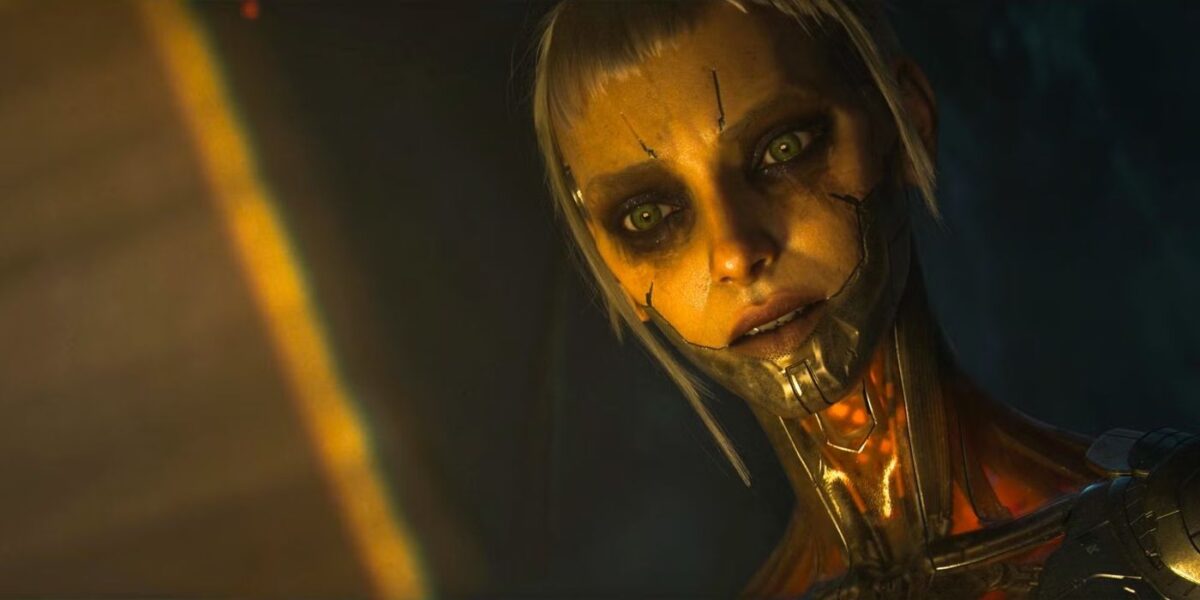
In Sterling’s original, a loner Mechanist named Spider Rose devours a visiting alien pet to survive. However, in Love, Death + Robots, it is the pet, an alien critter named Nosey, who eats its owner. Shocking, yes, but making it all the more jarring is the emotion that results from this change. Where the original short story ends with Spider Rose consuming Nosey and morphing from the experience, the episode’s reversal leaves viewers with something stranger: surrender, transformation, and a haunting kind of love.
Love, Death & Robots
Release Date
March 15, 2019
Network
Netflix
Directors
Víctor Maldonado, Alfredo Torres Martínez, Jerome Chen, Robert Valley, Rémi Kozyra, Léon Bérelle, Dominique Boidin, Alberto Mielgo, Maxime Luère, Dave Wilson, David Nicolas, Patrick Osborne, Simon Otto, Damian Nenow, Laurent Nicolas, Kevin Van Der Meiren, Vitaliy Shushko, Emily Dean, Owen Sullivan, István Zorkóczy, Javier Recio Gracia, Oliver Thomas, Jon Yeo, Elliot Dear
Fred Tatasciore
Count Dracula
‘Love, Death + Robots’ Moves Spider Rose From Predator to Prey
Netflix
In Bruce Sterling’s original tale, Spider Rose is a survivalist in the most literal sense. Hardened by war, betrayal, and isolation, she sees Nosey, an innocent alien pet, as both a companion and a resource. As food becomes scarce, she ultimately eats Nosey, taking on some of its genetic traits in the process. Although brutal, it is fitting in a universe ruled by evolutionary dominance and biomechanical competition.
In swapping the direction of consumption, the Love, Death + Robots adaptation does something drastically different: it makes the predator the prey. Nosey eats Spider Rose, and yet, it does not feel like betrayal — it feels like ascension. This single change repositions Spider Rose not as the last one standing, but as someone who chooses to give up control. Instead of seizing power through consumption, she passes it on. The episode also hints that this swap is Spider Rose’s choice. Right before her death, she gently tells Nosey that it is okay. There is a strange warmth in her surrender, an unnerving tenderness that reframes the violence into something resembling love.
When Nosey later merges aboard the Investor’s ship, apparently having gone through a transformation that makes it part-Rose, part-itself, it is clear that Spider Rose lives on in a way the short story never imagined. It also solves the mystery of Spider Rose, noting that Nosey had more DNA mutations than it needed at the beginning of the story. The change made to the narrative trades brutality for bittersweet evolution. The predator-prey dynamic becomes a story of legacy and sacrifice, flipping Sterling’s cold survivalism into something more emotionally complex.
Nosey’s Transformation in ‘Spider Rose’ Changes the Story
Netflix
In the source material, Nosey is a short-lived companion, serving as a kind of cosmic comfort animal before becoming lunch. Its role is transactional — sweet, but ultimately expendable. However, in the animated version, Nosey is more than a narrative stepping stone. It becomes the emotional anchor of the episode. By flipping the ending, the series gives Nosey agency and lets the critter evolve, not just biologically but narratively.
Related
After Scoring a Perfect 100% on Rotten Tomatoes, Sci-Fi Fans Are Sleeping on One of Netflix’s Best Shows
‘Love, Death & Robots’ is a great anthology show for sci-fi fans, and it’s streaming on Netflix right now.
Where the original short story was a study in isolated survivalism, the Love, Death + Robots episode becomes a tale of connection and transformation. Nosey’s survival is not just a twist, but can be construed as a reward for empathy. The creature’s care for Rose, defense of her against the attacking Jade, and the friendship offered give its transformation a deeper meaning. Nosey becomes a vessel for memory, with the new ending suggesting that compassion can be just as powerful a survival trait as aggression.
The New ‘Spider Rose’ Ending is Undoubtedly Dark
Netflix
Despite its narrative implications, the ending of “Spider Rose,” where Nosey eats the episode’s protagonist, is darkly twisted. The notion of a pet eating its owner is sure to leave a viewer disturbed. However, director Jennifer Yuh Nelson, speaking to TV Guide, said that despite it definitely being “a dark twist”, “the thing that happens in the original short story was just very hard to show visually and not leave people feeling, you know, really, really upset.” Moreover, Yuh Nelson explained that the ending was also meant to offer hope.
“The idea of flipping it so that Nosey is the one that actually survives was done very much because if this very short, compact, concentrated moment of bonding between these two characters is something that you buy into, the ending has to pay off on that. And personally, I think that it allows it to be dark and horrible, but also it gives you a little bit of hope, and that’s why it was switched over that way.”
Related
10 Best TV Shows on Netflix for Summer Streaming
Take a break from the sun, crank up the AC, and enjoy these super-summery shows on Netflix.
In many ways, the “Spider Rose” adaptation mirrors the evolution that happens within the story itself. Spider Rose begins the tale as a hardened Mechanist with nothing to lose. By the end, she becomes part of something much more than herself, literally and metaphorically. So too does the episode, morphing Sterling’s harsh vision into something that speaks to the modern viewer’s craving for meaning, emotion, and complexity.
This is also where Love, Death + Robots excels. The anthology is not merely about shock value or visual wizardry, but also about reimagining the strange in ways that feel deeply, sometimes uncomfortably, human.
Love, Death + Robots is streaming on Netflix right now.
Publisher: Source link




Rebecca Ferguson’s Near-Perfect Sci-Fi Thriller Is Officially a 600-Day Streaming Smash Hit
While it was the Mission: Impossible franchise that put Rebecca Ferguson on everyone's radar, it was her appearance as Rose the Hat in Doctor Sleep that cemented her as a superstar. It led to movies like Dune, Netflix's A House…
Oct 25, 2026
‘The Gentlemen’ Loses 2 Original Stars, Reunites ‘Lord of the Rings’ Icons in Big Season 3 Shake-Up
Guy Ritchie's signature blend of aristocratic elegance and gritty underworld chaos has officially solidified its place as a Netflix powerhouse. Originally launched as a television spin-off of his hit 2019 feature film, The Gentlemen captivated global audiences across its first…
Oct 24, 2026

Taylor Sheridan’s ‘Yellowstone’ Sequel Hits Major Milestone Ahead of Streaming Return
The Yellowstone universe has grown so fast since the main series ended that it’s fair to wonder whether the franchise might be stretching itself a bit thin. That’s part of why Dutton Ranch came as something of a surprise. Beth…
Oct 23, 2026
Taylor Sheridan’s 5-Part Western Sensation Returns to Streaming as New Spin-Off Battles for #1 Spot
Taylor Sheridan's seminal five-season western is officially one of the biggest shows on streaming, once again, all while its latest spin-off fights for the #1 spot on the charts. Taylor Sheridan keeps going from success to success. After his hit…
Oct 22, 2026