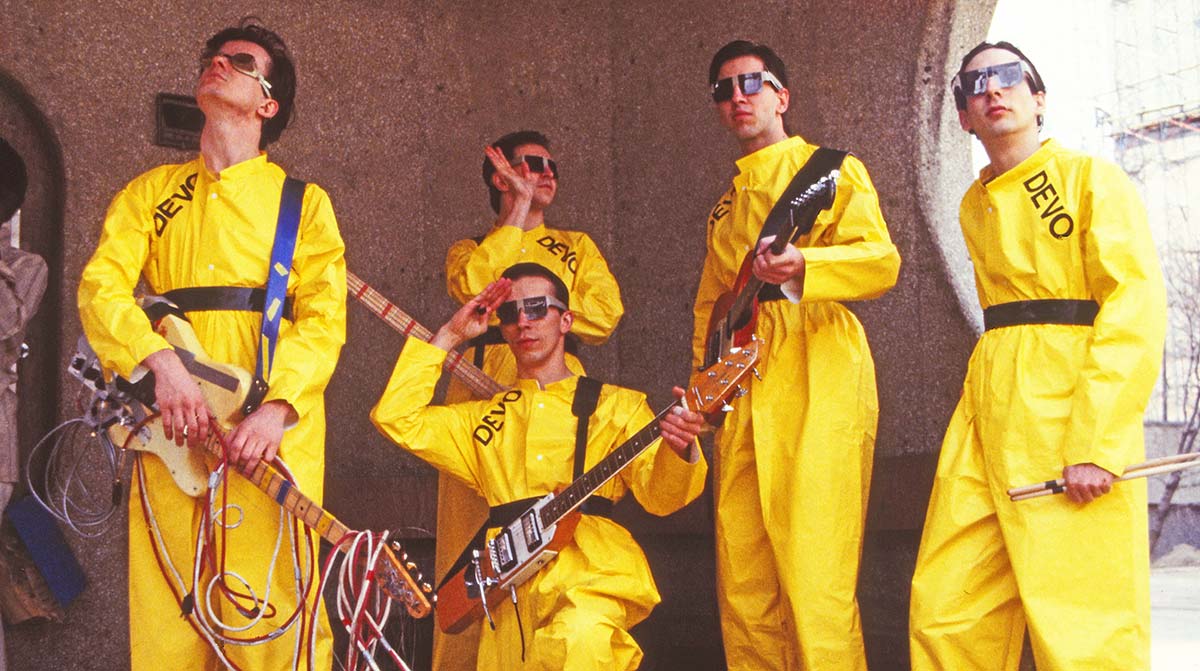
Chris Smith’s Documentary Reveals The Angry Protest At The Band’s Satiric Core
Aug 24, 2025
If a song containing a lacerating critique of Reagan-era America’s gross consumerism and mindless cowboy violence is not understood by most listeners, can the song still be called a satire? How far can a group of agit-prop commandos stealth inside corporate media without being corrupted by the system? Is the theory of De-evolution supported by peer-reviewed science? Questions like these loom in Chris Smith’s buzzy and thrilling documentary about Devo, but are not answered. The band has always been utterly serious in intent but comedic in delivery and evasive in response to critique. Meaning that easy answers are not in the cards.
Smith spotlights his thesis with a revealing, tired-sounding line from the band’s Mark Mothersbaugh: “A lot of people never got it. They heard ‘Whip It’ and went dancing.” Devo was seen as just a pop New Wave band with nerdy guys doing herky-jerk moves. But the reality was they were closer to a politically minded art collective that stumbled into the Top 40. This fascinating disconnect, along with Smith’s dense interweaving of the band’s own short films and an almost subliminal stream of other video clips that set the context for the culture that created the band, makes “Devo” more rewarding than a standard-issue music documentary.
READ MORE: Mark Mothersbaugh Credits Every Frame A Painting Video For Influencing ‘Thor: Ragnaork’ Score
Building on interviews, primarily with Mothersbaugh and Jerry Casale, Smith locates the band’s genesis not in a studio or concert venue but in the torrid anti-war protests at Kent State University in 1970, where Mothersbaugh and Casale were students. Horrified by the National Guard killing of unarmed student protestors (without that, “there would be no Devo,” Casale says), the two later refracted that fury through their concept of humanity’s “de-evolution.” A seemingly tongue-in-cheek philosophy that pulled from pop psychology, history, and the trashiest corners of pop culture (the “are we not men?” callout coming from the 1932 horror film “Island of Lost Souls”), De-evolution was akin to the Church of the SubGenius, another underground quasi-belief system which was intrinsically parodic but based on a true disgust with the bleak and ugly conformity of 1960s and ‘70s mass culture. Fans of Dadaism, Brutalism, and Andy Warhol’s mixing of pop art with music and video (ala the Velvet Underground), Mothersbaugh and Casale, along with their brothers (both named Bob), created Devo in the early 1970s as a kind of multimedia project for promoting De-evolution. Its core was a band whose clanging, jittery science-fiction sound was industrial and post-punk before those genres even existed.
Weaving in spectacular early footage of Devo’s first shows back in Ohio, Smith shows them happily alienating audiences who didn’t know what to make of these robotic weirdoes in the era of denim, sideburns, mellow harmonies, and noodly guitar solos. One show at an Akron bar called the Crypt, right by the Firestone plant, nearly led to the band getting pummeled. After being inspired a couple of years later by the Ramones’ first album to speed up their music and start playing CBGB in New York, Devo actually did get into it with the Dead Boys. This showed Devo could annoy even punks, whose music they appreciated for its sonic velocity but looked down on as “simple” and “anti-intellectual.”
Support independent movie journalism to keep it alive. Sign up for The Playlist Newsletter. All the content you want and, oh, right, it’s free.
Like many music documentaries about bands that came into their own during the mid-to-late 1970s, ‘Devo’ is at its zenith when showing its subjects in that fertile New York milieu. Briefly the toast of the underground, Devo gained fans like David Bowie, later connecting them with Brian Eno, who would produce their first proper album. Playing at an epicenter of cool like Max’s Kansas City led to moments like the one related to Smith by Mothersbaugh where after playing “Uncontrollable Urge” there (the staticky footage of which is electrifying), John Lennon walked up, shouted the song’s chorus of a dozen or so increasingly loud “Yeahs” in Mothersbaugh’s face, and then left.
Deciding to storm the citadel of mainstream culture so as to project their message from the inside, Devo signed with Warner Bros. in 1978 and weirded out the Saturday Night Live audience with their factory jumpsuit uniforms and metronomic, yowling take on “(I Can’t Get No) Satisfaction.” Well-positioned for the start of MTV since they had been making short art films of their music for years, Devo provided plenty of content for the fledgling network.
But even though the early 1980s were technically a successful time for the band, “Devo” does not present it as some pinnacle. Their interviews from this time are deadpan and cheekily hostile, the band refusing to spoon-feed the meaning of their songs. Given the mood of the country, what Casale describes as their antagonism towards “Western Christian society” and the reactionary milieu of their Midwest upbringing, spelling it all out would not have gone over well. The film suggests that after a few years inside the machine, Devo might have infiltrated mass culture as much as they ever could. Their time was always going to be limited, given the label’s demands for new radio hits and the band’s preference for playing along but only up to a point; per Mothersbaugh, “Trying to do another ‘Whip It’ was fake.”
Kept to a tight and packed running time, the film spends little time on the years after Warner Bros. bought out their contract in 1984, briefly noting Mothersbaugh’s soundtrack work. Smith brings a tone of melancholy to the closing stretches of “Devo,” acknowledging in some way that all revolutions fade and mass cultural subversion will only ever work up to a point. But there is also a lack of sentimentality or resume-burning here, which feels of a piece with the band’s spiky posture and protest mentality. [B+]
Publisher: Source link






‘Reacher’s Action Thriller Spin-Off Gets Major Season 2 Update Following Premiere
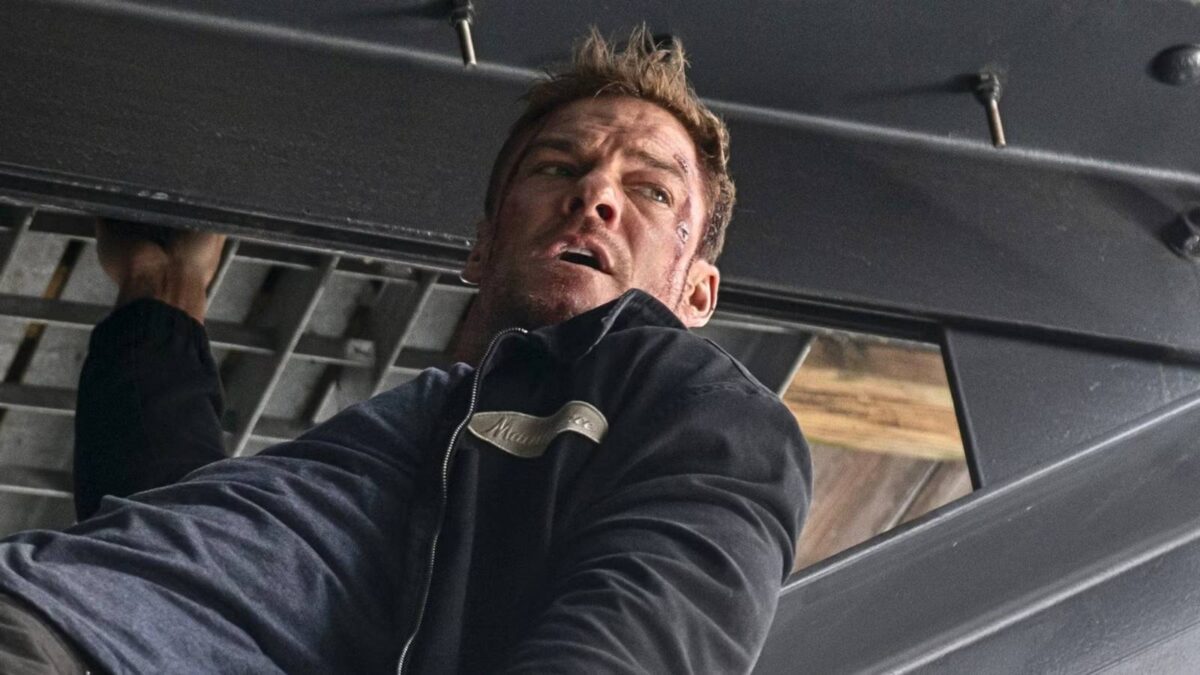
For four seasons, Reacher has been one of the biggest TV shows on Prime Video. Based on the novels by Lee Child, the series follows former military police officer Jack Reacher (Alan Ritchson) as he wanders from place to place,…
Sep 18, 2026

One of CBS’ Longest-Running & Highest Rated TV Shows Is Coming To End After 30 Years
Along with countless scripted dramas, comedies, and action shows, CBS is well known for its impressive run of unscripted programs over the last 50 years. More recent years have included major competition shows like Survivor and The Amazing Race, along…
Sep 17, 2026

Prime Video Officially Launches New Deal That Changes the Streaming Game Forever
It seems like streamers raise their prices every day. At the end of August, Apple TV raised the subscription service price by $2, bringing it to $14.99 a month. Netflix, Disney+, HBO Max, Paramount+, and Peacock have all raised prices…
Sep 16, 2026
Netflix’s 10/10 Thriller Series Returns After 3 Year Absence With Explosive New Trailer
Over the last five years, Netflix has expanded heavily into non-English content, with international series taking an even bigger focus for the streaming giant. One of the biggest driving forces in that effort is the French thriller series Lupin, led…
Sep 15, 2026