Endgames: Alejo Moguillansky on Pin de Fartie
Oct 9, 2025
Pin de Fartie
Pin de Fartie (2025), directed by independent Argentinian collective El Pampero Cine member Alejo Moguillansky, is less an adaptation of Samuel Beckett’s one-act play Fin de Partie (1957) than a centrifugal expansion unfolding into multiple nested narratives riffing on the play’s themes: death, departure and the approach of an ending. Marking a tonal shift from Moguillansky’s ensemble comedies, Pin de Fartie possesses a sense of wistful tragedy. The title refers to the end of a chess game; here, it signals the twilight of relationships––both filial and romantic––against the current approach of the end of civilization.
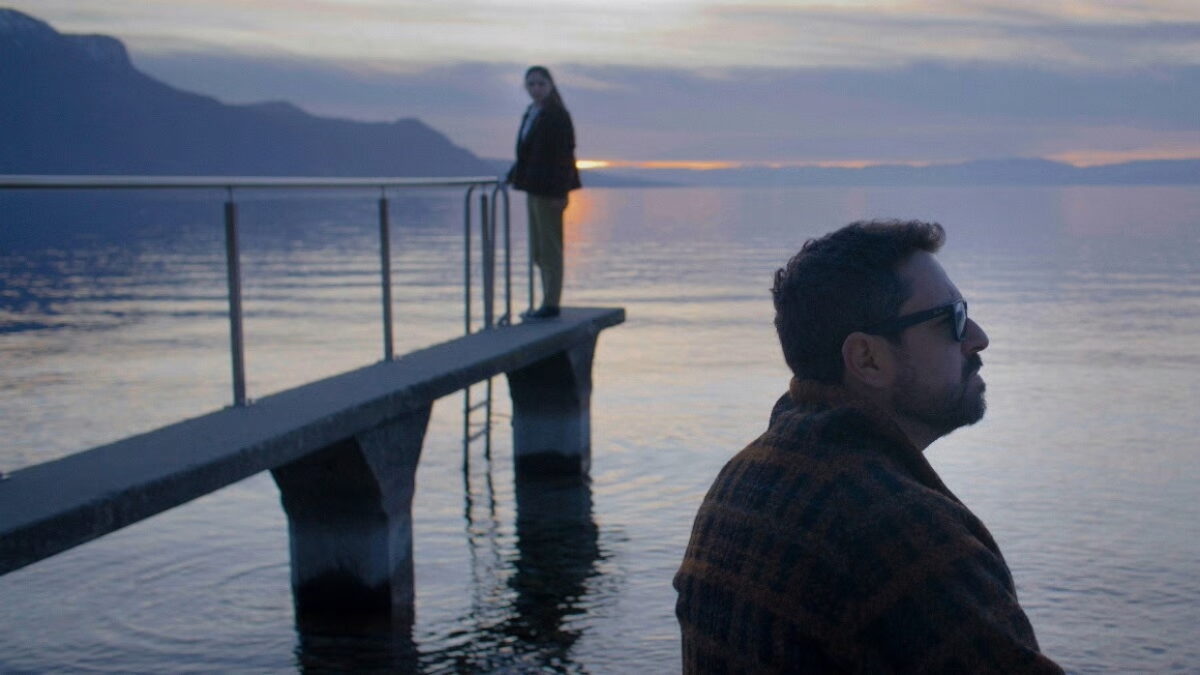
Each sequence of Pin de Fartie is composed of a pair who re-enact the original one-set play’s Hamm and Clov master-slave dynamic. On the shores of Lake Léman in Switzerland, a blind father (Santiago Gobernori) and his daughter (Cleo Moguillansky) embody their resentful, uneven dependence. In Buenos Aires, Laura Paredes and Marcos Ferrante are theater actors rehearsing the play in an apartment across from the Plaza del Congreso, where Beckett slowly becomes an intermediary for their growing affection. In another apartment in the Argentinian capital, a blind pianist (Margarita Fernandez) who repeatedly plays Beethoven’s Moonlight Sonata has her son (played by Alejo Moguillansky himself) read the text to her only for him to recognize their uncannily similar dynamics.
These iterations are framed by two narrators––Luciana Acuña and composer Maxi Prietto––who sing ballads and voice the characters’ inner anxieties in the manner of a Greek chorus, exerting an omniscient authority over their subjects as they follow their preordained script. At times, the camera turns to the cinematographers––Inés Duacastella and Ana Roy—as they construct props or record foley, folding the production itself into the film’s composition. Every character is caught within these structures of power: each Clov struggles to summon the will to depart, and every character is defined contrapuntally against another. Yet, even in the end, after all has been said and acted out, Moguillansky gestures to the impossibility of departure. The film itself is not an endgame but endgame after endgame after endgame, an ouroboric cycle that leaves us on a purgatorial plateau waiting for Beethoven’s sonata to return once more.
Moguillansky’s debut feature Castro (2009) is based off of Beckett’s novel Murphy (1938), while many subsequent works use literary or musical counterparts including Edgar Allen Poe, Schubert and Hans Christian Andersen as a jumping-off point to craft free-wheeling, unwieldy adaptations that experiment with temporal disjunctions, repetition and stretch out these literary metafictional worlds. This method is emblematic of El Pampero Cine’s reimagination of how cinema can be made on the international film scene. Working without external funding, El Pampero Cine embodies an anarchic break-away from cinematic conventions, filming everything with a small crew while embracing mystery and serendipitous encounters along the way, leaving their narrative open to alternate paths. For Pin de Fartie, Moguillansky began shooting with only his daughter Cleo, his partner Luciana Acuña, Santiago Gobernori and his Swiss cinematographer, Tebbe Schöning.
The day after the NYFF premiere of Pin de Fartie, I sat down with Alejo Moguillansky to speak about his interest in Beckett, and making a film structured around departures.
Filmmaker: Why did you want to make an adaptation of Beckett’s Endgame?
Moguillansky: Beckett is always present; he is part of the affective landscape of our times. Pin de Fartie is not an adaptation so much as an anagram––a kind of game, a play of variations that slowly crawls towards an ending. Perhaps the play itself functions more as a vehicle for the film, just like the detective in a film noir. At the same time, it’s impossible not to recognize the resonance of the work today in a social and political climate where everything feels positioned on the edge of collapse.
When we began shooting in Switzerland, we had no clear plan. The process was loose, even reckless. I was teaching at ÉCAL (the University of Art and Design) at the time and living on the shores of Lake Léman with my partner Luciana [Acuña] and daughter Cleo. We brought in our cinematographer Tebbe Schöning from Germany and Santiago Gobernori, who was working on a project with Luciana. We began working with fragments of Beckett’s texts simply as a way of going elsewhere, which is how the film began.
Filmmaker: Why did you set the work in the locations you did? Beckett’s play is set indoors, whereas here, the landscape plays a big part of the film––particularly Lake Léman in Switzerland and the Congress in Buenos Aires.
Moguillansky: To film by a lake requires one to take on a painterly attitude I always begin with light before anything else, never from narration. I start from the most material of things: an actress, an actor, light and a point of departure for the shot.
At Lake Léman, cinephilic associations were everywhere. Godard lived in Rolle—we lived there too. He filmed by the lake. Chaplin is buried in the Cimetière-sur-Vevey, above the lake. My generation belongs to, and is inspired by, Godard’s cinema. We have also inherited the responsibility of sustaining his attitude of resuscitating cinema, especially at a time when the death of cinema feels so near. I arrived in Switzerland on the very day Javier Milei was sworn in as president of Argentina, and I couldn’t help but feel that something had ended. Since taking office, his government has cut all state funding to the National Institute of Cinema and Audiovisual Arts (INCAA). The film grapples with this sense of finality, this atmosphere of crisis.
In Switzerland, you can see the limits of the water, and I found myself asking: what is the idea of homeland here? Who are the Swiss? I thought about what it means to construct a montage of the Swiss lake with the nighttime image of the Congress in Plaza Congreso, Buenos Aires, and this idea of these nations. The Plaza Congreso is in the same square as the Cine Gomón, which is the National Cinema Theater belonging to Instituto del Cine. Almost all the scenes in Argentina are filmed at nighttime. Usually, in the daylight, there’s lots of protests and militarised policemen milling around. But at night, the square is more melancholic: you can see the homeless people resting and people ambling home. Perhaps it’s best to shoot a country like Argentina at night.
Filmmaker: The various doubles are structured by an overarching narrator-double, Luciana Acuña and composer Maxi Prietto. Can you talk a bit about the construction of the structure of the film and how it’s joined by the voiceover and performance of the narrators?
Moguillansky: Everyone and everything is treated as a character: the narrators, the physical copy of Beckett’s play, Beethoven, the constructed artificial paper moon. The playful spirit of the work comes from animating these external elements to make them as present as the characters of the fictional world. In the end, what lingers with the audience is not the storyline but the composition of the work: the layering of voices, music, images and text. We wanted the audience to see how the film was made, to lay bare our cards, so to speak.
Filmmaker: That’s why you also included the shots of the crew creating the foley?
Moguillansky: Exactly. We started shooting without a script and Mariano [Llinás] and I wrote the Greek chorus script during the editing process. It doesn’t pretend to be a part of this same film world. It was a source of great fun. I wrote the lyrics, many together with Mariano, and Maxi Prietto composed some of the songs. Maxi wrote the track “Viene Arrastrándose”—heard during the traveling shots that follow Cleo and Santiago strolling along Lake Léman––with the line “viene arrastrándose” [it comes crawling]. I love that song.
Margarita [Fernandez], the pianist, wrote her own narration, mostly based on her real life. The fact that she saw Bresson in 1951 was true. She’s a Bresson addict. She was also the one who proposed Beethoven’s Moonlight Sonata as the central refrain of the film. It carries the dual weight of a funeral march and a serenade, which reflects the film’s themes: the sense of an ending, but also the feeling of resting on a plateau, where everything exists in a horizontal expanse. There’s something so sublime about filming her hands on the piano; you can see the memory playing out.
Filmmaker: Your daughter Cleo plays a prominent role in this work. In a way, you form another Clov-Hamm double as both director-actor and father-daughter. What was it like working with her in this capacity?
Moguillansky: She’s the daughter of a filmmaker and a dancer. If I had been a shoemaker, she would have known how to make shoes. She grew up acting in some of my films, and by now she knows how to act, how to record sound. She could easily make her own film. We started this project with just five people—three of us are family—so it felt entirely natural.
Still, I wonder whether she will want to continue acting as she grows older. She is 14 now. She is a good actor, especially here, where the work requires a certain kind of depersonalisation. But, will she go on acting with us? In a way, I was filming the end of her childhood, which was devastating for me but also profoundly moving. My personal sentiment of melancholy is folded into a work centred around departures.
Filmmaker: Of course, the film is about goodbyes, but also the impossibility of saying goodbye, which perhaps makes it as romantic as it is tragic.
Moguillansky: All the characters are the same character, enacting the same departure. One character, all the characters. One memory, all the memories. That’s where the tragedy lies. And yet, they cannot say goodbye. We don’t know how to say goodbye. I don’t know how to say goodbye. When someone is in their final days, you visit them with the intention of saying farewell, but in truth, you are always saying “until tomorrow.”
Luis Biasotto––a genius who co-founded Grupo Krapp with Luciana and one of our dear friends––appeared in my film The Middle Ages (2022) during the pandemic. He died a few months later. We recorded his final performance, and that created a magical, mystical situation. Cinema is always recording people who, inevitably, will no longer exist. That is its tragic reality. In this sense, the painterly attitude of cinema becomes not only an aesthetic choice, but also a moral responsibility.
Filmmaker: There’s direct references to the text with your annotations in pencil. How did you consider framing the tension between theatre, text, music and cinema? This is not the first time you’ve taken a literary text and re-considered it. Of course, with Little Match Girl (2017), there is also music and opera as another added dimension.
Moguillansky: How do you make a film about literature without being too literal or theatrical? It’s not by pushing cinema to mimic another language, but by creating a true montage between these forms and holding their tension. In that sense, I always return to André Bazin’s essay on Jean Renoir’s idea of filming theater. You must create distance from the stage to frame the entire theater in order to film it. Cinema must move elsewhere, too. When I filmed the pages of the Fin de Partie text with our pencilled annotations, we were mimicking the motions of a camera pan, exposing the relationship between word and image. It is, once again, about showing our cards. If you set out to make a film about music, theatre or literature, perhaps you must ultimately make a film about cinema —because you are compelled to think about the materiality of the image.
Filmmaker: In a Senses of Cinema interview, you said: “My filmmaking style is characterized by its fluidity and openness to variation, development and repetition.” I’m really interested in how repetition through your work facilitates movement.
Moguillansky: Repetitions are variations; each repetition is shaped ever so differently. In the love sequence between Marcos Ferrante and Laura Paredes––who are both actors––the act of rehearsing, of transporting themselves to fiction together, becomes a magical moment. It’s a little miracle that we can see and shoot. It’s so touching to witness the birth of these little miracles, where we see the slippages between the real and the performed, between documentary and fiction. In real life, you are always performing for someone. When you are an actor in a rehearsal, you are acting for the other person. That creates a very strange and romantic situation: when two people go somewhere else together through fiction, through their bodies, that’s a journey that can be thought of as a love story.
Publisher: Source link


Netflix’s 10/10 Thriller Series Returns After 3 Year Absence With Explosive New Trailer
Over the last five years, Netflix has expanded heavily into non-English content, with international series taking an even bigger focus for the streaming giant. One of the biggest driving forces in that effort is the French thriller series Lupin, led…
Sep 15, 2026
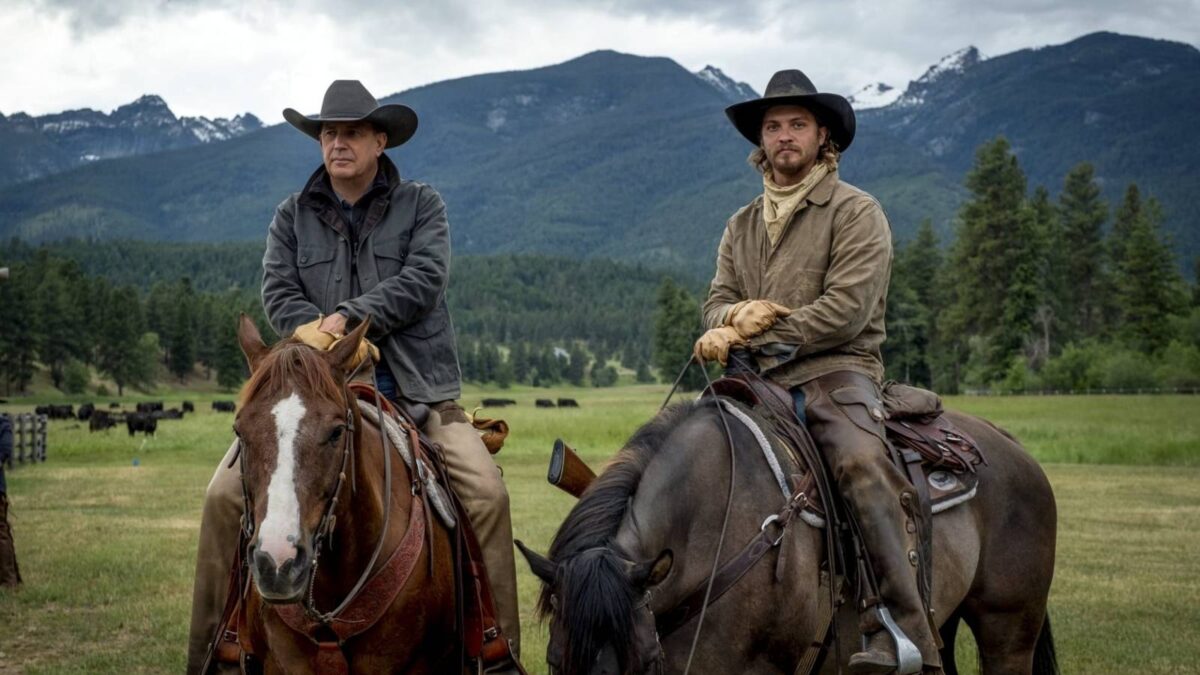
Original ‘Yellowstone’ Dutton Favorite Officially Confirms ‘Marshals’ Return Interest
Yellowstone jump-started a generation-spanning story that has so far spawned four spin-offs that are all interconnected by the Dutton bloodline. While creator Taylor Sheridan has since branched outside that saga with Tulsa King, Landman, Mayor of Kingstown, The Madison, and…
Sep 14, 2026
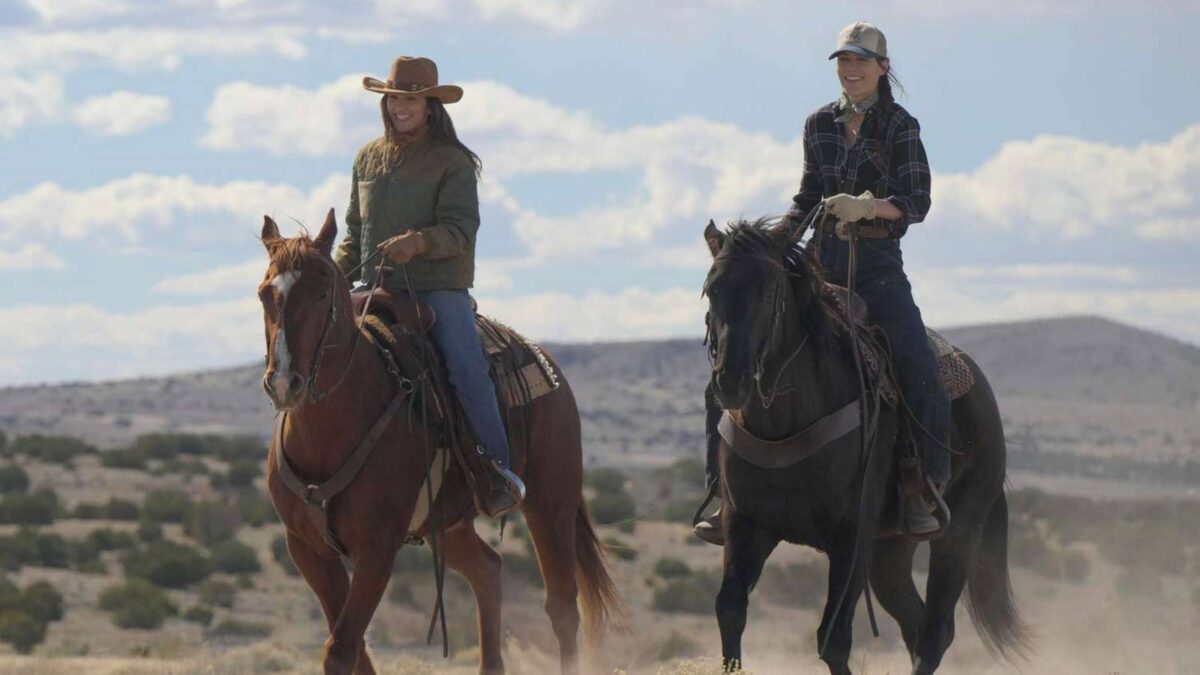
Netflix Officially Cancels Its 2-Part Taylor Sheridan Replacement Western
Netflix Published Sep 12, 2026, 10:30 AM EDT Omar is an experienced editor and writer who sees life and storytelling as one and the same — there’s always a story to tell. He’s helped shape features, headlines, and coverage across movies,…
Sep 13, 2026
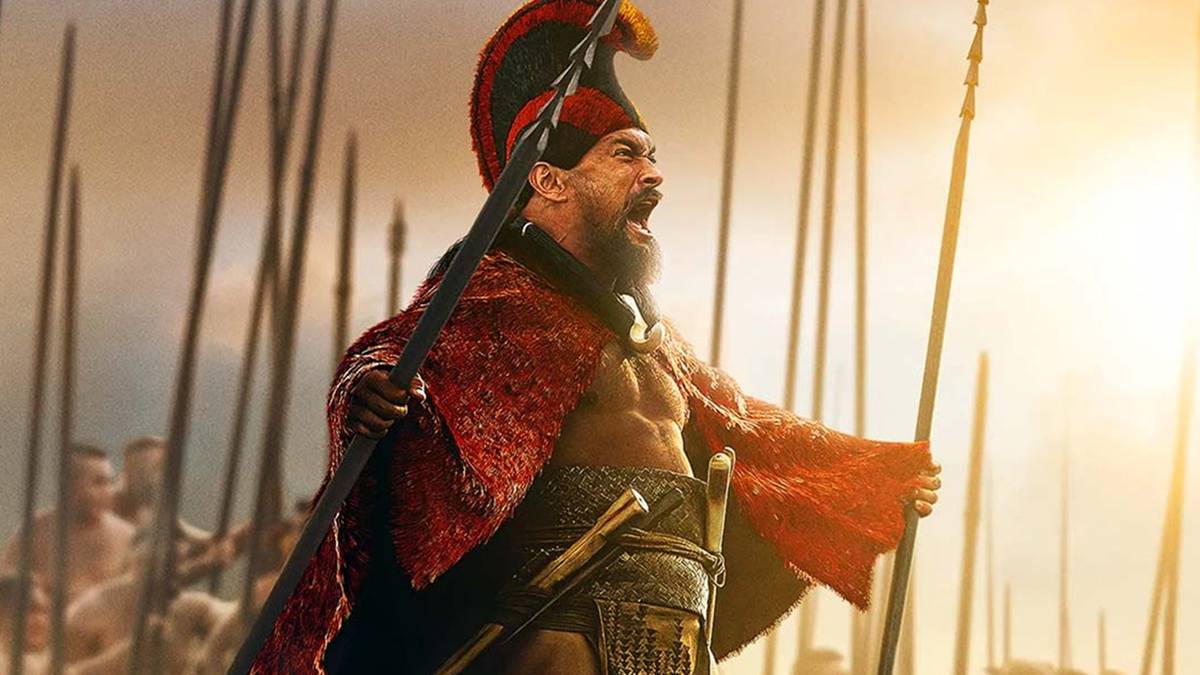
Jason Momoa’s Epic Historical Action Thriller Officially Getting New Release
Apple TV has established itself as a rising force in streaming entertainment. From Silo and Dark Matter to Pluribus and Ted Lasso, there is something for everyone, and not only that, but a ton of huge star power at the…
Sep 12, 2026