Interview: Harris Dickinson on Urchin
Oct 15, 2025
Harris Dickinson in Urchin
Harris Dickinson’s characters are demarcated by specific class consciousnesses: Coney Island’s Frankie in Beach Rats, who cruises for older men on a webcam site; a particular brand of selfishness and vulnerability as a model and influencer in Triangle of Sadness; most recently, a supremely confident intern who casts a domineering spell over a tech CEO in Babygirl. Urchin, the film Dickinson chose as his feature directorial debut vehicle (he’s directed shorts before, as early as 2013), stars Frank Dillane (Fear the Walking Dead) as a homeless addict trying to rehabilitate after his latest stint in jail. I spoke to Dickinson via Zoom on the eve of the film’s limited theatrical release in the US last week, during which he recalled having a near panic attack before the Cannes premiere this past May but was soon soothed after he saw the first few minutes play out and heard a few laughs. A thoughtful and engaging conversationalist, great listener and yes, very handsome, Dickinson is also a keen lover of cinema and has a lot to say about class consciousness and telling stories that dignify human weakness. Urchin expands into wide theatrical release starting October 17.
Filmmaker: I saw that you curated a screening series for the Roxy Cinema in New York. Usually, filmmakers are invited to be a festival’s guest artistic director—for example, Guillermo Del Toro at AFI Fest later this month—so it’s great to see your standalone series. Were you always interested in curation, and do you think filmmakers might try curating either as a part of their preparation or more generally pursue it?
Dickinson: I probably shouldn’t be curating. I was fortunate enough that they asked me to do it when I was at Cannes. I jumped at the opportunity, because it felt like an extension of what we were doing in prep, which was showing the cast and crew films that meant something to me and to Urchin. The films we showed were always about, how do we show essences of each of them to relate to certain things we’re trying to do without being like, “This is the film we want to make”? It was showing certain films for a feeling and then a discussion—raising the bar for cinema in general, for what we were doing everyday and trying to encourage everyone as a collective to just aim high. I think everyone probably has a little potential for curation in them.
Filmmaker: To have Varda (Vagabond) and Tarkovsky (Andrei Rublev) in any program, irrespective of whether it’s connected to your film or not, is wonderful. Could you pick any one of those films—the other two are Nil by Mouth by Gary Oldman and Manila in the Claws of Light by Lino Brocka—and talk about how that film influenced you earlier in your life?
Dickinson: Nil by Mouth, for me, ignited a sense of aggression with that kind of genre. There’s a real propulsion to that film. It’s a very brutal and harsh look at someone going through cyclical behavior and the consequence of that [for] the people around him, and shot in a very stylish, considered, at times very elegant way. It was by one of my acting heroes as well, Gary Oldman, and that obviously was his first film [as a director]. So, that inspired me in many ways, but the poetry and beauty in Vagabond is equally important. It still remains beautiful, despite having very severe themes, which is something that we spoke about a lot for Urchin.
Filmmaker: Speaking of Varda, the film of hers that I was reminded of is The Gleaners and I, especially the segment in Urchin with Andrea and Mike as modern-day gleaners. Urchin is timely because of the unhoused crisis across the world. How do you think about working class consciousness or even homelessness as themes? What I got out of Urchin was these folks are kind of beyond class and outside society, in a certain way.
Dickinson: 100%. It doesn’t [have] to do with class, actually. It’s circumstantial. The only relation to class is that, of course, stability [and] support networks make a great deal of difference. But you also have to realize [that] even someone in a middle-class situation could have exhausted their support networks. There’s a lot of times where behavior pushes someone to the brink so far that even people with a family that care about them will not [be] support[ed by] them anymore. Homelessness is obviously a huge theme of the film, but it’s not the whole film; to me, it’s more about cyclical behavior, and that really does translate to many different patterns within us. No matter how complex and advanced we claim to be as a species, we’re also incredibly rudimentary in our design, psyche and neural pathways. We fall back into things; we hold trauma, fail and fall relatively easily in the grand scheme of things. It takes a great deal of strength and courage and discipline to battle with yourself in that way. So to me, it was more about trying to present all of those themes, questions and challenges to an audience.
Filmmaker: With regard to the self-help tape that Mike [Frank Dillane’s character] listens to, Urchin might be a distant cousin of American Beauty, because of the self-help tape that Annette Bening aggressively listens to. Is American Beauty a comp for Urchin?
Dickinson: American Beauty was one of the first early films I remember. I watched it quite young and loved it, and it affected me deeper than I could have known. It wasn’t a reference, but it’s impossible to now say that it was not because of how deep film can run through your experience. The self-help stuff came more from my own experience and the pseudo-spiritual, pseudo-scientific idea around self-help and various forms of therapy. I did a form of RTT therapy [Rapid Transformational Therapy]. I thought it was going to be quite helpful, and actually it was really destabilizing. It made me quite unsteady. It made me access things that I wasn’t ready to access, or wasn’t ready to unravel. I think for Mike, that does exactly the same thing. It becomes his friend. It embraces him. It gently invites him to go deep into himself, and then when he does that, he realizes that the boxes that he’s about to open are deeply troubling. A lot of people have gone through that.
Filmmaker: One of the most memorable early scenes is the shower-leading-into-underground scene. You see the suds go into the drain, then you go through this underground which is beautifully absurd, where I think I caught some sea-urchin-like organisms floating around, leading to that bright red circle. How specific of an idea did you have, visually, for that little sequence, and how did you work with your VFX team to achieve it?
Dickinson: I had references from various sources. There’s a lot of incredible deep sea organisms and creatures that are barely explored that we referenced, some microscopic stuff that we used. Another part of it was just imagining what it is to go below the surface of reality, right? Go deep underground, and at the core of the earth there is a universe existing. It’s not space, it’s not lava, it’s not earth, it’s something altogether different. Then we worked with incredible artists that would draw and fabricate different shapes and creatures. That was a really, really hard part of the process. We had a very small budget, and we had to push extremely hard and work tirelessly to try and get that right. I was naive because I didn’t quite fully understand the elaborate nature of VFX sequences, so that was a learning curve.
Filmmaker: I was also very curious about casting. I love films which use non-actors in interesting ways. For example, Payal Kapadia’s All We Imagine As Light opens with a documentary scene of workers in Mumbai. One of those is a fictional character, and then we go into the fictional film. In Urchin, there’s something similar in the second or third scene. You show a series of quick cuts of a bunch of small conversations among non-actors, and Dillane is in one of them. Could you talk about how deliberate and intentional were you in casting those non-actors for those scenes, and how did you write the dialogue in those situations?
Dickinson: I spent a couple years working with people in the community and building trust, trying to sign people up to my film early on not knowing exactly what role they would have. There were certain roles [for which] I would just go up to people outside the pub and be like, “Do you want to be in my film?” I never wanted to pluck someone from the street and put them in front of the camera in a way that felt exploitative or unaware, so we were always conscious of that. We worked with a lot of theater companies that have lived experience with homelessness. So, it was a mixture of people that I’ve worked with in the volunteering community and people in East London that know me; it felt like a little family that I built over a couple of years. When you try and tap into something very truthful, you can build the tapestry of it very easily with real moments, because they are just talking amongst themselves. You just keep quite far away. You go in, give prompts, make sure they’re miked, make sure they’re heard well, then leave them to it. Then you go back in, give some thoughts and let them go. Then you just pick moments from long takes.
Filmmaker: I read that you weren’t planning to be acting in your film, but an actor dropped out. How did you and costume designer costume the character you play, Nathan, in the scenes that you’re in? I was curious about the blue trousers that Dillane’s character refers to you by, but also the really interesting scene in Mary’s house where you’re feeding the mouse to the snake, where I couldn’t tell exactly what you were wearing. And, of course, the particular dress you had in the final scene, which I won’t spoil right away.
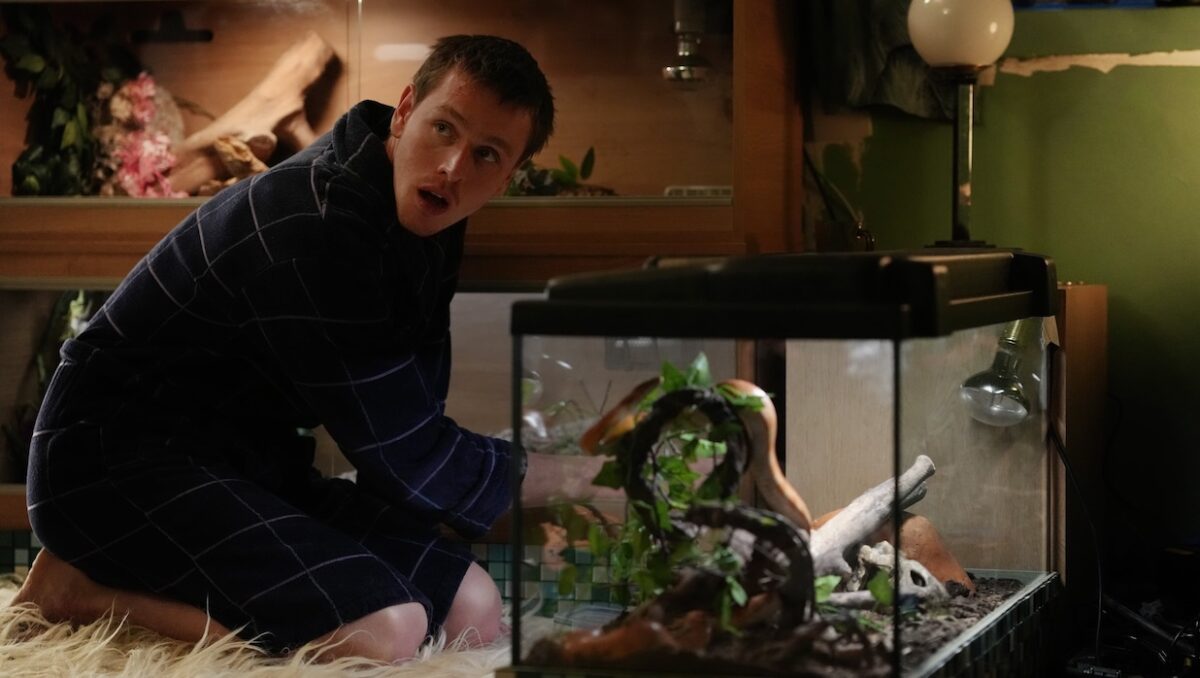
Dickinson: When I wrote the script, certain scenes that I wrote Nathan to be wearing no clothes. Then, when I came to playing the role, I decided that that didn’t feel appropriate, so I gave him more clothes. The scene at Mary’s, he was originally supposed to be wearing Y-fronts, and it was to suggest the intimacy of their relationship and that they were living in a very loving and comfortable way. He was safe and at home. The dressing gown became more interesting, not only for my own dignity, but also for Nathan, because it suggests something quite old-man-y about him in that scenario. He’s with a much older woman and settling into that dynamic quite well. There’s an element of that relationship that really is unsettling to Mike. The robe situation came from a lot of imagery around the Druid community. Pagan, Celtic clothing popped up a lot. The film’s more surreal moments and fable-like storytelling comes from my interest in folklore and the Pagan tradition. To me, it just made sense to try and pull it away from anything too specifically institutionally religious, and the robe was something that represented purity and neutrality.
Filmmaker: [Spoilers Begin] In that last scene, what struck me was the suddenness and the way in which you shove Mike into the abyss. It is like a particular turn that you do, and there’s this sound design element as well. I just wasn’t expecting it and it jolted me, so I was curious how you and he collaborated on that on set.
Dickinson: I always knew that needed to be aggressive and sudden, quick and smooth. I wanted it to be very efficient, like one quick movement and you’re out. Bang, bang! [Dickinson mimics the movement with his hand and thumbs] Like a beat and he’s gone. It needed to be that, for the reasons, you say: the shock factor, and also just efficiency.
Filmmaker: Did you have multiple takes on that in which you varied your performance?
Dickinson: I always stayed very neutral in my performance. For Frank, we tried different things, where he shouted out and did a bigger thing. It was hard because when we shot the profile shot of when he actually falls, once he’s pushed, there’s a profile shot, a wide and he falls out in 60 frames. It’s like slow motion, and we tried that in different ways. We tried it where he fell and jumped up and we tried it where he just fell. It was just about getting the right physical feeling. [Spoilers End]
Filmmaker: Speaking of framing choices, in one of the film’s last scenes, in the convenience store, where Frank has that outburst, I found his dialog there about people always closing the door, about no one letting him in, to be quite poignant.
Dickinson: [enacting the dialog] “Every day I wake up to this, someone telling me, ‘No, no, no, you can’t come in, not for you, not for you, not today.’”
Filmmaker: Yes! I think it is the first time we actually hear him speak up about how he feels about other people treating him. That shot, I think it’s a wide. You don’t use coverage, and both the store owner and Frank are in the frame.
Dickinson: Josée Deshaies, who shot the film, she and I always spoke about economy of shots and how we make the most interesting frame. I think we were both more intrigued with creating a story within one frame and figuring out how to make choreography the interesting element, and not rely too much on traditional coverage. There are times when it’s called for, then there are times where you can convey it on a wide. Sometimes it’s dictated by the scene, sometimes you don’t know until you’re doing it, sometimes you go in close and get it but know it’s not going to work. I think that was one of the scenes where we did shoot a close up on Frank, and we went to it a few times. But ultimately, the shot played out much better [if] he was separated. There was a man behind the desk, the desk, him—it was kind of a display of everything that he’s been going through. Then there were sections within the shop as well, aisles, that drew us to him. Then, as he became more aggressive and fell, it was an easier and more interesting way to show that physicality as well. That conveyed so much more than being on a close-up.
Filmmaker: How did you decide how many last straws you want to give Mike as a character? When we meet Frank in the beginning of the film, it appears to be at a random moment in his life. We learn he’s already been on the street for many years. He’s probably been in jail once before as well. Then towards the end, in the convenience store, when he’s lying unconscious and whatever happens afterwards, also could be a random moment. Between those, he goes through one obstacle after the other.
Dickinson: In pursuit of conveying the cyclical nature of so many people going through this kind of journey, we had to test people’s tolerance of [Mike] as well. We had to test the audience’s own morality. The reality of it is that people often have to go round and round multiple times before they can ultimately make progress. Sometimes they don’t, sometimes they do. In each section of the film, I wanted to present some sense of hope. On release from prison, I wanted to offer some sense of potential for change and optimism in each new relationship he makes. In the hotel, with the chef, with the girls, people embrace him and non-judgmentally take him in. Same with Andrea and her friends. They’re people that are potentially more in line with the way he could live, a sort of more habitual, socially acceptable version of hedonism. I think that was what was interesting to me. Perhaps these moments are where this guy is going to find a new way, and he’ll be okay. He can do this with people and partake, but it won’t ruin him. And the sad truth is that for a lot of people, it’s all or nothing.
Publisher: Source link



Netflix’s 10/10 Thriller Series Returns After 3 Year Absence With Explosive New Trailer
Over the last five years, Netflix has expanded heavily into non-English content, with international series taking an even bigger focus for the streaming giant. One of the biggest driving forces in that effort is the French thriller series Lupin, led…
Sep 15, 2026
Original ‘Yellowstone’ Dutton Favorite Officially Confirms ‘Marshals’ Return Interest
Yellowstone jump-started a generation-spanning story that has so far spawned four spin-offs that are all interconnected by the Dutton bloodline. While creator Taylor Sheridan has since branched outside that saga with Tulsa King, Landman, Mayor of Kingstown, The Madison, and…
Sep 14, 2026
Netflix Officially Cancels Its 2-Part Taylor Sheridan Replacement Western
Netflix Published Sep 12, 2026, 10:30 AM EDT Omar is an experienced editor and writer who sees life and storytelling as one and the same — there’s always a story to tell. He’s helped shape features, headlines, and coverage across movies,…
Sep 13, 2026
Jason Momoa’s Epic Historical Action Thriller Officially Getting New Release
Apple TV has established itself as a rising force in streaming entertainment. From Silo and Dark Matter to Pluribus and Ted Lasso, there is something for everyone, and not only that, but a ton of huge star power at the…
Sep 12, 2026