Elizabeth Lo on Her China Infidelity Doc, “Mistress Dispeller”Filmmaker Magazine
Oct 21, 2025
Mistress Dispeller
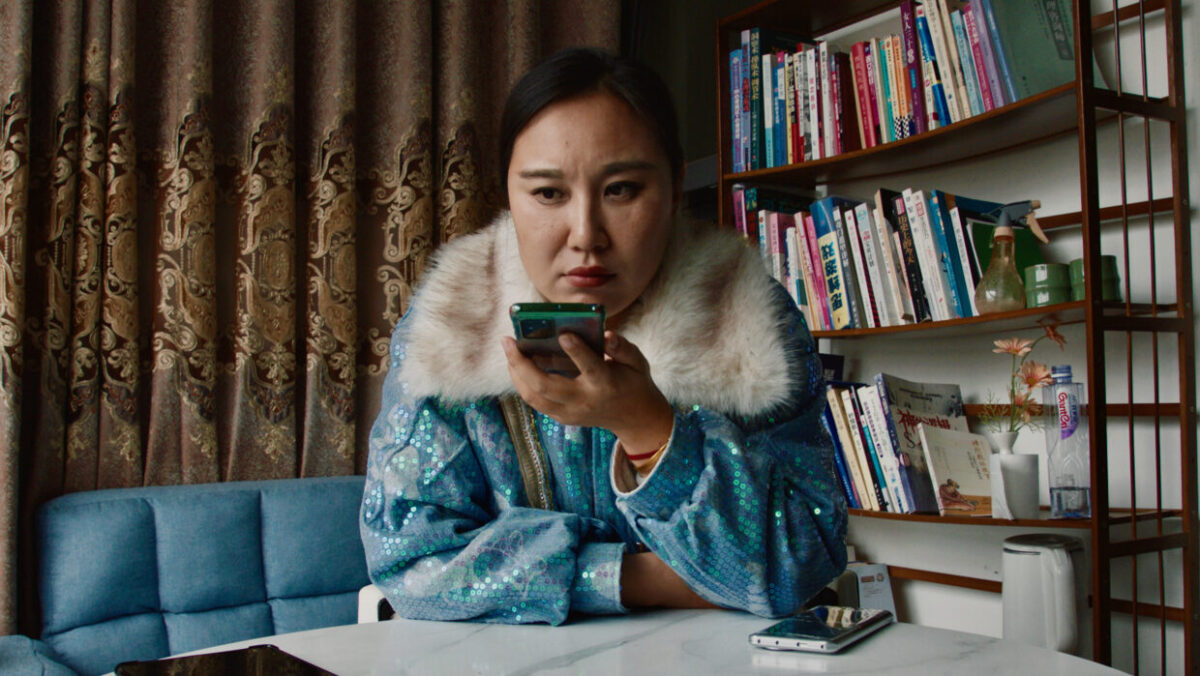
Perhaps one of the strangest and most captivating docs of the year, Elizabeth Lo’s Mistress Dispeller centers on a middle-aged wife and husband, the latter of whom is having an affair that the former is desperate to end. Enter Wang Zhenxi, one of a growing number of China’s professional “mistress dispellers.” For a fee, Teacher Wang will orchestrate scenarios that allow her to get to know the man and his mistress in order to discern how she can best manipulate a breakup – one in which all parties hopefully emerge for the better. A series of staged deceptions that add up to a real-life emotional journey.
A few weeks prior to the doc’s Oscilloscope release (October 22nd in NYC, October 24th in LA), Filmmaker reached out to the Hong Kong director-producer-DP (and “25 New Faces” 2015 alum) to learn all about crafting a film in which some level of subterfuge was necessary on both sides of the lens.
Filmmaker: So why did you choose to focus on “mistress dispelling” as a subject for a film? How did you even learn about this aspect of China’s “love industry”?
Lo: Making Stray – my first feature doc told from the perspective of stray dogs as they wandered through the city of Istanbul – was a revelatory experience because it exposed me to a culture completely foreign to my own. Spending months immersing myself in Turkish culture challenged and deepened my understanding of interspecies urban life, and I loved that widening of my worldview. For my next project I knew that I wanted to set it in mainland China – so I could spend time and get to know a country that was both unknown to me but close to my roots.
During my research I rewatched Zhang Yimou’s Raise the Red Lantern. That film, set in 1920s China, follows a young woman who becomes the fourth wife of a wealthy patriarch – a man we never really see yet whose invisible authority dictates the entire rhythm of the women’s lives. I remember being struck by the emotional question pulsing beneath the film’s formal rigor: what does it mean to exist as a woman under the weight of expectation? That question felt very close to me as a woman in her 30s feeling that pull of time. In many ways, Mistress Dispeller began as my attempt to confront that feeling directly.
I wanted to make something that transposed the spirit of Raise the Red Lantern to the 2020’s — to explore repression and desire through the lives of mistresses in modern-day China. Through my research I came across the “mistress dispelling” phenomenon. At first I thought this could only be a fiction film, but then I worked with our producer Maggie Li to scour the Chinese internet to look for real “mistress dispellers” who had lots of clients.
Mistress dispelling is this new industry that’s emerged in the last decade in China to help spouses who are struggling with infidelity in their marriages. We met with dozens of them but Wang Zhenxi was the only one who, on the first day that we met her, allowed us to film the entire tail-end of a case of a husband, a wife and a mistress. On the day that we did a scouting shoot I found myself unexpectedly moved by each of their perspectives – including the cheating husband and the mistress’s. If just one day with Teacher Wang (as her clients call her) and her work could expand my empathy towards figures that would normally be maligned in a situation like a love triangle, I thought this was something worth pursuing.
Meeting Wang was when we knew we had a film, because she was able to persuade all three parties of a love triangle to agree to be on camera. That would allow editor Charlotte Munch Bengtsen and I to craft a Rashomon-inspired love story that examines competing perspectives around a single crumbling romance.
Filmmaker: Could you talk a bit about the casting process? And was it nerve-racking to be so heavily reliant on a single character (Teacher Wang) for access?
Lo: Going into this project, producers Emma D. Miller, Maggie Li and I knew that casting and production would be an extreme challenge because we wanted to document an authentic mistress dispelling case unfolding from beginning to end, in real time.
At first, to alleviate the burden on Teacher Wang, my team and I thought that we could perhaps find and cast Wang’s potential clients ourselves. During this development period we created blogs advertising to wives who might need mistress dispelling services. Maggie posted ads on taxi windows; she even embedded herself in WeChat groups for mistresses. But what we found was that because the people we met this way had no idea who Wang was or her capabilities, they lacked the respect and trust that Wang’s own clients had – which was so integral to her effectiveness. So we soon gave up on this approach. We realized we had to rely solely on Wang’s organic, incoming pool of clients, on those who were willing to share their stories and be filmed.
It was three years of a lot of uncertainty because our access to Wang and her clients was a constant negotiation. For Wang, who works nonstop throughout the year, our production was lasting far longer than she expected, and at one point it was getting in the way of business. So midway through production she politely kicked us out of her offices. It was a process of us being patient, persistent, and hoping Wang felt the project we were embarking on with her was worth her time too.
During the windows in which we didn’t have access to Wang and her clients, we gathered other love tangents and textures around desire by filming with matchmakers, dating coaches, women’s self-help groups, divorce lawyers, and even BDSM rope-play communities across China. We knew that gaining deep access to one of Wang’s individual cases would lend itself to the most elegant storyline; but knowing how hard it would be to gain and maintain access, we pursued many other characters and love industries in case we couldn’t achieve what we set out to – some of which you see woven into the core love story.
All that said, I feel so grateful to Teacher Wang for sticking with our project for three years despite the challenges of making this as a documentary. I will always be in awe of her ability and the relationships she builds with people.
Filmmaker: You really strived to put as many ethical safeguards in place as possible, so I’m curious to hear about that process – and what may have ultimately been the most important ones. Were there certain scenes that proved especially uncomfortable to shoot?
Lo: I remember filming a case in which a husband was denying to his wife that he was having an affair; yet while I was filming with him in the presence of his mistress he made a move on her right as I was standing there recording. I remember being stunned and baffled by what was going through his mind. Though it might have made for a more salacious and juicy film, his behavior was so inexplicable and alienating it felt like it would defeat the impetus for making this film: to compassionately portray a love triangle in which the husband, wife and mistress would each be relatable to audiences in some way, despite their mistakes or shortcomings.
Mr. and Mrs Li and Fei Fei were remarkable in the way they carried themselves and were trying their best, despite the circumstances they found themselves in. Out of Wang’s hundreds of incoming cases, that’s what drew us to them as characters.
We filmed with multiple cases and clients over several years – some of whom chose to drop out midway through the process. We always respected this choice. Allowing participants the opportunity to re-consent and review their portrayal within the film, and to potentially drop out, was the most important aspect for how we were able to make this film ethically. Because we had filmed so much material over three years we had enough to pivot to if we needed to allow people the grace to drop out.
A big ethical challenge we faced was that deception was inherent to Teacher Wang’s work, and we had to figure out how to handle this from an ethical perspective. At the beginning of filming this case, both Teacher Wang and Mrs. Li, the wife seeking Wang’s services, knew that we were documenting Teacher Wang’s work as a mistress dispeller, and saw value in participating as a way to help other couples struggling in their marriages. In order to preserve the authenticity of Wang’s mistress dispelling process, however, Mr. Li and Fei Fei, his mistress, were unaware of Wang’s professional identity at the beginning of shooting. Initially, they were approached by Wang’s business partner about sharing their stories as part of a documentary about modern love in China, and both agreed to participate. Our intention was always to transparently discuss the film’s specifics before production concluded, but we allowed Wang’s typical process to lead.
When the film was finished, we showed a cut to each participant so they could fully grasp the truth of Wang’s role in their lives and review their portrayals. We were prepared at any point to pivot to a more diffuse artistic approach, focusing on the multiple love industries we had filmed over those three years, should participants withdraw their consent. Fortunately, they all chose to remain in the film.
Filmmaker: What’s it like being a Hong Kong director working in China? Did you have to take any special precautions for yourself and your characters?
Lo: As a Hong Kong citizen I was able to travel freely in and out of China, which was incredibly useful. However, the filming of Mistress Dispeller took place during the peak years of the pandemic, so every time I entered China I had to undergo a three-week quarantine at a government-sanctioned facility; and every time I re-entered Hong Kong I had to undergo the same. Though that aspect was really taxing, I remember thinking that no other foreign production could possibly be made in China during those years. I felt very privileged that because of my identity as a Hong Kong citizen straddling the US and China, I was able to gain access to this country despite the strict Covid measures in place.
I know that being Chinese and from Hong Kong helped my protagonists feel safer opening up to us. It was interesting because our protagonists were less concerned about exposing their private lives in terms of cheating or being cheated on than with whether the documentary would be in breach of any national security laws. So we actually signed a contract with our main protagonists, including Wang, stating that we would not portray China in a negative light.
It was a risk to sign our names to contractual language that was so broad, but at the end of the day, in this era of increasing anti-China sentiment in the West, it was important to me as a citizen brought up outside of the US to make a film that bridges rather than divides. A love story that felt both universal and culturally specific to China felt like it could achieve that. We also built in a ”safety review,” for Wang to review the film before we picture-locked, to ensure nothing would be in breach of China’s laws or endanger our participants or crew.
Filmmaker: Though all the participants ultimately agreed to appear in the doc, I’m guessing their family and friends might not even know they’re in a film. So what do you think motivated them to sign off on the final cut? Did the fact that it won’t be seen in China provide for some protection?
Lo: Yes, I think they felt much more comfortable revealing themselves on camera knowing that the film would never be released publicly in China. While everyone’s reasons for choosing to participate were varied and in some ways unknowable, the one thing I am certain of is that Mr. Li, Mrs. Li and Fei Fei each possessed a rare, enlightened attitude towards their own lives that was deeply generous and unselfconscious; and that exceptional quality they each possessed is what allowed us to film such incredible, raw and vulnerable scenes with them in a difficult time in their lives. I think the way in which they participated in our film and shared their inner lives with us was extraordinary, and truly unique to their personalities and outlook on life. Knowing how long it took and how hard it was for us to finally find people who allowed us into their lives in such a deep way, and still chose to remain featured by the end of the process…I don’t take their participation in our film for granted at all.
Publisher: Source link



Netflix’s 10/10 Thriller Series Returns After 3 Year Absence With Explosive New Trailer
Over the last five years, Netflix has expanded heavily into non-English content, with international series taking an even bigger focus for the streaming giant. One of the biggest driving forces in that effort is the French thriller series Lupin, led…
Sep 15, 2026
Original ‘Yellowstone’ Dutton Favorite Officially Confirms ‘Marshals’ Return Interest
Yellowstone jump-started a generation-spanning story that has so far spawned four spin-offs that are all interconnected by the Dutton bloodline. While creator Taylor Sheridan has since branched outside that saga with Tulsa King, Landman, Mayor of Kingstown, The Madison, and…
Sep 14, 2026
Netflix Officially Cancels Its 2-Part Taylor Sheridan Replacement Western
Netflix Published Sep 12, 2026, 10:30 AM EDT Omar is an experienced editor and writer who sees life and storytelling as one and the same — there’s always a story to tell. He’s helped shape features, headlines, and coverage across movies,…
Sep 13, 2026

Jason Momoa’s Epic Historical Action Thriller Officially Getting New Release
Apple TV has established itself as a rising force in streaming entertainment. From Silo and Dark Matter to Pluribus and Ted Lasso, there is something for everyone, and not only that, but a ton of huge star power at the…
Sep 12, 2026