“There’s an Opera Out On the Turnpike”: Benny Safdie on The Smashing Machine
Oct 29, 2025
The Smashing Machine
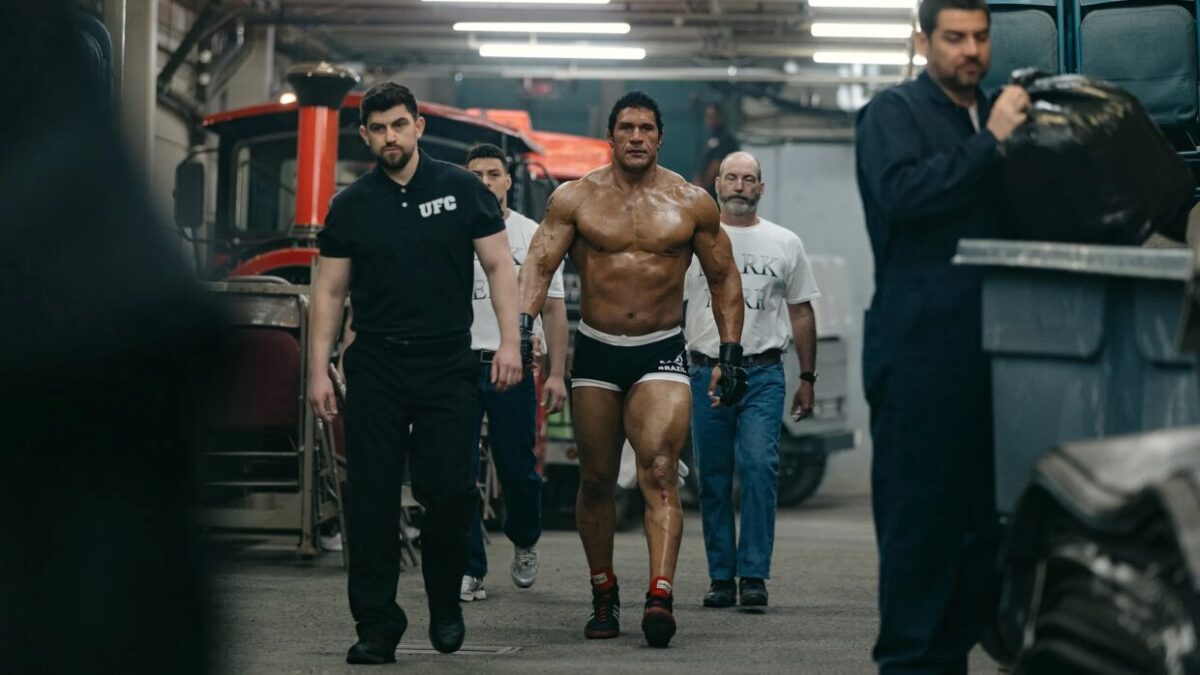
Benny Safdie’s mixed martial arts drama The Smashing Machine, currently in theaters from A24, is brutal and tender, and both in surprising ways. Working with blockbuster actor Dwayne Johnson, who, shapeshifting into the role of fighter Mark Kerr, is even more bulked up than usual, Safdie dramatizes an early 2000s time when MMA was in a transitional phase, with its fighters touring internationally on a loosely regulated circuit where the purses weren’t so huge, there was still a camaraderie among fighters, and the rules felt a bit slippery. Drawing from John Hyams’s 2002 documentary, The Smashing Machine: The Life and Times of Extreme Fighter Mark Kerr, Safdie captures the excitement of these violent matches but also the intimacy of the fighters’s relationships with each other. (A major storyline involves Kerr’s friendship and competition with fellow fighter, Mark Coleman, played superbly by real MMA fighter Ryan Bader.) At the same time, the arc of Kerr’s relationship with his now ex-wife Dawn Staples — who goes from cheering Kerr on to annoyance with his increasing self-absorption, focus on the sport and opioid addiction — becomes progressively darker and much more developed than in the documentary; The Smashing Machine‘s biggest gut punch, and its greatest scene, is an emotional one that occurs within the walls of the couple’s Phoenix apartment.
Even as it embraces a documentary-like approach, with Maceo Bishop’s camera darting and finding the physical and emotional action, The Smashing Machine has a very different rhythm from the pictures Safdie made with brother Josh, who’s a producer here, as well as more conventional sports biopics. With its wistful, almost elegiac present-day coda, where Safdie shifts from the film’s largely 16mm to 65mm, and a dreamy and fantastic jazz and electronics score by Nala Sinephro, it’s a film that finds drama, empathy and a bit of wisdom in the contrasting arcs of a sport and a life as framed by a few short years at the turn of the century. Over Zoom, I chatted with Safdie about his introduction to Kerr and the project, working with Sinephro and his resistance to “being the boss” while commandeering a 164-person crew.
Filmmaker: Tell me, what was the starting point of the film – was it your own interest in Mark Kerr or coming across John Hyams’s documentary about him?
Safdie: It was both. Dwayne [Johnson] said, there’s this guy I’m very interested in, Mark Kerr, and then he watched the documentary and said [to me] to watch it.
Filmmaker: And what was your connection to Dwayne?
Safdie: He had reached out in 2019 after he saw Uncut Gems. I didn’t know what to expect – he’s such a larger-than-life guy – but I when I met him I felt there was a strange, unspoken connection. And the fact that he wanted to tell this story said something to me – that he really wanted to explore something about himself. And when I watched the documentary, I saw that here’s somebody who has this kind of wound and a struggle that always is present, but he’s always performing, he’s always out there. He has put on a face for the rest of the world. He’s so large and strong, and yet he wants to be so unassuming. He doesn’t want anybody to think that he’s a threat. There’s this contradiction to him that I find really beautiful.
There were a few things that locked in place in my brain that made me think that this was something that could be really special. After Lenny Cook, I was into this idea of a 2000s-[set] documentary. I spent a lot of time editing that film, which takes place during a very short period of time. There was a lot of footage during that short period. [In the edit] you could jump around a lot, or you could focus on specific scenes and moments and live in those moments and understand things about the people from those moments. There’s a scene in a bus station that you would normally just skip right over, but they filmed everything in the bus station. You see [Cook] with his girlfriend, with his kid, and then a guy comes up to him and says something about the NBA, and then he goes and plays video games. There was a lot of stuff you could learn about him in that moment, but you had to live in it and accept the pacing.
So with that [experience in mind], I watched the documentary, and I thought, man, I wish I was there to document that world. The relationship between Dawn and Mark is kind of unexplored [because the filmmakers] didn’t have access to what was happening in their home. [Mark and Dawn] would be having fights, you’d see a little bit of the beginning, and then the door would close. Or, you’re not hearing them, because there’s no audio. So, I thought, okay, this is clearly an important relationship in his life. He has a son with this woman, and it’s a toxic relationship. Being married for a long time takes work. You have arguments and you say things you don’t mean, and you get kind of caught up in your own stuff. I thought there were parts of [Kerr’s story] that I could do in a way that were very realistic and that people could empathize with. I got an email from somebody who said, “When the fight scene came on, I was with my wife, and I squeezed her hand.” Knowing that happened is awesome. The reason I made this movie is because I’m trying to learn stuff about myself as well as trying to learn stuff about other people. I wanted [the audience] to have this feeling of going on this journey with this guy, good and bad, but at the end of it, to leave feeling really good about life. You can go through all that shit and still come out feeling okay.
You know, somebody said the best thing about the movie — they called it a Buddhist Raging Bull. There’s a scene that I couldn’t put in the movie where [Kerr] goes to a temple and prays. It was a five-minute journey in the movie where you saw him go on a train, on a bus, walking into the temple, lighting the incense and praying, and it was important to me, but I couldn’t find a pace for it in the movie. But I loved it.
Filmmaker: Tell me more about what interested you in Mark, who, as you say, is very powerful strong guy who didn’t want people to feel threatened by.
Safdie: Well, for example, in the filmmaking process, I don’t like being the boss. I want everybody to feel like it’s okay, that we can all have ideas. I don’t want to be this imposing figure. And there’s the idea that Mark wants people to like him in a way that’s sincere and gentle. He knows that a part of him is what he does, but it’s not who he is. I think of certain things that have happened to me that nobody knows about, and nor should they, and it’s like I don’t want my sadness to define who I am as a human being. I think he goes by that as well. I’m not going to use it as an excuse for people to give me a break, but I think there’s an uplifting element to [thinking], okay, if your life is going this way, you can shift your perspective and you can change everything. I find that really beautiful and profound.
When I would speak to Mark, he would say, “I was wrong to Dawn, I was a hard person to life with, and I’m sorry.” Full stop. I [thought], this is remarkable. We did Q&As where he would come to terms and be like, “Look, I watched that argument that happens in the movie, and it was like therapy for me. I saw my part in it, which I’d never seen before.” This is what I’m after. Mark also said to me, “I felt like I was discarded on the side of the road.” And, you know, there were a lot of guys like him, guys fighting in Japan and Brazil for just enough to barely get around. In Brazil, I think [Mark] made just enough money to pay for the staph infection he got in his hand. He was just a bit early. He didn’t get to bank in on what was happening [with the sport]. People don’t even really remember who he was. That’s why the card that comes up at the end, “His name is Mark Kerr,” is important. This is a guy who you could see walking down the street, and he has an incredible, beautiful internal life. That’s why when it cuts to [the real Mark Kerr at the supermarket], the song overlaps, because you’ve just been in his head. I said to DJ [Dwayne Johnson], when it cuts to him, nobody’s going to have any clue that it’s a different person.
Filmmaker: I clocked it. but I’ll admit it took a second.
Safdie: That’s all that matters, that one second.
Filmmaker: You said a moment ago that you don’t often feel like you want to be the boss, to be a super dominant presence. I don’t know what the budget of The Smashing Machine was — $50 million or so?
Safdie: $49 million. Underbudget and a day ahead.
Filmmaker: Okay, so that’s not nothing. And you had a bigger crew than you’ve ever had and lots of moving elements. How did you find ways to arrange the production to suit the way you wanted to direct? To not “be the boss”?
Safdie: Basically, I created a fully open [set]. I wanted everybody [to contribute]. For example, one day I went to a crystal shop. There was a box of these little ones [over Zoom, Safdie picks up a small crystal], and I spent an hour picking 164 good ones. I brought the box to set, and I said, “Everybody, come down and grab one of these crystals because we’re all mining this stuff together.” I really like it to feel that everybody is working together. I still have to make decisions, but I’m going make them in a way that’s collaborative. I like it when people come with ideas, and when they’re excited about what they’re doing, and that’s what I’m trying to foster. So, when [I] make these decisions, it doesn’t across like it’s been dictated from on high, if that makes sense. At the same time, everybody knows that I want what I want. But, for example, if one of the operators does something really awesome, I’m going to say something. It’s really just about acknowledging the work that people are doing and constantly doing that in a way [to make] people feel good.
Filmmaker: Given that you were shooting in Japan and with a much larger crew, what were the toughest elements of the shoot?
Safdie: There were all these moving parts. Dwayne was in the chair for three and a half to four hours a day, so I [thought], how can I maximize the time by the way I was shooting and lighting? We would light everything, block it like crazy, but I wasn’t coming in with a shot list, even though I had one in my head. I like finding it in the moment, and that’s exciting for everyone. The background has fun because they can talk, and nobody has to hit their marks because I’m editing and I don’t care if they hit their marks. So, it’s a lot of looseness. I’m putting a lot of stuff on myself [as the editor] so I can foster this kind of vibe [on set].
The Japanese stuff was really hard because it’s a period piece, and you’re not allowed to close down streets. I needed Dawn walking towards camera [on a busy street], with all of our period people. That was the one [scene] where I said, “Please, I just need 45 seconds. I know there’s one entrance here, and one entrance there, and can we all just get together and block it?” Everybody was like, “Let’s do it,” and Dwayne’s stand-in, who’s a big guy, blocks one of the entrances and it was, “let’s go.”
Filmmaker: I know you spent a lot of time talking to Mark before the film, but did you speak to Dawn too?
Safdie: Emily [Blunt] spoke to Dawn a lot. Dawn will admit she’s a very complicated person, and she will say, “This may not be everybody’s love story, but it’s my love story.” We wanted her to be part of the process, not because we were going to change things for her benefit, but because, for me, it was important that both Mark and Dawn had a positive experience at the end of the movie. I wanted this to be cathartic for both of them. Emily was talking to Dawn to try to understand trying to understand things about her personality, how Mark treated her in certain ways. And I’m talking to Mark about how he treated her and how he treated himself. A quick example of how that comes to be is in the argument that I’m trying to construct between them, which is a big moment in the movie. I wrote the line, “The only thing you’re doing is giving me leftovers and telling me it’s dinner time.” And Emily says [to me], “Well, isn’t that a little too on the nose? Everything I’ve heard from Dawn is that she wouldn’t say that.” And then she said that Mark would always say [to Dawn] that he was much smarter than her. I asked Mark, and he said, “Yeah, that’s true.” So, I wrote [Mark’s] response: “Oh, did you read that in one of your little books?” Which is so demeaning and mean. And she just says, “You know what? Fuck you, asshole.” And it’s like, now you’re seeing somebody. It’s a small moment, but it tells you that this person was trying to get better, was reading books, and he’s upset at her for using that against him. It’s such a complicated moment, and it comes out of the conversations I had with him.
Filmmaker: I want to ask you about format, because there’s VHS in the film but also 16mm and 70 mm, correct?
Safdie: Yes, there’s two VHS cameras, tube cameras, that we recorded on. Somehow, Glenn Kaplan, the first AC, created these Ghostbusters-like backpacks that could record on HD, so it was the tube sensor going onto an HD SD card. That’s for the first fight that you see in the movie. I wanted that to be straight YouTube – you go into the movie theater and you’re watching YouTube, which is how a lot of people discover these [fighters]. That’s the bloodiest fight you’re going to see, and we recreated all of that. And then it hard cuts into [Mark’s] head, and it’s 16mm, which is evocative of a kind of emotion, and it’s also a little bit nostalgic. [When you make] a documentary on 16mm, an audience understands that there’s something else at play, because you can’t film everything. [The filmmakers] had to choose certain things, whereas when it’s digital, you can film everything. So, there’s element of that [in my choice to shoot 16mm]. And then it goes to 65mm at the very end for Mark in the supermarket. It’s like you’re moving through resolutions as you get closer to the truth and reality. I had two IMAX cameras with a 1,400mm lens and an 800mm lens, and that whole scene is a fully scripted one of [Mark] doing this thing.
Filmmaker: I loved the score. I’m a big fan of your composer Nala Sinephro’s album, Space 1.8, and it was exciting to see and hear how her score worked against so many fight movie cliches.
Safdie: Working with her was the greatest. I chose her because I loved her music, and I thought it evoked a certain emotion that was not my own. It’s beautiful, and I wanted there to be beautiful music in the movie against the brutality of the ring. And these [fighters], I find them beautiful. I love them. They care for and support each other, and I thought the jazz mirrored how they felt. So, when they’re in the ring, she’s doing jazz drumming in time; it’s nervous in a way that you wouldn’t expect. And then when he loses, it’s not this big [music cue I edited] with all this electric guitar she recorded. She’s like, “Not, it needs to this” – this droning thing. I would speak to her like I would speak to an actor. I told her everything [Mark] was feeling, the emotions I thought were important, and I let her make music and then make edits based on the sessions we did. I went to London for a week and sat there and watched these jazz musicians work, and I saw a lot of my process in what she was doing. She’s there, everybody’s looking to her, and she’s kind of telling them stuff to do but everybody’s performing on their own, you know? They’re moving in her direction. She said, “I could relate to Mark when I played the harp because my fingers would get bloody.” You don’t think of the harp as an aggressive instrument, but she does. She said her mom would tell her how to play the piano. [Her mother would] say, “Play the song sad. Now play it as if it’s the happiest day of your life. And now play it as if you’re really angry.” Nala was like, “Here you are coming in and saying all this stuff that I remember hearing from my parents!” Like, I’d say, “Can we [make the music] really sad now, because he’s really upset?” And then I’d say, “I really want to hammer home these hits.” And she brings in this old rickety kind of bar piano, and every time Mark gets hit, it’s “dum, dum!”
As I was in the edit, I’m trying to figure out how to play up the final fight, and she had the idea to put those piano hits in, and I’m like, “that’s it!”, because it plays to that [earlier moment]. And I realized that I can cut to his memories. I actually got that from watching anime with my son. There’s this Anime One Piece that, partly for narrative reasons, because it’s been on for 15 years and there are 1,000 episodes, uses cuts to remind viewers what a character has been through or why he’s feeling a certain way. I had just done the edit, and I was trying to figure out how to make it more powerful, and I realized that I would go back to the takes and do the other cameras. Get an off view of a lot of these shots – a kind of different view of the moments in his life, what’s cycling through his head when he’s on the ground.
But to tie an end on Nala, it was such an amazing collaboration. She would tell me “no,” and I would have to say, “Okay.” And part of that was like, “I respect you as an artist, and part of the reason I wanted you to do this is to make these decisions.”
Filmmaker: But it sounds like you were a very active music editor too.
Safdie: Sure. I would send [the scenes] to her, and she would do music editing and send it back to me, and there was this constant back and forth. I would be surprised, she would be surprised, and at the end of the day, when I finally heard what she was able to do, never in a million years would I have known that this is what it needed.
Filmmaker: You are shooting the fight scenes, which were all televised and being shot by for an international audience. Could you talk about how you decided to cover those scenes and how you chose point of view? You’re often shooting from outside the ring.
Safdie: In order to make you connected to these characters, I decided I’m going to make it obvious to you where the camera is. And every time I edit, I’m aware of where the other cameras are because I don’t want to edit to a camera that would technically see itself, you know? We created a whole fake crew that was running around filming — we literally had a whole way of covering this stuff as if it were real. It allowed us to orient ourselves in the room, which I thought, for an audience, would be interesting and make you feel close to [the characters]. So when the camera moves, it goes behind you. If it turns again, it moves to another speaker. You’re getting reminders of where you are. All I wanted to do is put you in this place and eventually get you to come to terms with somebody [like Mark]. Yes, it’s a movie about a guy who’s an MMA fighter, and about the beginnings of the MMA, but there’s a real beauty in these people. There’s an opera out on the turnpike. So, I’m going to go all in on that.
This interview has been edited and condensed. — Editor
Publisher: Source link



Netflix’s 10/10 Thriller Series Returns After 3 Year Absence With Explosive New Trailer
Over the last five years, Netflix has expanded heavily into non-English content, with international series taking an even bigger focus for the streaming giant. One of the biggest driving forces in that effort is the French thriller series Lupin, led…
Sep 15, 2026
Original ‘Yellowstone’ Dutton Favorite Officially Confirms ‘Marshals’ Return Interest
Yellowstone jump-started a generation-spanning story that has so far spawned four spin-offs that are all interconnected by the Dutton bloodline. While creator Taylor Sheridan has since branched outside that saga with Tulsa King, Landman, Mayor of Kingstown, The Madison, and…
Sep 14, 2026
Netflix Officially Cancels Its 2-Part Taylor Sheridan Replacement Western
Netflix Published Sep 12, 2026, 10:30 AM EDT Omar is an experienced editor and writer who sees life and storytelling as one and the same — there’s always a story to tell. He’s helped shape features, headlines, and coverage across movies,…
Sep 13, 2026
Jason Momoa’s Epic Historical Action Thriller Officially Getting New Release
Apple TV has established itself as a rising force in streaming entertainment. From Silo and Dark Matter to Pluribus and Ted Lasso, there is something for everyone, and not only that, but a ton of huge star power at the…
Sep 12, 2026