Interview: Alex Winter and Tom Stern on Freaked
Nov 6, 2025
Freaked
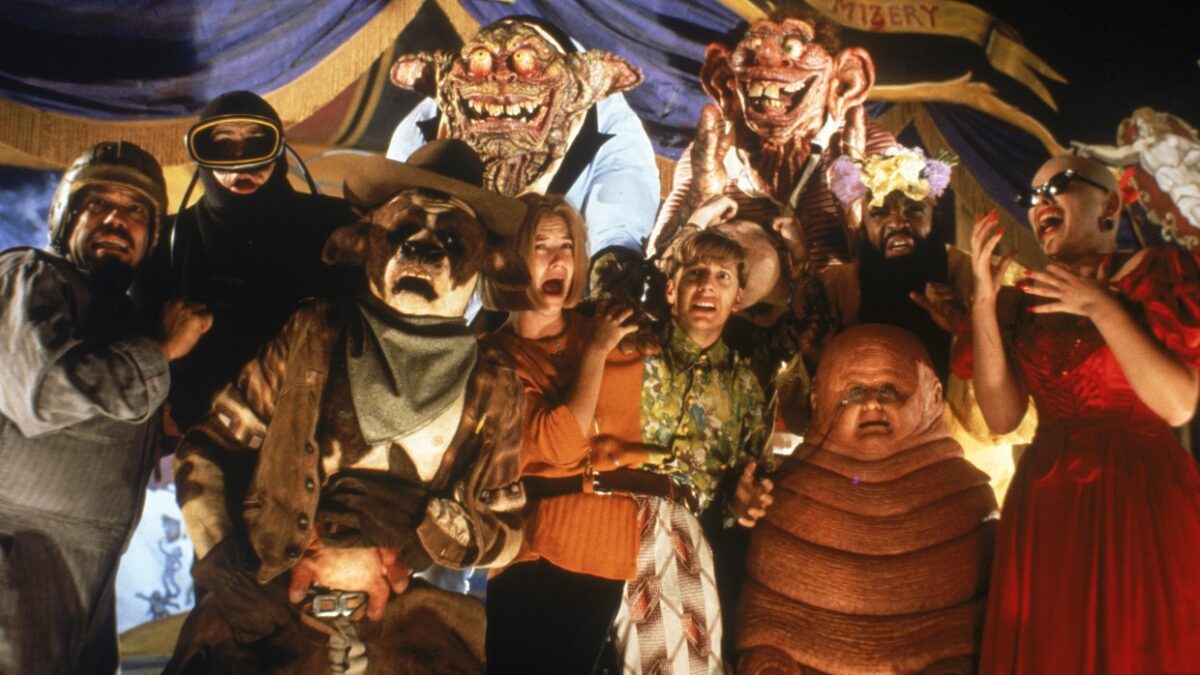
Alex Winter and Tom Stern’s 1993 cult classic Freaked is less an example of “high” and “low” art commingling than of pop- and-sub-cultures colliding. At the precipice of marquee fame after headlining the first two Bill & Ted movies alongside Keanu Reeves, Winter—along with his former NYU classmate Stern and TV writer Tim Burns—pitched 20th Century Fox on an anarchic comedy called Hideous Mutant Freekz, in which Ricky Coogan (played by Winter), a shallow TV idol, becomes spokesman for a patently evil chemical corporation. Ricky, his best friend and a handful of others board a plane to the fictitious South American country of “Santa Flan” where, it’s revealed, his new corporate masters are dumping excess toxic waste. Soon, Ricky learns there’s a “freak farm” in Santa Flan lorded over by a mad scientist (Randy Quaid) who manages to transform them into members of his traveling freak (or “freek”) show, whose supporting cast includes Mr. T as the bearded lady and an uncredited Keanu Reeves as a humanoid dog. Ricky pays the ultimate price for his vanity: not only does half of his face expand to the form of a hideous goblin, he’s also exposed as a lousy actor.
Winter and Stern’s film is a dizzying string of gags in the spirit of MAD Magazine which grows more postmodern as it goes along. With “strata-cut” opening titles by the brilliant claymation artist David Daniels scored by Blind Idiot God (featuring Henry Rollins), it announces itself from the jump as a pugnacious referendum on the slick, superficial world of celebrity newly entered by Winter at the time. The filmmakers tapped Japanese VFX maestro Screaming Mad George (Predator, Arena, Society) to design some of its phantasmagoric characters before expanding the remit to makeup wizards Tony Gardner (Alterian Studios) and Bill Corso (of XFX Studios, founded by Steve Johnson), whose hand-crafted prosthetic monsters are the real stars of the show.
Freaked is a primo example of the 1990s phenomenon whereby serious sociopolitical concerns were refracted into shit-eating (and/or infantile) entertainment; cf. its radioactive sludge plotline, which puts it in conversation with X-Men, The Toxic Avenger, Teenage Mutant Ninja Turtles, The Simpsons and Tim Burton’s Batman, among myriad others. It also epitomizes a brief, surreal moment in which proudly anti-commercial sensibilities were open for commodification, and “underground” culture stood to reach mass audiences like never before. But that’s not quite what happened: a changeover at Fox resulted in the movie getting a stillborn non-release in 1993, quietly accumulating fans via home video for decades after but basically consigned to a footnote within Winter’s (reliably fascinating, idiosyncratic) career as director and actor.
This fall, Freaked has found new life courtesy of a new 4K restoration underwritten by Winter, released to home video on blu-ray via Umbrella Entertainment with Drafthouse Films and, for the first time, is available to stream. (For anyone who still can’t get enough Freaked, I recommend Winter’s archived website Freekland, which includes a breathtaking feature from Film Threat about the making of the film.) Ahead of the re-release, I spoke to Winter—taking a break from performing Waiting for Godot with Keanu Reeves on Broadway—and Corso about the passion and the pain of making Freaked; our conversation has been edited for length and clarity.
Filmmaker: Screaming Mad George was what led me to see Freaked, but I hadn’t quite realized how many other artists worked on it as well. It feels like a prosthetics supergroup and quintessentially captures the pre-CGI moment.
Alex Winter: Freaked started as a vehicle for the Butthole Surfers, and we brought George on to design that—all the freaks you see in the film were designed for that version. Suddenly, we’re making a $12 million, PG-13 movie, and it got way too big for George to do all that by himself. So, we had a massive army of effects companies: George, Tony Gardner’s studio, Alterion, and Bill, working with Steve Johnson’s X-Effects studio.
Bill Corso: When they were pitching the movie, Alex and Tom had seen George’s work and loved it—so out-there, so crazy, it suited their approach. Once the gears started turning they realized George’s studio simply wasn’t equipped to do everything they wanted. I also think part of it was just to maintain a wide variety of styles. The VFX guys are all friends, but there’s also a competitive spirit to it. That’s part of why the work is so gonzo and crazy. Everybody kept saying, “How can we make this even cooler?” That was the mentality back then.
They hired Tom Rainone, whose job was to investigate the studios, interview them, evaluate their strengths and dole the work out. Many of the characters in the movie seem like they’re from Tony Gardner’s studio. Steve Johnson’s shop was more for the big, crazy, scary stuff. Alex and Tom had our shop in mind for the big monsters at the end, and somehow we also got saddled with the Siamese twins, Julie and Ernie, and Stewie, the little kid, a real-life Alfred E. Neuman.
Filmmaker: Alex, how would you describe the creative dynamic at that point between yourself and codirector Tom Stern?
Winter: We came together as NYU film students. We shared an interest in underground comix, punk rock, Monty Python, etc. We started doing stuff with the Butthole Surfers around that time in the ’80s. We both performed in short films and the like, and I would pull in actors from the movies I was doing. John Hawkes is in Freaked because we had both been in Percy Adlon’s 1989 comedy Rosalie Goes Shopping. Keanu appears in Freaked because of Bill & Ted, obviously. Despite the success of Bill & Ted, my interests were still music videos and making things like that. We ran a little troupe out of our shitty apartment in Venice Beach and had no money even though we were starring in major motion pictures. Stars weren’t quite getting paid $20 million a movie back then, and all my money was getting poured into this kind of creative stuff.
This is a movie Tom and I made when we were quite young. I wouldn’t call it “juvenile,” but I wouldn’t avoid calling it that, either. We knew that it wasn’t typical fare, and we made it for a studio chairman who was taking very bold swings at the time. Joe Roth was running production at Fox and greenlit Naked Lunch and Barton Fink. He was making mainstream movies too, but taking some big swings. Bill & Ted had blown up, which gave me the opportunity to do my show The Idiot Box on MTV. I took that political capital and spent it on this very crazy thing, which I’m extremely proud of. Now, the movie did get caught up in a studio administration changeover, but I want to stress that is common as dirt.
Filmmaker: So there was no studio interference during production?
Corseo: I’m sure Alex and Tom had to deal with the studio, but we had wonderful producers who served as buffers and really wanted to help out. It felt like a boom time, certainly for us as makeup artists and designers, and I think that enthusiasm carries through in the film. Catherine Hardwicke was our production designer. Mr. T was a blast, so was Brooke Shields; everybody working on this had a great sense of humor. Of course there were opportunities to go out and party but for me it was like, “Sorry guys. I gotta be up at three in the morning.” Mostly I just remember working in my little bungalow and being so happy about what I was creating.
Filmmaker: Jurassic Park is another movie from 1993—it’s very, very different, but the two feel comparable in the sense of, there’s a joy in being able to illustrate, or bring to life, a spectacle that had been impossible before.
Corso: A movie today will boast about its quantity of VFX shots: “This one had one thousand”, “this one had two thousand”, “Avatar had 4500”, whatever. But this was a film where every single shot was a makeup effects shot, and it was wall-to-wall practical [and] prosthetic. Since Freaked I’ve worked on movies where millions and millions of dollars are allocated just for makeup. Freaked was not budgeted quite like that.
I think George was just told to do what he does, and nobody else could tell him how to do it. Whereas we were given very specific style references: Ed “Big Daddy” Roth, Robert L. Williams, Basil Wolverton, all these great artists. So, I took Polaroids of Alex and drew pictures. With tracing paper, we’d do colored pencil sketches, then turn those into little sculptures and maquettes, because you can try anything with a pencil or a clay sketch. In fact, that’s the trouble with it sometimes: you can dream up these amazing things but then have to create them physically.
Filmmaker: You’re referring to a specific creation?
Corso: Alex’s freak is specifically supposed to look like a Big Daddy Roth, like one of those monsters driving dragsters. It doesn’t lend itself well to a human face, and this was back before the days of Photoshop, Zbrush and all that. We came up with this way to make these teeth that would stretch Alex’s mouth out huge, extra-wide—not very comfortable at all but it worked like gangbusters. When I did the first makeup test of that, just to see if it was even possible, it was a much smaller makeup, and the guys were just so gobsmacked and excited, literally saying: “Can we go bigger? Can we go crazier?” Soon you start getting away from his face and it’s like, “Now we’re losing mobility. How do we make it come to life?”
Filmmaker: As For Your Consideration Oscar campaigns sometimes say about weight loss or simulated drug addiction, “Alex Winter is unrecognizable!”
Winter: I didn’t have a mouth that got ripped open with multiple mechanisms inside me. I had all these different servo motors: one for my head, one for my ear, one to push pus out of the hole in my head. My teeth were pulled back by a device to make my mouth look significantly wider.
Corso: Making the lips move was the hard part. A few years earlier I had the privilege of working with Rick Baker on Gremlins 2: The New Batch. If you’ve seen it, you’ll remember—hopefully—the ear movements of the Gremlins. We were very proud of figuring that out: put weights in the bottom of the ear so you could swing them around. It adds a lot of expressiveness. So, we did that with Alex and gave him this giant hump, because we had to figure out where to hide the motors. The motors are behind his eardrums. I don’t know how realistic it is, but it stopped it from just being a giant mask when we added exploding pus pustules.
It only works because of Alex’s over-the-top performance. The constant drool was a nice touch. He’s a huge fan of Lon Chaney, and Chaney had a habit of torturing himself to achieve a certain look. For the lost film London After Midnight, by Tod Browning, Chaney had hooks in his mouth and his eyes to stretch his face. I must say Alex was just as gung-ho making Freaked: “If you need me to do that, I’m good.”
Winter: All that took about four hours and change to get into, and at least an hour and a half to get out of. And I was directing! I mean, co-directing, but still.
Corso: We would make Alex up at three o’clock in the morning, and he had to be completely made-up by the time the day started. Then he would direct and be in scenes for twelve hours, and I’d be there glued to his side, making the remote controls work, whatever I had to do. Seven or eight PM, we’d clean him up for an hour; he’d sleep for three or four hours, then we’d start the whole thing over again. We were doing that for three and a half months. There was a flu bug going around and everybody got sick, of course.
Winter: I got very sick after Freaked. I’m very glad I did the movie, but my body completely shut down.
Corso: The doctor’s number one mandate for Alex was, “You need to sleep if you’re going to do this.” He’s like, “Well, I can’t stop.” They told him he needed more sleep anyway. So, I came up with this crazy idea: What if you just sleep in the makeup? It wasn’t traditional makeup that would fall apart or come off if you touched it. We used paints that dried and were very durable, so we thought Alex could actually sleep without hurting it. That would give him another three hours of sleep, and I’d just touch it up a little before we resumed shooting. All we did at the end of the night was take off his hump, take off the remote controls, wrap the wires up and send him home. I’ll be damned if he didn’t look just fine coming in the following morning. In the end we went three, if not four, days where he kept that makeup on: “Hey, it’s not like he can’t breathe!” And this wasn’t the first or the last time I’ve done that, by the way. I’ve definitely cited Alex as an example for other actors down the road of why they should sleep in their makeup.
Filmmaker: The title was changed too.
Winter: From Hideous Mutant Freekz to Freaked, which we also came up with. That’s not a big deal though. I had to change the title of my last film, Adulthood, at the last minute because another movie came out with a similar title to my original. That happens all the time.
Filmmaker: I must say, via Ricky Coogan—his fame, his sponsorship deal, et cetera—it’s hard not to interpret Freaked as a skewering of ’90s corporate culture, indeed of the pressure to sell out. Or maybe it’s skewering the idea of selling out?
Winter: I think that’s true thematically. There was a shift in music from the ’80s into the early ’90s.I came up with this whole vibrant indie scene: Minutemen, Meat Puppets, Black Flag, Butthole Surfers. None of those people made any money, right? Then Nirvana broke, and that underground stuff became mainstream. If you watch Nirvana: Live and Unplugged in New York, Kurt played three different Meat Puppet songs, which seems crazy today. We were like filmmakers off the label SST Records—the generation before Sub Pop, before a grunge band could play Madison Square Garden. Suddenly this weird, subversive stuff is making its way into the zeitgeist. The Idiot Box was a big success for us, and it was hyper-violent and subversive. This was before South Park, Tim Burton was just coming up…
Filmmaker: I guess this is why I’m confused. There definitely was a market for this kind of anti-establishment thinking on a huge, globally visible mainstream level.
Winter: You seem young, so this is gonna sail over your head, but it was a time of “family values”.
Filmmaker: I’m old enough that I remember seeing the VHS of the movie at the store. But I think you’re referring to, what, Tipper Gore testifying before Congress?
Winter: The new regime at Fox came in and I think there was a feeling that the film was too offensive or renegade, super risky. They didn’t want to keep making Barton Finks or Naked Lunches; they wanted to make more Home Alones, which they did. But I want to stress, it’s not like we hoodwinked the studio. Look at the special effects, the makeup; you can’t just improvise a movie like this. It was so complex that it had to be fully storyboarded in advance. The studio was well aware of what we were making and sat in on rehearsals. I feel lucky the movie got made, even if it wasn’t released. I would never, ever go into a studio and pitch that today. We were rough-edged by design. We wanted it to be un-palatable. It feels like the difference between post-punk and grunge hitting the mainstream.
Corso: This is a different angle, but I’m glad this was a non-union movie. We never would have been able to make Freaked otherwise; the cost would have been just too prohibitive. Today a show like this would be picketed and protested, the publicity would be toxic. But back then, non-union meant you could basically work around the clock, sleep in your makeup. Today we would just do it with CG.
Filmmaker: I once did an event with Phil Tippett where he basically said a lot of the fun had gone out of SFX work because studios could exert ever-higher demands on shops of VFX artists for ever-faster turnarounds. I’m not sure a studio in 2025 would give you the time and space needed to create the kind of stuff you see in Freaked. How have digital workflows changed the literally artisanal craft of prosthetics?
Corso: Sadly, the advent of digital technology means that patience has gone out of the movie business. It used to be like, “We have no other way of doing this, so we have to problem-solve and figure it out,” which is why we have so many amazing talents born of the ’60s and ’70s. Phil Tippett was inspired by Ray Harryhausen, Rick Baker was inspired by Dick Smith; being inspired by artists led to the problem-solving, the fun of it. Steve Johnson, my boss, excelled at, “How do we come up with a way to do this thing nobody has been able to do before?”
When Rick Baker worked on Men in Black, digital effects were being used for sure, but still in their infancy. There’s this giant bug at the end of the movie, “Edgar.” The director, Barry Sonnenfeld, god bless him, couldn’t decide on what creature design he wanted. Rick went ahead and made Edgar, because they needed something for the shoot! They brought it to set and the questions began: “How many people does it take to operate?” “How long does it take to set it up?” The decision was made to just figure it out in post. I don’t know how many hundreds of thousands of dollars it cost to build that thing, but they just discarded it and did it all digitally. That started happening more and more.
There are certain directors and actors who insist on holding on for as tight and as long as they can, because they know special effects artists, sadly, have no decision-making power, not even Rick Baker. But the production model of filmmaking is simply overwhelming, and it takes precedent. I love Marvel, but all their things are becoming digital. The guys don’t even have to wear the cool costumes anymore; they’re just in a jumpsuit with dots on them now. Thank God you have somebody like Colin Farrell, who insists on wearing the Penguin makeup. Everybody’s like “Oh my God, it’s so amazing!” Well, yeah—that’s how we’ve been doing it since The Wizard of Oz. As much as I hate to say it, we’re a dying breed. Freaked was a high point.
Filmmaker: I also need to shout-out your work on Tim Burton’s Planet of the Apes. As a fan of that franchise, this may be my only chance to tell someone who actually cares: the makeup has never been surpassed. The new motion-capture ones are fine, but I’m not sure it’s really Planet of the Apes without the Shakespearean actors in rubbery primate costumes.
Corso: Rick Baker was going to take time off after The Grinch and then it’s like, “Well, how can you not do Planet of the Apes?” We all knew it wasn’t the strongest script ever, but we were such big fans it didn’t matter. If you look at Rick’s original conceptual illustrations he had, like, an albino gorilla smoking a cigar. The studio hated that. Rick wanted the apes to be as realistic as possible, such that you’d feel like you were seeing a real gorilla riding on a real horseback. But the studio kept pushing Tim to make his release date and didn’t really want too much of that kind of stuff. It was frustrating, because the studio got what they wanted, but I don’t think they really knew what they wanted.
I had worked with Paul Giamatti on Man on the Moon, and we had both bonded over being such huge fans of the original series. As a wrap gift, he gave me a Cornelius doll. Well, Rick had been the one to suggest Vincent D’Onofrio for Men in Black, and when he got the Apes job, I suggested that he suggest Paul for the orangutan. I think Steve Buscemi had been cast originally but bowed out due to the intensity of the makeup. Paul met with Tim and got the job; next thing I know, Rick calls me up and says, “Do you want to do your buddy Paul’s makeup?” So, for me, the magic of the movie was getting to do it with a buddy who shared my great love for the material. And our team got better, and got better at working faster, as the production went on. Regardless of how good or bad it turned out, I think you can tell we had a lot of fun creating those characters.
Filmmaker: I did an interview with Ron Shelton about White Men Can’t Jump, which was also greenlit by Joe Roth. Ron basically said, the difference between now and then is that studios trusted filmmakers; I took it as an example of this bigger shift, from people who actually like movies, to the boardroom executives.
Winter: I don’t agree with that at all. I’ve been inside the industry since I was nine years old, and the industry has always been hard. It has always been filled with a mix of people who love movies and people who hate movies, plus people who have a fuzzy idea of what movies are but they love putting on a suit and hanging out with movie stars. There’s a lot of those. This idea of the artist versus the machine, it’s just a crock of bitter, resentful shit. I’m not saying that’s what Ron Shelton is saying, by the way—I don’t know Ron Shelton from a hole in the wall. But I reject the sentiment as you paraphrased it—the juvenile, punk rock, “us versus them,” self-pitying perspective. The world is hard and there are people in that world who will fight to the death to help you get your shit done.
With Freaked, it’s not like the big, bad, evil people came in. When one administration got pushed out and a new administration comes in, they’re not exactly going to be sympathetic to the work of the previous administration. I mean, you’re watching that happen now with these huge studio changeovers in Hollywood, right? I don’t have a beef against Peter Chernin, who came in at Fox; he made some great shit. I didn’t come out of it thinking I had been beaten by The Man, I felt like we overreached and tried to make something punk rock on a mainstream budget. I have many lovely relationships in this industry with people, even at high levels, who are huge movie fans. It’s just hard. People get burned. They’ll make a movie, it’ll flop, they lose their job. It’s not an exact science. If it was, every movie would be a hit.
Freaked wasn’t a flop; it straight-up did not get released. It got stuck in, like, one theater as a contractual obligation. We didn’t get an original motion picture soundtrack. We got a great review in the New York Times, a great reception at Midnight Madness, back when it was [a section of] the Festival of Festivals, the year before they rebranded at TIFF. They let us tour the movie as if it were an indie, traveling with a print and showing it at arthouses. But they decided in advance the movie had no commercial prospects, and that was heartbreaking for us after so many years of labor.
Filmmaker: Any painful lessons at the time?
Winter: My sensibility has always been to do the things that I want to do, regardless of how it might perform, but I’m not irresponsible. My next film, Fever, was a rigorously non-commercial indie and did quite well. The lesson I took from Freaked was, lower your damn budget. Don’t try making something punk rock for ten, 12, 15 million dollars. You will not get a return. I made Fever for $4 million, my last feature Adulthood was $6 million; everybody’s getting their money back and I retain creative control. 30 years later I’m doing the same thing, even doing Waiting for Godot on Broadway with Keanu. People were like: “Really? You guys want to drop everything you’re doing for a Samuel Beckett play?” I think it’s about doing things, making stuff.
Adulthood, on the surface, it’s a loopy, farcical comedy. But there is a subtext there, and it’s quite dark. You’re not the same person at 19 or 20 as you are at 50, in terms of the type of thing you wanna do. Last year I had dinner with Screaming Mad George, in Japan, and we were talking about getting older. How does your art change? Does it evolve? George is still making beautiful, surrealist art, but he’s a dad, and he’s matured, and I think the work has evolved since we made Freaked. It’s lovely to see.
Filmmaker: What’s your relationship to Freaked today?
Winter: I made this reissue happen. It was very, very important to me. I spent a good chunk of time over the last couple of years on this, then we made a deal with Umbrella. Umbrella is amazing: they put together a book and all these extras, and we went and got interviews with a bunch of people. The movie had never been properly distributed; it got a wonderful, but a very limited, DVD release some years ago, but that was not from the internegative, was not particularly great resolution and there was no way to see the film on streaming. Those things bothered me. I probably spent the last five years working on getting the rights from Disney after they bought Fox. I managed to get to some people there who were, in fact, very lovely, fans of mine and the film, and they gave me the rights for specific things like VOD and so on. I immediately went to my friends at Giant, at Drafthouse Films, and they were very interested. So, we embarked on a very labor-intensive restoration going back to all the original materials out of the Disney vault, which they gave us very willingly. We did a complete restoration from the internegative, a brand new color-correct and remixed the sound. It was an expensive and very time-consuming process. We put the deal together with Umbrella to do a rerelease including a book and lots of extras.
Hard as it has been to find over the years, the film has still had an amazing life despite the difficulties we were talking about and amassed a cult following. It’s wonderful to have it restored, finally, and get a new version of it out there. I think the movie was a little ahead of its time, and the problem with many films is, they just aren’t distributed properly. Some of our most beloved, iconic movies were duds. It’s great to feel like you made a cult favorite. There’s no greater gift, which is why I find it hard to be resentful—we were very lucky.
Publisher: Source link


Netflix’s 10/10 Thriller Series Returns After 3 Year Absence With Explosive New Trailer
Over the last five years, Netflix has expanded heavily into non-English content, with international series taking an even bigger focus for the streaming giant. One of the biggest driving forces in that effort is the French thriller series Lupin, led…
Sep 15, 2026
Original ‘Yellowstone’ Dutton Favorite Officially Confirms ‘Marshals’ Return Interest
Yellowstone jump-started a generation-spanning story that has so far spawned four spin-offs that are all interconnected by the Dutton bloodline. While creator Taylor Sheridan has since branched outside that saga with Tulsa King, Landman, Mayor of Kingstown, The Madison, and…
Sep 14, 2026
Netflix Officially Cancels Its 2-Part Taylor Sheridan Replacement Western
Netflix Published Sep 12, 2026, 10:30 AM EDT Omar is an experienced editor and writer who sees life and storytelling as one and the same — there’s always a story to tell. He’s helped shape features, headlines, and coverage across movies,…
Sep 13, 2026
Jason Momoa’s Epic Historical Action Thriller Officially Getting New Release
Apple TV has established itself as a rising force in streaming entertainment. From Silo and Dark Matter to Pluribus and Ted Lasso, there is something for everyone, and not only that, but a ton of huge star power at the…
Sep 12, 2026