“Long Time Artistic Relations Are Fascinating… And Hard to Maintain”: Rick Linklater on “Nouvelle Vague” and “Blue Moon”
Nov 8, 2025
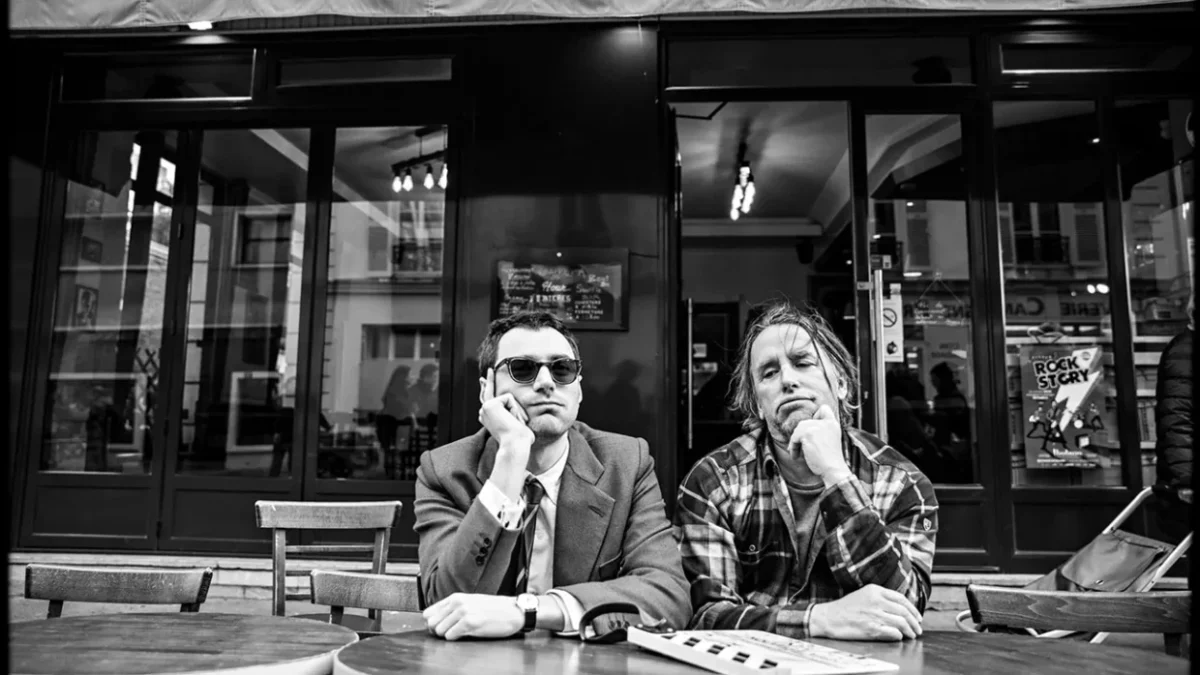
Guillame Marbeck and Rick Linklater on the set of Nouvelle Vague (photo: Jean Louis Fernandez, courtesy Netflix)
One of our most prolific independent American filmmakers, Richard Linklater, now has two new movies in release. Nouvelle Vague and Blue Moon are both evocations of transformative moments in, respectively, narrative cinema and Broadway musical theater. Both are period films, ingenious in form and generous in spirit — in other words they are two of the best films of the year. Nouvelle Vague is set in Paris in 1959, when many of the critics who had formed a community around the magazine Cahiers du Cinema had already directed at least one feature. Desperate to catch-up was Jean-Luc Godard. Nouvelle Vague depicts the making of Godard’s Breathless, which would influence generations of aspiring filmmakers worldwide including Linklater’s own. It is a how-did-he-do-it movie, not in the form of a contemporary investigative documentary, but of an imaginary one, made in 1959 by one of Godard’s Cahiers du Cinema friends and newly come to light. It is a French production with a French crew and French actors excepting Zoey Deutch, who plays Jean Seberg, the American interloper in the original. The film depends on the performance of Guillaume Marbeck, who is a most credible Godard — cool, purposefully enigmatic, but with a mind on fire.
Linklater is a superb director of actors, both novice and experienced, and Ethan Hawke, a longtime collaborator, is brilliant in Blue Moon as the alcoholic, self-destructive, closeted Lorenz Hart, who has been dropped by Richard Rogers (Andrew Scott), his creative partner of nine years. Hart can’t resist the humiliation of showing up at Sardi’s for the afterparty for Oklahoma by Rogers and his new lyricist Oscar Hammerstein. Remarkably contained in a single space, which nevertheless evokes the presence of World War II, and broken into three dialogue scenes with Hart doing most of the talking, Blue Moon is a heartbreaker beginning to end especially if you care about the moody love songs Hart wrote with Rodgers as much as Linklater does.
Filmmaker talked with Linklater when he was in New York for the screenings of both films at the New York Film Festival. Nouvelle Vague is currently in limited theatrical release from Netflix, and it will stream on the platform beginning November 14. Blue Moon is in theaters from Sony Pictures Classics.
Filmmaker: Could we start with Nouvelle Vague? It’s a time machine movie, not a biopic or a Breathless remake. It’s as if you discovered an EPK, except there weren’t EPKs when Godard shot Breathless in1959. I read that in post-production, you even added scratches as if this was a print made 65 years ago.
Linklater: That’s the conceit I had from the jump, 13 years ago, working with my colleagues, Vince [Palmo Jr.] and Holly [Gent]. I could see the final film. It’s like a film made back then, not by Godard but maybe by Jacques Rozier or one of Godard’s other friends about the community, the Cahiers du Cinema crowd, but focused mostly on the making of Breathless. And we discovered that the production had been very well documented. There were published books and photos, and we also found private collections and a lot of stuff in archives. We got the camera reports from the Cinematheque Francaise. Everyone had donated their stuff — I think they knew they had been part of something special. We had the camera that Raoul Coutard used — that’s the camera you see in our movie. Not to get too fetishistic about it, but Godard left it to the Cinematheque. We asked them, “Is that old Camoflex, the version of the Arriflex that they used, still around? And does it work?” “Yeah,” they said. “It’s like a Model T, it still works.” And I was like, “Can we use it?”
Filmmaker: And the lenses?
Linklater: Yeah. We knew from their camera reports what lenses they had. We knew what days they shot. I knew how many takes they did of each scene. So, I was recreating that. The scene where [Jean-Paul Belmondo] goes into the phone booth, they did in one take. So, I did that one quick. But the one where he goes to the travel agency is more complicated. I knew [Godard] couldn’t have done it in one take, and sure enough they did four. So, we show them doing take three. They’re getting pretty good, but there’s still a little fuck up at the end with the cops. So, we’re just reimagining all this but based on a lot of information. We used actual locations, but we had to build nearly everything they walked into. And we showed the Camoflex but we didn’t shoot with it.
Filmmaker: So, you stuck with your original conceit.
Linklater: I knew that was going to be a challenge, but it’s such a unique look in space and time. It would be weird if it was any different. But you have to do a lot of work to get those overexposed exteriors. Stocks are just faster today. We were emulating it, but it’s all fake, all reconstruction. We shot some film, but it was mostly digital. We got better results digitally because film stocks aren’t the same now. We could achieve that look either way, but it was ultimately a little easier to shoot mostly digitally. But not everything. We used some Kodak 5222, their black-and-white stock. And we use many visual effects, too. I don’t want the viewer to think they’re in a visual effects movie, but truth is, we would own the foreground with cars and extras, but the far backgrounds, we were really visual effecting. “Painting away,” as they say. And it’s so much easier now — I couldn’t have made this ten years ago. The rue Campagne Premiere, the street where [Belmondo] dies on the famous cobblestones, it’s asphalt today. So, what do you do? [The VFX artists] recreated it. You film some cobblestones and then you lay it out. You don’t need green screen. They just put them in. I mean, the first time they did it, it just looked like badly laid carpet. So, it’s months of back and forth. But they got there. It was kind of magical. It’s one of the more technological films I’ve done because of all the CG, the painting stuff out. But I didn’t want to feel that way. I wanted to replicate the Nouveau Vague feeling of just showing up and shooting. But with us, it was actually anything but. It’s all a trick.
Filmmaker: Where did you find the amazing actor who plays Godard?
Linklater: There are great young actors wherever you go. I started looking in Paris about six months before we started shooting. I met several guys, but when Guillaume [Marbeck] came in, he had this little swagger to him. He’d been around the film world, but he hasn’t done anything of note. But he acted like he had. I recognized that swagger, the unearned confidence of the first-time filmmaker. The general without an army that a first filmmaker is. The psychic battle that goes on when you’re making your first film is funny — you’re so compelled, and you’re so driven. And yet you don’t know what you don’t know so you’re kind of insecure. It was fun to show Godard as vulnerable as he’s ever going to be. But you can see he’s kind of compensating, filling in all the blanks with quotes and theory. He was definitely making it up as he did it. And he’s asking lightning to strike, and it did with Belmondo and Seberg. Yeah, it’s a happy accident, but he definitely conjured it with his own theories. I felt that way too with Slacker. It was the same kind of thing, unconventionally scripted. You have all these people wanting to know what the next scene is. And even the people working most closely with you don’t know. You can’t even describe the film to them. They think they know, but they kind of don’t. It’s a pretty precarious position to be in, but pretty fun, too. You can only do that once, and you’re also thinking, if you’re going to make something different, it’s actually necessary to do it differently. So, you’re going to shoot a little bit and quit for the day. Different methodologies are good in art. I remember feeling that way, so on this film I felt like I had gone back to a beginner’s mind. I was 28, making my first film again. But I had a bedrock of security, of years of making films. And because of my experience, I felt, beat by beat, that it would work. But unlike a first-time director, I had respect from everybody I was working with. It was a special experience. That Cahiers du Cinema office scene? My script supervisor came over to me in tears. And I was so emotional. When we were setting up the actors, it was like, “they’re here.” I’ll never feel that way again. Because none of them are still with us. They are all gone. And not only did we find people who looked like those filmmakers, we had an extras casting director who was obsessed. He found extras to be in the near shots who looked like the extras in Breathless.
I was focusing on the Cahiers du Cinema community, but there’s was also the Left Bank filmmakers — Varda, Demy, Resnais. And they were all in dialogue. I talked to Rosalie, Varda’s daughter. She said they all knew each other, but the Cahiers filmmakers didn’t always treat Varda very well.
Filmmaker: But Varda got Godard to take off his dark glasses in her film. She was the only one he did that for. And, so, it was heartbreaking when he doesn’t answer the door when she goes to visit him for her documentary Faces, Places [2017.]
Linklater: I felt so angry with him about that. But then I heard that she didn’t really let him know and he didn’t like surprises. He felt that he was kind of being used for her movie. And he didn’t like that. Michele [Halberstadt, co-writer and co-producer] knew him and told us that he said yes to most things. She said he would have allowed us to make the movie. He just wouldn’t have cared very much. But still, Varda was an old friend, and he stiffed her, so he was an asshole about that. Anne-Marie Mieville, Godard’s widow, saw our film. Michele went to Rolle and showed it to her. She really loved it. She said that she didn’t meet Godard until the ’70s, but of course she knew about the earlier era in his life. She loved that the film was about friendship, that it ended with Truffaut putting his arm around Godard. I did that intentionally. Community, friends, that’s how it always starts. The feuding came later. People go their own ways over the years.
Filmmaker: Do you still feel that you’re part of a community?
Linklater: Multiple communities. I have my own community in Austin around my theater and the film society. A lot of people are still around that were there at the very beginning. We’re getting older, but there’s the same love of cinema. I think we’re not as cohesive as a place like Paris. I think New York and L.A. probably have that to some degree. Filmmakers tend to find each other. I feel it spiritually with filmmakers of my own generation, not only in the US but internationally. But I’m really most connected locally.
Filmmaker: You know that people have made very mean movies about Godard, none of them any good.
Linklater: It almost kept our film from getting made. But I was like, “We’re the fun years, before he became so conflicted about cinema.” That’s the thing about art movements. Artists are very different, but they feel a kinship. And if you don’t give your friends slack to be themselves, then it’s a problem. I mean, you don’t sign a contract that you’re all going to make the same movie or be the same people. But Godard was a critic, and when he criticized his friends, they said “fuck you.” He was pretty spectrum-y. I don’t think he even knew he was insulting people. He was just being himself, about film, politics. He knew he had been an asshole to Truffaut. He was surprised Truffaut was an asshole back, ultimately. That’s the thing that surprised him. I could kind of relate. Long-term artistic relations are pretty fascinating. They’re hard to maintain. I mean that’s Blue Moon. It’s a break-up movie.
Filmmaker: Thank you for the segue.
Linklater: But unlike the Cahiers filmmakers who slowly drifted apart, [Richard] Rogers and [Lorenz] Hart didn’t work with anyone else during their entire collaboration. That’s a pressure cooker.
Filmmaker: What interesting about both films is that they are not only about artists. They are about radical breaks in the history of art forms. Breathless is a break from traditions of the theatrical film. When Rodgers drops Hart for Oscar Hammerstein and they write Oklahoma, that’s a huge break in Broadway musical theater.
Linklater: Yeah, it’s crucial. Some people would see it as triumphant, a huge success. But people who knew said, no, this is going the wrong direction. It was like Hitchcock’s quote about The Sound ofMusic. He said that it’s going to set filmmaking back for two decades. He knew that’s what the studios would expect, a success of that size. The tragedy of huge success is that it inflates expectations.
Filmmaker: The script for Blue Moon is brilliant.
Linklater: Robert Kaplow, my old buddy. This is his first screenplay. But he wrote novels, a lot of them,for young people. I think he’s really in touch with young people. And he has done a lot of radio. He says he was fired from NPR three times. And he wrote the book Me and Orson Welles that my movie is based on. He just loves old show business stories. He told me he was doing something about Lorenz Hart. He had his voice in his head, his opinions about Oklahoma, and he had these letters that a young woman at Yale had written to Hart. I said, “I love Lorenz Hart. ‘I Didn’t Know What Time It Was’ is the most beautiful song ever written.” He sent me a 40-page monologue. That was about 12 years ago. We worked on it on and off. Ethan [Hawke] got involved pretty early, but we waited until he was old enough to play Hart.
Filmmaker: Ethan is fantastic.
Linklater: I know. I’m so proud of him. He works so hard. I was a naggy director this time. He really had to deconstruct himself for the part. Lose Ethan as much as possible.
Filmmaker: Did you build a crevice in the set? So that Hart is much shorter than everyone else?
Linklater: Yeah, it was kind of old-school stagecraft. No visual effects. Instead of raising up everybody else, we just kind of lowered him. When we were doing a dolly shot, it was a total pain.
Filmmaker: And, obviously, it’s fictional.
Linklater: Yeah, it’s an imagining of a night at Sardi’s, after the opening of Oklahoma.
Filmmaker: But did he meet E.B. White there?
Linklater: We don’t know. They were definitely contemporaries, and E.B. White was at Sardi’s a lot, apparently. So, I think Robert just imagined all this stuff. I mean, [Stephen] Sondheim probably was there, given his closeness to Oscar. George Roy Hill was a senior at Yale and could have been Elizabeth [Weiland’s] date. It’s just a fun re-imagining of a moment. But we know Hart was definitely at that after-party. He was with his mother as always. It’s more of a fantasy than Nouvelle Vague.
Filmmaker: It’s heartbreaking, this public humiliating break-up.
Linklater: It’s such a perverse idea. To be at Sardi’s knowing your world’s ending. I always say it’s like going to your ex-spouse’s wedding or something. I said my tagline was “forgotten but not gone.” Romantic break-ups are pretty much the same, but artistic breakups are more complicated. The “why of it” is heartbreaking. Larry drinking and making himself unemployable. And Roger’s ambition. The music was flowing out of him, and Hart was slowing him down, but it is interesting that his relation with Hammerstein is so different. Hammerstein wrote the lyrics first and then Rogers set them to music. But with Hart, Rogers wrote the music first and then Hart gave him these wonderful words. And that’s why the shows are so different. In my early 20s, I kind of went on an Ella Fitzgerald kick, and I got the Rogers and Hart songbook album. And I loved them. But I had no idea this Rogers was the Rogers of Rogers and Hammerstein. They seemed like a different universe, the Rogers and Hart songs. But that’s kind of impressive, that Rogers could be so different, you know, and have different careers.
Filmmaker: Are you planning another film? It’s getting really hard. But you keep making them.
Linklater: If you don’t mind not getting paid anything, you can somehow survive. And if you can keep your budgets low and get some stars in it who will work for scale. I mean, we shot Blue Moon in 15 days, so that’s what you’re up against. I’m trying to make a bigger historical thing from the 19th century [about] the transcendentalists — Emerson, Margaret Fuller, Thoreau. The 19th-century American radicals. The hippies of the 1830s and 40s, the beginnings of feminism, environmentalism, abolitionism, all that. They’ve got a shitty president, Andrew Jackson. There’s a lot to complain about in our young country, a lot to be corrected and made better. Early reformers who are optimistic about this young country’s future. I’m going to drop in on the 19th century, and hang out with them. I’ve been researching this for 20-something years, so I think it’s time. Natalie Portman wants to play Margaret Fuller. She’s perfect. Ethan will be Emerson. Oscar Isaac…. I think it might be coming together. People feel a certain urgency to help it in a way that I’m grateful for. Like, our country needs to see this. I don’t really care about the social impact, but that’s what attracts other people. I just want to make it.
Publisher: Source link



Netflix’s 10/10 Thriller Series Returns After 3 Year Absence With Explosive New Trailer
Over the last five years, Netflix has expanded heavily into non-English content, with international series taking an even bigger focus for the streaming giant. One of the biggest driving forces in that effort is the French thriller series Lupin, led…
Sep 15, 2026
Original ‘Yellowstone’ Dutton Favorite Officially Confirms ‘Marshals’ Return Interest
Yellowstone jump-started a generation-spanning story that has so far spawned four spin-offs that are all interconnected by the Dutton bloodline. While creator Taylor Sheridan has since branched outside that saga with Tulsa King, Landman, Mayor of Kingstown, The Madison, and…
Sep 14, 2026
Netflix Officially Cancels Its 2-Part Taylor Sheridan Replacement Western
Netflix Published Sep 12, 2026, 10:30 AM EDT Omar is an experienced editor and writer who sees life and storytelling as one and the same — there’s always a story to tell. He’s helped shape features, headlines, and coverage across movies,…
Sep 13, 2026
Jason Momoa’s Epic Historical Action Thriller Officially Getting New Release
Apple TV has established itself as a rising force in streaming entertainment. From Silo and Dark Matter to Pluribus and Ted Lasso, there is something for everyone, and not only that, but a ton of huge star power at the…
Sep 12, 2026