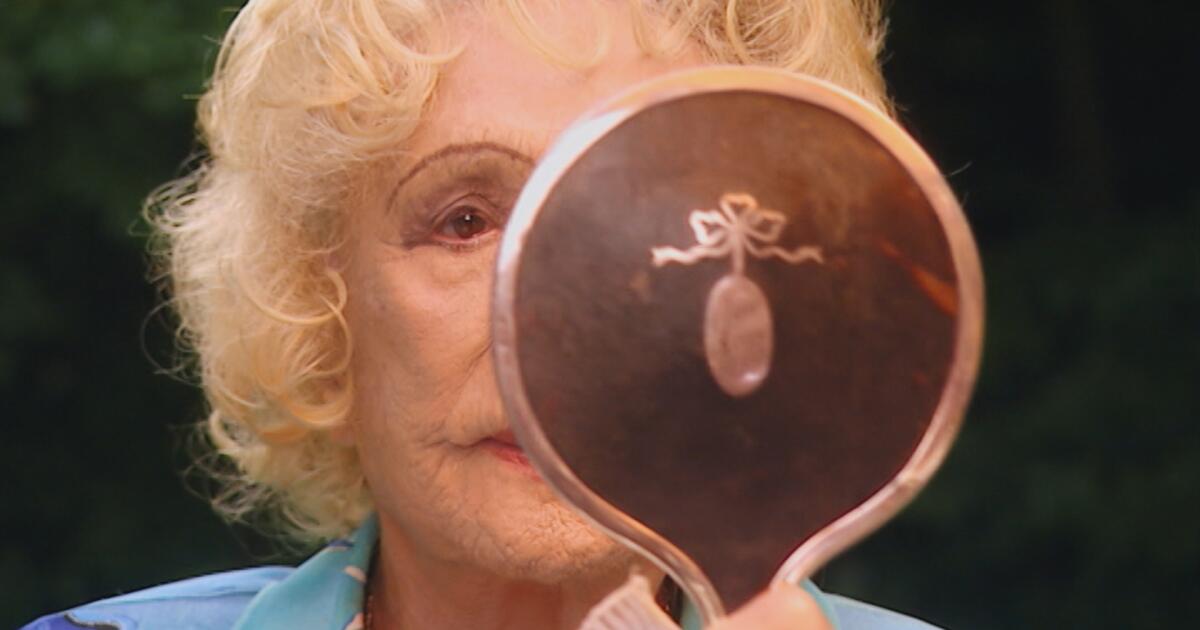
Andres Veiel on the documentary “Riefenstahl”Filmmaker Magazine
Nov 13, 2025
Riefenstahl
Andres Veiel’s Riefenstahl is an arresting and deeply disturbing all-archival portrait of the titular Third Reich actor-director, responsible for some of the most innovative filmmaking of the 20th century as well as horrific war crimes (though Riefenstahl would go to her grave insisting she knew nothing of the mass murder taking place all around her, let alone the power of her propaganda). That said, Hitler’s cinematic mouthpiece would undoubtedly agree that great art requires great sacrifice — just not her own.
The film is made up entirely of materials excavated from the 700 boxes Leni Riefenstahl bequeathed to the Prussian Cultural Heritage Foundation in Berlin, which arrived only after the death of her husband Horst Kettner (40 years her junior) in 2016. That’s when the doc’s producer Sandra Maischberger reached out and struck a deal with the Foundation: her Vincent Productions would undertake an initial examination of the estate for the right to use the contents for a film. What her team ultimately discovered was a never-before-seen goldmine of personal photos and intimate letters, startling recordings and even home movies. All of which, when pieced together by Veiel’s innovative artistic hand, prove what Maischberger (also a prominent journalist in Germany who conducted one of the last interviews Riefenstahl gave before her death) calls the “Riefenstahl principle.” While it’s pretty easy to tell if someone is lying to your face, it becomes nearly impossible when the person has told that lie to herself for so long she believes it to be the one and only truth.
Filmmaker was fortunate enough to sit down in person with Veiel in the lobby of the Perry Lane Hotel at this year’s SCAD Savannah Film Festival (October 25 -November 1), where the German director participated in a post-screening Q&A and on the Docs to Watch Directors Roundtable.
Filmmaker: As someone who studied psychology, and is also a theater and narrative film director, and even directed films focused on actors, how did you approach Leni Riefenstahl? Do you view her primarily as an actress who created and then lived inside a role?
Veiel: Yes, and frankly, it was a challenge to deal with somebody who is such a master of manipulation. She’s a master of fabrication, legends and lies. And when I first sifted through the archive of her estate, I felt annoyed because she is so repetitive, repeating like a sermon, “I was only an artist. I was never interested in politics.”
I had this question of why all these journalists and people who’d interviewed her never really pushed her into a reflection. Why? Because sometimes she got aggressive, intimidating people, and sometimes she represented herself as a victim: “Well, I suffered so much I after the war. I spent three years in camps and prisons.” Which is not true at all, so it’s almost like an actor playing a role, right? She was training, rehearsing.
So I actually asked myself if I should create something like an avatar. That way I could ask the avatar whatever I want, and she could — of course in the realm of the character as I don’t want to reinvent the character — be pushed somehow into another kind of reflection. So I wrote 30 pages of dialogue, [which was] a sort of relief because then I was the master of the game. But then the war in Ukraine started, and I discovered there’s this renaissance of the ideology and imagery. And frankly, the dialogue I wrote, which had a playful element, was suddenly not the right tone. I had the feeling I had to go beyond and restart and look deeper into her estate. Step by step, I discovered a lot of not only the things she took out, but also what she left in, as she made a lot of mistakes.
We found very personal notes, diaries, and the first drafts of her memoirs in which she described the experience of violence at the hands of her father. There’s the episode, which is in the film, when he threw her into the water. She was drowning — she describes being close to death — yet concludes not, “I had a nasty aggressive father who was a monster.” No. It’s that, “I became a good swimmer.” That for me was a discovery. Her need to identify strength was a survival strategy. She developed a contempt for her own weakness, which later on became contempt for the weakness of others.
Filmmaker: It’s interesting you brought up the notion of a survival strategy in response to childhood trauma because, to be honest, as an American Jew I was especially unsettled by my own reaction to the film. Overall, I just felt sorry for her. She was clearly both a perpetrator of lethal propaganda and a victim of horrific abuse — physical (and who knows what else) at the hands of her father as a young girl; and sexual, by the likes of Goebbels, and even by first man she was ever attracted to, who raped her. Riefenstahl was both a narcissistic sociopath and a run-of-the-mill woman of her time, who’d likely been blacking out the darker parts of her life since childhood just to survive. She was intent on not just saving her reputation, but her very sanity. So how did you wrestle with this contradiction as you were making the film?
Veiel: I thought a lot about it in the edit room, the childhood and the violence, which is the first precondition for becoming what she finally became, a prototype of fascism. One of my editors pointed out that Hitler was also beaten up. And then that precondition had to be paired with a second precondition: meeting the veterans of the First World War. The belief that the weak ones broke down and those that survived became even stronger was an organizing principle, assembled under the flag of the Führer. There you have again a contempt for weakness, for unhealthiness, and the separation of us and them. That’s the core of the fascist ideology.
But yes, as you mentioned, I also struggled; it was a tightrope. I want to understand her, but I don’t want to excuse her or exonerate her. There’s this letter from an adjutant describing her role in the first massacre in Poland — 22 Jews were murdered. When I discovered that I suddenly realized that maybe the responsibility, or one can even say the burden of guilt, was much heavier. Being the catalyst of a massacre means you are much more involved. Maybe that’s why she had to deny and say, “I didn’t realize anything. I was far away.” I had to find the balance between understanding but not giving her some sort of exit strategy.
And that was the reason why we changed the ending. In the beginning, we had another ending, more like the typical biography ends — you get frailer, you get weaker. We had a video, one of the private movies, in which she tried to comment on her underwater film. She was around 99, 100 years old, and she kept trying and failing. She finally gives up in front of the camera. And then the housekeeper takes her away, and you have the empty frame.
It’s very touching — some people said, “Now I can see she’s also a human being” — and I didn’t want to do that. It’s wrong. Because I felt the renaissance of the ideology, the renaissance of her aesthetics, and we have to end with the threat, not with empathy. She withheld empathy from everyone but herself.
Filmmaker: But it’s not like fascist ideology started and ended with the Second World War. Watching this film I unexpectedly kept thinking back to Michael Haneke’s The White Ribbon, wondering about the patriarchal, proto-fascist German society that had shaped — and traumatized and protected — Riefenstahl. After all, she was far from the only unrepentant Nazi post WWII, as the archive shows. Which made me wonder if her ability to successfully rehabilitate her image didn’t also heavily rely on the complicity of an audience looking to rehabilitate its own image.
Veiel: Yes, of course she couldn’t have done it without those people. But for me, it’s really two stories that I connected. One is that of the victims, not only of the concentration camps, but also the forced laborers who had to fight for decades just to get a small compensation. Meanwhile, you see Albert Speer, who came out of prison and made millions selling his memoir around the world. Riefenstahl didn’t have the rights to sell Triumph of the Will or Olympia — they were financed by the state — and yet she ended up getting 70% of the revenues. There’s the phone calls in which her husband Horst tells French TV that it’s 3000DM per minute — 3000 euros per minute today — to air Olympia. She became a millionaire. It’s so unfair.
The second story involves the reaction after the talk show, in which she was really celebrated. I asked myself, did she edit it? No, I don’t think so. At the time there was this longing for, let’s say, normalcy. This idea of “Let’s go back to the late ’20s, and let’s skip 1933.” We listened to the tapes, and it’s one phone call after another supporting her. No one criticized her. And then you read the letters — I read all of them, 500 — and they are also very supportive. Even people who survived the Gestapo interrogations, people who survived the camps. Some Jews even supported her, and that was the most painful reaction for me. There’s an exchange of letters between somebody from the Jewish community in Schleswig-Holstein, a northern state in Germany, and she used them as a sort of excuse. She was really ingenious in manipulating and using people.
But her celebration is also a contemporary reaction. When you think about Germany, we had, first of all, the Eichmann trial in 1960. It was in Jerusalem, it was far away. But then in the mid ’60s we had the (Frankfurt) Auschwitz trials, followed by the student movement in 1968. So people had begun pointing at [Riefenstahl’s] generation, saying “You were responsible.” By 1976, the reaction after the talk show was like a wave. It was a backlash to all that, the silent majority speaking up. She was their hero, refusing to be held responsible. So in a way, the phone calls widen the perspective on Germany in the ’70s, but also on the Germany of today.
Filmmaker: One of the most surprising aspects of the documentary for me was the shockingly — gleefully racist footage she and her partner shot with the Nuba tribes. Riefenstahl really seemed to think of Africans — and Jews and Sinti — as nothing more than inanimate props for her “important” artistic projects. So what were some of the biggest revelations for you personally as you were going through the archive?
Veiel: Yes, that footage was a surprise for me too because we’d first thought she was just happy to escape. In Africa nobody asked her about the past, and they loved Leni. They named mountains and kids after her. And I thought, okay, it’s a refuge.
But then I saw it as a repetition. Susan Sontag mentioned this in her great essay [about Riefenstahl’s photos of the Nuba people], how she continued the aesthetics of celebration, using it to mask her racism: “I’m not a racist because now I take pictures of people of color.” It’s absurd.
Another surprise was the shift in storytelling. For example, regarding her role in Końskie with the Jews being slaughtered. We had notes till 1948, and until then she hadn’t disputed being an eyewitness. But then around 1948, ’49, she did. Why? Because that was the time of the denazification trials. Now her story was that she’d learned about it only after the war. I think it was in the late ’50s that she gave a TV interview and you can clearly see that she’s still rehearsing the new version. It’s stiff. It took another two or three years until it became a part of her.
Filmmaker: Yes, you’re basically watching a sociopath at work, taking you through her process. It’s very disturbing, it really rattled me. So how have different audiences reacted to the film? What were the questions like after this screening in the South? What’s been the reaction in the States compared with Europe?
Veiel: Unfortunately, there wasn’t enough time to take questions from the audience since we had to clear the theater (for the next film). There were a lot of students waiting, so I offered to take questions in the lobby but that just wasn’t possible either.
Which was disappointing since the experience here has been amazing — in Chicago, LA, and especially New York. I’ve never experienced such a strong reaction like in the US. The conversations have been so intense. A doctor wanted to tell me about losing funding for breast cancer research because the study was focused on women. Another told me about wanting to marry her Venezuelan partner but now they’re too afraid, even to just go out of her apartment. So everybody’s somehow overwhelmed and confused and uncertain and afraid at the same time.
Filmmaker: But you have the far right threat in Germany, too.
Veiel: Yes, and sometimes things that happen here show up in Germany a few years later. The far right throughout the world talk to each other, support each other. They have a master plan. Vance just came to Germany and warned we don’t have freedom of speech anymore, that we’re not free.
I won’t equate what is happening now to 1933, but I will point out how well prepared Hitler and the NSDAP were after they seized power. Every section of society was infiltrated; it was really precisely planned. Partly it was repression. People got afraid. And at the same time the concentration camps were constructed the NSDAP transferred the unions into their system. So people, even if they were communist, just opportunistically joined for the benefits of the system.
Right now Germans aren’t panicked, but they are watching and they are very much concerned. We have elections coming up in some of the states, and when you look at the polls (the AfD) may not get the majority but they could get 40-45%. They will build up a government, and the first thing they will do is try to destroy the public broadcasting system.
And there’s a second challenge, and that’s economic development. We have a lot of problems now because decades were lost in the car industry, we are not really prepared for China, and now the tariffs may make it even worse. And we all know from the experience of 1932 that an economic crisis puts oil on the fire of extremist parties. Just the threat of getting into a crisis drives people to the far right. And actually, I’ve had death threats from the far right for this film. “You’re spitting on the monument of art.” And very violent words.
Filmmaker: That’s terrible. Was this just people spouting off online, or did you have to call the police?
Veiel: No, no, it’s just people on the internet.
Filmmaker: So with Riefenstahl, you seem to firmly side with the thesis that art cannot — and should not — be separated from the artist. Is this your view when it comes to Riefenstahl alone, or do you apply it to all art and artists?
Veiel: For me, it’s not a question of biography. It’s a question of when you start separating aesthetics from politics. That’s one reason why I said we have to show the fate of the cameraman. She was obsessively editing Olympia when she learned [of his mental breakdown and institutionalization]. She did nothing to intervene [in the subsequent forced sterilization]. Because then you see that the ideology is not just the celebration of strength, but also the exclusion of those who are weaker; a contempt for the unhealthy, the sick who are jeopardizing the idea of “healthy people.” The aesthetics are part of that ideology. That’s why I think you can’t separate the two. Even Tarantino, who said she’s one of the best artists ever — it’s a very naive way of looking at her.
Filmmaker: I guess because then, if you separate the art from the artist, you’re also separating the choices the artist made, not just aesthetically, but also in terms of subject or editorially. Even Riefenstahl says she would never shoot a film with disabled people because she didn’t make “documentaries.” That was a decision on her part — it wasn’t like she couldn’t do that. She just couldn’t make something artistic out of that because it didn’t align with her ideology. And every artist makes choices based on their own point of view, their own ideology.
Veiel: Yes.
Filmmaker: Even Tarantino.
Veiel: Yes, even Tarantino.
Filmmaker: So is there anything you’d like to add as we wrap up?
Veiel: No, I very much liked the questions. You inspired me to some answers.
Publisher: Source link


Netflix’s 10/10 Thriller Series Returns After 3 Year Absence With Explosive New Trailer
Over the last five years, Netflix has expanded heavily into non-English content, with international series taking an even bigger focus for the streaming giant. One of the biggest driving forces in that effort is the French thriller series Lupin, led…
Sep 15, 2026
Original ‘Yellowstone’ Dutton Favorite Officially Confirms ‘Marshals’ Return Interest
Yellowstone jump-started a generation-spanning story that has so far spawned four spin-offs that are all interconnected by the Dutton bloodline. While creator Taylor Sheridan has since branched outside that saga with Tulsa King, Landman, Mayor of Kingstown, The Madison, and…
Sep 14, 2026
Netflix Officially Cancels Its 2-Part Taylor Sheridan Replacement Western
Netflix Published Sep 12, 2026, 10:30 AM EDT Omar is an experienced editor and writer who sees life and storytelling as one and the same — there’s always a story to tell. He’s helped shape features, headlines, and coverage across movies,…
Sep 13, 2026
Jason Momoa’s Epic Historical Action Thriller Officially Getting New Release
Apple TV has established itself as a rising force in streaming entertainment. From Silo and Dark Matter to Pluribus and Ted Lasso, there is something for everyone, and not only that, but a ton of huge star power at the…
Sep 12, 2026