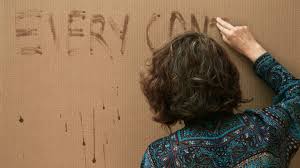
“Every Contact Leaves a Trace” Director Lynn SachsFilmmaker Magazine
Nov 17, 2025
Every Contact Leaves a Trace
Every Contact Leaves a Trace, its title alluding to a basic principle of forensic science, is the latest cinematic exploration from experimental filmmaker and poet Lynne Sachs. Pairing this concept with seven (of the 600) business cards she’s collected over the years, Sachs embarks on an investigation into “how an encounter with someone seeps into your way of thinking” (as she explains in a VO that runs throughout the film).
As a collage of words, sounds and images collide it becomes increasingly clear that Sachs’s mission to understand how each of these random contacts has changed her in some profound way is a heavy one. (Which doesn’t mean the film’s not fun. Rifling through her stack of cards looking for potential people to cast in the project, Sachs rules out folks like the first guy she slept with in college. And also the “goofy person” who “repairs feet — like ingrown toenails.”) And this journey to connect and reconnect with each contact that has left a trace on her being takes the peripatetic director to surprising individuals both near and far.
There’s her hairdresser of six years, who the filmmaker realizes she knows both intimately and not at all. And Angela, the festival director in Germany she met decades ago — a meetup that leads Sachs to ponder German guilt, her relationship to Germany as a person with German Jewish ancestry, and finally her relationship to guilt vis-à-vis Gaza. “When I care for a stranger is it only because a stranger reminds me of myself?” she wonders. (Later Sachs recalls the founder of the Chinese Women’s Film Festival having had a cough when they initially met, which is what endeared her to the director — she was a stranger she could care for.) A discussion of a famous German poet leads to the sound of music inspired by the man’s poetry, which then becomes a parallel soundtrack to Sachs’s own stream-of-consciousness phrases and questions. “In the stream of ideology that Angela named, I am drowning,” the filmmaker admits. Indeed, Sachs’s choice to lay bare onscreen her own uncertainty, foibles and vulnerabilities makes Every Contact Leaves a Trace unexpectedly touching as well.
The week prior to the film’s IDFA premiere (November 17th), Filmmaker reached out to Sachs, whose short This Side of Salina likewise debuted at DOC NYC (November 14th).
Filmmaker: So what was the genesis of this latest film? Did it begin with a curiosity about Edmond Locard’s basic principle of forensic science? With the business cards you’ve collected over the years?
Sachs: From a very early age, I have wondered how one person can be transformed by another. I was never particularly interested in genealogy, the act of going backwards through generations, but I was curious to know how the way that I had chosen to move through the world might have affected my way of thinking and feeling.
When I came across Edmond’s Locard’s principle of forensic science, “Every contact leaves a trace,” as it applied to the study of crime, I immediately transposed it to my own life. I began to wonder how I might prove his hypothesis. The hundreds of cards I had collected throughout my adult life offered clues. There, in one box, I had methodology for using a familiar mnemonic devise used to trigger memory. Each card offered a distillation and, in turn, a vector back to a moment of possible transformation.
Filmmaker: I’m also curious as to how you narrowed down your selection from hundreds of potential reconnections. Why these seven cards/contacts? Were other reconnections left on the cutting room floor?
Sachs: I was looking for a range of encounters. I came across these words from Samuel Beckett’s marvelously insightful novel Molloy, describing two characters: “At first, wide space lay between them. Then they raised their heads and observed each other. They did not pass each other by, but halted face to face. Strangers. Then each went on their way.”
And somehow, I knew the way to make this film. There were the cards for people whose presence in my life reminded me of a turning point from which I could never go back, or the cards for people who made me shiver inside when I thought of them. If a person haunted me in a way that really made me think, or left me with deep desire or even ambivalence, I simply insisted that I search for them – in real life or in my consciousness.
For example, I wanted to reckon with an intensely personal decision that I made after a therapy session in the mid-1990s. I spent two years looking for that therapist. I never found her. So I recreated her as I remembered her, by filming improvisatory interactions with an actress who played that woman.
There was one man whom I became aware of after many years only because he was publicly humiliated by the US government. I had to face my own assumptions, destroy them, and reckon with all the fragments that remained. It was a tough process but also a revealing one. These kinds of decisions are very similar to the ones I make all the time in my filmmaking practice. Who’s in? Who’s out? Ultimately, the people who present the most obstacles to the making of a film are the ones who complicate it and take it to a new place.
Filmmaker: Could you talk a bit about the sound design? I noticed you’ve continued your exploration of cinema and translation — most notably when the subtitles disappear as Angela, the German festival director, reads a poem in her native tongue.
Sachs: Thank you for listening so attentively to so many of my films. You are bringing attention to the difference between hearing words in a film and understanding them. I am keenly aware of the way that English as a language dominates our global cinema experience. For this reason I want my audience to rediscover their relationship to the sound, not just the meaning, of another language, in this case German.
Angela Haardt is the 80-year-old woman in the film who recites lines from the poem The Weavers by Heinrich Heine. In the context of the film it is clear that I do not understand German, so I am only able to hear the sound of her voice. I ask her to translate his words to English, and through her explanation I glean something that becomes relevant to our conversation about her awareness of the Holocaust as a young girl: “You know, when somebody dies, they put them into a cloth for the dead body. And, so they, they weave this cloth for the death of the country. The whole poem is a curse in a way…My mother knew that the Jewish girls one day weren’t there any longer. You didn’t see the action, but you saw the results. How is that possible?”
Filmmaker: What was it like collaborating with your editor Emily Packer, who also directed 2023’s Holding Back the Tide? The two of you seem to share a similar sensibility, if not always the same subject interest.
Sachs: Working with Emily Packer was truly one of the most profound film interactions I have ever had. Emily appreciates the intricate play between narration and images. They approach structure with nuance, inventiveness and ferocity — recognizing the struggle to find the beginning and ending of a film when the center is already so evident. In all of my work I am committed to bringing a conceptual rigor to transitions, so Emily and I would talk for hours about how to get from one scene to the next in a way that would build an intrinsic meaning.
Emily also expected so much from me during the writing and recording of my narration. Only with Emily as a guide could I find the place of vulnerable introspection that brought the film together.
Filmmaker: What do you hope audiences will ultimately take away from the film?
Sachs: A person enters your life and you might be profoundly touched by their presence. As we grow older we become more and more aware that we are an accumulation of these encounters – in our minds and our bodies.
Publisher: Source link




Netflix’s 10/10 Thriller Series Returns After 3 Year Absence With Explosive New Trailer
Over the last five years, Netflix has expanded heavily into non-English content, with international series taking an even bigger focus for the streaming giant. One of the biggest driving forces in that effort is the French thriller series Lupin, led…
Sep 15, 2026

Original ‘Yellowstone’ Dutton Favorite Officially Confirms ‘Marshals’ Return Interest
Yellowstone jump-started a generation-spanning story that has so far spawned four spin-offs that are all interconnected by the Dutton bloodline. While creator Taylor Sheridan has since branched outside that saga with Tulsa King, Landman, Mayor of Kingstown, The Madison, and…
Sep 14, 2026
Netflix Officially Cancels Its 2-Part Taylor Sheridan Replacement Western
Netflix Published Sep 12, 2026, 10:30 AM EDT Omar is an experienced editor and writer who sees life and storytelling as one and the same — there’s always a story to tell. He’s helped shape features, headlines, and coverage across movies,…
Sep 13, 2026

Jason Momoa’s Epic Historical Action Thriller Officially Getting New Release
Apple TV has established itself as a rising force in streaming entertainment. From Silo and Dark Matter to Pluribus and Ted Lasso, there is something for everyone, and not only that, but a ton of huge star power at the…
Sep 12, 2026