Inner Landscapes: Tenzin Phuntsog on “Next Life”
Nov 27, 2025
An image of the Dalai Lama gives diasporic texture to an otherwise anonymous suburban American house; the camera tracks to the next room, where a father, mother, and son sit like statues. A Tibetan doctor arrives, and father Pala (Tsewang Migyur Khangsar) tells him that Western medicine cannot seem to explain the pain he feels in his heart. The doctor takes his pulse, not to know his heart rate, but to listen to something deeper and more intangible hiding in the inner self. The blood rushing through his veins rumbles like a river running beneath the earth, the sound filling the empty room; the doctor can’t identify specifically what, but he knows something happened to Pala in Tibet long ago.
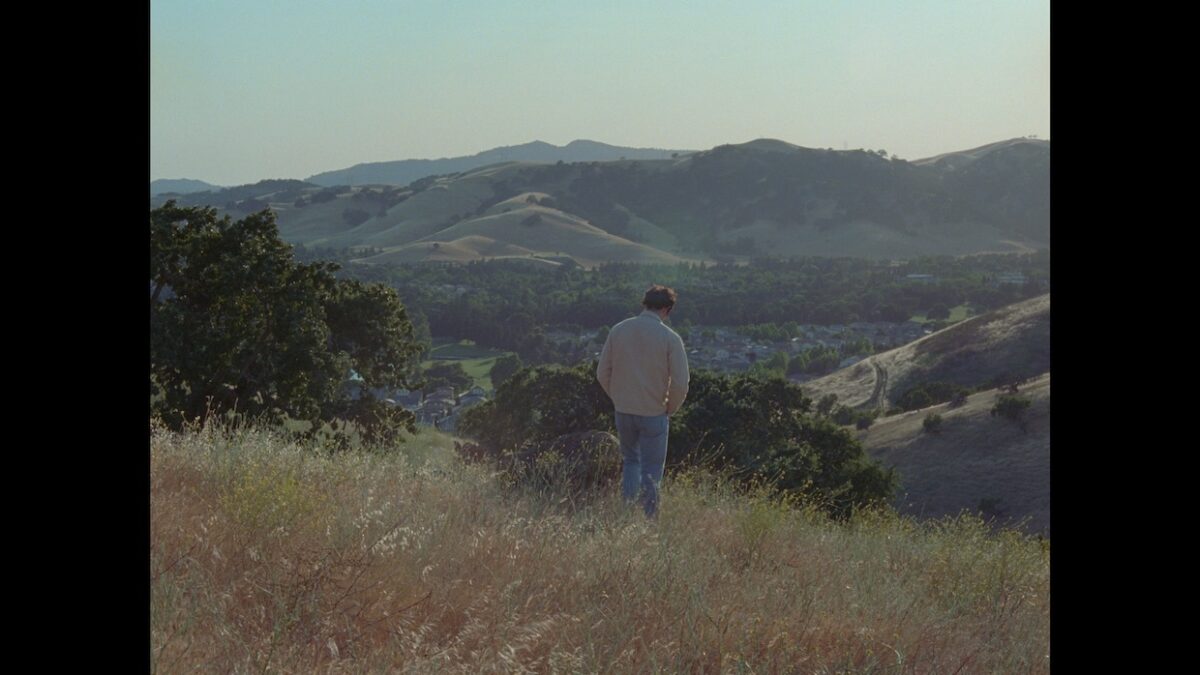
Tenzin Phuntsog’s fiction debut, Next Life, contrasts the bureaucratic reality of living in exile with the spiritual desire to return. Son Rigzin (Rigzin Phurpatsang) is trying to get his father through the red tape of the Chinese embassy and get him a visa to return to Tibet while simultaneously dealing with his father’s failing health and traditional spiritual practices that must be performed to prepare him for the next life. Phuntsog was denied entry into his homeland while trying to make a landscape-based film set in Ngari, a spiritually important region where the Brahmaputra, Indus, Karnalli and Sutlej rivers all find their source. Phuntsog was originally going to frame the landscapes himself, but his denial at the border after numerous attempts led to sending his cameraman, Anders Uhl (who also had an American passport, but critically not a Tibetan name), into the nation by himself with detailed shooting prep notes.
Phuntsog was born in India; his family emigrated to the U.S. when he was a child and he was raised in Massachusetts. He enrolled at UCLA for Design Media Arts, which he describes as “a kind of Fluxus, Situationist program,” before getting his MFA in visual arts at Columbia and going on to perform restoration work of his homeland’s cinema through the Tibet Film Archive while renting a studio space in New York’s Cineric. In Montana in the mid-2010s, Phuntsog saw echoes of Tibet in the American landscape where long grasslands stretch across the prairie east of the Rockies and jagged peaks hug the Gallatin Valley, exploring that relationship to Montana’s landscape in the short Pure Land (something of an early draft of Next Life given its generational family dynamic), and more indirectly in the experimental short doc The Day the Sun Died, which features Apsáalooke elder and cowboy poet Henry Realbird rhapsodizing in stream of consciousness about the total solar eclipse in 2017.
I briefly crossed paths with Phuntsog back then in Bozeman, when I was an undergrad at Montana State University and he was getting his start teaching cinema professionally. Now, Phuntsog’s practice has moved to California. He shot both Next Life and his short Father Mother in Fairfield, in his parent’s real house. He is currently working in the Bay Area on a new film executive produced by Carlos Reygadas (who helped get Next Life finished and released) while acting as the “film house resident” at SFFILM. I caught up with Phuntsog over Zoom after seeing Next Life at the Maryland Film Festival. This interview has been edited for length and clarity.
Filmmaker: You’re drawn to landscapes and the people in them, and you also like to work with celluloid. Can you tell me a bit about that?
Phuntsog: When I was in Montana, I made a decision to start teaching film. I had been working in film preservation for a long time, so I was coming out of this long, intense passion project restoring and preserving Tibetan films. You’re thinking about film as the best preservation medium; I couldn’t stop thinking about, if I were to make something I really cared about, the decision of the format being the first step in the creative process. I made a personal oath to myself that I would do my best to shoot and teach on film. I had not been trained—I took a class on 16mm, but I’m pretty much self-taught. I taught myself how to load 16mm and 35mm based off of YouTube videos, and then I’m teaching students how to load film.
I had worked in New York as a visual effects artist before teaching and really didn’t want to spend 12 hours a day behind a computer. Filmmaking forced me to work with my hands and think about things like light meter readings. Another thing I love about film is the camera doesn’t need a lot of batteries to run, so I’m not thinking about charging things, I’m just looking through an optical viewfinder. Shooting on film really forces you to make some really critical decisions. That limitation that amount of intentionality draws the best out of you.
When I was shooting Next Life, some of the shots were first takes. We barely ever had more than two takes, so everything was super lean. Our crew was six people or less, and I was making this film without any expectation that it would get shown. I just had such a strong desire to make it, and I had this crazy idea to shoot it on 35mm. I had this body of work orbiting around questions about landscape in relation to identity. When I was growing up, I imagined Tibetan landscapes. Accepting this different image, that I can only shoot in the US, is part of accepting my own reality as an artist and finding the beauty in front of me.
Montana cracked something open in me, because the landscape was at a high elevation, and when you go a few minutes out of town, it’s just wild country. Even my mother, when she visited, said it reminded her of Tibet. When I think of the camera frame, if you block out everything else—like the Costcos—for a moment, the frame can suspend your disbelief and you enter Tibet. Or, the landscape creates a tension where it’s not Tibet, but this Tibetan body in the landscape evokes a reading that it could be Tibet. I think that’s what Pure Land does really well. With Next Life, I wanted to focus on the internal landscape, and move into that same question of homeland—loss of connection to that very distinctive place that has a very distinctive landscape. For most people, a landscape that they wouldn’t associate with Tibetan stories is suburban America. That home [in Next Life] is actually where my parents live. That’s their real home, and that’s my mother.
Filmmaker: Tell me more about the space of the home. The interior is often barren in a way that’s generic to American housing developments, but inhabited by objects and people that create that internal world of Tibet.
Phuntsog: Many different things come to that decision-making process of why I stripped down the house. I remember moving around a lot when we first came to the States, and I wanted to have the home capture the sense of this transitory space. We don’t know if they’re ever gonna feel at home. It’s almost like they’ve never fully moved in, or like they’re always gonna move out. There’s a sense of not being too attached to any one place. And, just for practical reasons, when you strip away a lot of my parents’ aesthetic choices, the home becomes more of an archetypal home. It allows anyone to enter it, and the characters become more symbolic. If I were to have chosen something very sexy, like a mid-century modern home or something, I think it would be disingenuous—a lot of immigrants aspire to live in that American suburban home. I wanted to be authentic to all of those things, even if they’re not things I aspire to.
Filmmaker: Early on when the doctor checks the father’s pulse, the sound design totally overtakes the image.
Phuntsog: You start to project images in your head because the action in the frame is very simple. The sound starts to make your mind wander and imagine the inner workings of the psyche and body. Dreams are an important part of Tibetan culture, too, so by tying in the dreams with this pulse reading, the film goes into this surreal, fictional, tangent. In real life, pulse readings really are not about the metaphysical, they’re about, “Oh, my liver hurts.” It’s very much about the body. I wanted to use the Tibetan pulse reading as a device to go into something deeper.
Filmmaker: It seems to me that light is a very spiritual thing in the film as well.
Phuntsog: That summer was just magic. I’ve never seen a summer that nice. I was joking that the tree shot reminds me of Kurosawa’s Ran, this beautiful green grass—like, “We got the Ran green!” It was just a magical light, and the grass was green, which is unusual because California gets dry really quick. We had this long, green summer. Wind was rustling; it was warm, but it wasn’t too hot. Because of shooting on film. We didn’t have to shoot all day. We would shoot in the evenings [and] morning, then in the day we would take a long lunch break. We shot when the light was dramatic.
Filmmaker: You contrast that with VR. I think it’s interesting that in this film that’s so textured naturalistically, you also have them using VR to look at this footage of Tibet.
Phuntsog: I wanted that footage of Tibet to be ambiguous. I didn’t want flags there. I wanted people to project into it, so we also made the footage really impressionistic. It’s not this perfect rendering from Unreal; it’s painterly, strange, upscaled. That was very challenging. We spent a couple months on it, because it’s based off of a clip that someone shot in Tibet with their cell phone. I had to literally recreate, from a very short, couple seconds shot, the whole landscape in 3D, then recreate his head movements to match what you see in the VR landscape. That shot speaks to so many things. It speaks to the desire of the father wanting to return, and ultimately, seeing the son get drawn to that. Late in the film, it connects him to this longing.
Filmmaker: Carlos Reygadas was the executive producer on it and you two are working again, correct?
Phuntsog: Yes. Carlos and I met through a mutual friend. I actually hosted a Zoom workshop [with him] over the pandemic, and that turned into a friendship. He had an offer for me to come by and work at his studio in the future, so I waited several years until I had a project that I really wanted to bring to his studio.
I was able to finish the film at Splendor Omnia, through his help, as a co-production. That experience was really amazing, because I’ve never finished a film with that level of attention to sound. Mixing in a real 5.1 room, I learned so much. We had several months to do all of the foley and sound design. Remotely, I did a lot of early sound passes, then a very intense one-to-two weeks of in-person finishing the film in a dedicated 5.1 sound room where I’m finally able to hear the full potential of all the ideas. Before, if you listen to things on your headphones or your speakers, you’re not getting the full experience. Going there, I felt like we made a second film. The way that they’re doing it, it’s a one-film-at-a-time workflow. You’re living on the grounds, they’re feeding you, you’re sleeping there. You wake up and you’re working a full day with sound mixers and colorists, going between rooms, just finishing the film with really talented, skilled artists, and doing it all on systems that are real time so you’re not waiting for things to render. You’re seeing it and hearing it in two rooms. Then, when you leave, you watch the married film together and it’s like the first time the film exists.
Carlos helped me even when we finished the film. We chose FIDMarseille for our world premiere. I didn’t have any marketing budget, didn’t have a PR person. One of the things that Carlos told me is: if you really believe in and love your film, your film will find its audience in its own time. It was something I really needed to hear because I was thinking, “Oh, I need $10,000, $15,000, $20,000. I literally have no money.” The only way I could finish the film was through Carlos’ co-production. All of a sudden, I’m making a DCP and trying to get a PR firm. Carlos has created a space that filmmakers can come to to finish their films. I was lucky and fortunate enough to have him actually watch the film and he expressed his admiration for it—that’s what really inspired me to reach out to him to support me on my second film, Sentient Beings. If it’s not for these people, there’s no way I would be doing this.
Filmmaker: In one of your classes you had us read Sculpting in Time, and one of my big takeaways from that book was when Tarkovsky talks about how if an image means something to you, it could mean something to somebody else.
Phuntsog: Why are we making this thing if it doesn’t mean something to you? What are your intentions? Is it about fame, about money? It shouldn’t be about those things. In a purest sense, you’re making because you truly enjoy making, and you’re committed to this. My creativity is one of the most special things in my life. Now I have kids, but before I had kids that was the one thing I never tried to compromise on. Creativity is something that really needs to start in a pure place, and if it means something to you you should protect it.
Publisher: Source link



Netflix’s 10/10 Thriller Series Returns After 3 Year Absence With Explosive New Trailer
Over the last five years, Netflix has expanded heavily into non-English content, with international series taking an even bigger focus for the streaming giant. One of the biggest driving forces in that effort is the French thriller series Lupin, led…
Sep 15, 2026
Original ‘Yellowstone’ Dutton Favorite Officially Confirms ‘Marshals’ Return Interest
Yellowstone jump-started a generation-spanning story that has so far spawned four spin-offs that are all interconnected by the Dutton bloodline. While creator Taylor Sheridan has since branched outside that saga with Tulsa King, Landman, Mayor of Kingstown, The Madison, and…
Sep 14, 2026
Netflix Officially Cancels Its 2-Part Taylor Sheridan Replacement Western
Netflix Published Sep 12, 2026, 10:30 AM EDT Omar is an experienced editor and writer who sees life and storytelling as one and the same — there’s always a story to tell. He’s helped shape features, headlines, and coverage across movies,…
Sep 13, 2026
Jason Momoa’s Epic Historical Action Thriller Officially Getting New Release
Apple TV has established itself as a rising force in streaming entertainment. From Silo and Dark Matter to Pluribus and Ted Lasso, there is something for everyone, and not only that, but a ton of huge star power at the…
Sep 12, 2026