Ethan Hawke Is A Cool Cat “Truthstorian” In Sterlin Harjo’s Entertaining Wayward Citizen-Detective Comedy
Dec 11, 2025
Truth is slippery, community secrets curdle, and even good intentions sour fast in Tulsa’s heat. That’s the world of “The Lowdown,” FX’s new neo-noir comedy from Sterlin Harjo (“Reservation Dogs”), where conspiracy shadows every handshake and no father, citizen, or seeker of justice comes out clean. Harjo builds the show like a crooked blues riff—laid-back, shaggy, and funny on the surface, but with darkness humming underneath, waiting to consume anyone who digs too deep.
READ MORE: Fall 2025 TV Preview: 45 Series To Watch
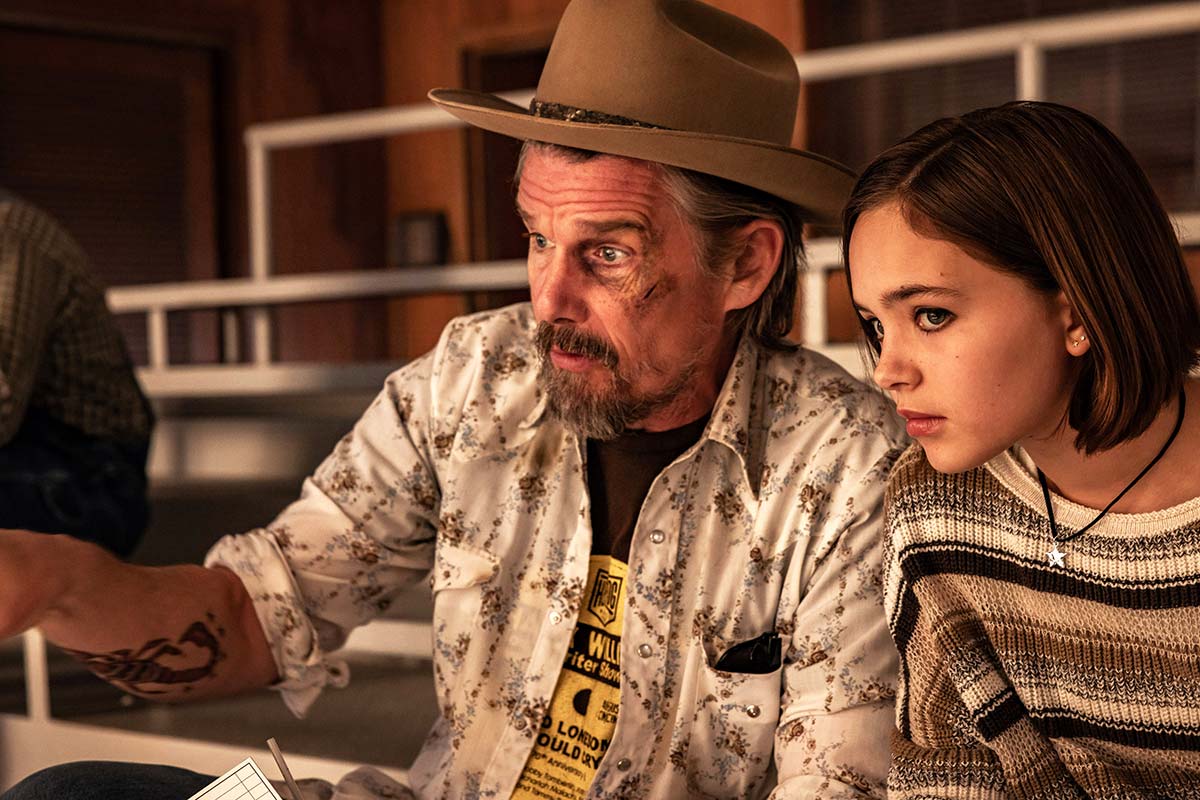
At the center is Ethan Hawke as Lee Raybon, a self-described “truthstorian”: part muckraker, part folklorist, part amateur detective, and full-time meddler. Hawke is effortlessly good here, as if the role were built for his easygoing sensibilities and his knack for playing a charming rogue. He easily threads comedy and consequence, toggling between soulful charisma and comic haplessness, often within the same scene. A divorced father trying to stay connected to his teenage daughter, Francis (Ryan Kiera Armstrong), Lee spends his nights chasing rumors, stirring up conspiracies, and cataloguing Tulsa’s hidden rot. His restless pursuit of “the real story” is half obsession, half vocation—equal parts comic blunder and dangerous crusade.
Seeking truth often finds trouble, and Lee Raybon cannot keep his inquisitive nose out of business when that business smells shady. Raybon is like a dog with a bone when his gut tells him a mystery runs darker than it looks on the surface. So when Dale Washberg (Tim Blake Nelson), the troubled outcast of Oklahoma’s most powerful dynasty, turns up dead in what officials rush to label a suicide, Lee can’t help himself. The timing is too suspicious—Dale dies just as Lee’s latest exposé on the Washbergs hits print—and the odd breadcrumbs Dale leaves behind practically beg for someone to investigate. Lee, being Lee, dives headfirst.
Dale’s widow Betty Jo (Jeanne Tripplehorn) wears grief like a costume, her eyes already drifting toward brother-in-law Donald (Kyle MacLachlan), a gubernatorial candidate with everything to lose. Tripplehorn radiates allure and calculation, while MacLachlan twists his trademark charm into something slipperier and more menacing—a politician whose smile hides opportunism and rot.
The deeper Lee digs, the more the shadows push back. Harjo sharpens the menace with Tracy Letts as Frank Martin, a political fixer tasked with protecting the Washbergs at all costs. Cold, calculating, and quietly ruthless, Letts makes Frank the show’s blunt reminder that Lee isn’t just chasing ghosts—he’s poking the machinery of real power. At his side lurks Allen Murphy (Scott Shepherd), a pallid, unsettling enforcer who handles the family’s dirty work with unnerving precision.
And as if tangling with the Washbergs weren’t dangerous enough, Lee keeps crossing paths with Marty (Keith David), a smooth, enigmatic stranger who seems to materialize whenever the investigation heats up. Marty shares Lee’s love of literature and philosophical chatter, but his persistent curiosity about the Washberg case feels a little too pointed, his refined wit shading into something quietly predatory. David makes Marty a riddle of a man—half ally, half threat—who keeps Lee on edge.
The back half also delivers Peter Dinklage as Wendall, a wayward friend from Lee’s past who’s somehow an even bigger drunken mess than he is. Their reunion is funny, chaotic, and sad all at once, with Dinklage serving as both comic foil and cautionary mirror of what Lee risks becoming.
Lee’s personal life is no less tangled. His ex-wife Samantha (Kaniehtiio Horn) is weary of his compulsions but remains a thorny reminder of the family he’s fractured. The real center, though, is Francis (Ryan Kiera Armstrong). Sharp-eyed and restless, she sees her father as unreliable, even reckless, yet can’t resist his pull. Over time, she discovers her knack for deduction and inserts herself into his half-baked investigations. Armstrong is terrific—witty, vulnerable, and sharper than most adults in the room—and she gives the series its beating heart. It’s a performance that suggests a star in the making, and her dynamic with Hawke, prickly but magnetic, becomes the show’s emotional core.
At its heart, “The Lowdown” is about fatherhood and obsession colliding. Lee wants to be present for Francis, but every lead he chases pulls him further away. Hawke captures the contradiction: funny and soulful one moment, selfish and distracted the next. The show clarifies that meaning well isn’t enough—truth-seeking comes at the cost of being present.
Support independent movie journalism to keep it alive. Sign up for The Playlist Newsletter. All the content you want and, oh, right, it’s free.
Harjo builds the show with the same DNA as “Reservation Dogs”—a love of hangouts, oddballs, and shaggy rhythms—but bends it toward noir. There’s a touch of Hal Ashby in the looseness, the way scenes drift between comedy and melancholy without losing momentum. Tulsa’s streets glow with sodium lamps, bars curl with smoke, and backrooms hum suspiciously. Classic noir setups—silhouettes in doorways, tense confrontations—quickly collapse into comedy: an interrogation dissolves into absurdity, a chase ends in pratfalls, a clue is overlooked because Lee is distracted. That tonal balancing act, where dread and laughter bleed into one another, gives “The Lowdown” its spark.
Harjo leans on JJ Cale, Boz Scaggs, and ’70s boogie-blues to ground the series in Tulsa’s spirit. The soundtrack is laconic and soulful, rolling under every scene like another conspiratorial character.
Ultimately, “The Lowdown” emerges as a witty, soulful noir that’s as much about family as it is about conspiracies. Anchored by Hawke’s cool-cat charisma, sparked by Armstrong’s breakout turn, and shaded by David, MacLachlan, Tripplehorn, Nelson, Letts, Shepherd, Dinklage, and Horn, the series thrives on Harjo’s blend of melancholy and mirth. It argues that truth is never clean, that community is built on contradictions, and that fatherhood means more than meaning well—it means knowing when to stop digging.
Like the best noir, “The Lowdown” isn’t about revelations or neat closure but about recognition: following the trail of truth means accepting that the closer you get, the more it costs. The show thrives on mood more than answers—dragging you into its smoky Tulsa night, where every secret uncovered comes with a scar, and every laugh leaves a battered black eye. [B+]
Publisher: Source link



‘Reacher’s Action Thriller Spin-Off Gets Major Season 2 Update Following Premiere
For four seasons, Reacher has been one of the biggest TV shows on Prime Video. Based on the novels by Lee Child, the series follows former military police officer Jack Reacher (Alan Ritchson) as he wanders from place to place,…
Sep 18, 2026

One of CBS’ Longest-Running & Highest Rated TV Shows Is Coming To End After 30 Years
Along with countless scripted dramas, comedies, and action shows, CBS is well known for its impressive run of unscripted programs over the last 50 years. More recent years have included major competition shows like Survivor and The Amazing Race, along…
Sep 17, 2026

Prime Video Officially Launches New Deal That Changes the Streaming Game Forever
It seems like streamers raise their prices every day. At the end of August, Apple TV raised the subscription service price by $2, bringing it to $14.99 a month. Netflix, Disney+, HBO Max, Paramount+, and Peacock have all raised prices…
Sep 16, 2026
Netflix’s 10/10 Thriller Series Returns After 3 Year Absence With Explosive New Trailer
Over the last five years, Netflix has expanded heavily into non-English content, with international series taking an even bigger focus for the streaming giant. One of the biggest driving forces in that effort is the French thriller series Lupin, led…
Sep 15, 2026