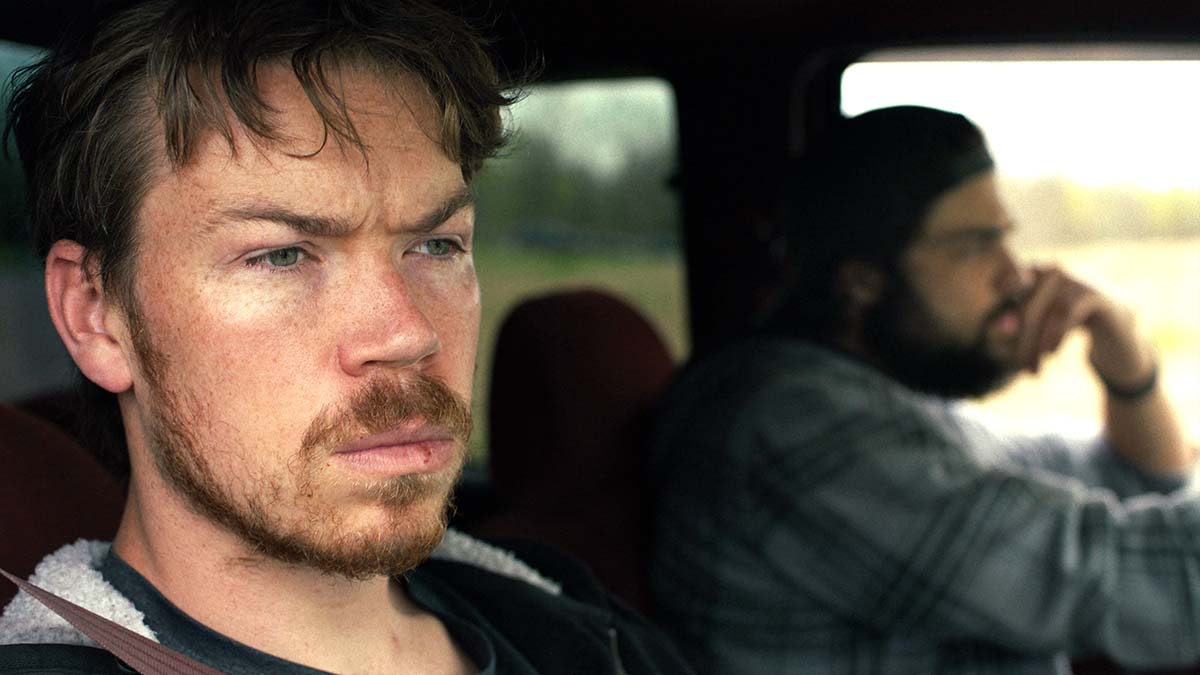
Will Poulter Is Sensational In An Addiction Drama That Avoids Sensationalizing [Sundance]
Feb 3, 2026
Despite all the movies made about addiction, the topic does not naturally lend itself to tidy cinematic narratives. (At least, when portrayed accurately.) While actors often visualize the condition of substance dependency through expressive physical outbursts, the reality of recovery tends to be much quieter. It’s a walking contradiction of presence defined by absence. It’s inside this liminal terrain where filmmaker Adam Meeks stages his feature directorial debut, “Union County.”
The film operates on an anti-narrative logic for Will Poulter’s Cody, a recovering opioid addict at the start of a court-mandated recovery program. It’s a disorienting inversion of stakes for both the protagonist and the audience. The goal of any scene is to keep the big action from taking place. Stasis and stability replace change as the main engine of character development.
READ MORE: Sundance 2026 Preview: 30 Films We Can’t Wait To See
Relapse looms large over every moment with Cody, but Meeks never treats the possibility of its occurrence as cheap narrative stakes. “Union County,” like its protagonist, pieces together a life through the accumulation of small details. In place of sensationalized story beats or pathologized characterization, Meeks’ screenplay stitches together mundane moments with an eye toward minutiae and procedure. Cody finds a job. He gets new housing. He flirts with a new love interest. He scores again. He starts over.
While this structure serves as a functional rebuke of emotionally manipulative dramas on the same subject, Meeks is not responding to anything beyond the characters’ daily routines. The aesthetic does not feel forced upon the events, nor does it overpower the work’s humanistic core. It’s a naturalistic way of articulating how simply getting through a day can simultaneously be the smallest and the biggest thing possible for those trying to get their lives back on track.
“Union County” really is just as simple and sincere as Cody attempting to regain solid ground under his feet and make it to the next stage of his program. His foster brother, Jack (Noah Centineo), walks alongside him – as do several first-time actors drawn from the real program as the production unfolded. Notably, Meeks conveys the nature of this collaboration solely through an end title card, further eschewing artificial methods of proclaiming the project’s significance. This sincerity is something felt in the film before it becomes identifiable.
Support independent movie journalism to keep it alive. Sign up for The Playlist Newsletter. All the content you want and, oh, right, it’s free.
Meeks finds a dedicated partner in his mission with Will Poulter, who also serves as producer on “Union County.” While addiction tropes have long been catnip for young actors looking to prove their immersion into a character, Poulter prostrates himself before the stripped-down banality of Cody’s existence. This is evident from the film’s opening shot, in which the actor is visible only at the bottom left of the frame. His story might receive the spotlight here, yet he’s merely one among the many in his rural Ohio community that opiates have ravaged.
This humility seeps into Poulter’s staggering performance as well. His turn recalls Casey Affleck’s Oscar-winning work in “Manchester by the Sea,” with his ability to harness something at once ethereal and grounded. Cody floats through the program like a ghost who’s still somehow alive. The character is haunted by a past that he cannot process and a present he can only handle as a series of immediate, discrete actions.
Meeks’ script judiciously doles out information about what brought Cody to this point. Only about halfway through “Union County” does the character begin to disclose personal details or reflections in a support group. But the address never feels like it’s cheating by delivering a monologue of exposition to the audience. The speech is true to the character’s own mental state. Besides, small nuggets like Cody’s mom calling him “Hurricane” as a child make for more telling, evocative morsels of backstory.
There is no jittery twitchiness in Poulter’s stunning performance, just raw and real reactivity to his circumstances. He exudes the program’s vision and the devoted public servants, such as his counselor, Annette Deao (playing a version of herself), who make it work. Bureaucratic proceduralism, ranging from urine tests to passing through metal detectors, is a powerful tool of character revelation so long as it upholds, rather than flattens, an individual’s dignity.
Meeks honors this experience through his unfussy aesthetic style. “Union County” feels imbued with the spirit of neorealism’s desire to portray the world in an unvarnished light, but Meeks never leans on lazy verité tropes to juice the stakes. Sequences tend to play out in plain singles with limited cutting between camera angles. There’s enough variety to keep the film from drifting into monotony, but the direction is never so obtrusive as to create drama rather than capture it.
Unsurprisingly, Meeks also eschews easy catharsis as Cody passes through the program. In fact, the closest thing “Union County” offers to reconciliation is its very opposite. Cody’s sister, the patient but fatigued Katrina (Emily Meade), expresses to him that she cannot understand him – and may never be able to forgive him.
The film concludes that addiction is never something Cody can vanquish. It’s simply something he can learn to manage. “Union County” offers something better than the Hollywood ending. It’s honest. It’s helpful. Perhaps, it’s even hopeful for those willing to sit with the uncomfortable reality of the condition, as Meeks and Poulter have. A transient victory is a triumph all the same. [B+]
Follow along for all of our coverage from the 2026 Sundance Film Festival here.
Publisher: Source link








‘Reacher’s Action Thriller Spin-Off Gets Major Season 2 Update Following Premiere
For four seasons, Reacher has been one of the biggest TV shows on Prime Video. Based on the novels by Lee Child, the series follows former military police officer Jack Reacher (Alan Ritchson) as he wanders from place to place,…
Sep 18, 2026

One of CBS’ Longest-Running & Highest Rated TV Shows Is Coming To End After 30 Years
Along with countless scripted dramas, comedies, and action shows, CBS is well known for its impressive run of unscripted programs over the last 50 years. More recent years have included major competition shows like Survivor and The Amazing Race, along…
Sep 17, 2026

Prime Video Officially Launches New Deal That Changes the Streaming Game Forever
It seems like streamers raise their prices every day. At the end of August, Apple TV raised the subscription service price by $2, bringing it to $14.99 a month. Netflix, Disney+, HBO Max, Paramount+, and Peacock have all raised prices…
Sep 16, 2026
Netflix’s 10/10 Thriller Series Returns After 3 Year Absence With Explosive New Trailer
Over the last five years, Netflix has expanded heavily into non-English content, with international series taking an even bigger focus for the streaming giant. One of the biggest driving forces in that effort is the French thriller series Lupin, led…
Sep 15, 2026