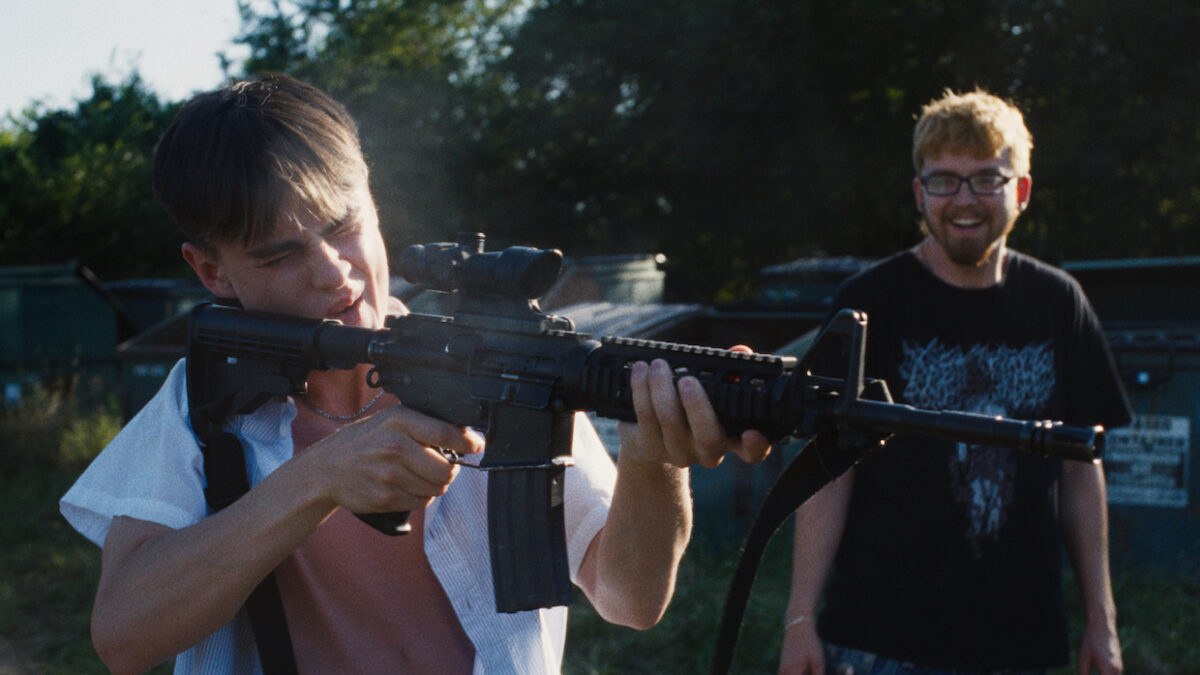
Oscar Boyson and Ricky Camilleri on Our Hero, BalthazarFilmmaker Magazine
Apr 3, 2026
Our Hero, Balthazar
“It was important to us not to be a shit post,” says Ricky Camilleri, co-writer and co-producer of Our Hero, Balthazar, thanking me for not describing it as “edge-lordy.” On paper, the film, directed and co-written by Oscar Boyson, sounds like a provocation: a dark comedy about a teen who tries to stop a school shooting—not out of moral clarity, but out of ego.
Balthazar Malone (Jaeden Martell) is a wealthy Manhattan private school kid living in a high-rise, performing sensitivity online through teary grief narratives—essentially crying for influence. In a bid to impress his school crush, a girl more politically engaged than he is, he latches onto a new idea of himself: a hero. Balthazar travels to Texas to befriend the lonely and potentially murderous soul who goes by @deathdealer_16, tracking him down through a mix of online sleuthing and catfishing him as a sexy AI-generated woman.
Early Letterboxd reviews out of the Tribeca Film Festival, where the film premiered last year, drew comparisons to Taxi Driver and Uncut Gems, which are not entirely off-base. There is a misunderstood potential mass shooter, a handheld freneticism, and James William Blades’ synth-heavy score that features unusual sounds and devices. Boyson was also a producer for the Safdie brothers, but those parallels flatten the nuances that make Our Hero, Balthazar distinct. The film, Boyson’s feature debut, is stranger and messier without exploding into empty shock. “At a Q&A someone introduced the film by saying it revels in bad taste, and I remember thinking that it really doesn’t,” says Camilleri, pushing back on the description. “It’s not a midnight movie. There’s a little more heart.”
Rather than mock its characters, the film exposes the fragile, front-facing logic of internet life—the way identity is performed, curated, and often untethered from reality. “During that post-pandemic period, I felt really bad for these kids spending their 12th and 13th birthdays alone,” Boyson says. “Kids performing an identity on social media, feeling like they have to be a brand by the time they’re 10.”
Boyson and Camilleri are in their forties, old enough to remember a version of the internet that felt less corrosive. They met as teenagers at a Boston University summer film program—“basically film nerd camp”—and stayed close as their careers diverged. “We were 17, sitting around talking about movies, making little productions,” Boyson recalls.
“We’re Mark Zuckerberg’s age—Facebook felt like it was just for us,” he adds. “The internet was a healthier place. You could follow independent movies, all the cool music that was coming out.” For Boyson, that kind of space was crucial to figuring out who you were as a teenager—an outlet into subculture and discovery that now feels diminished and more performative.
The impetus for Balthazar came in part from the 2022 Uvalde shooting, and reports that a woman in Germany had been messaged by the shooter but didn’t take it seriously. “It’s not that different from what a lot of people do,” Boyson says. “When we get an extreme message, we just tune it out or respond ironically. Or, like in her case, make an ironic response.” The woman simply messaged back, “cool.”
He brings up the school shooting in Vancouver that happened last month, and the recent news that the perpetrator used ChatGPT to plan the attack. “ChatGPT saw these messages and questions from the shooter, and none of them did anything about it. It’s very different from what happened in Uvalde, but it also speaks to the same distance from these shooters that we have.”
“Balthazar came out of this idea of who would have the means to act and do something, and who wouldn’t be paying enough attention so he could go off and stop him,” Camilleri adds. From there, they could extrapolate and create the appropriate world of warped characters: his sweet but neglectful mother (Jennifer Ehle); his self-absorbed life coach (Noah Centineo) meant to help him “break out of his shell.”
Solomon (Asa Butterfield), meanwhile, lives a very different life. Sharing a trailer with his grandmother, he’s recently lost his gas station job and can’t make rent, all while buying into his father’s pyramid scheme—a toxic masculinity figure (Chris Bauer) peddling testosterone and self-help mantras like a grizzled version of Magnolia’s T.J. Mackey. Butterfield is nearly unrecognizable, fully inhabiting a character who is both volatile and painfully adrift.
His collision with Balthazar forms the film’s uneasy core: two neglected boys, each performing versions of themselves online, both searching for connection in the wrong places. Balthazar, despite his privilege, is the more deluded of the two. “He’s even more flawed than the guy who’s helplessly looking for attention on the internet,” says Boyson.
“Flawed is an understatement for the kind of characters we like,” adds Camilleri. “It’s not necessarily that we like characters who back themselves into mistakes so a plot can unfold. It’s that there’s an inherent conflict for someone who doesn’t have the capacity to make the right decision.”
Crucially, the film—shot on location in a Texas trailer park with local residents—avoids the trap of poverty porn. “I’ve seen so many movies where, to be blunt, it feels like rich kids from New York going to some small town and saying, ‘Oh my God, did you see what that guy just did in his trailer?’” Boyson says. “I’m not from where Solomon’s from, but I grew up in a place with a real mix of economic backgrounds. That kind of perspective doesn’t sit well with me.”
Camilleri is similarly wary of easy shorthand. “I really don’t like it when a blue-collar character shows up and suddenly has all the answers to the lead’s problems in some forced monologue about grief or tragedy,” he says. Casting Asa Butterfield as Solomon also helped ground the performance, steering it away from a narrower set of references that might feel overly familiar to a cool New York indie actor. (Speaking of references, Balthazar was not intentionally named after Robert Bresson’s donkey, but a happy coincidence.)
Boyson, who has worked extensively with non-actors, is especially attuned to the difference between portraying a character and representing a real person. “If you’re going to go into that world and talk about these people,” he says, “there’s an immense responsibility. Otherwise, you shouldn’t be doing it.”
The film’s humor operates with that same sense of specificity and care. In one scene, Solomon’s grandmother (Becky Ann Baker) listens to him practice a sales pitch and responds with a joke that some viewers, Camilleri tells me, have misread as inappropriate—a crude aside at the character’s expense. But that misreading (“It’s her version of a lighthearted joke. Her way of giving him confidence”), he suggests, says more about the viewer. “I grew up in a world like this,” he says. “This crass and vulgar humor is how a lot of people live and get by. This is me leaning into what I know and what feels real, and not being afraid of making something vulgar just because someone who’s never been in that world doesn’t totally get it.”
Another thing the film tries to get right is its portrayal of a distinctly modern, online-inflected reality. The filmmakers avoided using slang, which Camilleri notes would feel “totally uncool and immediately outdated,” and instead filmed phones using real social media apps rather than green screens. When it came to production, Boyson also prioritized performance above all else, insisting on two weeks of rehearsal. “It doesn’t cost that much to put them in a position to do their best work and take risks.”
Boyson aimed to “hold onto that electricity of performance that isn’t getting cut after each syllable or sentence,” arriving at a shooting style built to preserve it. As Camilleri puts it, the question became, “How can we shoot as much as possible and give the actors the most freedom?” Given the low budget, that meant letting go of some more formal ambitions, with Boyson letting go of “this-is-a-beautiful shot-on-a-dolly ego” to remind himself that “nobody gives a shit about that unless they’re connected to the performances and the energy of the movie.”
Above all, they were chasing a feeling they remembered from their own adolescence—the jolt of discovery that came from films like The Idiots, Boogie Nights, or Refn’s Pusher series. “We wanted something that makes a kid sit up in their seat,” Camilleri says. “Something that feels alive.”
Whether Our Hero, Balthazar achieves that for its audience may vary—but it’s hard to deny that it takes a real swing. And for Boyson, that was the point.
“I’m very sensitive to people taking the risk and gamble of working on an independent film,” he says. “It means everything to me that they come out the other side a believer, rather than thinking it’s a waste of time.”
Publisher: Source link


Netflix’s 10/10 Thriller Series Returns After 3 Year Absence With Explosive New Trailer
Over the last five years, Netflix has expanded heavily into non-English content, with international series taking an even bigger focus for the streaming giant. One of the biggest driving forces in that effort is the French thriller series Lupin, led…
Sep 15, 2026
Original ‘Yellowstone’ Dutton Favorite Officially Confirms ‘Marshals’ Return Interest
Yellowstone jump-started a generation-spanning story that has so far spawned four spin-offs that are all interconnected by the Dutton bloodline. While creator Taylor Sheridan has since branched outside that saga with Tulsa King, Landman, Mayor of Kingstown, The Madison, and…
Sep 14, 2026
Netflix Officially Cancels Its 2-Part Taylor Sheridan Replacement Western
Netflix Published Sep 12, 2026, 10:30 AM EDT Omar is an experienced editor and writer who sees life and storytelling as one and the same — there’s always a story to tell. He’s helped shape features, headlines, and coverage across movies,…
Sep 13, 2026
Jason Momoa’s Epic Historical Action Thriller Officially Getting New Release
Apple TV has established itself as a rising force in streaming entertainment. From Silo and Dark Matter to Pluribus and Ted Lasso, there is something for everyone, and not only that, but a ton of huge star power at the…
Sep 12, 2026