Damian McCarthy on HokumFilmmaker Magazine
Jun 5, 2026
Hokum
Damian McCarthy knows how to scare an audience. At the Hokum premiere at SXSW, screams and giggles filled the theater as festivalgoers jumped in their seats and covered their eyes watching McCarthy’s tightly wound trap spring out at them—sometimes literally—on the screen. The Irish writer-director describes his films as “classic ghost stories,” campfire tales designed to have you searching for faces in the shadows all the way home. They’re elemental, they’re impeccably crafted, and they’re a lot of fun.
Hokum is McCarthy’s third feature, and the first time he has worked with a major actor—Adam Scott, who stars as an acerbic novelist named Ohm Bauman—in one of his films. To say that McCarthy has humble beginnings is an understatement: He supported himself as an electrician while making microbudget short films before completing his first feature, the similarly handcrafted Caveat, in 2020. His second feature, Oddity (2024), built on the eerie vibes and trap-door mechanics of the first, drawing praise as one of the best horror films of that year.
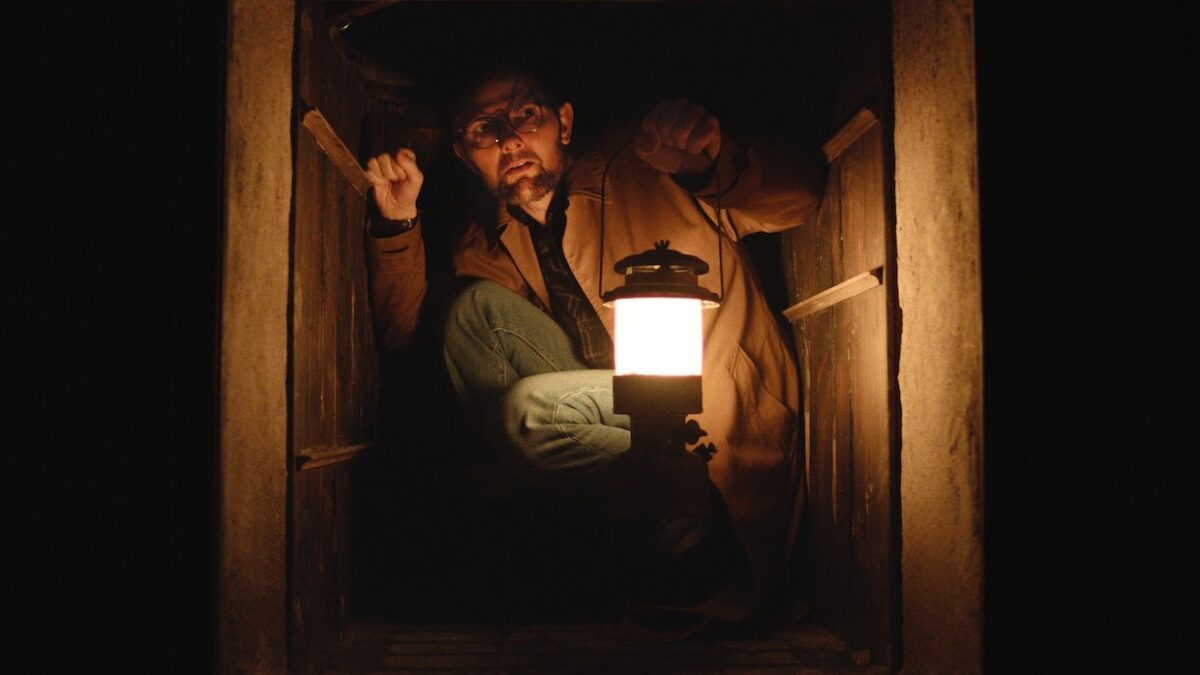
Hokum shares these traits, as well as a preoccupation with folklore that runs throughout McCarthy’s work. It’s a side effect of growing up in rural Ireland, the filmmaker says, a place where roads to nowhere stretch on for miles and miles. Hokum takes place on Halloween, in the birthplace of the holiday, at a haunted hotel in the Irish countryside that’s full of handsome wood carvings and flickering autumnal light. That’s where Scott’s character gets drawn into a mystery that takes him from the hotel’s bar to its long-abandoned honeymoon suite; there, he discovers a dumbwaiter that lowers him to the hotel’s claustrophobic basement, where a soul-snatching witch is rumored to live.
These days, McCarthy has transitioned to filmmaking full time as Hokum prepares for a wide release in the United States through its distributor, NEON, which acquired the film last August. But his shoestring early experiences shaped McCarthy’s process in ways that still benefit him today, as he explained to Filmmaker in an interview that reveals the preparation, passion, and precision of his craft.
Filmmaker: Would you say that you’re a disciplined filmmaker?
McCarthy: In terms of my approach, yes. There’s not really a looseness to [my films]. I don’t move the camera unless it’s absolutely necessary. There are moments of chaos, but it still feels intentional.
It’s probably because I storyboard everything. I don’t do a lot of rehearsing, but I talk to the actors a lot before we get into it, just going through the script and just trying to find any issues. So yeah, there would be that disciplined feel.
Filmmaker: You’re not doing anything improvisational.
McCarthy: No, no, certainly not. I mean, actors always bring something great you hadn’t thought of. I find a lot of that in the talks I’ll have with the actors.
But it’s always [important] to have that plan, because then when you get there on the day, you can throw it out. There’s always a certain amount of improv, I guess, in that things change on the day, which is fine because it’s always “the best idea wins.”
Filmmaker: When I’ve talked to filmmakers who started off very small, they say that you have to plan ahead when you don’t have a ton of resources on the day. Would you agree with that?
McCarthy: I would. It starts right back from He Dies at the End, Hatch—these really small short films I made. That was always somebody giving us a location, like a bar we used to drink in. The owner would be kind enough to give us the bar for the night: “It’s going to close at midnight, and you’ve got to be out at 10 in the morning.” [In that scenario] you don’t have time to figure out where to put the camera. Then you really have to show up storyboarded. It was never a budget thing, because I never had any money, but it was definitely the schedule and the time. We’d have six hours to shoot, so we needed to be really prepared.
That carried over into Caveat, because again, no budget. I mean, absolutely tiny. Our crew was technically four or five people. I had to know exactly what we were filming because we just didn’t have time or resources to think too much about it. And that’s just carried on. I’ve never changed the way I work. Even with Hokum, where you have a lot more support and you have people with a lot of experience, a clock is always ticking.
Filmmaker: When we’re talking about suspense and horror, the editing is really important. How hands on are you with that?
McCarthy: Brian Phillip Davis edited Oddity and Hokum, and we got on great. Brian’s a big horror fan, the same as me. I guess maybe it’s been helpful for him too. I edited all of my own short films. I edited Caveat over a year on weekends and after my day job. I know what it’s like to edit a film and try to cut around things that maybe aren’t coming together,so I’m not coming as a complete amateur, either. I can offer suggestions and solve some problems.
Brian is very much the same. So between the two of us, we’ve got a good rhythm going and lots of good references to swap. It’s all in the edit, really, with a horror film. Taking things out or changing things or holding a beat longer can make something so much scarier.
Filmmaker: Would you say that that’s a science or an art?
McCarthy: It’s got to be an art. It’s just the feel of it. We’ll watch something, and it feels like nothing’s changed. We’ll say, “That scare isn’t landing for some reason.” And it can be very frustrating. “Performance is great. It’s all there. Why isn’t it working?” And then you leave it alone and come back to it. We’ve taken out a frame or two and then suddenly it works.
On Hokum I’ve tried to dig into [that] a little bit more. I need to figure out why it suddenly works. We’ve taken out two frames—what was happening in those two frames that was spoiling something? It could be that an actor has taken half a step too close, or they’ve blinked, or the light changed ever so slightly. It’s the funniest thing. Frames make a difference.
Filmmaker: How long you hold on certain shots can be very important, too.
McCarthy: Holding on the shot signals that something is about to happen, and now it’s up to the audience to try to figure out when. When you slow down that edit,it’s a back and forth between you and the audience, and seeing if you can keep a step ahead of them. Of course, you can also do jump scares, where you don’t signal at all that something is coming. That’s fun too. I do it just to put people on edge.
Filmmaker: How do you feel about the great jump scare question in horror?
McCarthy: I like them. Yeah, they can be cheap, and people complain about them. But as long as they’re earned, it’s okay. It’s all about what leads up to it.
I’d made a bunch of short films that never worked. They were terrible. Then I made this four and a half minute long short called He Dies at the End. It was just my best friend—who still works on the films with me—sitting at a computer, and we know something’s going to jump out at him at some stage. It really worked.
The monster that pops up at the end is ridiculous-looking. Objectively, it’s just not scary. It’s silly. But I’ve watched it with the audience, and the tension would be really good because there’d be that nervous laughter. There’d be a fake out in the middle, and then this ridiculous thing pops up and it scares people, but it’s immediately followed by laughter. All of the positivity with that film was very much about the buildup. It’s a lesson I’ve held onto.
It’s just all about building up that suspense as much as you can till you get to the release. Of course, I have also done the out-of-nowhere jump scare where there’s no sign that it’s coming, and that’s fine too. It’s just to keep people on their toes.
Filmmaker: How do you use darkness and shadow to create horror in your films?
McCarthy: It’s a basic primal fear, the dark. We don’t know what’s there. All of my films are supposed to feel like a classic ghost story, almost like they’re lamplit or lit by fire. It has that old feeling of, “We’re safe in this tiny space of light and warmth. But then beyond that, who knows?” There could be somebody just outside the reach of the light.
It’s always been something I’ve kept in mind, to have as much darkness in the frame as possible. People’s eyes will naturally start to wander around the screen and see if they can find something hiding in there. Especially with Hokum, which opens up under this wide, beautiful blue sky in a vast desert. Eventually, it’s Adam going right down [into the darkness]. That’s all about building claustrophobia and working your way into the horror.
Filmmaker: Sound design is extremely important with designing horror. In this film, you use a lot of emptiness and layering of sound. Can you talk a little bit about your approach to that?
McCarthy: If a film is scaring you, turn off the sound and it’s no longer scary. I don’t care what’s happening on the screen. It’s all sound.
Joseph Bishara’s score is amazing, but Steve Fanagan is a wonderful sound designer as well. It was really about layering. I kept saying to him, “This is a ghost story. Think of somebody pretending they’re a ghost, doing this silly, cartoonish kind of noise. We’ll work backwards from that.” That was where we began, [the idea that] somebody is messing with you, going “OooooOooohhh.”
Then it became all those layers of wind effects, manipulating the speed of them and layering voices on top of that. You can hear that someone is whispering Ohm’s name, but he’s never sure if he heard it. Hopefully the audience will have the same reaction. The building creaking, the animals, the fox cries—sound-design-wise, this was the film that I’ve been waiting to make, because I absolutely love sound design. I think it’s undervalued in [terms of what] it can bring to a film, especially a horror film.
Filmmaker: Did you study folklore? Was it part of your life when you were growing up? It’s so pervasive in your films.
McCarthy: It’s just something I always had an interest in. I mean, I live in rural Ireland, so there are stories of banshees and the puca and all this kind of stuff. Even in school, when you’re learning Irish, all these old myths and folklore are taught in class. It always seems to find its way somehow into the films, especially this one.
Filmmaker: How rural is it where you live?
McCarthy: Well, I live in Cork now, but I grew up in a place called Bantry. There were only a couple of houses in the area. My family is from a very small village called Glengarriff, and there’s nothing there. I mean, it’s beautiful, but it’s a tiny place. The opening of the movie where you see Adam’s car driving through the hills—that’s where I’m from. There are lots of lovely places to visit, but there are certain roads where you go for miles and miles and there’s nothing there.
Filmmaker: There’s a theme of punishing the wicked in your films. Does that tie in to your interest in folklore?
McCarthy: I’ve made three features now, and all of the villains in them are cowardly, pathetic men, and they do get punished by something supernatural at the end. It’s a way of having both a supernatural threat and then also having a real-world villain, just to double up on problems for the protagonist. I guess there is something in there, that the wicked are punished in the films. That’s probably from growing up in Catholic Ireland.
Filmmaker: I made a joke about that in my review and I thought, I hope I don’t offend him by saying that it seems very Catholic.
McCarthy: A character at the end is dragged off to hell, literally, so yeah. You’re bang on.
Publisher: Source link


Netflix’s 10/10 Thriller Series Returns After 3 Year Absence With Explosive New Trailer
Over the last five years, Netflix has expanded heavily into non-English content, with international series taking an even bigger focus for the streaming giant. One of the biggest driving forces in that effort is the French thriller series Lupin, led…
Sep 15, 2026
Original ‘Yellowstone’ Dutton Favorite Officially Confirms ‘Marshals’ Return Interest
Yellowstone jump-started a generation-spanning story that has so far spawned four spin-offs that are all interconnected by the Dutton bloodline. While creator Taylor Sheridan has since branched outside that saga with Tulsa King, Landman, Mayor of Kingstown, The Madison, and…
Sep 14, 2026
Netflix Officially Cancels Its 2-Part Taylor Sheridan Replacement Western
Netflix Published Sep 12, 2026, 10:30 AM EDT Omar is an experienced editor and writer who sees life and storytelling as one and the same — there’s always a story to tell. He’s helped shape features, headlines, and coverage across movies,…
Sep 13, 2026
Jason Momoa’s Epic Historical Action Thriller Officially Getting New Release
Apple TV has established itself as a rising force in streaming entertainment. From Silo and Dark Matter to Pluribus and Ted Lasso, there is something for everyone, and not only that, but a ton of huge star power at the…
Sep 12, 2026