Paul Thomas Anderson Finds Intimacy In The Shadows [NYFF]
Oct 25, 2026
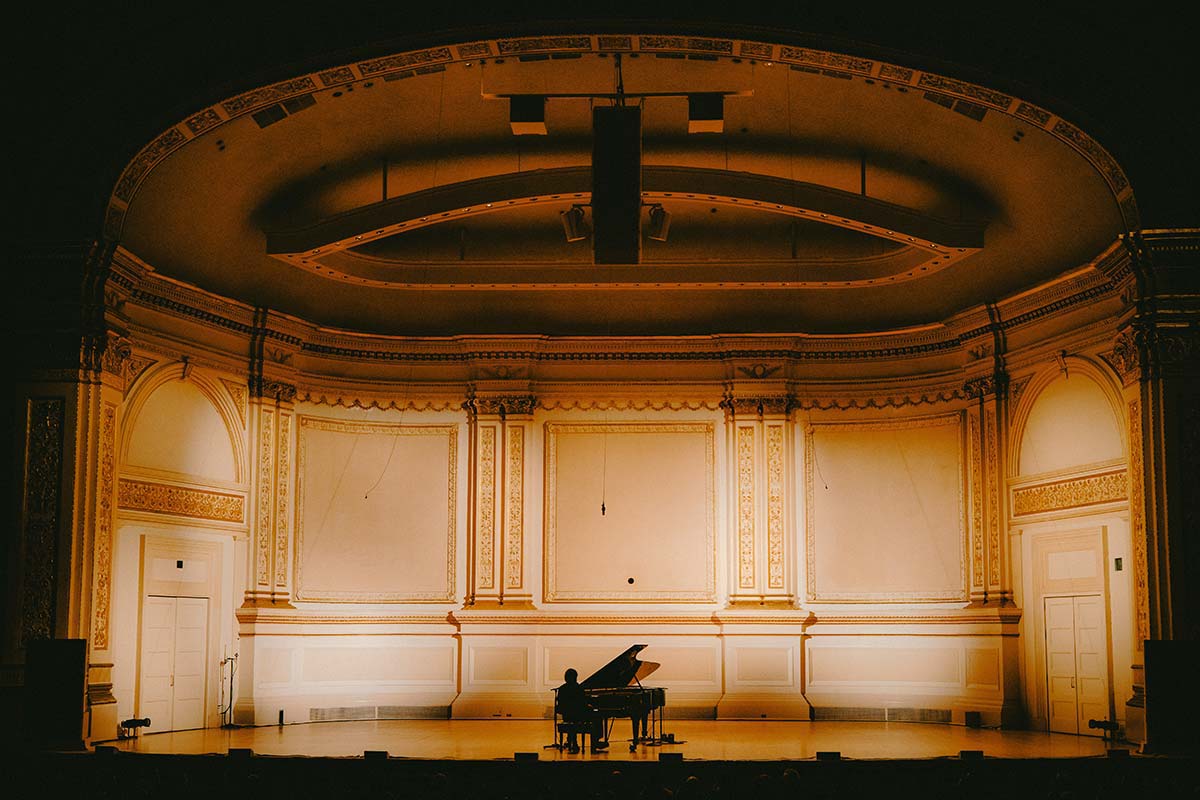
There’s something almost comically disproportionate about “Cameron Winter at Carnegie Hall.” The legendary venue is enormous, Paul Thomas Anderson is one of the most celebrated American filmmakers alive, and then there’s Cameron Winter himself: a 24-year-old wunderkind singer-songwriter who, in barely a year, has gone from cult curiosity to being greeted with the sort of near-messianic fervor usually reserved for a once-in-a-generation arrival. The hype has been massive, the ascent startlingly fast, and the whole occasion carries the whiff of coronation. Yet here he is: one tall, awkward, gangly figure, one Steinway grand piano, a pool of light, and a collection of strange, wandering songs that keep shrinking the evening into something intensely personal, even private.
READ MORE: 2026 New York Film Festival Preview: 21 Must-See Movies To Watch
That tension between scale and intimacy gives Anderson’s 72-minute concert film much of its meaning. Shot on 35mm during Winter’s December 2025 solo performance, it looks gorgeous without constantly announcing the fact: deep blacks, warm pockets of light, faces materializing from darkness, and Winter frequently ensconced in shadow. More important is how Anderson manipulates the room itself. Patient zoom-ins gradually erase Carnegie Hall until Winter’s face, hands, and piano seem to occupy the entire world. Then he pulls back, the balconies and gilded architecture return, and the spell breaks just enough to remind us where this hushed encounter is actually taking place.
Winter, the frontman of Geese, was 23 when the concert happened, following the acclaim for his 2024 solo debut Heavy Metal. Comparisons to Bob Dylan, Leonard Cohen, Tom Waits, and Rufus Wainwright have accompanied his rapid rise, and this project could easily have reinforced all that mythmaking. Instead, Anderson keeps finding the mismatch between the stature of the occasion and the young man occupying it.
Winter can sound ancient and impossibly young at once. His deep, bruised baritone seems to belong to someone several decades older, while hunched behind the piano he can appear almost boyish, folding his long frame inward rather than projecting the ease of someone born for the spotlight. Anderson’s slow zooms make that contradiction vivid. A wide shot reduces Winter to a tiny body in the darkness; moments later, the lens has crept close enough to register a squint, twitch, crooked smile, or movement of his hands. The camera patiently crosses a distance Winter himself seems reluctant to close.
His music comes from a classical singer-songwriter tradition but approaches it with a much shaggier, more eccentric sensibility. The songs can feel half-composed and half-discovered, full of detours, malformed jokes, grotesque images, and melodies that wander until they unexpectedly find their destination. Water, bodies, religion, money, lovers, God, departures, and damaged things pile together until an emotional logic emerges. They don’t always make literal sense, but they tend to make emotional sense.
With little underneath him but piano, the Carnegie arrangements amplify that unruliness. Songs stretch and circle rather than march toward a chorus. Winter bends melodies, elongates phrases, and worries at compositions until another possibility emerges. Anderson responds in kind, letting shots breathe and allowing the film’s tempo to follow Winter rather than manufacturing momentum around him.
That becomes the movie’s real remit. Anderson finds a visual equivalent for songs built around exposure and concealment, longing and withdrawal. Winter repeatedly returns to distance, faith, separation, and the difficulty of reaching another person; the camera answers through proximity, drawing him toward us before wider frames restore the surrounding space.
READ MORE: Paul Thomas Anderson’s Secret Cameron Winter Concert Film Sets 35mm Theatrical Tour
The lighting makes that idea almost literal. Winter appears shrouded in black, emerging only partially into isolated pools of illumination. In “Try As I May,” he sings, “You were meant to watch my private ceremonies…all in the dark parts of rooms,” and the lyric feels uncannily suited to Anderson’s images. This is a ceremony shot almost unceremoniously, one that can sometimes resemble a wake for someone who is very much alive. Anderson’s stripped-down approach grants access to something that looks secluded, while the setting itself insists on the moment’s importance.
Winter hardly behaves like someone accepting a crown. He never really addresses the audience, maintaining an oddly sealed-off presence at the piano, but his songs cheekily do the talking for him. “Fuck these people, I’m not even here” gets a laugh precisely because thousands of people are hanging on the words of somebody acting as though they barely exist. Spiritual yearning brushes against bodily ugliness, romantic devotion crashes into absurdity, and Winter keeps mussing up the reverence Carnegie Hall naturally supplies.
Anderson largely refrains from inserting himself into that tension. An occasional conspicuous camera move or visual joke breaks the trance, but such flourishes register because he otherwise refuses to goose the performance to remind everyone who directed it. Then, after the end titles, he finally can’t resist: “Dead at 23” appears onscreen, a mordant little gag aimed at the mythology surrounding Winter. What other explanation could there be for a 23-year-old receiving the Carnegie Hall, 35mm, Paul Thomas Anderson treatment except that everyone has already begun martyring him into legend?
That fidelity also creates the film’s limitation. Winter’s drowsy low register, the single instrument, and similarly drifting song structures can produce a narcotic sameness. At its strongest, repetition becomes hypnotic, making tiny alterations in framing, phrasing, or mood feel enormous. At other points, the spell edges toward the soporific. Anderson refuses to manufacture another gear, admirable in principle but occasionally limiting in practice.
Support independent movie journalism. Sign up for The Playlist Newsletter for the latest film and TV news, reviews, interviews, and more—free.
Still, “Cameron Winter at Carnegie Hall” understands that closeness in a concert film doesn’t require backstage access or explanatory context. Anderson repeatedly turns a palace into a darkened room and then opens it back up again, finding cinematic form for a songwriter whose music reaches outward while remaining partly hidden.
“Try as I may, I never did seduce the wall,” Winter sings in his odd hymnal. Maybe not. But for 72 minutes, he sure as hell seduces the room—and Anderson’s camera along with it. [B/B+]
Follow along for all of our coverage of the 64th New York Film Festival.
Publisher: Source link



‘The Gentlemen’ Loses 2 Original Stars, Reunites ‘Lord of the Rings’ Icons in Big Season 3 Shake-Up
Guy Ritchie's signature blend of aristocratic elegance and gritty underworld chaos has officially solidified its place as a Netflix powerhouse. Originally launched as a television spin-off of his hit 2019 feature film, The Gentlemen captivated global audiences across its first…
Oct 24, 2026
Taylor Sheridan’s ‘Yellowstone’ Sequel Hits Major Milestone Ahead of Streaming Return
The Yellowstone universe has grown so fast since the main series ended that it’s fair to wonder whether the franchise might be stretching itself a bit thin. That’s part of why Dutton Ranch came as something of a surprise. Beth…
Oct 23, 2026
Taylor Sheridan’s 5-Part Western Sensation Returns to Streaming as New Spin-Off Battles for #1 Spot
Taylor Sheridan's seminal five-season western is officially one of the biggest shows on streaming, once again, all while its latest spin-off fights for the #1 spot on the charts. Taylor Sheridan keeps going from success to success. After his hit…
Oct 22, 2026
5 Years Later, Spin-Off of Netflix’s Rescued Sci-Fi Hit Reaches a Major Milestone
Manifest is one of the few examples of a canceled television series finding new life on a streaming platform. After being canceled by NBC in 2021, Netflix added the supernatural drama to its extensive library, and it immediately shot to…
Oct 21, 2026