
âWhat Does a Thing Provide You With?â: Amanda Kramer on the Props and Interiors in By Design
Mar 4, 2026
By Design
“I have never seen the problem with fetishizing objects and fetishizing people as though they were objects,” director Amanda Kramer tells me in a conversation ahead of the release of her latest film, By Design. “It doesn’t mean we don’t also see the person for their soul…They elicit romance. They elicit seduction. There’s something drawing you in, compelling, alluring, and the object itself is not necessarily lesser-than because it’s looked at in this way.”
Kramer’s provocative theory is instructive. Her latest film, By Design, about a lonely woman named Camille (Juliette Lewis) who swaps bodies with a beautiful chair and the equally lonely pianist Olivier (Mamadou Athie) who comes to possess it, released, just as provocatively, on Valentine’s Day Weekend. It’s a film about what objects mean to people, not just as possessions, but as reflections of our desires—not everyone’s idea of romance. It also brings Kramer’s career-long preoccupation with design to the forefront. We can see her ideas working both underneath and on the surface of the story. But to understand what Kramer is doing here, it’s important to think about how she arrived.
Of her three most recent films’ production designers—Grace Surnow (By Design), Liz Toonkel (Give Me Pity!), and Bette Adams (Please Baby Please)—Kramer says, “Their artistic register is just so high, they’re coming in with the most beautiful, ecstatic, eclectic ideas.” Kramer’s films are full of ecstatic feelings and experiences, and production design is central to expressing them.
Please, Baby, Please (2022) fuses a lineage of Classic Hollywood and avant-garde inspirations (Sirkian melodramas, the Marlon Brando-starring The Wild Ones, and Kenneth Anger’s Scorpio Rising) into a rabid, musical thrashing of gender norms. After an identity-altering run-in with a sexy, leather-clad street gang, buttoned-up hetero couple Arthur and Suze (Harry Melling and Andrea Riseborough) shed their rigid notions of gender and throw caution to the wind. The smooth surfaces and, as Kramer calls them, “perfect messes” of Bette Adams’s production design turn the real world into an abstraction, and act as weapons with which to “scrap the world we live in.” Here we find production design in perfect alignment with Kramer’s imagination.
In her follow-up, Give Me Pity!, also released in 2022, Kramer and production designer Liz Toonkel work with artificiality in new ways. The set for musical sensation Sissy St. Claire’s television special is the playground for her wildest imaginings and her deepest fear. A paranoid riff on the televised musical specials popularized by 1970s and ’80s divas like Diana Ross, Cher, and Bette Midler—the real-life mother of lead actor Sophie von Hasselberg—the film lets Kramer’s interest in theatrical flatness or, as Kramer puts it, “the space that is on the opposite side of the thing that’s happening,” take brand new shape.
Not only does Sissy interact with her audience (which because of COVID restrictions, was not actually there), but she’s haunted by a physical presence beyond the cameras of the only world that’s real to her—the fictional set.. Kramer’s prior work in theater means she knows how a theatrical space operates, and positions the viewer both inside and outside of Toonkel’s exuberant, deliberately manufactured creation. The luscious satins, sparkling jewels, and performative Americana that define Sissy’s musical acts are thus sincere and suspect at the same time. Kramer achieves this through a keen understanding of how to infuse meaning into physical spaces within the frame.
“I’m fascinated by a person who can live with so little,” Kramer admits of fashion designer Thierry Mugler, whose Paris apartment inspired Camille’s in By Design. “Camille lives in a studio apartment with one bathroom. You can see there’s no kitchen…Everything about her room, she needs to love everything in it. And that, to me, is a fascinating way to live. Imagine the things that could come into your mind if you didn’t have so much bullshit everywhere.”
Production designer Grace Surnow echoes Kramer’s sentiment. “There’s so much not there that when you’re thinking about what is there, it has to be really special and unique to the world. It is about love and obsession with objects and things, about the personification of objects. Every little detail we wanted to add had to be like its own person, like somebody could be trapped inside.”
This being a film by Amanda Kramer, whose work thrusts and lurches around the logical boundaries between minimalism and maximalism, those essentials aren’t necessarily what you or I might, for example, save in a fire. But Camille and Kramer are, in some ways, similar. They “would find an object of art, a curiosity, a rarity, and would covet it and want it.” The ear-shaped bookend, bulbous pink sea shell, and glass chess set upon which Kramer’s camera alights are less thematic symbols than they are genuine necessities for character and story.
On the subject of personification, Surnow remembered the process of selecting “The Chair,” an elegant, early 20th century “stunner,” as it’s called in the film by narrator Melanie Griffith, of warm glowy wood and sensitive curves. Kramer and co. knew “that it should feel archetypal in a way. Something not very special, in that it’s a chair with four legs and it’s something you’ve kind of seen every day, but also different enough that it feels like it stands out.” The Chair’s singularity is all the more powerful on a set, designed according to Kramer’s maximalist sensibilities, where “everything [is] a focal point” inside emotionally empty spaces. This sensibility is reminiscent of Jacques Tati, whose films constantly fluctuate between visual congestion and openness, and encourage the viewer’s eye to wander and focus on something new.
The line between anonymity and subtlety is thin, and for a filmmaker who takes conceptual swings as big as Kramer does, there’s a risk of not pulling it off. Luckily, the rest of the film makes calls for other extravagant design choices—for example, the other chairs in the showroom, and a gothic, Tim Burton-esque dining room—which Kramer approaches with good humor. “We got the chairs, and suddenly it was like they had personalities, as if you were looking at a full room of men and women. Suddenly you’re like, ‘This one’s too funny. This one’s coming off as too humorous. This one is way too stuck-up.’”
Camille wants to be desired as she desires this chair; she envies its beauty and usefulness, its deserving of praise. The moment she falls in love with it, Kramer’s essential question, which she posed in our conversation, emerges: “What does a thing provide you with?”
Once she’s swapped bodies with the chair and is in Olivier’s possession, Camille fulfills her wish to be someone’s object of unflinching, obsessive desire, a stark contrast to her role as sex object, sounding board, and emotional punching bag to the other people in her life, including a spurned lover (Clifton Collins Jr.), her materialistic mother (Betty Buckley), and her petty, self-centered friends Lisa and Irene (Robin Tunney and Samantha Mathis, respectively). Olivier also has a vessel for his love, one whose supple lines and sturdy construction attracts ravenous attention from everyone who sets eyes on it—be they snotty dinner companions or even the chair’s designer, played by the late, great Udo Kier—and affirms his worthiness to own it.
This quality of the romance between Olivier and Camille, as the chair, is the perfect example of Kramer’s theory, in which one’s objectification can trump one’s humanity when that humanity is denied elsewhere.
“I really appreciate and feel that there’s such soul and desperation in Juliette’s performance,” Kramer says. “And I think it ends on a note where you can only feel for her as you would feel for anyone who feels life might have been better [as] someone else’s object. That’s sad, but it also works for her.”
Troubling as Kramer’s theory may be, in By Design’s tragic climax of fated reunion and incompatible desires, we find its ultimate expression.
Publisher: Source link







A Flame The Colour of Air – Film Threat
SLAMDANCE FILM FESTIVAL 2026 REVIEW! You will shimmer and shake, like you’re riding the snake while being wowed by the dynamite animated short A Flame The Colour of Air, written and directed by talented Canadian filmmaker Emily Pelstring. Jessica Mensch’s…
Mar 3, 2026

‘9-1-1’ Can’t Decide What It Wants To Focus On in a Lackluster Season 9
Editor's Note: The following contains spoilers for 9-1-1 Season 9, Episode 11.I was hoping that 9-1-1 would take advantage of its month-long hiatus and course-correct after its most recent episode, but while this week is certainly an improvement from last…
Mar 3, 2026
Good Luck, Have Fun, Don’t Die Review
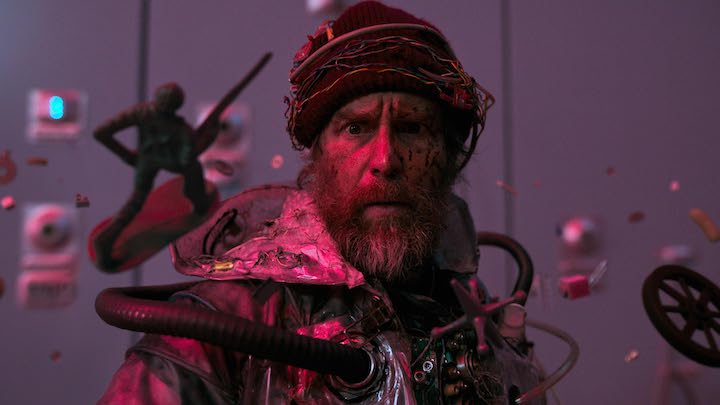
Mercy was a film about AI that AI could’ve written. Good Luck, Have Fun, Don’t Die also tackles AI, although it could only come from the mind of Gore Verbinski. As he did with his Pirates of the Caribbean trilogy…
Mar 1, 2026

Investigative Screenplay Review: Suspenseful but Weak Antagonist
Vadh 2 (2026): When Murder Is Justified — Starring Sanjay Mishra as prison guard Shambhunath Mishra When evil tries to take control, its destruction becomes necessary. With this theme, Bollywood brings you a spiritual sequel to its 2022 crime-thriller “Vadh”.…
Mar 1, 2026