A Body Horror Take On Cinderella, By Way Of Coralie Fargeat’s The Substance [Sundance]
Feb 4, 2025
An Ozempic allegory, a feminist takedown of Disney princess stories, and Coralie Fargeat’s Cinderella will be among the interpretations thrust upon “The Ugly Stepsister.” Norwegian filmmaker Emilie Blichfeldt’s horror dramedy is largely entertaining on its own terms, even for viewers unwilling to dig deeper. Its modernist meta-textual caustic sting? You can take it or leave it. But it will richly reward those in tune with Blichfeldt’s gleeful bastardization of fairytale tropes. The ending title card, “Slutt,” Norwegian for “the end,” is a final wink and middle finger that perfectly encapsulates Blichfeldt’s arch sensibilities for the material.
READ MORE: 25 Most Anticipated Movies At The 2025 Sundance Film Festival
The Cinderella tale and its variants have existed for literally two millennia. “The Ugly Stepsister” sets up all the familiar archetypes before upending the board. Stepmother Rebekka (Ane Dahl Torp) travels with her two daughters, the stepsisters Elvira (Lea Myren) and Alma (Flo Fagerli), to the estate of the Cinderella figure Agnes (Thea Sofie Loch Næss) to marry Agnes’ father. Agnes’ father promptly dies, and Rebekka assumes control over the household. Meanwhile, the local prince Julian (Isac Calmroth) has announced a ball in four months, where he will pick a beautiful, virginal young woman as his bride, with Agnes & Elvira aspiring to be picked.
Blichfeldt makes notable alterations to find her vantage point on extremely familiar and played-out material. Like recent Hollywood villain origin stories, “Maleficient,” “Cruella,” and “Wicked,” “The Ugly Stepsister” makes Elvira the protagonist, as the title indicates. Far from four-quadrant family blockbusters, Blichfeldt also makes a distinctly adult version of Cinderella – erect penises and hacked body parts abound. Blichfeldt also wilfully punctures any romantic idealism, her Prince Julian is a whoring, STD-infested fuckboi, and the cabal of aristocrats at the royal court are without exception, seedy, grotesque, leering and given to debauchery and exploitation of young women.
It is in her treatment of the female figures that Blichfeldt establishes her feminist bona fides. The evil stepmother Rebekka remains a mustache-twirling villain, but the ugly stepsister Elvira and the Cinderella figure Agnes are suitably evolved and complicated—neither entirely contemptible nor sympathetic. Showing a frustration with virginal purity attributed to young women as a badge of goodness in fairytales, Blichfeldt portrays Agnes as sexually active, carrying out a dalliance with a stableboy in a deliberately overheated sex scene.
Elvira, the protagonist, undergoes the most significant transformation. Lea Myren’s committed, unsparing lead performance resonates with “The Ugly Stepsister.” Blichfeldt’s take is, first and foremost, the portrait of a young woman thwarted and infantilized by societal and gender expectations and subjected to every indignity and humiliation imaginable—by well-wishers and detractors alike.
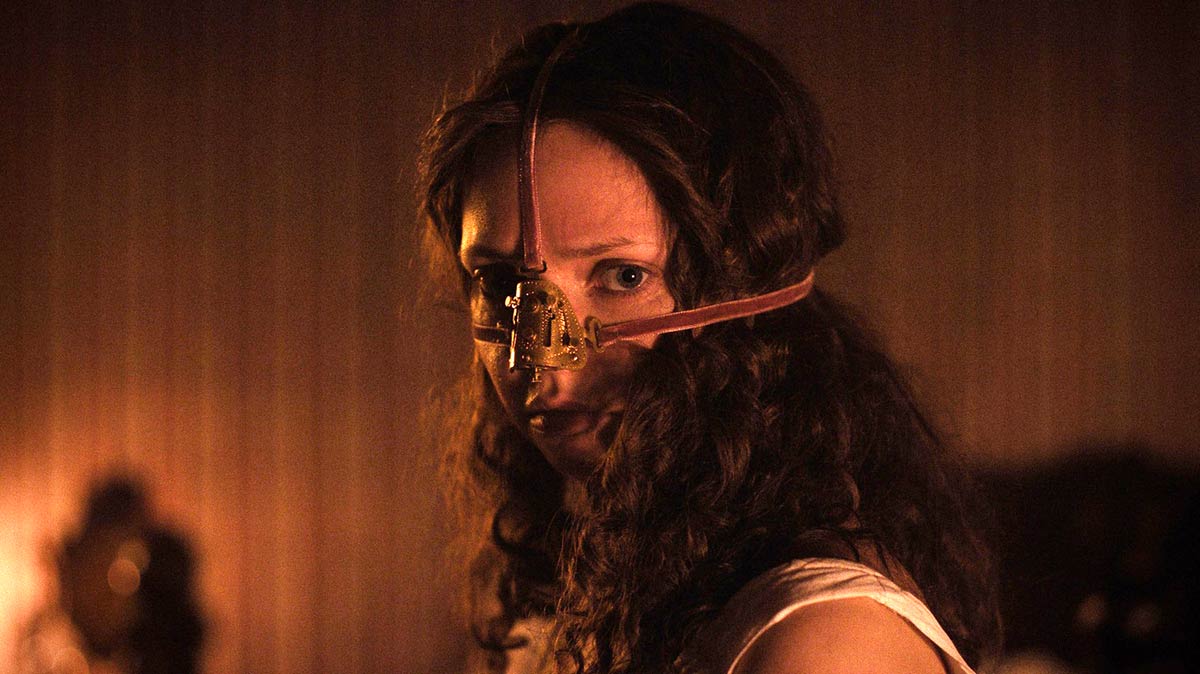
Though the film has an indeterminate fantasy period setting, Blichfeldt highlights contemporary concerns through numerous cosmetic surgery procedures that Elvira has to go through to look presentable for the ball—a conduit for “The Ugly Stepsister” ’s body horror elements. Dr. Esthétique’s (Adam Lundgren) procedures include fixing Elvira’s nose with a hammer and cudgel. When Elvira wants more enormous eyelashes, he literally sews them onto her eyes and eyelids, with only cocaine as an anesthetic. Most pointedly, Elvira is given a tapeworm egg to swallow that will live inside her gut and eat up all the food she swallows to make her lose weight.
Support independent movie journalism to keep it alive. Sign up for The Playlist Newsletter. All the content you want and, oh, right, it’s free.
“The Ugly Stepsister” is Blichfeldt’s debut feature, and she impresses with her talent and ambition, especially in some of the main set pieces. Along with the horror sequences, “The Ugly Stepsister” has a noteworthy dance/ballet narrative as the young women to be debuted at the royal ball prepare for a performance. The performance is fully shown during the finale in an exaggerated music-video-like form.
Technical credits are substantial for this period-fantasy production. Sabine Hviid’s art direction and Manon Rasmussen’s costume design are handsome, shot by cinematographer Marcel Zyskind with gauzy fairytale lighting as needed. The new-age music used is not precisely period-accurate but eclectic and memorable. Molly Lewis’s “Crushed Velmet” used over the main titles and several Vilde Tuv cues leave a lasting impression and add another winking, modernist meta layer. The ballroom scenes use Mozart, Beethoven and Strauss.
After the excesses of Coralie Fargeat’s “The Substance,” “The Ugly Stepsister” will seem tame by comparison. The comparison is unnecessary but inevitable. Blichfeldt doesn’t quite push the genre elements as far as horror fans might like. But “The Ugly Stepsister” provides sufficient blood and gore, with a dash of sex and nudity, to make it an appealing ticket at film festivals throughout 2025—particularly in the midnight section—where it world-premiered at the Sundance Film Festival. [B]
Check out the latest reviews from the 2025 Sundance Film Festival and The Playlist’s complete coverage from Park City here.
Publisher: Source link






Born Again’ Showrunners Detail How the Media Ties into Season 2
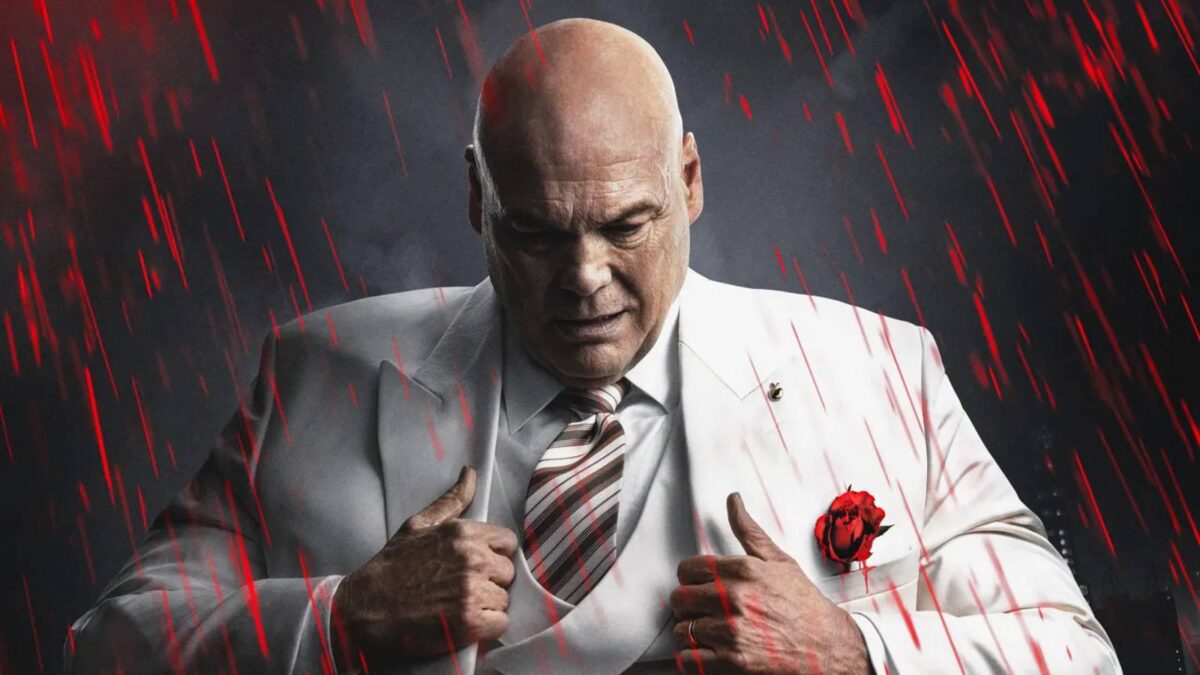
Marvel is fast approaching the release of Daredevil: Born Again Season 2, marking its second live-action Disney+ show of 2026. Bringing back Charlie Cox's Matt Murdock and Vincent D'Onofrio's Wilson Fisk, this season picks up where Season 1 left off,…
Mar 23, 2026
New ‘Wheel of Time’ Animated and Video Game Adaptations Are in the Works
Amazon might be finished with The Wheel of Time, but we haven't seen the end of the story when it comes to adaptations of Robert Jordan's bestselling high fantasy saga. Fans were left blindsided when Amazon abruptly pulled the plug…
Mar 22, 2026
‘Off Campus’ Teaser and Release Date Revealed by Prime Video
No one expected a love story between rival hockey players to become one of the most talked-about TV shows of 2025, but there's a lot more where Heated Rivalry came from, as a new teaser for Prime Video's foray into…
Mar 21, 2026
Sarah Michelle Gellar Urges ‘Buffy’ Fans to Avoid Reading Leaked Reboot Scripts
Buffy the Vampire Slayer fans have had a rough few days after Hulu officially pulled the plug on a revival of the series, which would have brought star Sarah Michelle Gellar back as the titular heroine. Described as a continuation…
Mar 20, 2026