A Fantastical Queer Tale In The Chilean Mountains [Cannes]
May 25, 2025
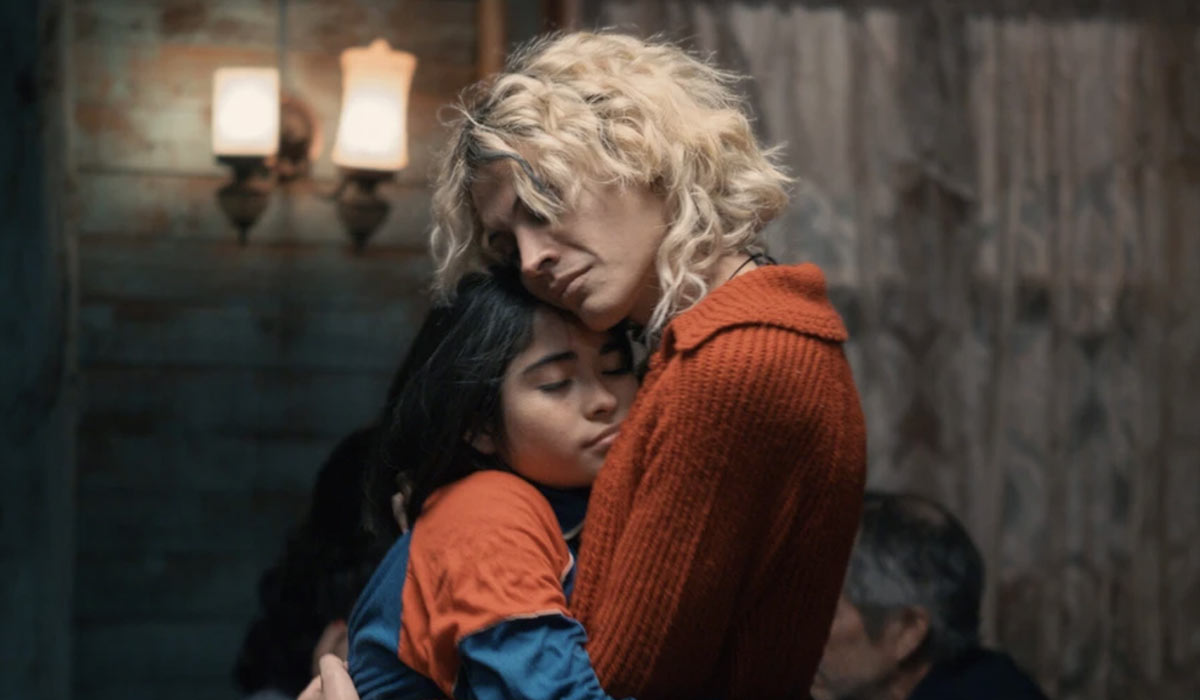
CANNES – There is a court of queens living in the high desert in Chile. They are full of life and here to entertain not only you but, deliriously, themselves. It’s the 1980s, and a small, almost abandoned mining town has few inhabitants, but one ranch home features a chosen family of cabaret performers. Tragically, the plague has found them, and they may not be able to dance much longer. That’s the provocative scenario for Diego Céspedes’ confident directorial debut, “The Mysterious Gaze of the Flamingo,” a world premiere at the 2025 Cannes Film Festival that provides a showcase for the filmmaker’s tantalizing talents.
READ MORE: “The Little Sister” Review: A French Arab queer woman tries to find herself [Cannes]
The heroine of our tale is Lidia (Tamara Cortés), a young girl who, after being found abandoned as a baby, was adopted by transvesite performer, Flamenco (Matías Catalán, captivating). Her “mother” is suffering from said plague (AIDS), refusing to let it stop her (or head to Santiago for treatment). As Lidia finds herself at odds with the young boys who live in the town (seemingly innocuous, but maybe not), Flamenco cannot escape her own tumultuous love affair with Yovani (Pedro Muñoz, effective). Their pairing is a classic soap opera storyline with Yovani crashing her big number, unable to live without her, and Flamenco succumbing to her passion for him. When tragedy ultimately shows its hand, Lidia finds herself under the care of an elder queen, Mama Boa (Paula Dinamarca, a legend, an icon, the moment), and on a mission of vengeance. Well, as much of a mission of vengeance as an 11-year-old girl can pull off.
Dipping his toe into the not-so different motifs of Hollywood Westerns and telenovelas with a wink or two to some queer cinema classics, Céspedes has bold artistic aspirations. He mixes the real-world fears over HIV (it’s never named specifically) with fantastical imagery and a bit of indigenous lore. At one point, the men of the village become convinced they have caught the disease by looking into the eyes of the queens and insist on blinding them to protect themselves (at gunpoint, no less). But their passion for these artists soon finds the roles reversed and themselves blindfolded instead in a sensual romp where the queens retake control. Earlier, Lidia discovers Yovani and Flamenco in a passionate embrace at the local oasis. Their sexual connection is represented as beams of energy searing from Flamenco’s eyes into Yovani’s. How else would a young child comprehend their pairing?
Despite all this death, heteronormative conflict, and a former bustling mining town now almost abandoned (a pretty smart allegory for the queens’ fortunes), Céspedes cannot help but include a flicker of hope for the future. He finds it in an unexpected love affair for Boa and Clemente (Luis Dubó, fantastic), a retired miner who previously always saw himself as straight. Perhaps this is a coupling that could only happen in a place cut off from the real world, but Dinamarca and Dubó make you believe. You want it to be true, even if it would seem improbable back in the nation’s cosmopolitan capital of Santiago or anywhere else in the world (in that era, at least).
And, frustratingly, it is the one aspect of his fantastical concoction Céspedes cannot overcome, its inauthenticity. The film wants to be a grounded fairy tale as much as a Western, and for you to believe that there’s a hint of historical truth to the proceedings. Outside of the fall of Chile’s mining boom, there shockingly isn’t much. That shouldn’t matter, but in this case, it’s a needle Céspedes can’t completely thread. What he can do is deliver a knockout final shot. A truly inspired one-er – in a moment of perhaps too many extended one-shot takes – that utterly entrances. And when that image is still stuck in your mind a week after seeing countless other films at one of the world’s greatest film festivals? Well, that is something you can’t teach. [B]
Follow along for all our coverage of the 2025 Cannes Film Festival, including previews, reviews, interviews, and more.
Follow Gregory Ellwood on BlueSkyFollow Gregory Ellwood on Threads
Publisher: Source link





‘Off Campus’ Teaser and Release Date Revealed by Prime Video
No one expected a love story between rival hockey players to become one of the most talked-about TV shows of 2025, but there's a lot more where Heated Rivalry came from, as a new teaser for Prime Video's foray into…
Mar 21, 2026

Sarah Michelle Gellar Urges ‘Buffy’ Fans to Avoid Reading Leaked Reboot Scripts
Buffy the Vampire Slayer fans have had a rough few days after Hulu officially pulled the plug on a revival of the series, which would have brought star Sarah Michelle Gellar back as the titular heroine. Described as a continuation…
Mar 20, 2026
![Born Again’ Stars Explain Why Bullseye Is So Dangerous in Season 2 [Exclusive]](https://www.filmibee.com/wp-content/uploads/2026/03/Born-Again-Stars-Explain-Why-Bullseye-Is-So-Dangerous-in-1200x675.jpg)
Born Again’ Stars Explain Why Bullseye Is So Dangerous in Season 2 [Exclusive]
Along with Charlie Cox's Matt Murdock and Vincent D'Ofnorio's Wilson Fisk, Daredevil: Born Again Season 1 brought back one of The Man Without Fear's most notorious villains: Wilson Bethel's Benjamin Poindexter, better known as Bullseye. Not only was he back…
Mar 19, 2026
Born Again’ Showrunner Confirms ‘Avengers’ Character Is Key to Street Level MCU [Exclusive]
Ahead of the Avengers' return to the big screen later this year, Marvel Studios will return to street-level storytelling with the second season of Daredevil: Born Again on Disney+. Along with making the show canon to everything that happened in…
Mar 18, 2026