A Heartbreaking, Close Look at One of the Most Harrowing Crises of Our Era
Feb 7, 2025
No Other Land, a Palestinian-Israeli documentary portraying the Israeli government’s progressive encroachment on, and destruction of, the homes and lives of Palestinians in Masafer Yatta of the Southern West Bank, should have been a shoo-in for U.S. distribution. Internationally award-winning and a front-runner for Best Documentary Feature in the 97th Oscars, it’s overwhelmingly timely and a harrowing look at resilience in the face of constant repression, receiving distribution on a wide international scale, but U.S. distributors wouldn’t touch the film with a 10-mile pole. Written and directed (as well as produced and edited by) Basel Adra, Hamdan Ballal, Yuval Abraham & Rachel Szor, it’s a heartbreaking on-the-ground look at the human cost of the Israeli government’s settlement policy that must be seen.
The UK was granted control of Palestine in 1922, and supported the “Balfour Declaration” expressing the construction of a “national home for Jewish people” in Palestine. Waves of Jewish settlers entered between 1922 and 1947, causing rising tension in the region until the UK voted to turn over administration to the U.N. in 1947. The U.N. supported the creation of independent Palestinian and Jewish states. Jewish settlers declared an independent state of Israel hours before the transfer, provoking the 1948 Arab-Israeli war that ended with Israel controlling much of the territory. 750,000 Palestinians were displaced in an event known as the Nakba (Catastrophe in Arabic), with Jordan occupying the West Bank and East Jerusalem and Egypt controlling the Gaza Strip.
In 1967, Israel attacked Egypt, starting the Six-Day War, consolidating larger swaths of territory, and putting a million Palestinians under Israeli rule. The 1970s saw the U.N. affirm the rights of Palestinian people to self-determination, though the Israeli government has encouraged the expansion of settlers within occupied Palestinian territories over subsequent decades. Waves of settlers have continued to push out Palestinians, building new settlements in violation of international law, with roughly 700,000 Israeli settlers living illegally in the area. No Other Land brings us on the ground to witness that process.
What is ‘No Other Land’ About?
The documentary follows the West Bank community of Masafer Yatta, and particularly the young Palestinian activist and journalist Basel Adra, who is from the region and who has chronicled the military encroachment for years in hopes of affecting change. He and a team of documentarians give a poignant look at the destruction and displacement, all part of the largest single act of coercive displacement in the occupied West Bank. Joined by the Israeli citizen and journalist Yuval Abraham, they and allies seek to chronicle the devastation in hopes of spreading the word and protecting Palestinian communities, while also capturing the extremity of political inequality between the pair and their situations. It’s a harrowing look at the effects of political oppression under a military occupation that is little acknowledged.
A Devastating Look At Tragedies Unfolding
Antipode Films
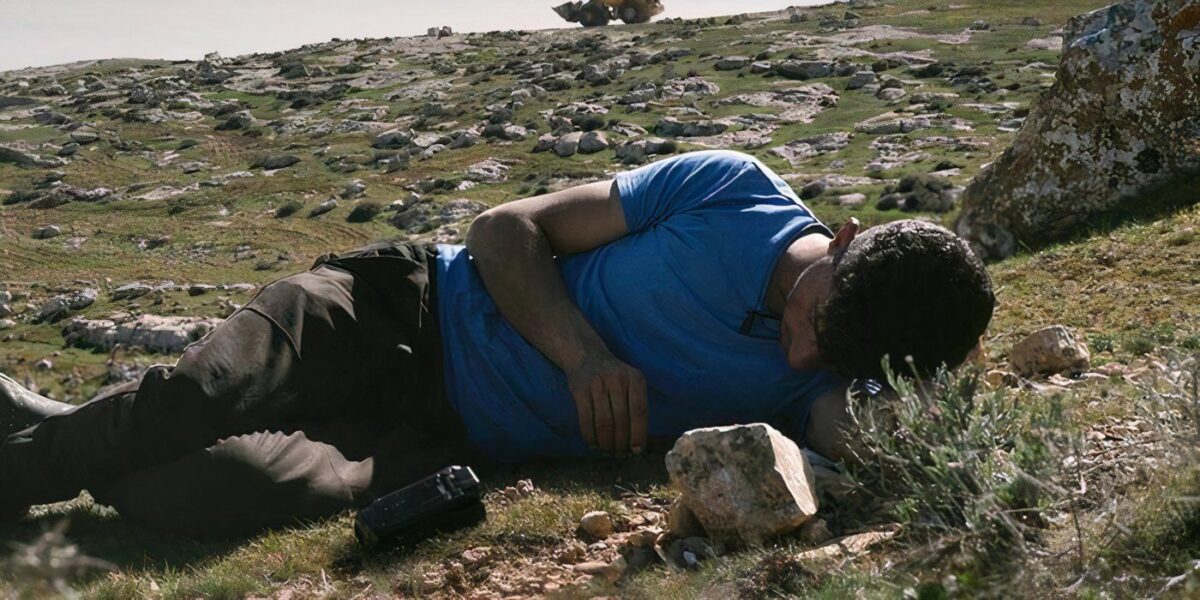
No Other Land should be commended first and foremost for putting the viewer continuously in the thick of a harrowing situation. It’s clearly a victim’s-eye view of a century-long pattern of community destruction, situating the audience in the thick of efforts from resilient Palestinian communities who want nothing more than to live, attend school, and raise their children in peace. These cinéma vérité-style give both voice to these people, and a chilling look at soldiers and settlers who threaten and attack with seeming impunity, and the scenes are punctuated by smartly chosen on-site interviews that give depth and context to the daily struggles. Given the controversy around the situation, it’s a smart approach to chronicle events with minimal fluff or interpretation, placing the audience sometimes inches away from suffering as well as a voice for the Palestinian people, unwilling to give up hope.
Basel Adra has been working to chronicle these events for years as a journalist with legal training. The documentary takes place over half a decade, and as his coverage brings international attention, the proximity of his filming to soldiers comes to frustrate their evident desires to destroy communities without inhibition. He’s placed in growing harm as the documentary progresses. In one segment of the documentary, soldiers proceed to steal a man’s tools and generator after destroying family homes. The man confronted them and was promptly shot, with the ensuing non-violent protests met with state coercion, all recorded by Basel. He was attacked at the time, and soon after, his community was raided, while soldiers were reportedly asking for him by name–moments like these provide unparalleled clarity over the moral status of the displacements, purportedly to take the land over for military purposes. His work with Israeli journalist Yuval Abraham adds needed further layers to the project, as the pair’s wildly different rights bring contrast to the strict impositions Palestinians are subject to, and highlights illuminating tension between Yuval and the displaced people of the community.
Related
‘From Ground Zero’ Review: 22 Powerful, Harrowing Stories From the Besieged City of Gaza | PSIFF 2025
The anthology film is Palestine’s official entry to the Academy Awards.
From a technical standpoint, the documentary lacks polish, and there’s little by way of the struggle’s larger context that a viewer just coming to terms with the situation might hope for. At the same time, the lack of polish and proximity to the crisis largely benefit the film’s narrative. There’s cruelty in these displacements, and it’s evident in the callousness of the soldiers and the fervent violence of the settlers. At one point late in the documentary, throngs of settlers with covered faces destroy homes, smash windows, and harass residents in an act of malicious fun more unsettling than most horror scenes you’ll see this year. With a few soldiers accompanying the assailants, there’s little the community can do but film, and Basel gets attacked for doing so. These images and feelings aren’t easy to shake off, making for one of the finest documentaries of our era.
‘No Other Land’ Is A Heartbreaking Must-See Film
Antipode films
No Other Land is one of the most necessary documentaries of our era. As the fact of increasing settlements are thrown around as bullet points in a news broadcast or endlessly debated on opinion shows, real communities full of families are subjected to second-class citizenship, denied rights, expelled, threatened, and repeatedly attacked with no recourse to law or help on the horizon. The documentary showcases the deep human cost of these displacements, alongside the callous predatory vigor of those who perpetuate and stand to benefit from them. It’s heavy, at times difficult to watch, and necessarily a little structurally repetitive as a consequence of these communities being subjected to these processes again, and again, and again, a Groundhog’s Day of suffering contrasted against the Palestinian community’s perpetual hope that someday justice will come. It’s a heartbreaking film that we cannot afford to forget, whether U.S. distributors discover courage or not.
No Other Land is now playing in theaters.
No Other Land
No Other Land is a must-see chronicle of community resilience in the face of political oppression and predation.
Release Date
January 31, 2025
Runtime
96 Minutes
Pros & Cons
The on-the-ground focus puts little room between the viewer and the crisis, creating a devastating unfiltered look at the displacements of families in the West Bank.
Basel Adra and Yuval Abraham are an ideal pairing of navigators here, their differential rights and privileges adding layers to audience understanding.
The interviews are well chosen and allow powerful voice to the Palestinian community.
Publisher: Source link






Born Again’ Showrunners Detail How the Media Ties into Season 2
Marvel is fast approaching the release of Daredevil: Born Again Season 2, marking its second live-action Disney+ show of 2026. Bringing back Charlie Cox's Matt Murdock and Vincent D'Onofrio's Wilson Fisk, this season picks up where Season 1 left off,…
Mar 23, 2026
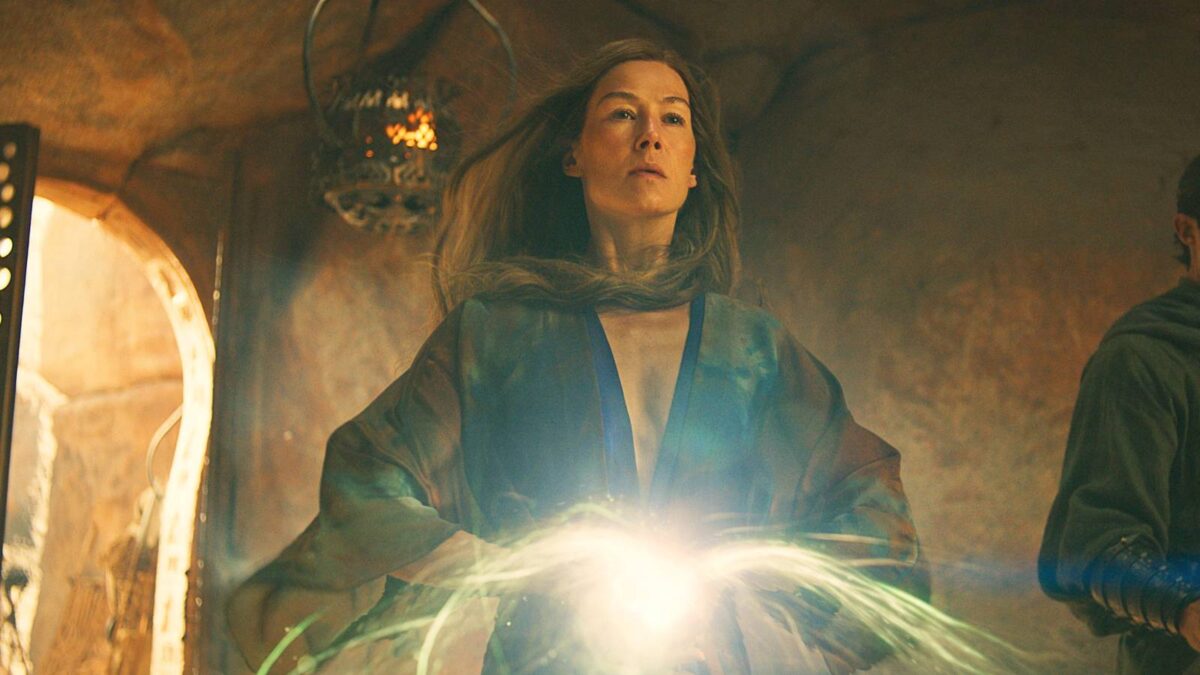
New ‘Wheel of Time’ Animated and Video Game Adaptations Are in the Works
Amazon might be finished with The Wheel of Time, but we haven't seen the end of the story when it comes to adaptations of Robert Jordan's bestselling high fantasy saga. Fans were left blindsided when Amazon abruptly pulled the plug…
Mar 22, 2026

‘Off Campus’ Teaser and Release Date Revealed by Prime Video
No one expected a love story between rival hockey players to become one of the most talked-about TV shows of 2025, but there's a lot more where Heated Rivalry came from, as a new teaser for Prime Video's foray into…
Mar 21, 2026

Sarah Michelle Gellar Urges ‘Buffy’ Fans to Avoid Reading Leaked Reboot Scripts
Buffy the Vampire Slayer fans have had a rough few days after Hulu officially pulled the plug on a revival of the series, which would have brought star Sarah Michelle Gellar back as the titular heroine. Described as a continuation…
Mar 20, 2026