Art and Politics Intertwine in This Superb Documentary
Feb 12, 2025
It might sound weird to draw comparisons between a heavy documentary like Johan Grimonprez’s Soundtrack to a Coup d’Etat and a classic Hollywood musical, and yet, there is a distinct parallel that can be traced between the Oscar-nominated film and Bob Fosse’s Cabaret. In Cabaret, the music played at the Kit Kat Club serves as a soundtrack to the fall of Germany’s Weimar Republic and the rise of Hitler and the Nazi Party. That doesn’t mean, however, that the songs performed by Liza Minnelli and Joel Grey are nothing more than background noise. Instead, they serve as a diversion, as a commentary on the events of the time, and even as downright propaganda, as brownshirts begin to fill the tables at the titular cabaret. Art, the movie says, particularly music, is not innocent. It is an actor that plays a pivotal role in the goings-on of a certain period in history.
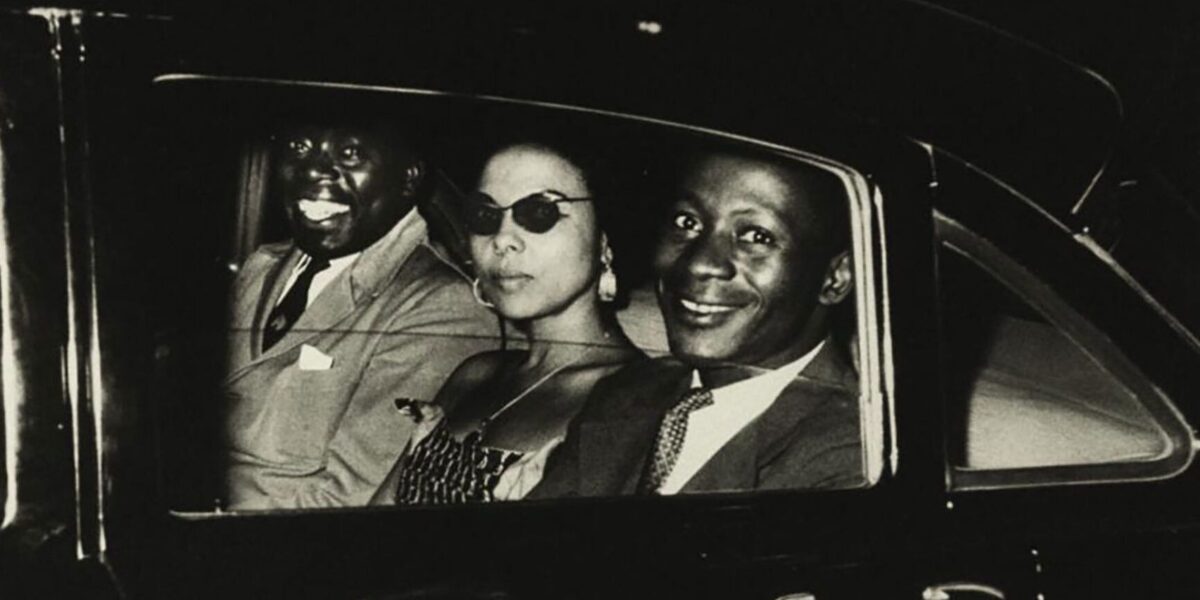
Likewise, in Soundtrack to a Coup d’Etat, music is at the forefront of events that aren’t as well known as the Nazi’s rise to power, but are nonetheless equally brutal, culminating in years of war and genocide. The music in question is jazz, sometimes American, sometimes African, always deeply involved with the political events depicted on screen, chief among them the independence of the Democratic Republic of Congo from Belgium and the international plot led by the former colonial power, the U.S., and the United Nations to eliminate Pan-African nationalist Patrice Lumumba. In this rigged game of chess, men and women like Louis Armstrong, Dizzy Gillespie, and Nina Simone are used as unwilling pawns to conquer hearts and minds as well as to hide assassination attempts, their music and the works they inspire paradoxically play the part of a leitmotif to liberation.
‘Soundtrack to a Coup d’Etat’ Feels Like a Jazz Song
Image via Kino Lorber
Such a story is pieced together on screen through music recordings, old photographs, and archival footage, all edited in a way that makes Soundtrack to a Coup d’Etat feel almost like a jazz music video. The movie’s montage, signed by Rik Chaubet, is fast-paced, with so much information popping up on the screen that it is impossible to look away. Not that you would want to, of course. With an intense research effort that paints a history of the Congo crisis from the times in which the African country was the private property of King Leopold II to the still ongoing exploitation of the land’s natural resources through political destabilization and murder, Grimonprez’s documentary is nothing short of brilliant. Sure, you will most likely feel the two hours and thirty minutes of runtime passing, but sometimes, the best watches aren’t easy, and Soundtrack to a Coup d’Etat is not only an amazing movie, it is full of hard truths.
At the core of the film is a reckoning. Johan Grimonprez isn’t shy about how he grew up oblivious to what his country was doing in the Congo – something quite similar to what France was doing in Algeria, or Portugal in Angola, and so on. His original background is that of a child who benefited from colonialism, but knew nothing about the horrors that were embedded in his comfortable life. Much like Soundtrack to a Coup d’Etat tells us, we today drive our electric cars and spend hours on our smartphones without sparing a thought to the people who suffer for the lithium in our batteries to be harvested. The independence of the African colonies – the independence of Congo in particular – was a lie, the movie continues. A ruse put together by American and European governments and companies to keep colonial violence going unchecked. There were, for sure, those who believed in and fought for it, but they were crushed by foreign armies, spies, and mercenaries mere months after conquering the freedom they so desired.
Related
What’s New on Streaming This Weekend: Oscar Contenders and Thought-Provoking Documentaries Dominate the Lineup
‘Flow’ is among the films arriving on streaming this weekend.
The timeline portrayed in Soundtrack to a Coup d’Etat is shocking. Congo’s de facto independence lasted for less than a year. If we take into consideration the fact that there were Belgian spies infiltrated into Lumumba’s government from the get-go, it was never a reality. And, in an essay-like format, Soundtrack to a Coup d’Etat isn’t afraid to make clear who was on whose side, nor to connect the dots between the fight against colonialism, the Apartheid system, the fight for civil rights in the United States, and even Nazi Germany. All that and more are part of the same project: a project of disenfranchisement that has racism at its core, yes, but also the desire to control resources that grant power and wealth to the world’s already richest countries.
‘Soundtrack to a Coup d’Etat’ Uses Music as Its Driving Force
But while the story of Lumumba and the Congo is at the center of Soundtrack to a Coup d’Etat, the film isn’t only concerned about the hard political facts. Or, at least, not in the sense we usually understand them. Instead, Grimonprez’s focus is on the music that served as the, well, soundtrack to this coup d’état. From African voices like Miriam Makeba to American legends like the aforementioned Louis Armstrong, jazz musicians are an integral part of the plot to overthrow Lumumba, and their role isn’t exactly clear. While Makeba gives speeches against colonialism and apartheid, Armstrong is used to cover up an assassination attempt, his concert a hotbed for spies carrying the most James Bond-like weapons, all to ensure the continuation of the imperialist regime. Said role isn’t played willingly by Armstrong, who the movie tells us was completely unaware of what he was being used for, but it is played nonetheless.
Now, of course, if you’re interested in world politics, you should definitely watch Soundtrack to a Coup d’Etat. However, if you’re interested in music history, you should also be getting ready to press play on the film. Apart from the necessary moments of silence and the odd interview, jazz is everywhere on Soundtrack to a Coup d’Etat, and even if you don’t find the way the movie presents its music particularly enthralling, it is crucial to understand the role that art plays in our world. Otherwise, we might unwittingly commit crimes such as calling things apolitical when they are anything but.
Actually, if there is a flaw to be found in Soundtrack to a Coup d’Etat it is that, for about an hour in the middle of the film, jazz takes the backseat for too long in order for the movie to center the political plot. This feels awkward considering that music is purportedly at the film’s forefront, but it is necessary for us to understand what is at stake. Without this musical intermission, there is no context for when the syncopated beats eventually make their way back. And when they do, it drives home the point that Soundtrack to a Coup d’Etat is a movie that should be watched by everyone, whether to understand art or to understand the backbone of our political and economic system. To put it simply, Soundtrack to a Coup d’Etat is a film essential to understanding the world.
Soundtrack to a Coup d’Etat is now available to stream on VOD services.
Soundtrack to a Coup d’État
Johan Grimonprez offers a reckoning in the form of a movie that deeply understands both arts and politics.
Release Date
January 24, 2024
Runtime
150 minutes
Director
Johan Grimonprez
Producers
Rémi Grellety
Cast
Louis Armstrong
Self (archive footage)
Pros & Cons
‘Soundtrack to a Coup d’Etat’ is a movie about colonialism that isn’t afraid to point fingers at the right people.
The editing and the rich research make for an extremely interesting watch.
‘Soundtrack to a Coup d’Etat” proves itself essential to the understanding of art and its role in our global context.
Jazz takes a backseat for a portion of the movie, which might make it less appealing for those that are in it for the music.
Publisher: Source link




Born Again’ Showrunners Detail How the Media Ties into Season 2
Marvel is fast approaching the release of Daredevil: Born Again Season 2, marking its second live-action Disney+ show of 2026. Bringing back Charlie Cox's Matt Murdock and Vincent D'Onofrio's Wilson Fisk, this season picks up where Season 1 left off,…
Mar 23, 2026
New ‘Wheel of Time’ Animated and Video Game Adaptations Are in the Works
Amazon might be finished with The Wheel of Time, but we haven't seen the end of the story when it comes to adaptations of Robert Jordan's bestselling high fantasy saga. Fans were left blindsided when Amazon abruptly pulled the plug…
Mar 22, 2026

‘Off Campus’ Teaser and Release Date Revealed by Prime Video
No one expected a love story between rival hockey players to become one of the most talked-about TV shows of 2025, but there's a lot more where Heated Rivalry came from, as a new teaser for Prime Video's foray into…
Mar 21, 2026

Sarah Michelle Gellar Urges ‘Buffy’ Fans to Avoid Reading Leaked Reboot Scripts
Buffy the Vampire Slayer fans have had a rough few days after Hulu officially pulled the plug on a revival of the series, which would have brought star Sarah Michelle Gellar back as the titular heroine. Described as a continuation…
Mar 20, 2026