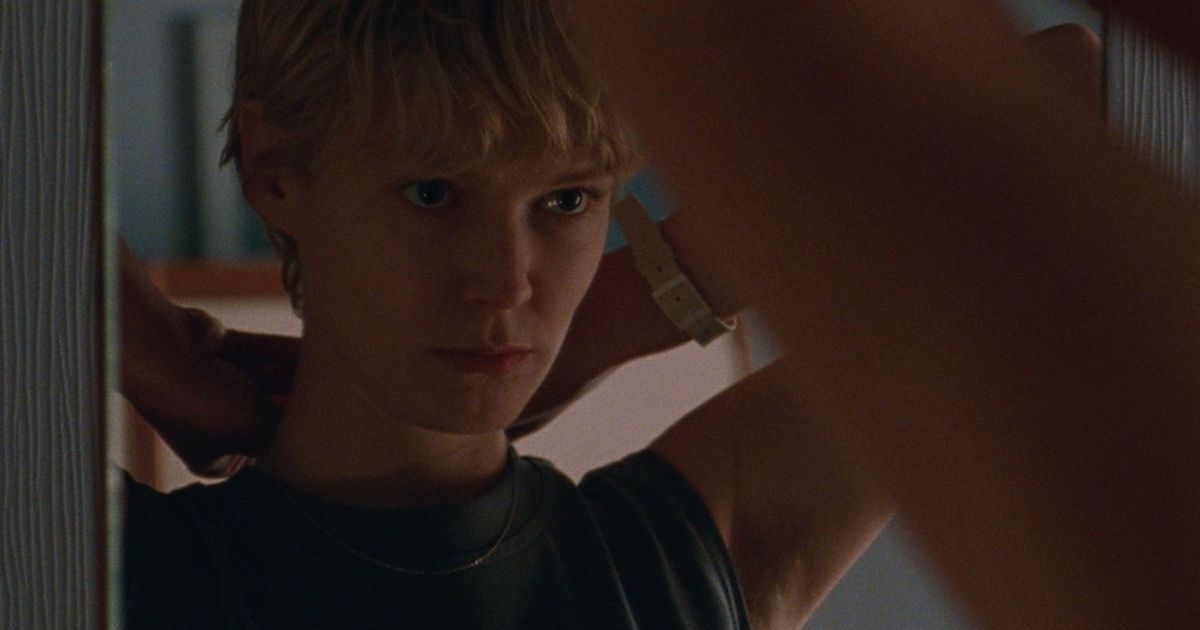
Blue Jean Filmmaker Georgia Oakley on Her ’80s-Set Queer Drama
Jun 10, 2023
LGBTQ+ Pride Month is upon us, a perfect time to celebrate queer cinema — especially the more challenging stories about acceptance that make us question the unruly standards of society that we’ve lived in over the years. Blue Jean is a new film that’s now in theaters, which follows “Jean” (Rosy McEwen), a closeted female gym teacher in 1988 England amid Margaret Thatcher’s conservative reign and Section 28 along with it.
Despite the difficult journey she must navigate, there is certainly much to celebrate in this powerful LGBTQ+ drama. Sure, it’s tough to watch at times, as the conflicted protagonist lives in perpetual fear of revealing her sexuality publicly. That’s especially the case, given that there’s a curious new student at school (played to perfection by Lucy Halliday) who keeps showing up at the gay-friendly pub that Jean and her girlfriend frequent. Though uncomfortable we’re gripped from start to finish thanks to its relatable themes of belonging and the unfortunate bounds of society.
MOVIEWEB VIDEO OF THE DAYSCROLL TO CONTINUE WITH CONTENT
We recently caught up with writer-director Georgia Oakley, who spoke about her feature debut and working with the talented actor Rosy McEwen — who some might recognize from TNT’s The Alienist. Following the success thus far of Blue Jean, Oakley remains hard at work on her next projects. Find out more from our exclusive interview below.
Navigating a Section 28 Society
Oakley has directed a handful of short films over the years, but stepping up to the plate on a heavy feature like Blue Jean sounds daunting — but that didn’t deter her from telling a story that simply needed to be told. “I was filled with apprehension,” she said. “And I was pretty sure what kind of story I wanted to tell and what kind of themes I wanted to touch on, but I just wasn’t sure what kind of shape that would take. And around that time, I found a newspaper article about Section 28 and specifically about some women who had abseiled into the House of Lords gallery during a debate on Section 28. And I thought, ‘That could be an interesting opportunity to tell a story.'”
Related: Dead Ringers: How the Prime Video Series Compares to David Cronenberg’s 1988 Movie
It certainly helped, meanwhile, that Oakley could draw on her own experiences to make the film deeply personal and relatable for folks who lived during such a pivotal and controversial time in history. “As somebody who had been at school during Section 28, I started unraveling the effects that it must have had on me as a teenager without me really knowing about it,” she said.
And the rest is history, with Blue Jean now on the silver screen. Oakley continued:
“And that was what led me to Blue Jean and wanting to tell a story about a teacher, but also a story that interrogates the kind of long-term effects of this kind of homophobic legislation on students, not just on teachers. And then, when I kind of got into that mindset, I stumbled across some interviews with women who had lived that experience as P.E. teachers in the late ’80s and early ’90s. And we went on to meet them, and they became a huge part of the development of the film […] Everything just kind of started snowballing because I knew, having met them, that there was this story that had not been told, and that they were so passionately wanting it to be told. And I felt a responsibility at that point to give that to them.”
Universal Themes in Blue Jean
Magnolia Pictures
Filmmakers can agree on how refreshing it feels when your audience can draw a unique parallel between your story and their own lives. Even if you didn’t live in England during Thatcher’s reign as prime minister, with the fear of being ID’d as gay ever-present, viewers in general will certainly be able to relate to certain universally-understood parts of Jean’s life, such as living a life of secrecy and balancing your work and personal life.
“I would say, almost every time we screen the film, there is somebody who puts their hand up at the end and says, ‘I was Jean’ or ‘I was Lois,'” said Oakley. “I think we were quite surprised because obviously, it’s a very specifically British film about British law. But when we screened the film in Venice, and then around Europe, in Spain and other places, there would always be somebody who put their hand up and said, ‘I was a teacher,’ and even if that particular law didn’t exist in their country, attitudes were similar. And so the experience of Jean is something that quite a lot of people could relate to, particularly as queer women who live through that time.”
Academy members, do we have your attention? Rosy McEwen is simply a knockout in Blue Jean, a sensational turn that should make the rounds come award season. It’s a nuanced, often subdued performance that speaks volumes about the pressure of society on the queer community at that time. Acting is reacting, as they say, and some of McEwen’s best moments don’t really involve a whole lot of dialogue. Those piercing eyes of hers often say it all. “I think because it was her first lead role, and it was my first feature, we felt the weight of what we were doing,” said Oakley on working with McEwen. “We both felt like, if we f*cked it up, then that would kind of be it. And so we were very much united in that shared experience.”
Oakley continued on working with McEwen:
“Neither of us got very much sleep, and the whole thing was extremely stressful in lots of ways. But she was always good-humored and always prepared and had done loads of work on the accent, because the accent is very notoriously tricky to master. She worked with this brilliant voice coach, and she was just extremely dedicated. And for someone who’s quite young, and was leading in a cast with quite a lot of actors who had no experience. I would also say that she led them so beautifully. There was obviously Jean, the teacher, the character, but then there was like Rosie, who was the kind of teacher of those students, some of whom had never been on a film set before.” Related: Exclusive: The Eight Mountains Star on His Visually Stunning New Character Study
Coming Out on Film
Magnolia Pictures
And speaking of McEwen, perhaps her most memorable moments comes in a sort of throwaway bit in the third act, where the increasingly agitated Jean finds herself at a party and decides to “come out” to a random stranger who has no bearing on her life whatsoever. She sort of gets a kick out of it, and we can’t help but laugh along with her. Says Oakley about that epic moment:
“There was always a moment in the script where Jean comes out, as it were, but it was always to somebody who was kind of irrelevant. I remember from the beginning, that scene didn’t exist as it is in the film. But there was a scene always where Jean says ‘I’m a lesbian’ to someone who’s not expecting it and to someone who doesn’t mean anything to her. I think at one point, it was to a taxi driver or something. And I think that was always going to be a part of the film because it really spoke to my own experience. I know what it’s like to live with some of the fear that Jean experiences in the film, but I also know what it feels like to sort of move through that fear and come out the other side of it.
Georgia Oakley Gets That ’80s Look
Magnolia Pictures
With a story taking place decades ago in history, Oakley admitted that it was challenging during production to find locations that didn’t look so modern. Fortunately, they tracked down “pockets of Northeast England that were relatively untouched,” as she puts it. Added to that is the overall look of the film — which was shot on actual film versus digital.
“Shooting on film, I think, does allow you some freedom,” said Oakley. “So many of the films that I love that were made around the time this film was set were shot on 16mm. And I also like the fact that when you work on 16mm, the cameras are quite light. Everyone’s quite mobile. You’re not weighed down by a lot of equipment. And I like the fact that the monitors are terrible, and you can’t really see what you’re shooting. So everything’s a little bit of a surprise. And that intensifies what you’re doing, the stakes of what you’re doing, and I enjoy that.”
Looking ahead, Oakley remains busy with her next project. “I’m working on an adaptation of a book called Expectation,” she said. “I’m writing it with Clémence Poésy, the French actress, and she’s going to direct it. So that’s been a different experience for me, writing something that I’m not going to direct, and I’ve actually really enjoyed that experience and hope to do that again.”
In the meantime, Oakley has much to celebrate with her powerful new film that fittingly comes to the U.S. during Pride Month. From Magnolia Pictures, Blue Jean is now in theaters.
Publisher: Source link




New ‘Wheel of Time’ Animated and Video Game Adaptations Are in the Works
Amazon might be finished with The Wheel of Time, but we haven't seen the end of the story when it comes to adaptations of Robert Jordan's bestselling high fantasy saga. Fans were left blindsided when Amazon abruptly pulled the plug…
Mar 22, 2026
‘Off Campus’ Teaser and Release Date Revealed by Prime Video
No one expected a love story between rival hockey players to become one of the most talked-about TV shows of 2025, but there's a lot more where Heated Rivalry came from, as a new teaser for Prime Video's foray into…
Mar 21, 2026
Sarah Michelle Gellar Urges ‘Buffy’ Fans to Avoid Reading Leaked Reboot Scripts
Buffy the Vampire Slayer fans have had a rough few days after Hulu officially pulled the plug on a revival of the series, which would have brought star Sarah Michelle Gellar back as the titular heroine. Described as a continuation…
Mar 20, 2026
Born Again’ Stars Explain Why Bullseye Is So Dangerous in Season 2 [Exclusive]
Along with Charlie Cox's Matt Murdock and Vincent D'Ofnorio's Wilson Fisk, Daredevil: Born Again Season 1 brought back one of The Man Without Fear's most notorious villains: Wilson Bethel's Benjamin Poindexter, better known as Bullseye. Not only was he back…
Mar 19, 2026