Boneyard Review: Dishonourable Garbage
Jul 18, 2024
The internet will tell you plenty about the so-called “West Mesa Murders,” a series of killings in the southwestern United States in which the skeletal remains of 11 women (and one fetus), believed to be connected to a sex trafficking ring, were discovered in 2009.
But what seemingly very easily could have been an interesting enough true crime thriller gets chopped and diced beyond all recognition in the puzzling new drama Boneyard, which is enjoying a brief (and no doubt contractual) theatrical run in advance of its same-month digital debut.
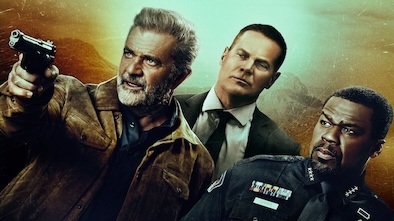
The presence of a couple notable names in the cast (Mel Gibson and rapper-actor Curtis “50 Cent” Jackson among them) might, in theory, slot this title at the top of the “intrigue pile” for those for whom low-budget genre efforts remain a source of fascinating digital-era entertainment industry dissection. But there’s honestly just not enough here to sincerely recommend the film, even for diehard true crime movie buffs.
Boneyard indulges a cold open set in Albuquerque, New Mexico, in 2002, and then flashes forward seven years, to the discovery of its titular, dusty, desert graveyard. Under the guidance of Chief Carter (50 Cent), Detective Paul Ortega (Brian Van Holt) and his partner Detective Laura Young (Nora Zehetner) start trying to get to the bottom of all these bodies, and who might be responsible.
A hard-drinking FBI profiler, Agent Pete Petrovick (Mel Gibson), is brought in to assist on the case, but those excited at the prospect of dense, exposition-laden arguments in front of a “murder board” with lots of photos and string denoting connections will be sorely disappointed.
A list of suspects, or at least associated dirty parties, comes bubbling to the surface — a roster that includes allegedly reformed dirty cop Tate (Michael Sirow); Tate’s new boss, Sergeant Graham (Vincent E. McDaniel); and Caesar Monto (Weston Cage, Nicolas Cage’s son), an addled, bug-eyed loner with deeply conflicted feelings about his own penchant for visiting sex workers.
But Boneyard can’t really decide upon a point-of-view, and with Ortega essentially working the case by himself — motivated by the fact that, unbeknownst to everyone else, one of the victims is his niece — the movie unfolds in fits and starts, a jumbled mass of discrete scenes that just don’t connect.
Director Asif Akbar seems to be a volume shooter (he has five directorial credits over the past two years), but delivers here, with cinematographer Joshua Reis, a casserole of unappealing nonsense. Certain editorial cuts, perhaps masking basic coverage issues, don’t make sense. Others — like a tracking shot that jumps to an establishing shot which pans back into the same frame, then cuts to a feet-to-face shot, then an affected slow-motion insert, followed by a color negative flash — are stylized and busy merely for the sake of being busy.
They communicate nothing about character, and generate no additional excitement. A personal “favorite” is when a raid sequence is rather inexplicably intercut with footage of 50 Cent’s character (or maybe just 50 Cent?) preparing by working out on a speedbag.
Still, the bulk of the movie’s failures rest quite clearly with the script, on which Akbar shares a credit with three other writers. Probably suffering from at-odds draft iterations, the movie is a tangled mess of pointlessly intercut timelines.
The aim, maybe, is to attempt to generate mystery or ambiguousness about various characters, but it doesn’t work. Petrovick, for example, is granted a flashback that gives him an entirely unnecessary backstory — possibly to give Gibson a bit more screen time, possibly to give Akbar’s daughter a scene in which to act, or both.
It doesn’t help, either, that Boneyard’s dialogue is so frequently inane. Of many examples of this, the most egregious and forehead-slapping is probably a scene in which another federal officer, a seasoned investigator of sex trafficking cases, is brought in and, in a discussion about the killer, refers to potential victims as “some of the girls he’d been canoodling with.”
There’s at least a hint of playfulness in Gibson’s grizzled performance, as embodied in an early scene (meant to establish his expertise in field) when he says, “Why don’t we talk about serial killers for a minute, okay?” If Gibson, due to the controversy and career damage wrought by his offscreen life, has been largely reduced, onscreen at least, to lead roles in low-budget action movies and as an expositional bit player in paycheck gigs, he of course not only realizes it, but also embraces it — and in a way that provides a bit of rascally entertainment around the edges.
Unfortunately, the rest of the acting isn’t great, and holds no such intrigue. Performers like Van Holt dutifully hit their marks, but aren’t in the hands of someone putting them in a position to deliver good work, and they all know it.
Our Rating
Summary
Boneyard could have been an interesting true crime tale, but in serving so many different narrative masters — inventing phony intrigue by way of suspects that don’t exist in real life — and also doing so incredibly poorly, it kind of dishonors its story and those real-life victims, sadly.
Publisher: Source link







Prime Video’s ‘God of War’ Casts ‘Lost’ Star Sonya Walger as Freya
Amazon's upcoming God of War series that is currently in production is also one of the most anticipated of the next couple of years. Film and television adaptations of popular video games have been on the rise, with creative teams…
Mar 28, 2026
Paramount+ Renews ‘Criminal Minds: Evolution’ for Season 19
The start of its new season is still weeks away, but fans of Criminal Minds: Evolution won't have to wait that long to learn the fate of the long-running hit crime procedural. Execs at Paramount+ have already decided what the…
Mar 27, 2026

‘A Tale of Two Cities’ First Look Reveals Kit Harington in MGM+ Series
The BBC and MGM+ are teaming up with a new four-part limited series adaptation of Charles Dickens' classic 1859 novel A Tale of Two Cities. Game of Thrones veteran Kit Harington will play Sydney Carton, a cynical English lawyer who…
Mar 26, 2026

HBO ‘Harry Potter’ Series Image Reveals Dominic McLaughlin in Title Role
The first official look at HBO's upcoming reboot of Harry Potter has finally arrived, and it is already teasing a magical trailer release. As we inch closer to the show's expected 2027 release, the network has begun to reveal more…
Mar 25, 2026