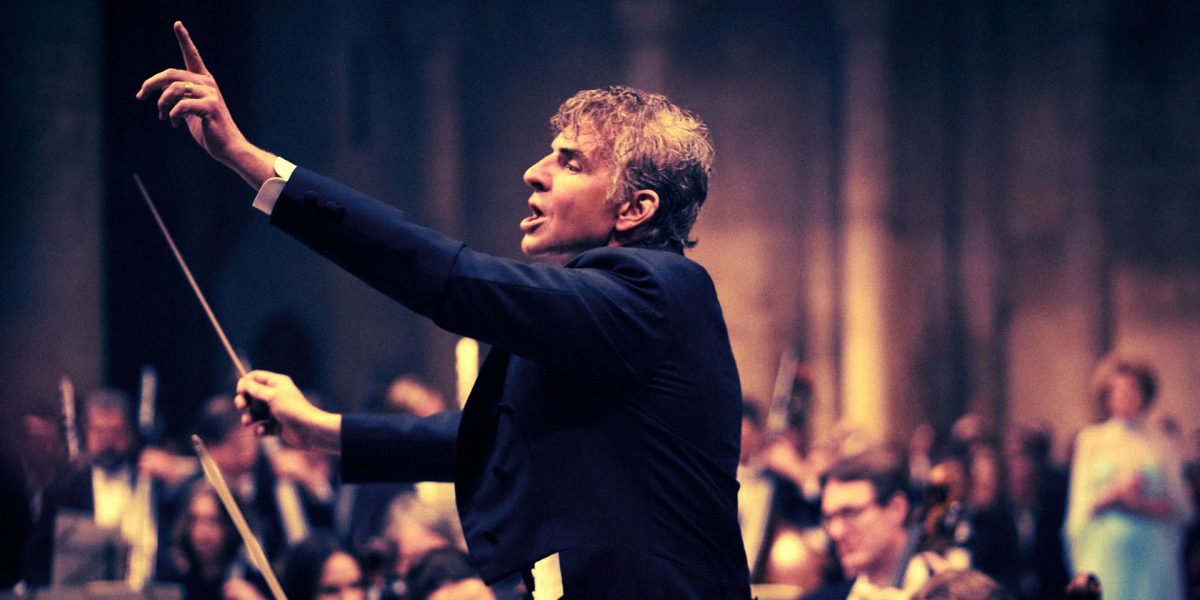
Bradley Cooper’s Bernstein Biopic Is Artful & Fractured
Oct 11, 2023
Summary
“Maestro” captures the contradictory and complex nature of Leonard Bernstein as a human artwork, provoking questions and revealing contradictory answers that define him. The film explores the committed and lifetime bond between Bernstein and Felicia, showcasing their joyous unity and bitter divisions, their strengths and energy-sapping tendencies. The aesthetic aspects of “Maestro,” including the cinematography and makeup, are visually stunning and should be appreciated on the biggest screen possible. It affirms Bradley Cooper’s talent as a director of actors.
Maestro begins with a quote from its real-life subject, Leonard Bernstein: “A work of art does not answer questions, it provokes them; and its essential meaning is in the tension between the contradictory answers.” As a mission statement, I struggled to reconcile it with the film that followed. With 2018’s A Star Is Born, Bradley Cooper showed himself to be a filmmaker of striking emotional clarity, and this quality carried over to his second feature — I did not feel like I was being left with questions. Only after thinking about it for some time did I realize Cooper’s epigraph does not describe his movie, but his Bernstein. This is not a biopic of an artist so much as a human artwork, capturing the many questions he provokes and the contradictory answers that define him. Seeing it in this light has helped me appreciate the project as a whole more than I did at the time, when it spoke to me only in pieces.
Maestro is most interested in the relationship between Bernstein (Cooper) and Felicia Montealegre (Carey Mulligan), to whom, I should note, the opening quote could also apply. They meet one night at a party and instantly connect. Lenny has already had the tipping point of his rise to fame, when he was asked to conduct the New York Philharmonic with just hours notice after that day’s guest conductor fell ill. Felicia, an actor, hasn’t yet, and is the understudy in a Broadway play. But they recognize in each other a kindred potential to be and do many things, which draws them to one another. For a while, Cooper shows them in parallel, capturing their elation as audiences applaud his conducting and her acting. But, as the film leaps through time, rendering their lives a mosaic of moments, Felicia is gradually subsumed by their marriage. She still acts, we hear, but her place on camera is soon in the wings, listening as her husband is lauded as one of the most significant, multifaceted artists in the world.
Carey Mulligan and Bradley Cooper in Maestro
The nature of this arc, and indeed of their entire marriage, is one of those questions defined by contradictions. Lenny and Felicia are at various stages joyously united and bitterly divided. They give each other strength, and sap each other’s energy. Theirs is a committed, lifetime bond, but Lenny still needs to form connections with others; Felicia allows him his freedom without judgment, but resents him for it. Lenny’s affairs and fluid sexuality function like an open secret (fittingly oxymoronic), and he simultaneously stays his authentic self by living a kind of lie. And, just Bernstein prefigured, it is through this push-and-pull that we find understanding. Their love makes sense to us, even if it seems like it shouldn’t. This is, naturally, a feast for the performers, and Cooper and Mulligan are both excellent in their roles.
They each walk a delicate line to keep their choices open to our interpretation. For example, in one early scene, Lenny runs excitedly to introduce Felicia to David Oppenheim (Matt Bomer), who Lenny was in a relationship with when we first met these characters. The camera cuts between Mulligan’s face, smiling brightly, and Bomer’s, struggling to hide the pain visible in his eyes. There has been no indication that Lenny has formally left David, who showed him such tenderness in an earlier scene, nor that Felicia has been fully informed of who she was meeting. As the frame lingers on Bomer, we hear Lenny say, “Perhaps I’ve been insensitive,” but David assures him everything is quite alright. I cannot say, from Cooper’s intonation, whether Lenny was genuinely unaware of how this would feel for David, or had done it knowingly. Felicia will ascribe both innocence and malice to his behavior across the runtime, but what’s important for Maestro is that both possibilities remain in play.
Carey Mulligan in Maestro
This sequence stuck with me, as have a few others, and I credit the actors (and their direction and framing) for locking me in. Cooper’s camera shows such interest in their faces (another strength carried over from his debut), and he catches nuances of expression that filled me with emotion — Mulligan is most often responsible, but Bomer really does leave an impression with minimal screen time. Otherwise, my chief viewing state was one of admiration, not unlike how you might feel standing in an art gallery. I would imagine, with the way Maestro sometimes goes for the big swell, that this consequence of Cooper’s approach was unintended. Though I see the project’s aim better now than I did, I experienced the movie as fractured, missing the emotional thread I wanted to bind it all together.
That’s not so say admiration isn’t a valid artistic experience; there’s a great deal to enjoy about Maestro on an aesthetic level. The cinematography by Matthew Libatique, who gets to photograph sections in both sharp black-and-white and rich color, is some of the best I’ve seen this year. If I had to pick one reason to see this in theaters before it lands on Netflix, it would be to enjoy how beautiful everything looks on the biggest screen possible. The makeup and prosthetics by Kazu Hiro that transform Cooper into Bernstein at various ages are some of the best I’ve seen, ever. A wave of controversy about the non-Jewish Cooper wearing a false nose to play the Jewish Bernstein, based largely on an unflattering angle of young Lenny in the Maestro trailer, prompted Kazu Hiro to issue an apology for unintentionally causing offense. Whatever your stance on the role identity should play in Hollywood casting, actually seeing his work should make it clear how unfortunate it was that it was ever accused of something as base as racialized caricature.
Bradley Cooper in Maestro
There’s much more to talk about – a testament to the movie’s thoughtful construction. It will likely speak to some more than it has to me. But, as a second film, it does affirm Cooper’s talent behind the camera, especially as a director of actors. I hope he continues to allow them, and the human moments they capture, to remain his lodestar, rather than following a path I can see branching out from Maestro that leads, for me at least, to more definitive museum pieces.
Maestro releases in limited theaters on November 22 and becomes available to stream on Netflix December 20. The film is 129 minutes long and is rated R for some language and drug use.
Publisher: Source link




‘Bob’s Burgers’ Star Eugene Mirman Gives Health Update After Fiery Car Crash
The Simpsons has rightfully earned its legacy as the first family in animation, but in the 15 years since Bob's Burgers debuted, the series' Belcher family has given Homer, Marge, Bart, Lisa, and Maggie a run for their money. The…
Apr 5, 2026
‘Peaky Blinders’ Sequel Series First Look Image Reveals Jamie Bell as Duke Shelby
A new era of Peaky Blinders begins. Following the hugely successful release of the final chapter in the Tommy Shelby saga in Peaky Blinders: The Immortal Man, Netflixhas now revealed our first look at the upcoming sequel series, confirming that…
Apr 4, 2026
Apple TV’s ‘Imperfect Women’ Is Silently Taking Over Streaming
Apple TV's newest series is quietly taking over streaming following its debut last month, as the psychological thriller has risen to become the second most popular show on the streaming platform. Apple has always been home to great thrillers like…
Apr 3, 2026

The Last Airbender’ Season 2 Release Date Announced by Netflix
In February 2024, Avatar: The Last Airbender got its first chance to shine in a live-action format, as a live-action reboot debuted on Netflix after years of utilizing an animated setting. Starring Gordon Cormier as the titular Avatar Aang, next…
Apr 2, 2026