Christian Petzold’s First Film In Cannes Is Exquisitely Realized But Strangely Predictable [Cannes]
May 18, 2025
Self-consciously drawing attention to their own workings, the films of German director Christian Petzold have always displayed a degree of abstraction. Although “Afire” (2023), his previous effort before this year’s Directors’ Fortnight entry “Mirrors No. 3,” was one of his most naturalistic in years, the romantic relationship at its core made more sense as a narrative tool in Petzold’s exploration of the misery of artmaking, than as a realistic connection. In its focus on a self-involved, arrogant, and downbeat novelist staunchly refusing to enjoy his holiday, the often dryly funny film also felt like a self-conscious effort from Petzold to tell a story in the style of Éric Rohmer. A great film in its own right, “Afire” then was also a finely executed cinematic exercise — and absolute catnip for critics gleefully picking up on Petzold’s cinephilia.
READ MORE: Cannes 2025 Most Anticipated Films: ‘Sentimental Value,’ ‘Eddington,’ ‘Die My Love’
For its part, the arch and bare “Mirrors No.3” comes across as Petzold’s reinterpretation of the over-the-top, psychosexual melodramas of François Ozon, though in a much less hysterical register. Even so, the film is littered with Petzold signifiers. The story is kicked off by a car accident (see “Yella” (2007) and “Afire”), whose sole survivor spends most of the runtime in a sort of dissociative fugue (recalling Nina Hoss’s Holocaust survivor in “Phoenix” (2014), but also the male protagonist of “Afire”, unmoored from the reality around him). Noticing Petzold’s recurring use of the bike ride motif, for example, accentuates the distancing feeling of watching a filmmaker play with the tools of cinema, experimenting with new arrangements and dynamics in each film.
This can make for a pleasant and entertaining viewing experience, if often in a smug, chin-stroking way. But while “Mirrors No.3” does not put a foot wrong, it does not display the narrative and formal intricacy we have come to expect from the director either. After the film elegantly sets its mechanisms in motion, we are left to watch the cogs turn without a hitch, but also without much surprise.
Of the several formal and narrative motifs chosen by Petzold to construct his film, sound is the first of notice and, at least initially, the most intriguing. Although Paula Beer’s Laura has perfect pitch, her boyfriend ignores her worries about the noisy car engine: he is eager to get to an important music event as fast as possible. Once there, Laura acts strange, and he reluctantly agrees to drive her back — before crashing his car. He dies instantly, but she is rescued by a local woman who had locked eyes with her both times she drove past her house.
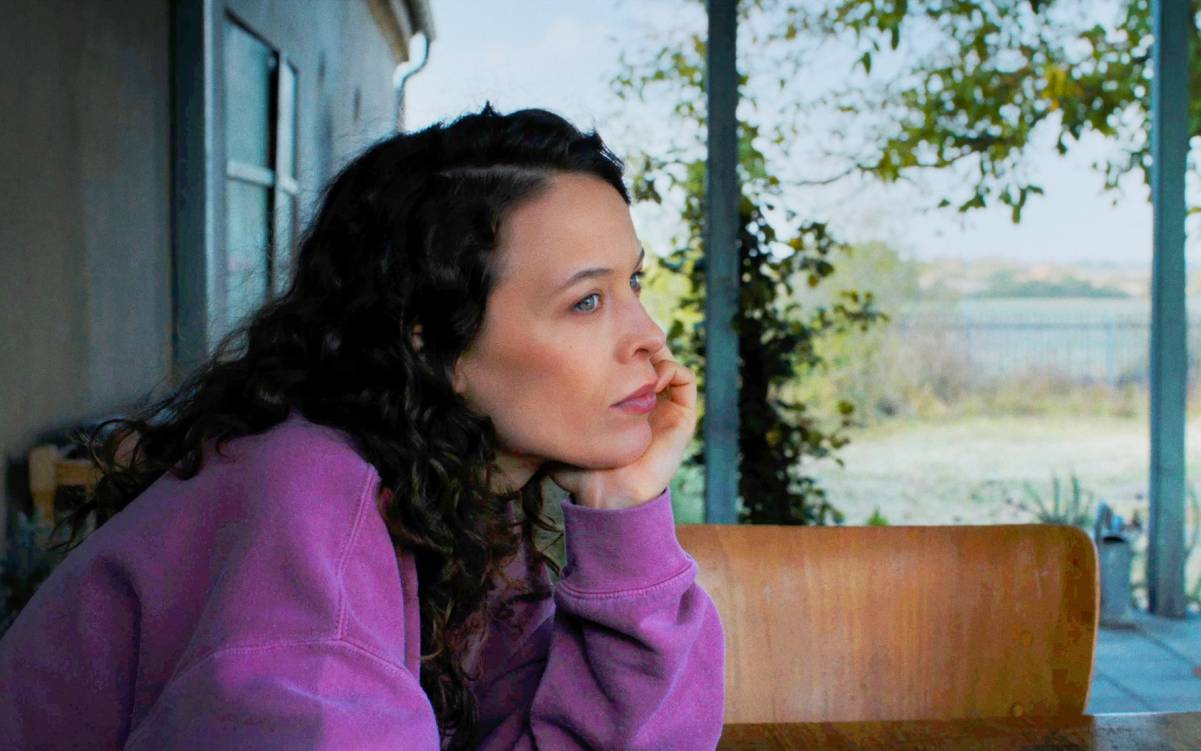
What kind of mystical pull brought these people together? This palpable, mysterious tension puts the audience in a headspace open to ambiguity and poetry — which is why the much more straightforward, even predictable, developments that follow left this viewer confused and wanting more. Laura soon takes up residence in the house of this kind woman named Betty (Barbara Auer), who agrees to look after her for a few days as she might be concussed. Laura, in a comfortable daze, is happy just to take in the slower rhythm of life in this sunny and cozy home. She asks no questions of Betty, except to help her around the house. Through her eyes, and in her respectful relationship with Betty, the humble abode soon takes on the airs of a homely idyll; when Laura tells her host, “I saw you painting the fence and I thought, that looks nice”, we know exactly what she means.
It is clear early on in this new arrangement that Laura’s presence also brings solace to Betty herself — when she mistakenly calls the young woman Yelena, we understand that the clothes she’s been lending her guest belonged to a daughter, either estranged or deceased. It’s a strangely obvious hint, which the film goes on to needlessly tease out even more when Laura is introduced to the men in Betty’s life. Working together in a small garage a short way from the house, Betty’s husband Richard (Matthias Brandt) and her son Max (Enno Trebs) are alarmed to find her housing a stranger, and fear that the experience may cause another breakdown. As redundant as these scenes sometimes feel, Petzold finds lovely ways to illustrate his characters’ emotions within his restrained, abstracted framework. When Laura offers to cook Koenigsberg dumplings for Max and Richard, Betty is giddily excited that her new host happens to know how to prepare the family’s favorite dish. Their worries quickly melt away as they, too, get used to the comfortably simple routine of life with Laura. They take delight in ordinary things, like working the flower beds, drinking coffee, and fixing up the broken down appliances around the house — a plain metaphor for this family’s desolate state before Laura came along.
The spell occasionally threatens to be broken by random reminders that, at any moment, all of this could be taken away: the washing machine explodes, and shady looking gangsters occasionally come to the garage. Petzold’s cinema is full of lives thrown upside down by unexpected tragedy, which does create some tension here. But the real threat to the peaceful arrangement is the fact that Laura is replacing an actual, dead member of this family. The perversity of the situation is self-evident from the start, and Petzold’s delaying of that unravelling feels like a narrative contrivance, rather than the slow dissipation of a soothing dissociative state. That this collapse would be triggered in part by Laura’s piano playing seems little more than a strategy to return to the motif of sound, in large part because it was established early on.
The most original part of the story comes after this unsurprising exploration of grief and broken people’s shared search for happiness. Laura and Betty’s family all seem to have recovered from their experiences, somehow healed from their traumas by their strange momentary communion. But could their relationship continue afterwards, this time on a healthier basis? It seems a shame that Petzold did not not choose to delve into this unknown dynamic instead. [C+]
Follow along for all our coverage of the 2025 Cannes Film Festival, including previews, reviews, interviews, and more.
Publisher: Source link






‘Off Campus’ Teaser and Release Date Revealed by Prime Video
No one expected a love story between rival hockey players to become one of the most talked-about TV shows of 2025, but there's a lot more where Heated Rivalry came from, as a new teaser for Prime Video's foray into…
Mar 21, 2026

Sarah Michelle Gellar Urges ‘Buffy’ Fans to Avoid Reading Leaked Reboot Scripts
Buffy the Vampire Slayer fans have had a rough few days after Hulu officially pulled the plug on a revival of the series, which would have brought star Sarah Michelle Gellar back as the titular heroine. Described as a continuation…
Mar 20, 2026
![Born Again’ Stars Explain Why Bullseye Is So Dangerous in Season 2 [Exclusive]](https://www.filmibee.com/wp-content/uploads/2026/03/Born-Again-Stars-Explain-Why-Bullseye-Is-So-Dangerous-in-1200x675.jpg)
Born Again’ Stars Explain Why Bullseye Is So Dangerous in Season 2 [Exclusive]
Along with Charlie Cox's Matt Murdock and Vincent D'Ofnorio's Wilson Fisk, Daredevil: Born Again Season 1 brought back one of The Man Without Fear's most notorious villains: Wilson Bethel's Benjamin Poindexter, better known as Bullseye. Not only was he back…
Mar 19, 2026

Born Again’ Showrunner Confirms ‘Avengers’ Character Is Key to Street Level MCU [Exclusive]
Ahead of the Avengers' return to the big screen later this year, Marvel Studios will return to street-level storytelling with the second season of Daredevil: Born Again on Disney+. Along with making the show canon to everything that happened in…
Mar 18, 2026