Cinematographers Fredrick Elmes And Peter Deming Reflect On Their Iconic Collaborations With The Auteur
Jun 27, 2025
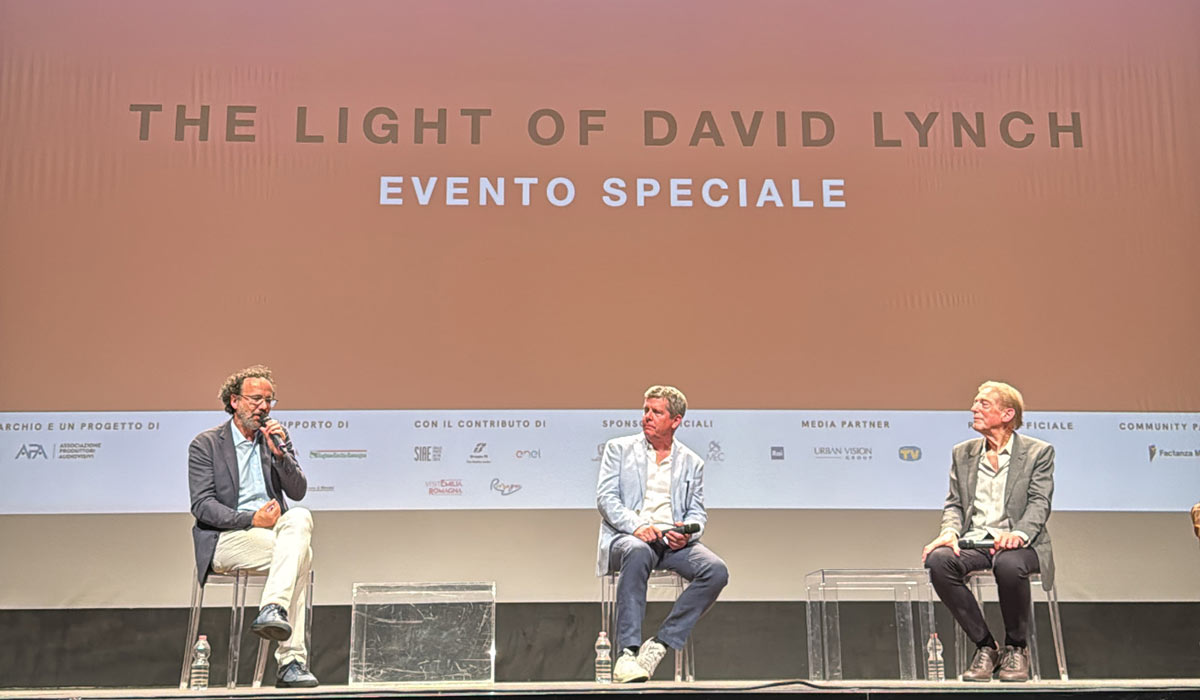
RICCONE, ITALY – Despite his age, the news of David Lynch’s death came as a shock to most of his fans and cinephiles around the world. This week, his most frequent cinematographers, Fredrick Elmes and Peter Deming, sat down at the Italian Global Series Festival in Riccone, Italy, for a special Q&A to discuss their work with the legendary auteur. They did not dwell on his passing. Instead, this was a night for artistic discussion. That being said, Deming shared one particularly poignant thought.
READ MORE: David Lynch, Legendary director of “Blue Velvet,” “Mulholland Drive,” and “Twin Peaks,” dies at 78
“There’s a line in ‘Lost Highway’ that Bill Pullman’s character says that the more I think about it over the years, sort of is David in a nutshell,” Deming says. “And it’s when he’s being questioned why he doesn’t have own a video camera. And he says, ‘Because I like to remember things the way I remember them, not necessarily the way they happened.’”
A legend in his own right, Elmes collaborated with Lynch on their first feature, “Eraserhead,” as well as the iconic “Blue Velvet” and “Wild at Heart.” He later went on to shoot classics such as Jim Jarmusch’s “Night on Earth,” Ang Lee’s “The Ice Storm,” Charlie Kaufman‘s “Synecdoche, New York,” among others, and co-shot Jarmusch’s next project, “Father, Sister, Mother, Brother” which is expected to debut at the Venice Film Festival at the end of August. Despite his success, he still has fond memories of their breakthrough film together.
“I met David when we were young at the American Film Institute, a graduate film school in Los Angeles, and he asked me if I wanted to work on a film with him,” Elmes says. “It happened to be ‘Eraserhead.’ So, we started on this venture together, and we were both young filmmakers, very energetic with a knowledge of film history and our training. What we discovered along the way was how much of a process making a movie is. And how well you get to know the people you work with as you go along, in addition to the whole act of making the film. It’s not just one foot follows the other. It’s a learning experience every day.”
Deming met Lynch after the filmmaker finished the second season of “Twin Peaks,” primarily shot by Frank Byers, and their works included “Highway,” “Mulholland Drive,” and “Twin Peaks: The Return.” The Emmy and Oscar-nominated Director of Photography worked with Lynch as much for his television projects as for his big screen endeavors.
“We had worked together on a program after ‘Twin Peaks,’ after the first two seasons, called ‘On The Air.’ He had shot the pilot, and he wanted someone to shoot the episodes upcoming,” Denning reveals. “Those episodes, he didn’t direct any of them. And then slowly, we did some commercials together. We did a show for HBO called ‘Hotel Room’, which was three half-hours; he did two. And then eventually ‘Lost Highway.’”
What many casual cinephiles may not have realized was how often Lynch played with different formats throughout his career. He was open to using tools that were not 35 mm film-based. His artistic vision was not limited to the medium.
Deming notes, “The projects I did with David Lynch, we shot anamorphic wide screen. We shot essentially 16×9, and then ‘The Return’ was the same, but obviously the first two were on film. The last was digital. I don’t think that the origination technique of those projects really altered David’s way of shooting or way of seeing the film. The return was something that David initially wanted to be very immediate in its capture. And he went to Showtime and said, ‘I want to shoot an iPhone.’ And through a process of elimination, we got up to an ARRI digital camera. But still, even had we shot on the iPhone, he would’ve shot it as if it was 35. I don’t think his process changes at all.”
Elmes adds, “‘The Amputees,‘ a little short film, is the poorest possible quality of black and white VHS video that you’ve ever seen. So, it was very much like David’s earlier films in eight or 16 millimeter in his experiments. But to be working really simultaneously in black and white, 35 millimeter was a wonderful thing. I had shot black and white, but not in 35 millimeter. And to have that extra quality and the ability to make the frames so dark and to play with the light and shadow in that way was just fabulous.”
Deming then reflected on “Premonition Following An Evil Deed,” a project shot with one of the original Lumiere Brothers crank cameras with black and white film that was 16 frames a second. The project was part of a larger documentary titled “Lumiere and Company.”
“The limitations were that you got three takes, 58 seconds each,” Deming recalls. “You could use no lights and no sync sound. And if you are able to watch the full documentary, David says clearly he spent a lot of time concepting it, and it was very complicated to execute because even though it’s a continuous take, there are five different shots in it. And so I just think it reminded me of his early work, and I just thought it was something to see.”
Elmes adds, “It’s a brilliant little film.”
This event was at a television festival, so the topic of Lynch’s landmark “Twin Peaks” naturally came up. Denis Lim, the director of programming at the Film Society of Lincoln Center, was on hand and noted that “Twin Peaks: The Return” was arguably his favorite Lynch film, as it’s a “radical work of art.” Deming, who eventually worked on “The Return,” recalls being curious that an established network was going to let Lynch make a TV show.
“He was more amazed that people really were fascinated by it,” Deming says. “And it seemed like he turned gears a little bit to me, almost a soap opera in a way. And I don’t know if it was intentional, but whether it was to sort of mock something or to make it part of the show, but it really, I was just happy that it was a success for him.”
Elmes had just finished working on “Wild a Heart,” he recalls, “To see David move into the realm of television and bring his values and his storytelling to really a whole new audience and a much, much larger audience? We feel so happy that he had found this new window, this new opening into the world. And I was such a fan of the show when it came out originally and watched it, I really looked forward to it, but was mostly very happy for David and his success.”
Publisher: Source link





Wuthering Heights Review | Flickreel
As far as adaptations go, I’ve never viewed any source material as sacred, including The Bible. While a faithful adaptation is always welcome, I’m open to a filmmaker leaving their signature on a classic story, especially one that’s been told…
Mar 17, 2026
Amy Adams Sinks In Vapid, Misguided Alcoholism Drama By ‘Pieces of a Woman’ Director [Berlin]
For a solid decade, starting in the late 2000s with Disney’s charming fairytale comedy “Enchanted” all the way to Denis Villeneuve’s melancholy sci-fi “Arrival,” it was easy to trust Amy Adams, a six-time Academy Award nominee. Then, somewhere around Ron…
Mar 17, 2026
Mason Gooding & James Van Der Beek’s Bad Night Is Aggressively Dull
Ever since the Scream franchise helped put him on the map, Mason Gooding has been a great talent to watch. The genre-bending slasher Heart Eyes is still his best non-franchise role yet, but he's also branched outside of horror in…
Mar 15, 2026
A Grumpy Nick Offerman Keeps This Fish Tale Swimming Along
Animated fish films have been done. Finding Nemo. Shark Tale. Ponyo. So to hear about another doesn't feel like anything new. However, The Pout-Pout Fish, starring Nick Offerman as a grumpy ocean pout named Mr. Fish, is a little different.…
Mar 15, 2026