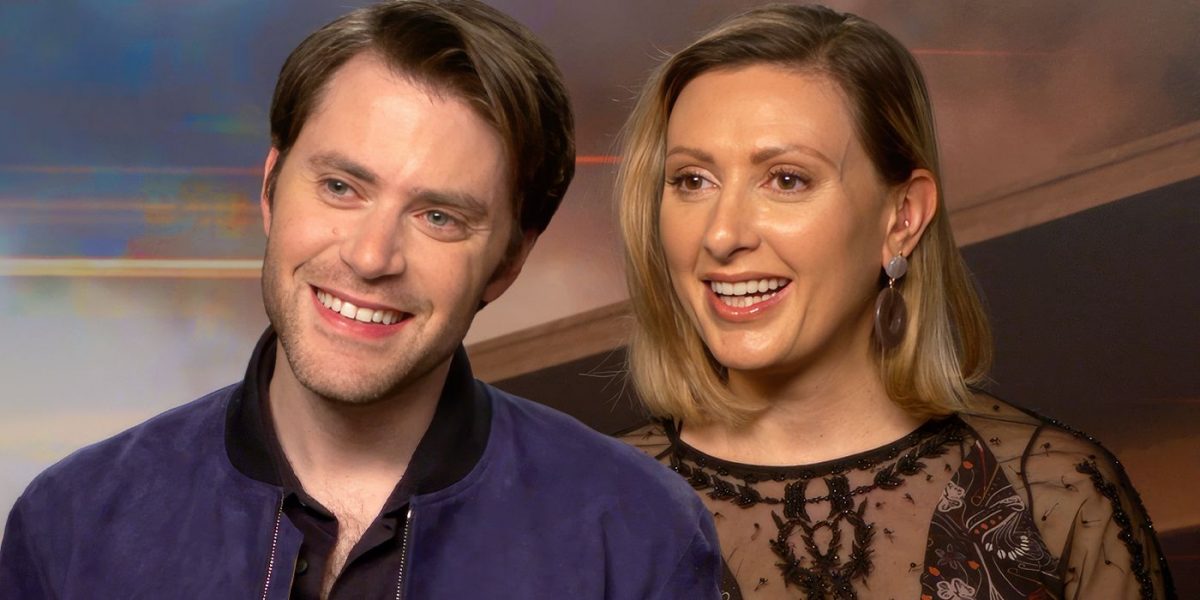
Citadel’s David Weil & Angela Russo-Otstot on Cliffhangers and Season 2
Apr 30, 2023
If you’ve already been drawn into the Russo Brothers’ Citadel on Prime Video, Collider’s Steve Weintraub spoke to writer and showrunner, David Weil, and executive producer, Angela Russo-Otstot, about the creation of this one-of-a-kind spy series. If you haven’t caught the episodes yet, this is a spoiler-free conversation that details how this first season, starring Richard Madden and Priyanka Chopra Jonas, interconnects with the subsequent installments in Italy and India.
Citadel is a “throwback to the great serializations” that begins eight years after this global intelligence agency is compromised from the inside. In order to protect their agents, Mason Kane (Madden) and Nadia Sinh (Chopra Jonas), Citadel wiped their memories and assigned them new identities. When Kane runs into an old colleague, Stanley Tucci’s Bernard Orlick, they’ll have to reactivate and relearn in order to save the world from Citadel’s opposition, Manticore, who seeks to take control of the world’s security.
COLLIDER VIDEO OF THE DAYSCROLL TO CONTINUE WITH CONTENT
During their interview, which you can watch in the video above or read in the full transcript below, Weil and Russo-Otstot explain how the writing of Citadel has been involved with the Italian and Indian series from the beginning, and how that collaboration continued into post-production. They clarify why the shows are not spinoffs but installments in this new global IP, and discuss being cognizant of a Season 2 since conception “so that it’s as fulfilling a journey as possible.”
COLLIDER: I have a ton of questions about Citadel, but I like throwing curveballs at the beginning. So I’m curious about Butch & Sundance, what’s the status of that?
ANGELA RUSSO-OTSTOT: We’re in the early stages of the creative process where, as you know, we’re working with Regé-Jean Page and Glen Powell, and both of them are such stars in their own right and bringing a lot to the table as collaborators, and it’s been a lot of fun. I’m really excited about that one. I think it’s gonna be great.
Image via Paramount
I’m looking forward to it. Jumping into why I get to talk to you guys. So the series is six episodes, which of the six are you most looking forward to audiences seeing?
RUSSO-OTSTOT: That’s a good question.
DAVID WEIL: One and six, I think would be mine.
RUSSO-OTSTOT: Yeah, me too. Me too.
Yeah, everyone said six, so that’s the reason I’m mad I don’t have four, five, and six. Every episode basically ends on a cliffhanger, so talk a little bit about that aspect.
WEIL: Look, it’s a throwback to the great serializations that people love so much. These are very thrilling episodes, you’re sort of riding by the seat of your pants every episode. And so, to end on this delicious cliffhanger that will then propel you to come back week after week was certainly by design. And in a story about spies and secret identities and duality and all that, and secrets, there was real fertile ground to craft some incredible cliffhangers.
Image via Prime Video
One of the things that I’m very excited about is you have another series that’s going to be in Italy and another series that’s going to be in India. I’m most excited about the Indian one because I think RRR has almost primed a lot of people in Western audiences for Indian content. What can you tease about those installments and how maybe they’re connected to this one?
WEIL: They’re extraordinary.
RUSSO-OTSTOT: And extraordinarily different.
WEIL: Yes, and we’d love to talk with you, truly, when they come out because there’s so much we have to say about them. We’re such admirers of those creators, we’re such fans of theirs and have been for a very long time. What we will say is, Citadel is a global spy organization, so all of the series sort of collide with Citadel in some way. There may be some characters that cross over and some backstories we may learn about certain characters or futures we may learn.
So we build this big IP, this big mythology, with those creators. Every other week we have a global writers’ room with them. So we’re really holding hands as we write this thing in real time together, this sort of tapestry of story.
RUSSO-OTSTOT: And each of them hold equal weight. These aren’t spinoffs. This first series, Citadel, is an introduction, and then Italy is the next installment and India is the next installment. All of them have the same level of importance within the larger mythology and world, and all of them have the same great ambition when it comes to execution, as evidenced by the fantastic creatives that have been brought on to spearhead them.
One of the problems with streaming shows is that the first season comes out in January of whatever, then there’s like a two-year break, or even three years, before you get to the next season. So is there some sort of concerted effort where the next version in Italy will be out at the beginning of next year? Some sort of thing where there’s always a version of Citadel at a certain period of time?
WEIL: We’re certainly cognizant of that, and I think we, as viewers and lovers of TV, have felt that as well. I think in the past few years COVID really derailed so many series and created that delay in many ways. But we would love for the story to feel like there’s always a Citadel and a series to watch that builds toward the larger mythology.
So, yes, it’s our ambition. The best-laid plans can always go awry, but we’re efforting to do that to really reward the audience and to ensure that they continue to come back.
RUSSO-OTSTOT: And what you’re talking about is such an important part of the experience when it comes to elongated storytelling because it’s a singular journey that exists between all of the series. And so I think that the amount of time that you have to wait to get into the next chapter, if you will, is so important for audiences in terms of maintaining that investment. So it’s a great question because it’s very top-of-mind for all of us.
Image via Prime Video
Obviously, we’re going to see what happens with the show and what audiences think at the end of this month, but assuming it’s a hit, how quickly do you think you could be in production on a Season 2?
WEIL: We always want to be as quick as possible, but if we’re so lucky to have a second season, we just have to make sure the story is right. It all starts on the page for us, and as soon as we can lock that in and we feel great about it and this is exciting, it’s different and it evolves the story, then we go. It would be a good problem to have, and we’ll see, we’ll see.
Have you started thinking about it just in case?
WEIL: Always. I think any time a story is created, we always think of the destination and where it can go and what a second season could be, in part because we fall in love with these characters in this world so much that it’s a thrill for us. It’s the thing we dream about at night. It’s the thing we love just thinking about. So yes, I guess is the answer, yeah.
RUSSO-OTSTOT: I think as producers, too, we are cognizant of the investment. Also as fans, we are cognizant of our own investment in series and the long-form storytelling. And so it’s important to reward people for that time, and that’s definitely the case here. You always want to think about where you’re going so that it’s as fulfilling a journey as possible.
The first episode has a massive action set piece that’s like movie quality. How important was it to start the show off with something like that? Because I’ve noticed a few series are starting with a big action thing. Is it to pull people in right from the beginning?
WEIL: It is. It really is to pull people in and to show them the scope and scale of what Citadel is. This series introduces a language, in terms of the action, that we often see on screen in theaters with Bond or Mission: Impossible. I mean, it’s really massive.
But so too, I think that the opening train sequence was not only to forward the idea of what the action will be but also tell the story of these two spies, of the romance, the wit. It’s sort of like this symphonic piece that tries to play every instrument and tell an audience, “Oh, this is what you can expect Citadel to be. It has all these ingredients.”
Image via Prime Video
I’ve spoken to a lot of creatives and they talk about how making the first season of anything is incredibly challenging because you’re learning about the characters, you’re learning what works, what doesn’t work, just all the things to pull off a show. So, what did you actually learn making the first season that you’ll take with you if you get to make a second season?
RUSSO-OTSTOT: That’s a great question. It’s so interesting because I think this experience is a little different than one we’ve ever had before, and perhaps anybody since this is the first truly global franchise, I think ever. Typically those lessons learned come from our own choices, right? But in this instance, we learned a lot of things because of the ideas coming in from others because of where they were at in their creative process. And then those ideas, I think, jolted us to say, “Oh, we can turn this knob here and lean in further there,” and I think that that was, more than anything, the biggest lesson for us.
WEIL: Absolutely, I totally agree. I totally agree. I mean, it was like having a continual writers’ room. So even in post-production, as our partners would watch our episodes, they had ideas. “What if this, what if that?” and we love that. I mean, it was never done. Producing and creating Season 1 is never done. It’s just going to air, though, April 28. You know what I mean? [laughs]
The first two episodes of Citadel are available on Prime Video, with subsequent episodes releasing weekly. Check out our interview with stars Richard Madden and Priyanka Chopra Jonas below.
Publisher: Source link


‘Off Campus’ Teaser and Release Date Revealed by Prime Video
No one expected a love story between rival hockey players to become one of the most talked-about TV shows of 2025, but there's a lot more where Heated Rivalry came from, as a new teaser for Prime Video's foray into…
Mar 21, 2026
Sarah Michelle Gellar Urges ‘Buffy’ Fans to Avoid Reading Leaked Reboot Scripts
Buffy the Vampire Slayer fans have had a rough few days after Hulu officially pulled the plug on a revival of the series, which would have brought star Sarah Michelle Gellar back as the titular heroine. Described as a continuation…
Mar 20, 2026
![Born Again’ Stars Explain Why Bullseye Is So Dangerous in Season 2 [Exclusive]](https://www.filmibee.com/wp-content/uploads/2026/03/Born-Again-Stars-Explain-Why-Bullseye-Is-So-Dangerous-in-1200x675.jpg)
Born Again’ Stars Explain Why Bullseye Is So Dangerous in Season 2 [Exclusive]
Along with Charlie Cox's Matt Murdock and Vincent D'Ofnorio's Wilson Fisk, Daredevil: Born Again Season 1 brought back one of The Man Without Fear's most notorious villains: Wilson Bethel's Benjamin Poindexter, better known as Bullseye. Not only was he back…
Mar 19, 2026
Born Again’ Showrunner Confirms ‘Avengers’ Character Is Key to Street Level MCU [Exclusive]
Ahead of the Avengers' return to the big screen later this year, Marvel Studios will return to street-level storytelling with the second season of Daredevil: Born Again on Disney+. Along with making the show canon to everything that happened in…
Mar 18, 2026