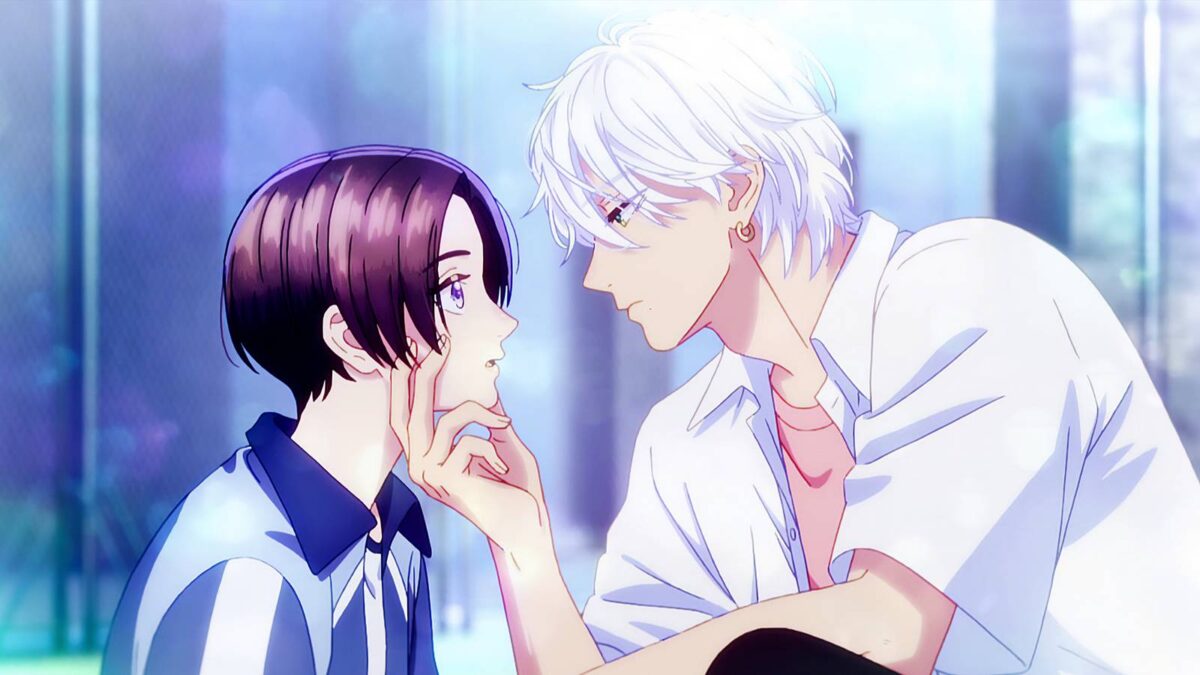
Crunchyroll’s 12-Part Anime Adaptation Rewrites the Manga Series’ Most Powerful Romantic Moments
Apr 2, 2026
Summary
In the Clear Moonlit Dusk stays extremely faithful to the manga, with the team aiming to preserve everything that made it special
Yoi’s and Kohaku’s subtle, gaze-driven chemistry anchors the series’ emotional core.
Mika Yamamori and staff closely guided the anime, adding scenes and anime-only touches like pinwheels.
The winter season was packed with romance series for anime fans. From the first-ever anime adaptation of Hana-Kimi to the sophomore season of Anyway, I’m Falling in Love with You, and the charming You and I Are Polar Opposites, there was no shortage of love stories to enjoy. However, one sleeper hit won over audiences with its relatable first-love story, compelling characters, and beautiful animation: In the Clear Moonlit Dusk. The series follows Yoi Takiguchi, an androgynous girl nicknamed “Prince” by her peers. Used to being called “handsome” and often mistaken for a boy, Yoi has grown accustomed to it. But when she meets Kohaku Ichimura, a popular upperclassman who is also known as a “Prince,” everything begins to change. He becomes the first person to call her beautiful, leaving Yoi to question whether her growing feelings for him are genuine or simply the result of being seen as a girl for the very first time. Collider’s Laura Adams had the opportunity to speak with Head Writer Ayumu Hisao about the challenges of adapting the story from page to screen, what needed to be adjusted, and how the creative team brought their own unique perspective to the series.
The ‘In The Clear Moonlit Dusk’ Team Put the Unspoken Into Words for the Anime
“That was a tough process because putting them into words felt like it would lose what couldn’t be expressed through words.”
COLLIDER: When adapting In the Clear Moonlit Dusk for the screen, what elements of the original manga were most important for you to preserve? AYUMU HISAO: Everything. I did everything in my power to express what makes this work amazing through animation. COLLIDER: What were some of the biggest challenges in translating the story from manga to anime, particularly when it comes to the internal emotions that are often conveyed visually on the page? HISAO: The delicate emotional expressions Yamamori-sensei drew needed to be translated into words to come up with the script. That was a tough process because putting them into words felt like it would lose what couldn’t be expressed through words. But by articulating them with words, it helped us face the emotions of the characters at a deeper level, and share that with the members of the staff in the form of a script. COLLIDER: Adaptations often require adjustments for a new medium. Were there any moments from the manga that had to be reimagined or expanded in order to work better in animation? HISAO: The original work is still being serialized on a monthly basis, but as the anime series, we had to fit them in the format of 12 episodes of 30-min show, and the story needed to reach its climax in that limitation. So we came up with the structure of the series by thoroughly identifying the delicate emotions Yoi-chan and Kohaku go through, and based on that, what needs to happen in each episode, and how to present it. We also focused on how to drive the story forward toward the final episode since the anime narrative had to reach its climax in the middle of the original storyline. COLLIDER: The story resonates with many readers because of its emotional core and the dynamic between the main characters. From your perspective as a writer, what makes this story so emotionally impactful? HISAO: Yoi-chan is the “oshi” type of protagonist. She’s someone you can look up to, someone attractive that you can fall for. And when you see someone like that struggle over romance with her senpai, you can’t help but root for her every action. I think the readers feel that way because very subtle, delicate emotional changes that can be easily overlooked in daily life are brilliantly captured and vividly drawn. COLLIDER: On the other side of that, what has been the most rewarding part of bringing this story to life in anime form? HISAO: Everything. Because the original work is so wonderful, it was extremely challenging to try and express its appeal through a different medium without losing its charm, and I poured my every being into it. This anime series pretty much follows the original work, and there’s no big change. But that was an intentional choice after going through each scene one by one to consider how it needed to be treated.
Yoi and Ichimura Can’t Keep Their Eyes Off Each Other
“When you’re in love with someone, your eyes subconsciously follow that person.”
Ichimura kissing Yoi’s foreheadImage via Crunchyroll
COLLIDER: Yoi and Ichimura have such a unique dynamic. When writing the adaptation, how did you approach capturing their relationship? HISAO: In the script, we paid extra care with the line of sight, because that is a consistent, symbolic element throughout the 12 episodes of the anime series, that when you’re in love with someone, your eyes subconsciously follow that person. COLLIDER: For fans of the manga who are about to watch the anime, is there anything in the adaptation you’re especially excited for them to experience on screen? HISAO: The charming characters from the original work, the story, its stylish ambiance, and how all of these will have colors, lights, voices, and start to move with sounds and music. Which means everything! COLLIDER: Is there a character you feel particularly drawn to, and what is it about them that you like? HISAO: Every character is charming, but I’d have to say Yoi-chan beats them all. She’s beautiful inside and out, she’s cool, she can be a handful at times, but she’s funny and cute, and you just want to cheer for her as she struggles her way through her romance. I count myself as one of her fans.
‘In The Clear Moonlit Dusk’s Mangaka Was Heavily Involved in the Anime
“Yamamori-sensei herself wrote the storyboard for a scene that wasn’t in the original manga.”
COLLIDER: Did Mika Yamamori provide input or feedback during the adaptation process? If so, how did it influence the final work? HISAO: Yamamori-sensei and her team, who worked on the original work, went over the series structure and the scripts, and they gave us feedback for each episode. In episode 10, Yamamori-sensei herself wrote the storyboard for a scene that wasn’t in the original manga. Thanks to their support, we were able to adapt the parts that needed to be changed due to rights issues or parts that were anime original without losing the ambience of the original manga.
COLLIDER: How do you and your team bring your own unique perspective to Mika Yamamori’s work? HISAO: I think you can see it when you watch the show, but there are elements you can only get through an anime adaptation, such as colors, lights, voices and movements, sounds and music, and how they come together to tell a story… The skills and creativity of the staff are on full display in those fields. Here are only a few of the many examples of that in the scripting phase. You read dialogues with manga, but you hear them with anime. So there were times when we tweaked monologues or dialogues and/or switch orders around so that it was easier to understand. We’d discuss the best choices in the script meetings. Director Maruyama paid close attention to the continuity of the movements and flow. In manga, the narrative progresses panel by panel. In anime, this is expressed through continuous animation. And he wanted to make sure that things flow naturally when that happens, so I paid attention to that in the script as well. In episode 7, a pinwheel was added quite effectively. This is an addition introduced to the script by Naruhisa Arakawa, the writer of episode 7. These are just some examples of how each staff did their best and worked together to showcase the appeal of the original work in the way that fits best as animation. COLLIDER: Do you have a favorite episode from this first season? What makes it stand out to you? HISAO: I love every episode since each is imbued with delicate and subtle emotional changes, but if I have to pick one… I’d say that the episode where they go to eat gyoza dumplings left a big impression on me when I read the original manga. When Kohaku sits next to Yoi-chan out of the blue, how her heart beats faster and her temperature rises are so realistically and perfectly expressed. It’s not a dramatic moment or a major event, but how vividly that moment is captured shows you what makes this manga truly powerful.
In the Clear Moonlit Dusk
Release Date
January 11, 2026
Network
TBS, MBS, CBC, Tulip Television, BSN, tys, NBC, HBC, RKK, i-Television, SBS, IBC, BSS, MRO, OBS, TUF, RSK, TUY, tbc, RKB, SBC, KUTV, RBC, UTY, RCC, MRT, atv, MBC
Directors
Yusuke Maruyama
Writers
Ayumu Hisao, Naruhisa Arakawa, Kazuya Matsumoto
Cast
Rei Ichinomiya
Yoi Takiguchi (voice)
Ryota Suzuki
Kohaku Ichimura (voice)
Aya Yamane
Nobara Tone (voice)
Momoko Seto
Kotobuki Hibiya (voice)
Publisher: Source link


The Last Airbender’ Season 2 Release Date Announced by Netflix
In February 2024, Avatar: The Last Airbender got its first chance to shine in a live-action format, as a live-action reboot debuted on Netflix after years of utilizing an animated setting. Starring Gordon Cormier as the titular Avatar Aang, next…
Apr 2, 2026
‘Agent From Above’ Images Tease This Week’s Release of Netflix Action Fantasy Series
In anticipation of its long-awaited debut this week, Netflix has revealed several new images from the streamer’s most ambitious action fantasy epic series. Nearly a decade after it was first announced, the popular streaming platform is hoping all that effort…
Apr 1, 2026
Maul – Shadow Lord’ Will Use Draw From George Lucas’ Original Plans for the Character
It sounds like Star Wars: Maul — Shadow Lord will revisit some of George Lucas' original ideas for Darth Maul before he sold Lucasfilm to Disney. Introduced in 1999's The Phantom Menace, Maul became an instantly iconic and recognizable character…
Mar 31, 2026
Ron Perlman Explains How His Role as Super Mutant in ‘Fallout’ Came to Be
Ron Perlman has a long list of impressive credits on his resume, including his fan-favorite portrayal of Hellboy in a pair of movies from 2004 and 2008. He also has a long history in video games, thanks to his work…
Mar 30, 2026