‘Deaf President Now!’ Film Review: An Inspiring and Passionate Documentary
May 17, 2025
Nyle DiMarco and Davis Guggenheim’s Deaf President Now! is one of the most riveting documentaries of the decade and one of the most important human rights stories ever told. It is the rare film (fiction or nonfiction) that is able to capture a moment in time so completely while standing behind a strong message with conviction. This stunning new documentary is a rousing, informative, and eye-opening experience. The filmmakers seek to teach those who were not aware of one of history’s most important revolutionary acts; an act that would become a turning point for Deaf rights and a catalyst for the Americans with Disabilities Act, paving the way for broader legal protections for people with disabilities, including Deaf and hearing-impaired individuals.
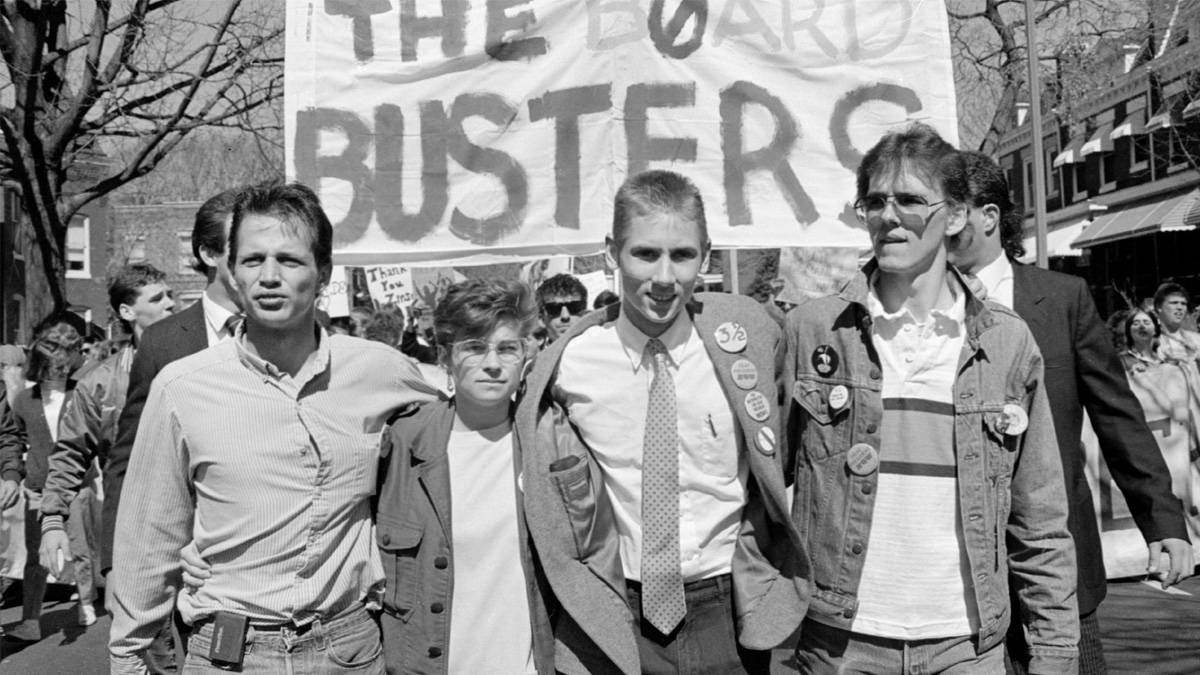
Deaf President Now! stunningly recounts the history-making protests that took place at Gallaudet University, the world’s first and only college for the Deaf. March 6, 1988, saw students rise up in rebellion after the school’s board of trustees (led by a morally ugly woman of privilege named Jane Bassett Spilman) appointed a hearing person, former nurse Elisabeth Zinser, to be the university’s president. This comically unqualified woman had no knowledge of the Deaf community and didn’t know any sign language. There were more accomplished Deaf candidates in the running, but the school’s board of trustees ignored them in favor of someone who seemed to meet their standards of White, snooty, and able to hear.
The film’s title refers to the “Deaf President Now” (DPN) movement that changed the course of the school’s history. This united and peaceful activism remains important and relevant in today’s world, as the Deaf communities are not in need of, as Tennessee Williams wrote, “The Kindness of Strangers.” There is a stigma that the Deaf need our help. The students and makers of this film want to show that being deaf doesn’t make one incapable of living life. The four students who led the resistance (Greg Hlibok, Bridgetta Bourne-Firl, Jerry Covell and Tim Rarus), had a fire and passion in their hearts and rose up to take a stand against those who would discard the Deaf community as less-than, compared to those who can hear.
The filmmakers keep the main focus on the four young activists, taking time for us to get to know them and further the emotional connections. Jerry Covell was more animated and outspoken, as his in your face, no filter, personality was the spark that became an inferno. Bridgetta Bourne-Firl was a strong young woman who stood in defiance alongside her counterparts, but also wanted to bring a Deaf woman’s perspective to the male-dominated revolution. Tim Rarus was the most collected of the crew. A handsome and determined young man, Rarus always had a sharp focus on the desired outcome. The more subdued Greg Hlibok (much to the dismay of Covell) became the face of the “DPN4”.
The documentary finds an interesting path as it brings focus on the very different personalities of the four students who didn’t always see eye-to-eye on how to handle the protests. It is fascinating to see how these young people came together in the hope of turning the anger of the entire student body (and many faculty members) into a strong and unified rebuke of the blatant bigotry toward, and patronization of, the Deaf.
One particular moment of ignorance is found when Hlibok is invited to appear on the ABC news program, Nightline with Ted Koppel. As the nervous young man awaits his first time on national television, he is in the makeup chair. One of the assistants, knowing Hlibok is deaf, puts an earpiece in his ear. The scene is just one document of how many in the hearing world are ignorant of the Deaf community. It is Jane Bassett Spilman who gets caught on camera angrily stating that she believes Deaf people can’t function in a hearing world. Her offensive remarks would escalate the protests.
Perhaps the most fascinating figure is I. King Jordan (a Gallaudet graduate who was serving as Gallaudet’s Dean of Arts and Sciences at the time of the protests) was the students’ main choice for president and who would become just that when Zinser resigned after only four full days as president, where she did absolutely nothing. Jordan was not born deaf, losing his hearing in a motorcycle accident when he was 20 years old and there were some who perceived him as an outsider.
A complicated figure, I. King Jordan speaks honestly to his place in the movement’s history. A devastating moment comes with footage of Jordan standing with the students in unison, only to back down when bullied by Spillman and the board. As Spillman introduces him to the microphone during a meeting with the protesters in the school’s auditorium, Jordan (visibly shaken and aware of the bad decision he is about to make) takes to the mic and states that he is in agreement with the board’s decision to elect Zisner. During his interview, you can see how this statement still bothers him. As he speaks to the moment, the pain and regret are evident.
Jordan’s kowtowing to Spillman took the wind out of the movement for a time, but the students were strong and their determination helped him to find the courage to be a leader. As the protesters held firm (the school was completely shut down by the students) and would not waver, the time came for Spillman and president-of-three-days Elisabeth Zinser to throw in the towel.
The students had only four demands, with nothing being unreasonable and each one benefitting the university, its faculty, and its students-
- The immediate resignation of Elisabeth Zinser.
- The immediate resignation of Jane Bassett Spilman.
- The reconstitution of the Board of Trustees with a 51% or more majority of deaf members.
- No reprisals against ANY students or staff members involved in the protest.
On March 13, 1988, after almost eight days of continued resistance, the students’ demands were met leading I. King Jordan to become the first deaf president in Gallaudet’s 124 year history.
DiMarco and Guggenheim have a gold mine of archival footage to assist in the telling of this important chapter in Deaf history. Working with editor Michael Harte, the events are told day by day, using news coverage of the time from both Washington D.C. affiliates and, eventually, nationwide news outlets. Each moment is precisely structured, following the increasing outrage of the students as they watch their rights and wishes ignored. The footage is intercut with interviews of the DPN4, I. King Jordan, and others who were there or who followed the protests. Each interviewee paints a vivid picture of the week-long resistance while their passionate recollections are powerfully moving and inspirational.
In a style perfected by filmmaker Errol Morris, Deaf President Now! uses the occasional reenactment, but sparsely and only in moments where there is no actual footage to reflect a particular moment the documentary’s subjects are speaking to. Dramatic reenactments are usually a demerit for a serious documentary, but the directors are smart in their structure, achieving a resonant, articulate, effect by having actors Tim Blake Nelson, Leland Orser, Abigail Marlowe, and Paul Adelstein narrate these passages.
As the ads state, this film captures “the greatest civil rights movement most people have never heard of.” The filmmakers put the audience on the frontlines with the protesters during the intense week-long standoff, as the unfiltered interviews allow a candid insight into the Deaf community and the struggles they face, then and now. The filmmakers shine an interesting light on the different levels of perception in the Deaf community. In his 1988 classic, School Daze, director Spike Lee was taken to task for daring to speak to the racism within Black students on college campuses. DiMarco and Guggenheim show instances of students not fully on the I. King Jordan bandwagon, as he was seen by some as not being truly deaf. It is smart to include the fallibility found within the movement and in Jordan himself. No one is designed for cinematic sainthood, Flaws and imperfections are as important a part of these people as their grit and determination.
On a personal note, my wife (who studied hearing and Speech Sciences and Deaf Education and taught sign language to children) was a part of the DPN protests. As the movement and its cause began to receive national attention, people from all around D.C., Maryland, and Virginia came to Gallaudet to show solidarity with the students. I spoke to her about her time there and she confirmed the power of unity, respect, and love was the unshakable force that fueled the movement, even when all felt lost.
This April, I was honored to attend the film’s East Coast premiere at Gallaudet University. It was a powerful experience, as many of the subjects and their families were in attendance and the seats were filled with University students who are all “children” of the school’s history. To my left were the parents of Greg Hlibok, while I. King Jordan sat in the seat in front of my wife. There was an unmistakable sense of pride beaming through the auditorium that night. Everyone in attendance had an emotional and personal connection to the events of that time. What those four students accomplished changed history and helped to springboard forward movement in how the world communicates with the Deaf community.
We live in a world where some see disability as weakness. DiMarco and Guggenheim present their film in the hope of dispelling such uninformed perceptions. Deaf President Now! is not only insight into a forgotten piece of history, it is a call for acceptance and inclusion and a demand that everyone’s human rights be recognized. 37 years later, the actions of those four brave students continue to echo in the sounds of change.
Deaf President Now!
Directed by Nyle DiMarco & Davis Guggenheim
Producers Amanda Rohlke, Davis Guggenheim, Jonathan King, Nyle DiMarco, Michael HarteDavis
Executive Producers Laurene Powell Jobs, Lizzie Fox, Casey Meurer
NR, 100 Minutes, Apple Original Films, Concordia Studio
Publisher: Source link




A Flame The Colour of Air – Film Threat
SLAMDANCE FILM FESTIVAL 2026 REVIEW! You will shimmer and shake, like you’re riding the snake while being wowed by the dynamite animated short A Flame The Colour of Air, written and directed by talented Canadian filmmaker Emily Pelstring. Jessica Mensch’s…
Mar 3, 2026

‘9-1-1’ Can’t Decide What It Wants To Focus On in a Lackluster Season 9
Editor's Note: The following contains spoilers for 9-1-1 Season 9, Episode 11.I was hoping that 9-1-1 would take advantage of its month-long hiatus and course-correct after its most recent episode, but while this week is certainly an improvement from last…
Mar 3, 2026
Good Luck, Have Fun, Don’t Die Review
Mercy was a film about AI that AI could’ve written. Good Luck, Have Fun, Don’t Die also tackles AI, although it could only come from the mind of Gore Verbinski. As he did with his Pirates of the Caribbean trilogy…
Mar 1, 2026
Investigative Screenplay Review: Suspenseful but Weak Antagonist
Vadh 2 (2026): When Murder Is Justified — Starring Sanjay Mishra as prison guard Shambhunath Mishra When evil tries to take control, its destruction becomes necessary. With this theme, Bollywood brings you a spiritual sequel to its 2022 crime-thriller “Vadh”.…
Mar 1, 2026