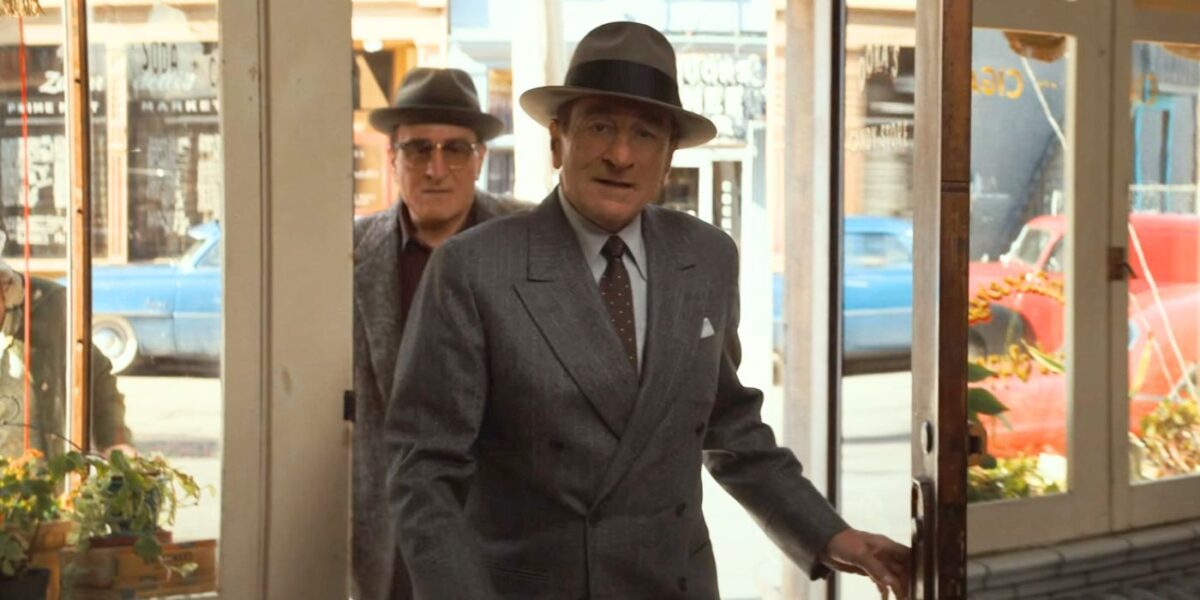
Did We Really Need Two Robert De Niros?
Mar 19, 2025
Martin Scorsese may have directed some of the greatest crime dramas ever to be created, but Robert De Niro starred in most of them. The unofficial trilogy of Goodfellas, Casino, and The Irishman is a testament to that fact, and that doesn’t even include other classics like Scorsese’s early hit Taxi Driver and his recent epic Killers of the Flower Moon. This probably sounds like Cinema Snob 101 material, but the reason we bring it up is because any film that casts Robert De Niro in a gangster film is inevitably going to draw comparisons to those aforementioned masterworks. That is certainly a fate that The Alto Knights is unlikely to escape.
Directed by Good Morning, Vietnam and Rain Man filmmaker Barry Levinson, The Alto Knights sees De Niro star as not one, but two real-life figures from the world of organized crime during the mid-1900s. It’s not the first time we’ve seen this in a gangster movie, such as with Tom Hardy’s Legend, but the concept does give the legendary actor a chance to showcase a great level of range. Sadly, as intriguing of an elevator pitch as the film may be, The Alto Knights never quite delivers an engaging crime story nor does it justify its ambitious core concept.
What Is ‘The Alto Knights’ About?
The Alto Knights takes place at the absolute height of organized crime, when the Mafia’s presence and reach across the United States was practically omnipresent. Still, the epicenter of this crime wave can be traced back to New York City, where two crime bosses (both played by Robert De Niro) will go from lifelong friends to bitter enemies. One side of this coin is Frank Costello — a well-respected member of the community who takes great lengths to keep his dealings in organized crime hidden under a facade of philanthropy. The other is Vito Genevese — an outspoken Mafioso who wants to get everything he wants by any means necessary. When the two have disagreements about how their crime families should move forward in life, it leads to a deadly rivalry that puts the entire Mafia organization in the crosshairs.
One might think that The Alto Knights gives Costello and Genevese an equal amount of screen time and agency in the story, but that’s not exactly what the film does. Instead, Costello is directly depicted as the main protagonist who gets his entire history (and we do mean his entire history) while Genevese is portrayed as more of a shadowy villain. That’s a bit of a shame, as this seems like a story that is perfectly suited for a dual narrative (or rather a dual narrative similar to something like Ron Howard’s Rush) where Costello and Genevese are treated as having equal importance in this tale. Not to mention, it results in Costello’s story feeling overdeveloped with too much filler, while Genovese’s story feels undercut by minute details.
Apart from the film’s core narrative struggling to give its central characters their due, Robert De Niro is doing his best to bring these characters to life. He’s surprisingly convincing as two separate individuals. Frank Costello is essentially Robert De Niro just playing himself, while Vito Genevese exudes a more over-the-top persona in the vein of De Niro’s frequent co-star Joe Pesci. The prosthetics on De Niro when he’s Vito Genevese aren’t always the most convincing, but The Alto Knights does overall succeed in making these feel like two distinct individuals despite being played by the same actor.
So… What Exactly Is the Purpose of Robert De Niro Playing Two Characters in ‘The Alto Knights’?
Now that we’ve established that De Niro does sell himself as two different figures, one may be wondering why the decision to have the actor play two separate characters to begin with. It’s a fair question, but the thematic weight behind the move feels nonexistent and superfluous. There doesn’t seem to be any clear reason why Vito Genevese couldn’t have been played by one of the many great heavies who have played villainous mobsters on countless occasions, making this all feel more like a gimmick than anything else.
The Alto Knights could have benefited by giving its supporting cast more to do, especially considering how packed and overcrowded it is. So much so, to the point where it’s easy to forget or get confused by which characters are being referred to and how important or unimportant they are to the plot. Cosmo Jarvis and Debra Messing are the most relevant examples, and while they each give strong performances, their characters are treated more as set dressing to De Niro’s characters.
Not that learning more about these characters would be much better, as an expansive chunk of The Alto Knights is just pure, meaningless exposition. The film spends a truly obscene amount of time telling the audience about Costello and Genevese’s relationship instead of showing their upbringing via flashbacks and creative storytelling devices. Instead, we get a barrage of static images via some very choppy editing that is an ongoing issue throughout the film (particularly in a scene where one of the characters gets shot). Costello and Genevese only share about two to three scenes in the entire film, so their so-called friendship before their rivalry comes across as pure hearsay.
‘The Alto Knights’ Moves at a Snail’s Pace
Image via Warner Bros
Compared to another Robert De Niro-led gangster movie, The Irishman, The Alto Knights is about two and a half hours shorter. So why does it feel even longer than the infamously lengthy Scorsese caper? Abysmal pacing and a lot of pointless sequences. So many of Alto Knights’ dialogue sequences feel entirely aimless, with the characters going round and round in tedious circles before the plot takes a mere half-step forward. A lengthy subplot involving Genevese trying to take over a local club feels like it could have been chopped from the film entirely, especially since Costello spends almost the entirety of that time just watching TV. The pacing might be forgivable had there been tension and suspense, but sadly everything is fairly straightforward with the inclusion of one of the most predictable movie deaths in history during the third act.
That’s not to say that there aren’t a sprinkling of bright moments sprinkled throughout The Alto Knights. For starters, some scenes are genuinely funny, such as a few arguments between Vito Genevese and Vincent Gigante (Jarvis) being among the film’s most entertaining moments. There are even some scenes that had to have been unintentional, such as a Pomeranian dog actor who just didn’t seem to want to film that day. While that one is more obviously played for laughs (cooperating puppy or not), others feel more tonally inconsistent, such as the big climax that should come across as a dramatic finale reading more as something to come from a goofy slapstick comedy.
It’s a real shame that The Alto Knights doesn’t explore its real-life story as thoroughly as it should have, as there is a genuinely interesting story to tell here. The film details historical events that didn’t just dramatically impact the shadowy world of organized crime, it changed the public perception of the Mafia forever. The Alto Knights perhaps would have been better served if it had been a documentary narrated by one Robert De Niro instead of a meandering feature film that stars two.
The Alto Knights comes to theaters on March 21.
The Alto Knights
‘The Alto Knights’ has double the Robert De Niro, but only half of what made the movies that inspired it special.
Release Date
April 21, 2025
Runtime
120 Minutes
Writers
Nicholas Pileggi
Vito Genovese / Frank Costello
Debra Messing
Bobbie Costello
Pros & Cons
Robert De Niro gives two decent performances.
Some genuinely funny moments (both intentional and unintentional).
Having De Niro play both characters feels like a gimmick.
A metric ton of expository dialogue.
Some very choppy editing paired with poor pacing.
Publisher: Source link



New ‘Wheel of Time’ Animated and Video Game Adaptations Are in the Works
Amazon might be finished with The Wheel of Time, but we haven't seen the end of the story when it comes to adaptations of Robert Jordan's bestselling high fantasy saga. Fans were left blindsided when Amazon abruptly pulled the plug…
Mar 22, 2026
‘Off Campus’ Teaser and Release Date Revealed by Prime Video
No one expected a love story between rival hockey players to become one of the most talked-about TV shows of 2025, but there's a lot more where Heated Rivalry came from, as a new teaser for Prime Video's foray into…
Mar 21, 2026
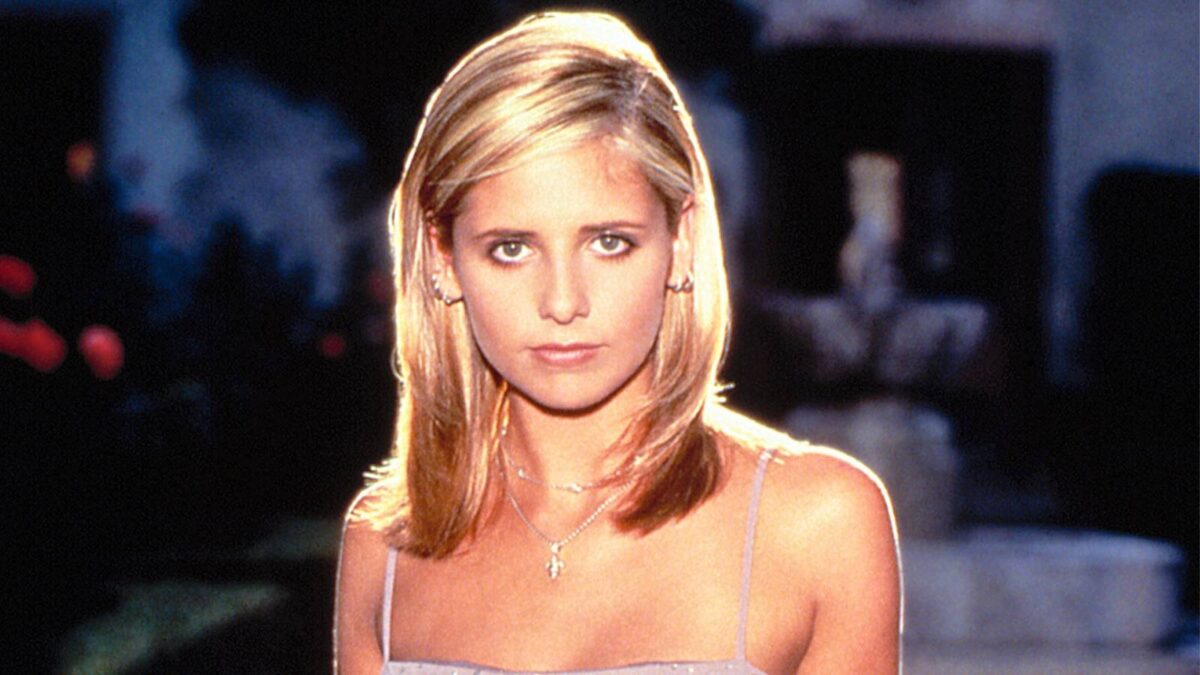
Sarah Michelle Gellar Urges ‘Buffy’ Fans to Avoid Reading Leaked Reboot Scripts
Buffy the Vampire Slayer fans have had a rough few days after Hulu officially pulled the plug on a revival of the series, which would have brought star Sarah Michelle Gellar back as the titular heroine. Described as a continuation…
Mar 20, 2026
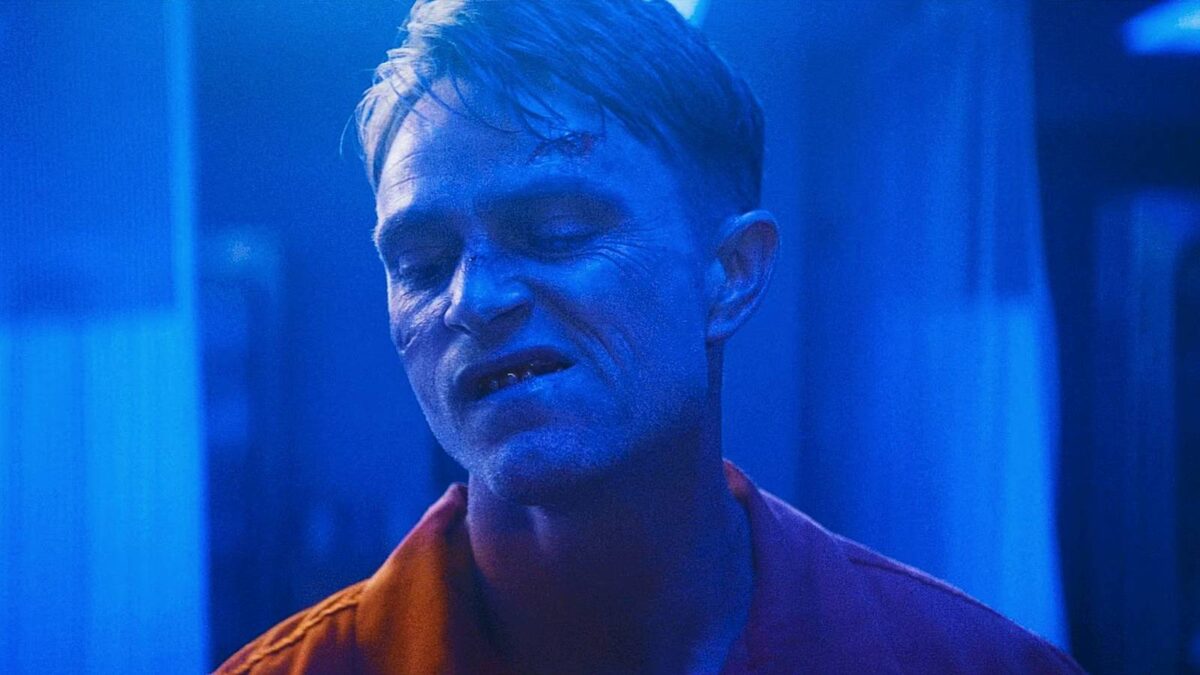
Born Again’ Stars Explain Why Bullseye Is So Dangerous in Season 2 [Exclusive]
Along with Charlie Cox's Matt Murdock and Vincent D'Ofnorio's Wilson Fisk, Daredevil: Born Again Season 1 brought back one of The Man Without Fear's most notorious villains: Wilson Bethel's Benjamin Poindexter, better known as Bullseye. Not only was he back…
Mar 19, 2026