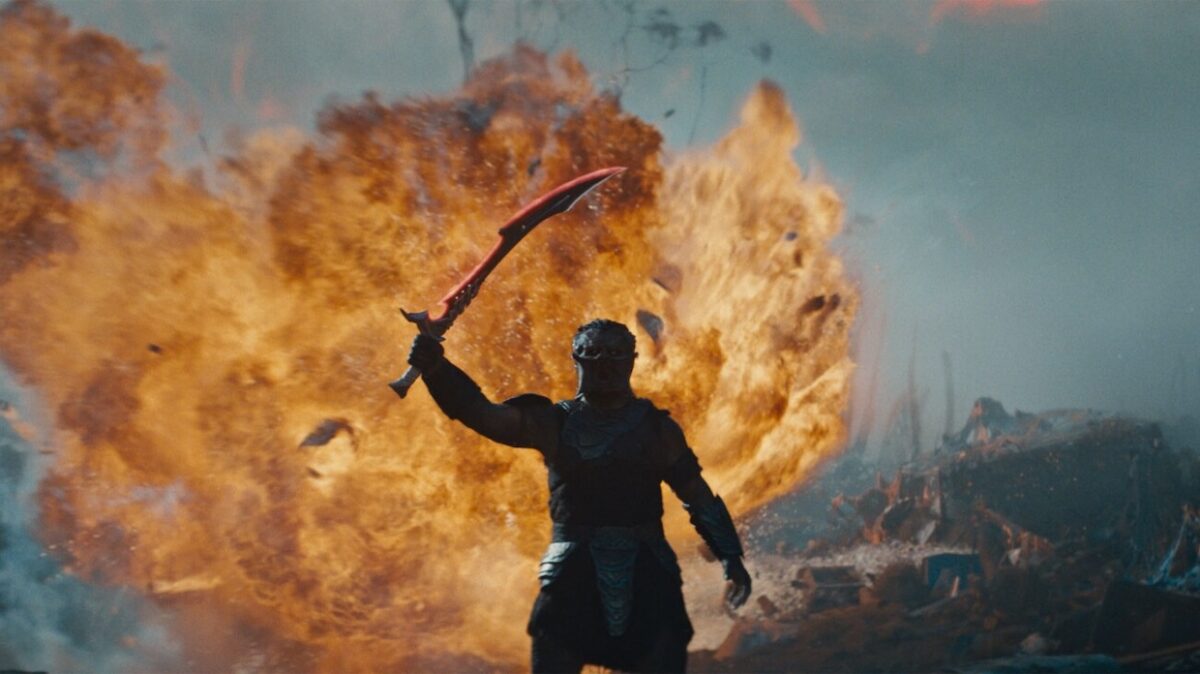
Director as Dinner Party Host: Dan Trachtenberg on “Predator: Badlands”
Dec 5, 2025
Predator: Badlands
Architect of the three last films in the Predator franchise (the previous two being the 1719-set Prey and animated anthology film Predator: Killer of Killers), Dan Trachtenberg would be the first to tell you that many of Predator: Badlands’s gorgeous landscape shots are inspired by Terrence Malick or Sergio Leone. In the same breath, he’d also be quick to mention how composer Sarah Schachner’s score for the video game Anthem served as a launching pad for the this film’s music—Trachtenberg creates something new by unifying artforms most people don’t group together.
With Predator: Badlands, for the first time the franchise centers the titular predator (called a Yautja) as the protagonist. Dek (Dimitrius Schuster-Koloamatangi) is a runt eager to prove himself to his clan by traveling to the deadliest planet in the galaxy to kill its most dangerous creature. Along the way, he encounters Thia (Elle Fanning), an android working for Weyland-Yutani Corporation (of the Alien franchise). He begrudgingly works together with her to navigate not only Genna’s hostile terrain but also Weyland-Yutani forces.
Trachtenberg’s feature directorial debut, 10 Cloverfield Lane, took the bones of J.J. Abrams found footage monster film and married it to the cadence of a psychological thriller; his short film Portal: No Escape laces in the gunplay of John Woo films. Within the confines of the Predator franchise, he’s managed to preserve his own artistic ideas amidst worlds with their own rules and mythology. Predator: Badlands became the highest-grossing film in the Predator franchise/. Filmmaker spoke with Trachtenberg in a spoiler-filled conversation about creating cinematic dinner parties with one’s creative influences, the tension between deepening franchise mythology and overexplanation and how working on the film has reshaped Trachtenberg’s thoughts around generative AI.
Filmmaker: How do you maintain the integrity of your ideas while working within pre-established sets of rules? When do you break the rules versus trying to expand on them?
Trachtenberg: These movies come from asking myself, “What’s the story that I want to tell?,” then it evolves into “Oh my gosh, this would work well within the iconography of the Predator franchise.” As opposed to starting with “Okay, how do I subvert and break what’s established with these films?” Prey came from my wanting to tell a story primarily through action. I was very much inspired by Mad Max: Fury Road and Indiana Jones and the Temple of Doom—I consider every scene an action scene in the latter. I was also thinking about survival tales like The Revenant or Gravity, which made me think: what’s a character we rarely see trying to prove themselves? It would be both the actor trying to prove themselves as well as the character, which led to me envisioning a Native American, then more specifically, a Comanche protagonist. I’ve been continually interested in period films and science fiction and realized those two things often don’t go together.
All of that led me to think about Predator. When you look at Predator: Killer of Killers and Predator: Badlands, the main character is always searching for the most “worthy” enemy. That allows filmmakers to make these movies about characters proving themselves, which is very thematically rich, and also happens to be a theme I’m personally interested in. I do not play and don’t really watch sports, but I love sports movies and underdog stories. I love being able to make movies with a lot of heart and emotion, but which also have visual delights and visceral thrills. It’s been an awesome canvas.
The premise of Predator: Badlands is something we haven’t seen before, where the creature is the main character. I guess Star Wars could decide to make a Chewbacca movie, and the MonsterVerse could pull the trigger and have no humans be in their next films. It was really when I started thinking of Predator as someone like Conan the Barbarian, Mad Max or the Man with No Name from Leone’s films: “This is a cool character to do this crazy undertaking with.”
Filmmaker: I’m happy you listed some of those influences because much of your work feels like you’re throwing these dinner parties. You have Clint Eastwood mingling with the Shadow of the Colossus Games on one end of the table, then Terrence Malick is hanging out with Monster Hunter—you’re remixing media in interesting ways.
Tranctenberg: I think every filmmaker is that dinner party host in some form. I love this idea of taking things that have existed separately and giving them the space to interact. For example, [with] Prey, I was thinking: wouldn’t it be great if you could have a landscape that’s photographed at dawn or dusk that you’d usually see in a Malick film, but on that landscape you have a Yautja fighting a wolf? That’s the stuff that creates new art: we’ve had this kind of experience, we’ve had this other experience, but we haven’t had this other third thing. I love being visually inspired by films or filmmakers that often can be cold and removed but the visuals are so beautiful. Conversely, there are other filmmakers who are so warm and have so much heart, and I love the idea of creating films in the middle. I think James Cameron is someone who tends to be in the middle spectrum of that filmmaking, and I’ve always loved that.
Filmmaker: Have you seen the joke about how you have to subtitle future Predator movies based on other Malick films? The people yearn for Predator: The Way of the Wind.
Trachtenberg: (Laughs) I did see that. I’m still waiting for the Internet to make a trailer that combines Malick’s Badlands trailer and the trailer for this film.
Filmmaker: Do you find it difficult to balance mystery preservation with lore exploration? I thought it was interesting that at least for this Yautja clan, we learn that not all Predators are given the technology that makes them invisible; they have to fight for that.
Trachtenberg: The “earning your cloak” idea came from our writer, Patrick Aison. I love finding a way to embrace and indulge in the culture of the Yautja without breaking the mystique. It’s a real third rail for horror movie characters; usually, the thing that makes them interesting is the mystery, but then some films go “Guess what? You’re going to know now.” Patrick and I wanted to weave in that knowledge, but in a way that was story-oriented and left viewers feeling the titular creature was more badass. I didn’t want to take away from the Yautja or get too seduced by the lore; hopefully, it feels more mythic. There’s also a concept in the ancillary materials about the predators becoming “blooded,” so Patrick and I took that and thought, “What if there was a step before that? What if everything had to be earned?”
Filmmaker: It makes me think of that sequence where Elle Fanning’s Thia character is firing off question after question about Yautja culture and terminology. We never get answers to them though, particularly the question “What does the chewing? Your outside fangs or your inside mouth?”
Trachtenberg: It’s funny that you bring that up, because that line was pitched to us by the very funny comedic actor Ben Schwartz. He’s been a friend since I worked at Bad Robot; he was always around, and I’ve been a huge fan of his forever. He was nice enough to help out and pitch some comedy moments.
Filmmaker: Will the deleted scenes just be Elle riffing and/or saying more Ben lines?
Trachtenberg: There are a bunch of deleted scenes on the disc, but now you’re making me regret that we didn’t include more. There are definitely some gems with Elle.
Filmmaker: You’re on record for saying that this film is set in the farthest timeline in both the Predator and Alien franchises. I’m curious how that timeline influenced some of the callbacks you had in this film. We see a version of the Pulse Rifle and the Power Loader from Aliens. Your film takes place many years after that film; what was the starting point for the design of those elements?
Trachtenberg: Before Predator: Badlands, I kept having to go backwards. With Prey, I had to make sure that the Yautja technology would be things that we’d see prior to the technology of the Predator that Arnold faces off with in the 1987 film. In these films, though, I think of time as moving in slow motion, because what you see has to feel connected iconographically to what you’ve seen in those other films. For example, if you took something like the power loader and tried to envision what it would look like two hundred years later, it would likely be outdated or unrecognizable and not even be used if we’re thinking about the way things work here on Earth. At that point, it’s not fun and doesn’t even look like the thing it’s supposed to be. I approached it more spiritually; the power loader we see in the film is more advanced than what we’ve seen from Cameron’s film, but it’s probably next year’s model as opposed to something we’d see three hundred years later.
Filmmaker: It’s always a comfort to see returning classics like the Plasmacaster.
Trachtenberg: For eagle-eyed viewers, there’s a moment where Tessa is talking to MU / TH / UR and the camera pans across the table, and we see that she’s dissected it. When we later see it on her shoulder, it looks like it’s been jerry-rigged. She’s got one of those neck pieces–the same one that Thia has to communicate with her legs–on her person, and there’s a wire going from the plasma caster to that neck piece. If, of course, you happen and care to look that closely.
Filmmaker: It was rewarding to see how all the flora and fauna you introduced prior came full circle by the end. Which came first: you knew you needed to find replacements for Dek’s weapons and built animals that could supply that need, or did you have the creature designs in your head first and then tried to find a way for Dek to use their abilities?
Trachtenberg: I knew I had to make the movie immediately once we came up with the idea that Dek would use Squirt as a makeshift plasmacaster. The notion that everything on the planet could be used as a weapon came off of that idea.
Filmmaker: I’m not sure if this was a direct influence, but the creatures made me think of Peter Jackson’s King Kong. The lore behind the monsters of Skull Island is that they were able to evolve unabated, thus a Tyrannosaurus Rex became a Vastatosaurus Rex, and so on and so forth.
Trachtenberg: That’s interesting. The guiding principle for the designs on Genna was thinking about all the creatures evolving on that planet. It’s really challenging to figure out how to make a creature that looks cool when you’re just thinking of what’s “cool-looking,” if that makes sense. It’s more helpful to work within some parameters. Take the Bone Bison; the razor grass was a fixture of Genna, so when I’m coming up with a creature that feeds there, I have to think, “If it’s going to eat, it has to develop this armor on its hide and a beak on its snout so it can push away the grass so it can graze.”
Filmmaker: One of the themes of the film is the idea that the true danger isn’t the creature that’s the biggest, but the creature that doesn’t have a family, or at least can’t appreciate the concept of family. Your brother, David, was one of the editors on this film. How has your family sustained and supported you in this industry?
Trachtenberg: Certainly my brother is a huge part of me being the man that I am and the filmmaker that I am. He’s 12 years older than me and was doing movie stuff when I was little. He became an editor, so I understood the building blocks of movies in a way that I wouldn’t have if I weren’t aware of what he was doing. He introduced me to the world of making commercials, so I understood the power of short-form storytelling. He also introduced me to European filmmakers like Jonathan Glazer and Jake Scott. We’ve worked on a variety of projects; we did [the] The Boys pilot together and a bunch of commercials, but never a movie.
I want to have a great time at the movies and also come away with something. I don’t want to walk out of the theater and just think, “Oh yeah, I saw that. That was fun.” I don’t want that to be it. I want there to be something I can take from a film, put in my pocket and keep for the rest of my life. [In] Prey, there’s this character who wants to be viewed a certain way. There’s this conflict between her and her mother, and she’s saying, “Mom, I don’t want to do what you do. I want to do this other thing.” The answer is not, “Yeah, mom was wrong; just go do your thing.” The answer at the end of that film was “I need to be both.” Similarly, with Dek, I at no point wanted to say “Being ferocious, being a badass, that’s not the way to be.” It’s certainly an important part of who he is, especially when it comes to pulling off a crazy undertaking, but it’s not the only part. Finding strength in others is that other part that can make you more powerful. As Thia puts it, “The alpha isn’t the one that kills the most, but the one that best protects.” It’s easy to kill; it’s harder to protect.
Filmmaker: I was reading a review of a colleague of mine, Matt Zoller Seitz, who summed up another theme of the film quite beautifully: “Sometimes the things you want most are not worth having, and when you figure that out, you’ll be free.” Whether in life or in this industry, I’m curious what those moments of realization have been for you, where you’ve chased something wholeheartedly and then maybe realized “This is not worth wanting.”
Trachtenberg: There are always these carrots dangling at the end of sticks, movies I grew up watching and loving. Kid me would have freaked out at the opportunity to make a movie in said franchise. Yet sometimes those things can have a ceiling; it’s easy to step into that world and make it just a genre exercise or a cool action movie. I’m hoping to make movies that are fun genre exercises and cool action films, but full cinematic meals. Along the journey, there are always these [moments]: “Oh, that would be fun to make!” “That would be fun, to work with that actor!” “That would be fun, to shoot in that part of that world.” I have to, as best I can, resist that temptation to continue to make things I can be truly proud of.
Filmmaker: The Predator and Alien franchises have always explored characters’ relationships to technology. I’m curious how working on a project like this has reframed your thoughts around the use of something like generative AI or Artificial Intelligence as a whole. Do you find that your relationship with these emerging technologies has changed or influenced your creativity differently?
Trachtenberg: I never loved the sentiment of “Vote with your dollars” or “Go see this movie to support!” I do not like that. Our job as filmmakers is to make something that demands you come and see it. Don’t go see something just out of obligation, homework or this need for the theatrical experience. I feel burdened by the need to make a movie that people would go out to see.
It used to be that we would all go to the movies. The question would just be “Which movie?” Now, we are not all going to the movies. I have to make a movie that drags you up off the couch so you get into your car and go to the theater. It has to be that compelling to get you to come. That leads to different choices that I make as a filmmaker than I would have made if I were more active in the business twenty years ago and prior. I think AI is going to become a tool before it becomes a medium. It’s all moving so exponentially fast, and I think any conversation we have about AI now is going to sound really silly in about five or ten years. My sense, though, is that if it does become more of a medium than a tool, we’ll be enjoying things made by AI at home, and if you want an auteur or more authored experience, maybe that’s the theatrical experience.
For example, part of the reason why we’re not going to the theater as much is that TV got really good. How do you go see a good Star Wars project before? You’d go to the theater. How do you see the best Star Wars now? You watch Andor at home. Now there is a lot of it, but I wonder if the pendulum will swing again, and TV will not be the best place to see things. It will instead be the place where you can feed the prompt “What if Quentin Tarantino directed Halloween?” and then watch a full movie of that. Maybe the theater is where we then go for things we can’t type or prompt AI for. That’s where I’m at; that’s a more positive take—well, maybe that’s not even positive, but maybe that’s the best case scenario.
Publisher: Source link




Wuthering Heights Review | Flickreel
As far as adaptations go, I’ve never viewed any source material as sacred, including The Bible. While a faithful adaptation is always welcome, I’m open to a filmmaker leaving their signature on a classic story, especially one that’s been told…
Mar 17, 2026
Amy Adams Sinks In Vapid, Misguided Alcoholism Drama By ‘Pieces of a Woman’ Director [Berlin]
For a solid decade, starting in the late 2000s with Disney’s charming fairytale comedy “Enchanted” all the way to Denis Villeneuve’s melancholy sci-fi “Arrival,” it was easy to trust Amy Adams, a six-time Academy Award nominee. Then, somewhere around Ron…
Mar 17, 2026
Mason Gooding & James Van Der Beek’s Bad Night Is Aggressively Dull
Ever since the Scream franchise helped put him on the map, Mason Gooding has been a great talent to watch. The genre-bending slasher Heart Eyes is still his best non-franchise role yet, but he's also branched outside of horror in…
Mar 15, 2026
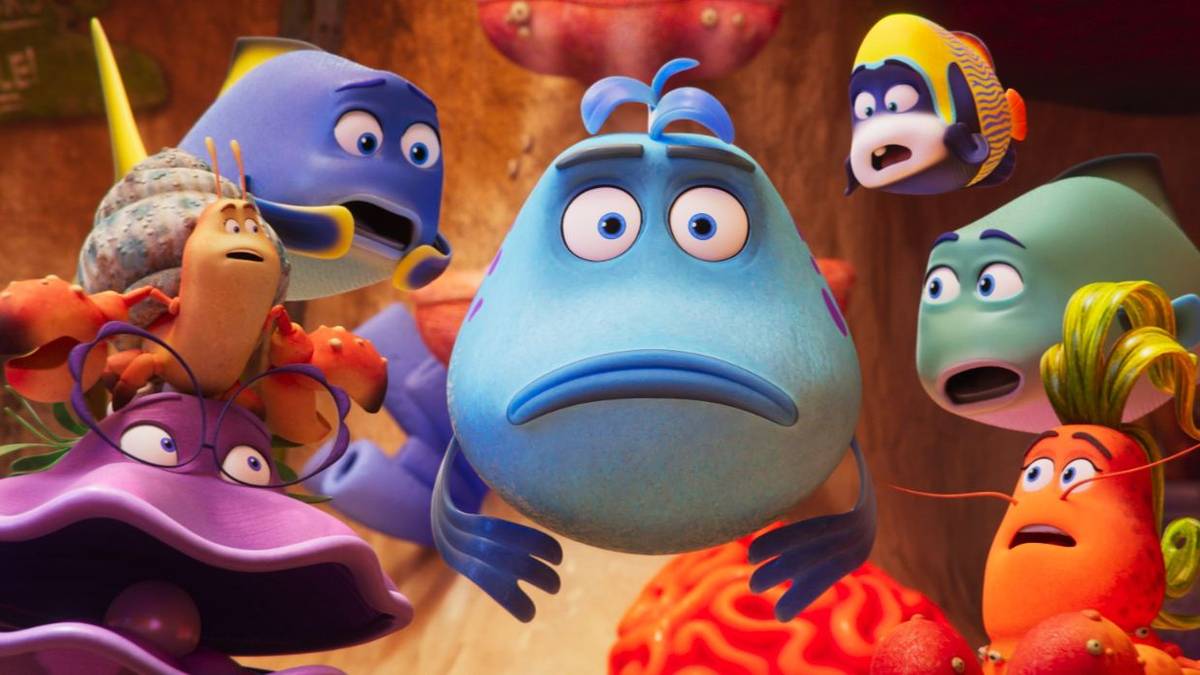
A Grumpy Nick Offerman Keeps This Fish Tale Swimming Along
Animated fish films have been done. Finding Nemo. Shark Tale. Ponyo. So to hear about another doesn't feel like anything new. However, The Pout-Pout Fish, starring Nick Offerman as a grumpy ocean pout named Mr. Fish, is a little different.…
Mar 15, 2026