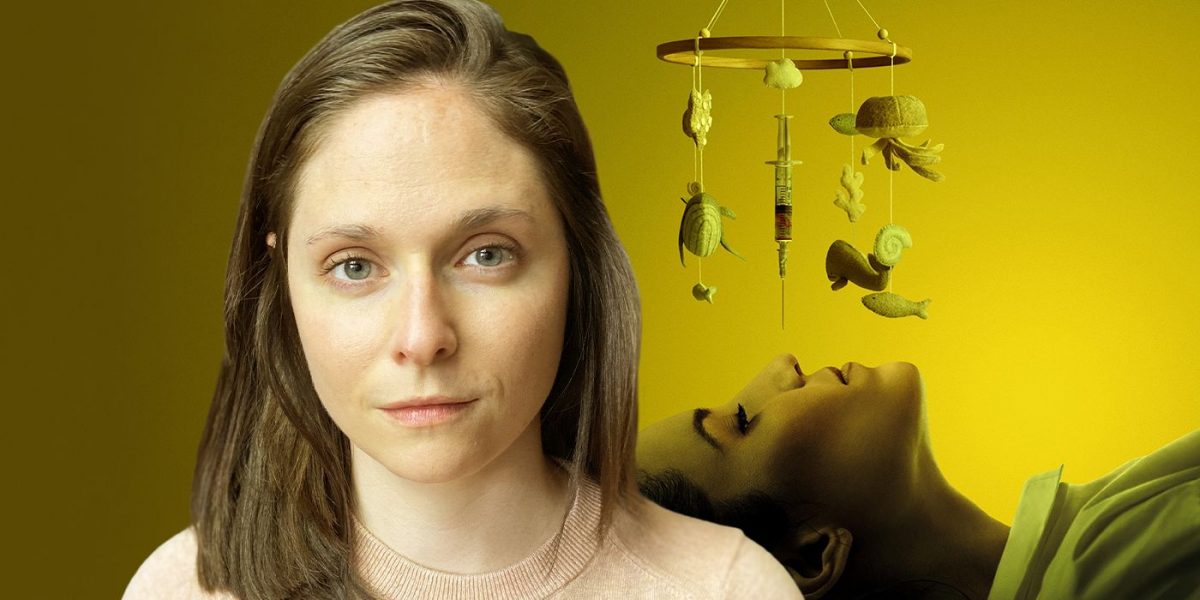
Editor Alexandra Amick on Crafting Tone in a Psychological Horror
May 10, 2023
One of Hulu’s newest original movies is writer-director, Alexis Jacknow’s psychological horror, Clock, starring Dianna Agron (Glee) and Melora Hardin (The Office). The movie suggests society’s expectations of pregnancy is the true antagonist, and explores the idea that people who can become pregnant can’t not want children – it’s simply a hormonal imbalance that can be corrected. With Clock available to stream now, Collider had the opportunity to speak with the film’s editor, Alexandra Amick, about collaborating with Jacknow to bring her vision from script to screen.
COLLIDER VIDEO OF THE DAYSCROLL TO CONTINUE WITH CONTENT
Previously, Amick served as the editor for 2018’s The Wind, a slow-burn Western horror that showcased her ability to hone atmosphere and build suspense, and later with Kirk Thatcher on Muppets Haunted Mansion, which presented its own unique obstacles. During our interview, Amick explains how the editor’s job is to work side-by-side with the director’s vision, operating on the idea that “there are other possibilities beyond the script.” Clock presents the concept of a biological clock as something that can literally be fixed, and viewers watch as Agron’s Ella descends into pill-induced psychosis. The culmination is truly horrifying and heartbreaking, but how did they achieve what we see on screen?
During our conversation, we discuss the relevancy of the movie’s themes today, and what about the script convinced Amick she wanted to meet with Clock’s director. She talks about the collaboration process, saying, “We ripped scenes apart, put them back together, changed the order of things, and it’s truly a third rewrite of the film.” Read on to learn more about the behind-the-scenes and her next horror project, Lovely, Dark, and Deep, with Barbarian’s Georgina Campbell, in the interview below.
COLLIDER: Jumping right in, Clock is a psychological horror that deals with some very topical issues right now. I believe they said that [Roe v. Wade] was overturned the last day of filming?
ALEXANDRA AMICk: Yes– well, the decision was leaked on the last day of filming, and then they were shooting the cold open in pickups a little bit later, and that’s the day that it was overturned. So both days were very bad days on set.
Image via Hulu
That made the movie that much more relevant, unfortunately.
AMICK: Yeah, exactly. Unfortunately, it’s always been relevant, but I feel like we didn’t need it to be this relevant.
Clock has themes of autonomy, societal expectations of people who can become pregnant, and it also ties into generational trauma, so before the editing process began, what were the conversations like between you and the director to tell this story in the most authentic way?
AMICK: I actually didn’t have a whole lot of time to speak with Alexis [Jacknow] beforehand. I was brought on pretty quickly before they shot. I read the script, obviously first before taking a meeting with her, and it was pretty much already there in the script, you know? When I read it, I thought, “This is weird, this is cool, this is timely. I want to meet the person who wrote this [laughs].”
But what really made me want to meet with her is that the movie itself never takes a position one way or the other on pro having kids or pro not having kids. It’s about autonomy. It is about your choice. The main character, Ella, should not have children because she doesn’t want them. But that’s why, not because people shouldn’t have children. And so I felt like it was not an alienating film, and that it just said that you need to make your own choice for your own life and stand by that. So when I met with her for the very first time, I expressed that and made sure that that’s what she wanted out of the film as well, and it’s exactly what she wanted. We were on the same page, and so I felt very confident moving forward on the project with her. And yeah, it worked from there.
Did you have a lot of creative influence over things like pacing and transitioning, or was that all in the script?
AMICK: Definitely. I think no matter what is in the script – and it was a great script – no matter what is in the script, when an editor takes it over, it doesn’t really matter, at least in my opinion. I like to read the script probably twice; once to see if I’m gonna even do a meeting with the director, and then once while I’m building the assembly. As I’m getting footage in, I wanna make sure that I know what is supposed to be happening in this scene to make sure that the footage that I’m receiving from set covers the entire scene. And also to know, since they shoot out of order, what comes before, what comes after, to make sure that they’re getting what I think they need, and then also that I know what I should be expecting out of this scene.
But after that, I don’t like to look at the script at all. Because now I’m dealing with everyone’s decisions who come before me, and the script is just one of many, many decisions. So I definitely think I had a lot of input on pacing and transitions, and all of that. I mean, if it was written in the script and shot that way, then sure, that stayed that way, but it was all subject to change. And Alexis was a really amazing collaborator, she was open to anything. We ripped scenes apart, put them back together, changed the order of things, and it’s truly a third rewrite of the film. It was a really great collaborative process.
Image via Hulu
I wanted to talk about, specifically, the tank scene. It was pretty graphic imagery, and I know that you probably sit there with the footage over and over again, so could you talk about how that scene was for you?
AMICK: It was intense, but for me, not as intense, I think, as it was for Alexis [laughs]. We had real birth imagery that was from various sources, so it was not fake, it wasn’t stock footage that made it look like it – this is real, live birth. So I would edit, and Alexis would just say, “You know what? Just tell me when you’re done and I’ll look when it’s over,” you know [laughs]? Like, “I’ll go ahead and look when it’s over.” It was okay for me.
It’s kind of funny, actually; originally, that sequence has flowers blooming, and then we’re cutting to the birth imagery, and then when she starts to hallucinate, we see Dr. Simmons and Ella in a birthing room, and then of course, the baby pendulum, but there was no other imagery in the script. When we would show that sequence for notes, it was very interesting because a lot of people, men or women who had had a baby, were like, “Well, this is very graphic, but it just kind of is what it is. I think you should make it scarier.” And we’re like, “Make it scarier? This is… whoa!” But those who had not had a baby, or been through any kind of experience of childbirth, were like, “Oh my God, that scene was intense.”
When I was editing it, I had not been through childbirth, and now I have and I agree! I’m glad we added more imagery, that our visual effects kind of zhuzhed everything, because childbirth is graphic in and of itself. And so once you go through it, it’s kind of like, “Well, yeah, this is kind of gross, but that’s just the way it goes.” That’s just what happens! So, yeah, it was very interesting seeing the two perspectives and then living through both perspectives.
Image via Hulu
You mentioned in a previous interview that the editor’s job is essentially “cutting to create,” taking the raw footage and creating an atmosphere or explaining the unspoken. Can you talk about how you achieve that in this movie, and are there certain techniques that you use?
AMICK: You know, I think every movie is different. I definitely have my own personal style that I like to bring, but I think in terms of atmosphere, where you start is the intent of the script, and then you have to see what was shot and how it was shot. Because you could read a script and think, “Oh, this is very cutty. This reads very frenetic to me,” but how the director views it is not, and you get a oner, and you’re like, “This is… Okay, we are not on the same page here, and that’s okay.” That’s what makes it a collaboration. So yes, it’s first interpreting the script in your head, then meshing that reality with what is shot and what is sent to you, and then maybe seeing if you can blend those two, you know?
But yeah, on Clock specifically, it was very important that we pushed tone further and further and further. Every single version of the cut we needed to make sure that the edit and the atmosphere of the film was matching Ella’s mental decline, and just the whole messed-upness of it all. So yeah, it’s always a long process, but I’m very happy where we landed in the end.
It was very effective, and that actually kind of plays into my next question. I really liked the baby shower scene. I feel like some women can very much relate to that one. It was a frustrating moment for Ella, but the pacing made it very dark comedy. Was there a scene in the movie that was challenging for you, or was there a favorite scene that you worked on?
AMICK: Well, I think that Alexis and I will both agree that the baby shower was the most difficult scene to cut. Nailing that tone was very tough. I think it was their first or second day of shooting, so that’s always got stuff that needs to be figured out no matter how put together every single person is on set. There’s always– something’s gonna go wrong, everybody’s finding their footing. But yeah, just nailing that tone.
She shot it a couple different ways where the mothers on the couch are looking straight into the camera, or not looking into the camera, and so it’s like, which one is more intense, or which one is the language of the film? Are we breaking this fourth wall? Is it a POV? Is it not a POV? Are we zooming in or are we not? You know, all of that kind of stuff. I think we have 50 versions of that scene. I mean, every day it was like, “Should we go and look at that scene again?” “No, no, no. Let’s come back to that. Let’s come back to that [laughs].” I think we’re both very happy with where it landed, but yes, it was a tough one to nail, so I’m glad that you liked the tone of that because we worked really hard.
And then, in terms of a favorite scene, I would say the scene towards the end where Ella and her husband, Aidan, are in the kitchen after she has destroyed the grandfather clock. I think that Dianna [Agron] and Jay [Ali], who play Ella and Aidan, did such an amazing job with that scene, and it’s such a long scene that has so many steps to it. Just the evolution and the turns that it takes.
Image via Hulu
I did not expect that.
AMICK: Yeah! And they play it so, so well. And so that, for me, was one of my favorites, even during the assembly. It took a couple of days to do, just on my own, and then obviously, who knows how many days it takes once you’re honing it afterwards. But it was one of my favorites at the very beginning and it stayed one of my favorites all the way until the end.
Speaking of the script earlier, you’ve said before when you were working on The Wind that even if a script is beautifully written, sometimes it doesn’t translate to film the way it’s intended. Did Clock change in similar ways to that?
AMICK: Yeah, definitely. I think how you read a script is not how you watch a movie. Your brain remembers the words, and scripts can remind you of things that are not dialogue. If a character says something on screen, sure, then you’re watching it and you’re reading it the same way. But if a script just says, you know, “The room is eerily quiet…” Okay. Atmospherically in the script, great. How do you shoot that? How do you show that? How does the actor respond to that? And so, how you view that is different than how you read it.
So definitely, I think the the heart of every single scene in the script is where we landed in the movie, for sure, in the actual film itself. But there were certain lines of dialogue, for instance, that just didn’t need to be in there, that worked on the page, but when you hear them delivered? Repetitive. Or Dianna, or Melora (Hardin), who plays Dr. Simmons, delivered this line with much more impact than the line that comes later. So this one, based on her performance, is more important than later, or a scene might drag when you watch it, so you have to remove it.
Then also, we rearranged some scenes, especially up at the front. When we go from the baby shower to the doctor’s office, to her dinner with her father, those were shifting a lot, and we ended up cutting the doctor’s office scene in half. Originally, it was supposed to play from when she shows up to receiving the doctor’s phone number and getting offered to go into the clinical trial, and we took that out and moved it and withheld that information because we felt like it was more impactful that she’s been mulling on this. So yeah, I think that that’s what you have to do as an editor, is keep in mind that there are other possibilities beyond the script.
Image via Hulu
I did want to ask you about a future project. Correct me if I’m wrong, but I believe your next film is with Teresa Sutherland for Lovely, Dark, and Deep?
AMICK: It is, yes.
I’m very excited about that! You two worked together previously on The Wind, but this will be her feature directorial debut. Is there anything that you can tease about the project, and can we expect more team-ups with you two?
AMICK: Oh, I hope there are more team-ups! Working with Teresa is a lot of fun. But yeah, I’m very excited about Lovely, Dark, and Deep to come out. We just got news that it will be debuting at a film festival that I’m not allowed to say yet, but we’re very excited about it, later this year. It’s very cool. It’s very isolated, slow burn, very weird, gross. I think it plays into the conspiracy theories – that are not really conspiracy theories – about how many people go missing without a trace in national parks. And this is like real data about people and going missing in national parks, and just weird, weird occurrences. So it’s about a woman who, something has similarly happened to her in her past, and she becomes a backcountry ranger to uncover what really happened.
Clock is now streaming on Hulu.
Publisher: Source link




New ‘Wheel of Time’ Animated and Video Game Adaptations Are in the Works
Amazon might be finished with The Wheel of Time, but we haven't seen the end of the story when it comes to adaptations of Robert Jordan's bestselling high fantasy saga. Fans were left blindsided when Amazon abruptly pulled the plug…
Mar 22, 2026
‘Off Campus’ Teaser and Release Date Revealed by Prime Video
No one expected a love story between rival hockey players to become one of the most talked-about TV shows of 2025, but there's a lot more where Heated Rivalry came from, as a new teaser for Prime Video's foray into…
Mar 21, 2026
Sarah Michelle Gellar Urges ‘Buffy’ Fans to Avoid Reading Leaked Reboot Scripts
Buffy the Vampire Slayer fans have had a rough few days after Hulu officially pulled the plug on a revival of the series, which would have brought star Sarah Michelle Gellar back as the titular heroine. Described as a continuation…
Mar 20, 2026
Born Again’ Stars Explain Why Bullseye Is So Dangerous in Season 2 [Exclusive]
Along with Charlie Cox's Matt Murdock and Vincent D'Ofnorio's Wilson Fisk, Daredevil: Born Again Season 1 brought back one of The Man Without Fear's most notorious villains: Wilson Bethel's Benjamin Poindexter, better known as Bullseye. Not only was he back…
Mar 19, 2026