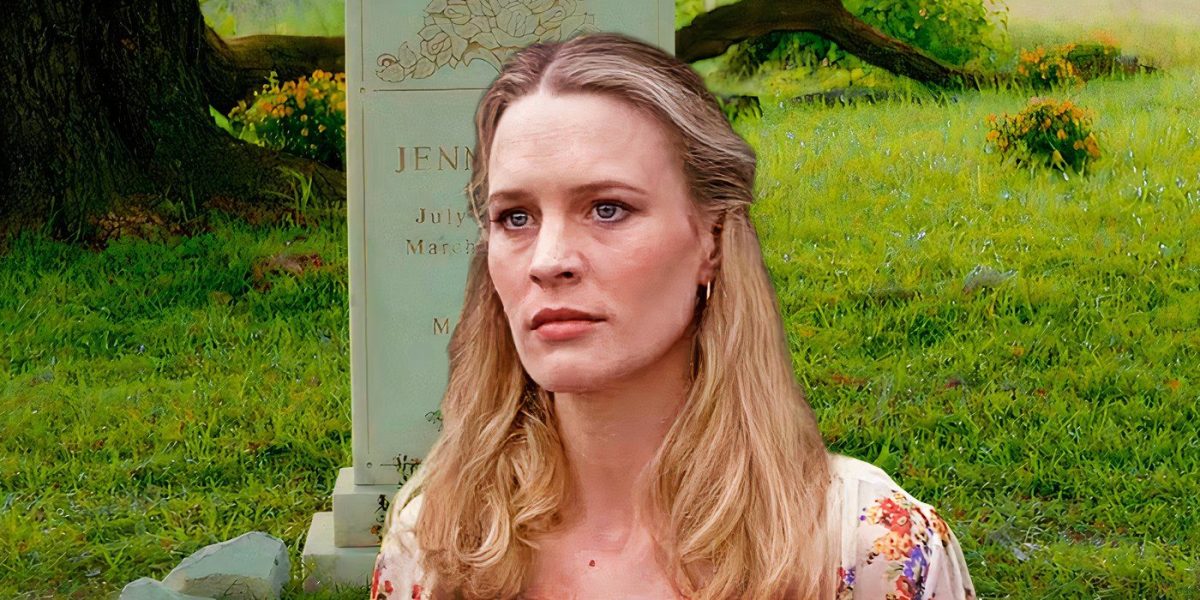
Forrest Gump Star Robin Wright Immediately Shuts Down Implications Of Jenny Being Anti-Feminist
Nov 4, 2024
The article contains discussions about sexual and physical abuse.
Robin Wright has never believed that Forrest Gump was an anti-feminist story. Wright played Jenny, a young woman who eventually marries Tom Hanks’ titular protagonist. While Wright and the rest of the Forrest Gump cast have moved on over the years, the movie has become a cultural giant. It was an adaptation of Winston Groom’s book and earned an impressive $678 million at the box office on a $55 million budget. The movie also won six Academy Awards, three Golden Globes, and three People’s Choice Awards. However, even thirty years after its release, Jenny remains one of the most criticized characters in film history.
In an interview with The New York Times, Wright was confronted with the idea that Jenny was an anti-feminist concept, but she quickly shut down any arguments against her character. While admitting that Jenny was “selfish,” the actor answered that the character was not anti-feminist in any way. Check out her quote below:
No! It’s not about [anti-feminism]. People have said she’s a Voldemort to Forrest. I wouldn’t choose that as a reference, but she was kind of selfish. I don’t think it’s a punishment that she gets AIDS. She was so promiscuous — that was the selfishness that she did to Forrest. He was in love with her from Day 1. And she was just flighty and running and doing coke and hooking up with a Black Panther. And then she gets sick and says, “This is your child. But I’m dying.” And he still takes her: “I’ll take care of you at Mama’s house.” I mean, it’s the sweetest love story.
Jenny Was Not An Anti-Feminist In Forrest Gump
Jenny’s Tragic Story Explains Everything
At first glance, Jenny is easily recognizable as a non-progressive character. She is a promiscuous hippie who does drugs and has open relationships with many men. Tragically, her story culminates when Jenny eventually contracts HIV. The condition develops into AIDS, and she passes away from related complications. That very concept is, on its surface, extremely anti-feminist. This is a character who is seemingly punished for having sex with men who are not the main protagonist, Forrest. When she eventually finds peace, it is through marriage to a childhood friend, which is perceived as a very conservative story.
It is a tragic love story, not an anti-feminist or prudish work.
However, the true reality is far deeper. Jenny was a victim of childhood abuse and never received the support that she needed. Even her friend, Forrest, was sent away to Vietnam, leaving her with no one to lean on. It is only natural that Jenny would struggle in the aftermath. Forrest Gump’s painful ending is not an insult to Jenny’s character, but instead, it is a moment of peace after a tumultuous life that never gave Jenny any clear path. It is a tragic love story, not an anti-feminist or prudish work.
Our Take On Jenny In Forrest Gump
Forrest Gump Was Surprisingly Honest About Jenny’s Character
Not everyone who experienced abuse in childhood will default to promiscuity, as Jenny did, but the movie portrays a version of that effect. The on-screen depiction is an honest portrayal of the impact of physical and sexual abuse, and the ending offers a bittersweet conclusion that allows Jenny a peaceful and happy ending. She does die at a young age, but her final months are spent at Forrest’s side, living beside a man who would never hurt her. Forrest Gump is not an anti-feminist story. Instead, it portrays Jenny as a nuanced and complicated character who deserves better.
Source: NYT
In this iconic piece of American film history, the presidencies of Kennedy and Johnson, the events of the Vietnam war, Watergate, and other history unfold through the perspective of an Alabama man with an IQ of 75.Director Robert Zemeckis Release Date July 6, 1994 Studio(s) Paramount Pictures Distributor(s) Paramount Pictures Writers Winston Groom , Eric Roth Runtime 142 minutes Budget $55 million Expand
Publisher: Source link


‘Dutton Ranch’ Trailer Reveals ‘Yellowstone’ Sequel Release Date
Rip Wheeler and Beth Dutton gamble everything on a new life in South Texas in the first trailer for the Yellowstone spin-off, Dutton Ranch. The footage reveals all manner of gun fights, fist fights, explosions, galloping horses, and even mysterious…
Mar 24, 2026
Born Again’ Showrunners Detail How the Media Ties into Season 2
Marvel is fast approaching the release of Daredevil: Born Again Season 2, marking its second live-action Disney+ show of 2026. Bringing back Charlie Cox's Matt Murdock and Vincent D'Onofrio's Wilson Fisk, this season picks up where Season 1 left off,…
Mar 23, 2026
New ‘Wheel of Time’ Animated and Video Game Adaptations Are in the Works
Amazon might be finished with The Wheel of Time, but we haven't seen the end of the story when it comes to adaptations of Robert Jordan's bestselling high fantasy saga. Fans were left blindsided when Amazon abruptly pulled the plug…
Mar 22, 2026

‘Off Campus’ Teaser and Release Date Revealed by Prime Video
No one expected a love story between rival hockey players to become one of the most talked-about TV shows of 2025, but there's a lot more where Heated Rivalry came from, as a new teaser for Prime Video's foray into…
Mar 21, 2026