Gradually, Then Suddenly Featured, Reviews Film Threat
Jul 14, 2024
What happens when you run out of money? Where do you go? Who do you turn to? Now, ask yourself this. What happens when a city runs out of money? In Sam Katz and James McGovern’s documentary, Gradually, Then Suddenly, we go in-depth into the U.S.’s largest bankruptcy case when the city of Detroit filed in 2013.
The film’s title refers to a quote from Ernest Hemingway regarding how exactly one finds oneself in bankruptcy. The documentary opens by examining how Detroit got to this position. The Detroit Free Press went back fifty years and concluded that the politicians in charge of Detroit spent too much money, borrowed too much money, and paid too much for stuff. By 2013, all of the city’s debt was 13x the amount of the city’s assets.
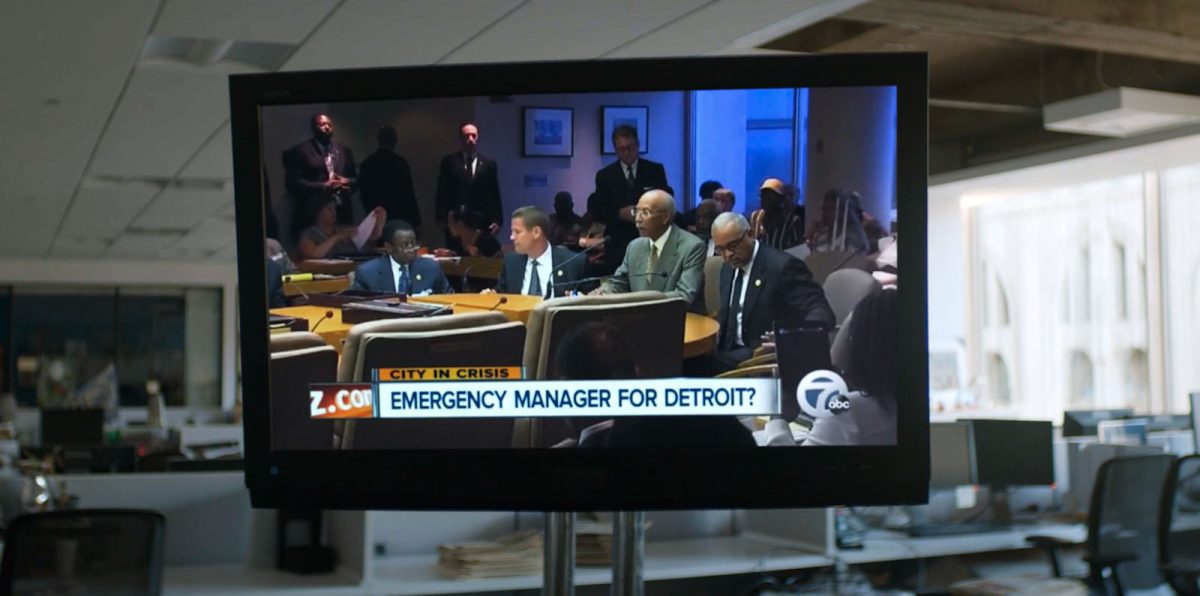
When the city filed for bankruptcy in federal court, Governor Rick Snyder passed the Emergency Manager Act, which allowed the state government to take over the city’s governance by appointing an Emergency Manager to usurp the power away from the city to fix this financial mess.
“…go in-depth into the U.S.’s largest bankruptcy case when the city of Detroit filed in 2013.”
Noted African-American bankruptcy attorney Kevyn Orr was appointed as Detroit’s Emergency Manager. With the city out of cash, Orr took drastic measures to restore the city to some working order. With the priorities to fund police and fire and save widows and children, everything else was on the table for drastic reductions. Let’s just say that no matter what Orr proposed, no one would like it.
Without getting into the weeds of the situation (I’ll leave that for the documentary), the issue of note for us doc lovers was the need to cut city worker pensions. Ah, Hell No! Thousands of Detroit citizens and city workers had been paying into the system since its inception. Times were already tough, and cutting pensions would shift many recipients under the poverty line. At the same time, less money was being paid into the system than what was being disbursed. It was a broken system in massive debt.
Detroit also faced the issue of having very few assets that could be sold. The first was the water and sewer company. The other was the Detroit Institute of Arts, which was owned by the city and, over the past century, purchased art now worth billions. It was clear that the creditors wanted to liquidate the collection to pay pensions and the city’s over 100,000 debtors.
Publisher: Source link








Netflix’s ‘Jo Nesbo’s Detective Hole’ Debuts With Perfect Rotten Tomatoes Score
Anyone currently on the hunt for a new crime thriller to binge-watch may want to divert their attention to Jo Nesbo's Detective Hole, which is currently streaming on Netflix. The nine-part drama, adapting the fifth book in Jo Nesbø's bestselling…
Mar 29, 2026

Prime Video’s ‘God of War’ Casts ‘Lost’ Star Sonya Walger as Freya
Amazon's upcoming God of War series that is currently in production is also one of the most anticipated of the next couple of years. Film and television adaptations of popular video games have been on the rise, with creative teams…
Mar 28, 2026
Paramount+ Renews ‘Criminal Minds: Evolution’ for Season 19
The start of its new season is still weeks away, but fans of Criminal Minds: Evolution won't have to wait that long to learn the fate of the long-running hit crime procedural. Execs at Paramount+ have already decided what the…
Mar 27, 2026

‘A Tale of Two Cities’ First Look Reveals Kit Harington in MGM+ Series
The BBC and MGM+ are teaming up with a new four-part limited series adaptation of Charles Dickens' classic 1859 novel A Tale of Two Cities. Game of Thrones veteran Kit Harington will play Sydney Carton, a cynical English lawyer who…
Mar 26, 2026