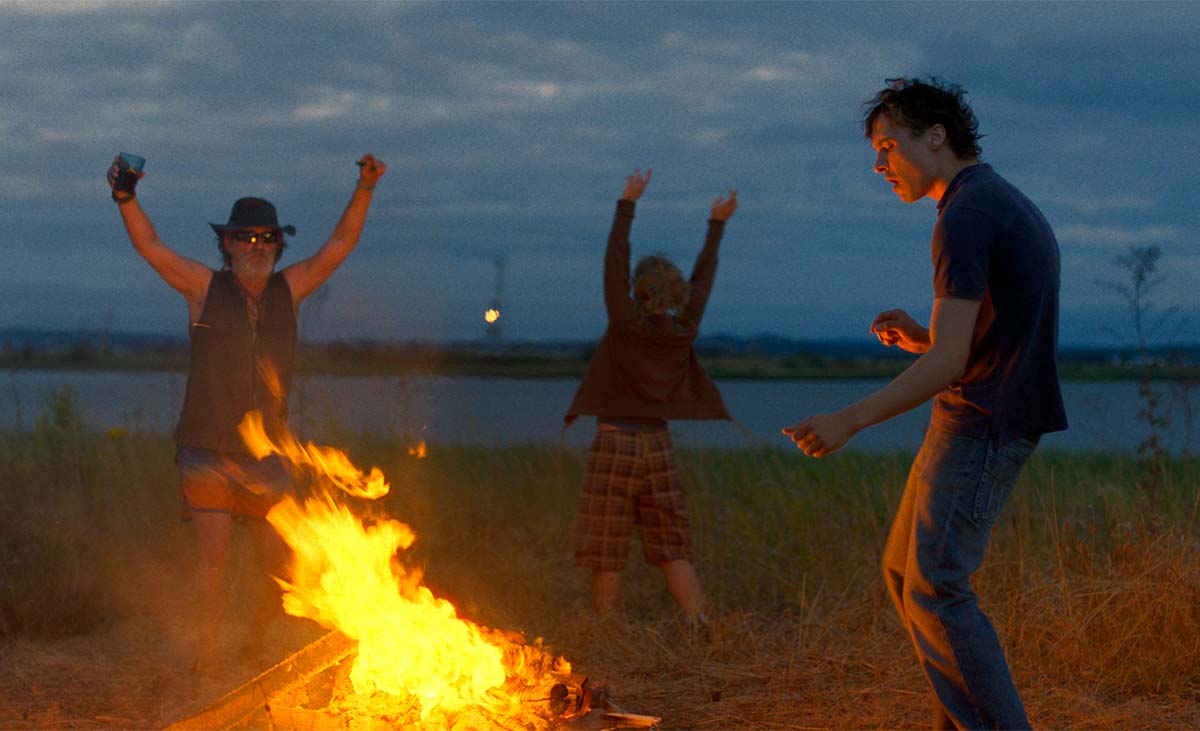
Harris Dickinson’s Feature Debut Starring Frank Dillane Is Earnest Yet Unsteady [Cannes]
May 20, 2025
Being unhoused is often associated with the idea of roughness: rough sleeping, having it rough, going through a rough patch. Yet, Frank Dillane’s Mike embodies a contrasting elegance. His delicate limbs tuck tightly against a slender frame when night comes, his contained body quietly lying atop a makeshift bed wrangled with flat cardboard boxes and a thin layer of fabric. This beautiful, angular man is the central character in Harris Dickinson’s feature debut “Urchin,” which takes its name from a largely retired term assigned to mostly unhoused, poor young children dressed in dirty rags.
READ MORE: Cannes 2025 Most Anticipated Films: ‘Sentimental Value,’ ‘Eddington,’ ‘Die My Love’
From Sherlock Holmes to Oliver Twist, urchins have long populated British storytelling, and Dickinson’s contribution to the trope first finds Mike waking up to the loud words of a street preacher, singing the praises of a God he knows not to be all that merciful. It is telling that it is the woman who wakes Mike up, her voice proving more disruptive than the revving motors and sharp horns zooming dangerously close to his ears as he sleeps on a bustling sidewalk. But, as we’ll learn, Mike is less jolted by the shrieking, mechanical loudness of the physical structures surrounding him than he is by quietly spoken words drenched in the type of honesty that will shield him from the mistakes he is so settled into making.
This clear understanding of Mike, which is established from the very first scene, is the second greatest strength of Dickinson’s first directorial outing. The first is Dillane, brilliantly cast in a role that requires precisely the brand of unpolished charisma of the young performer. While “Urchin” is rooted in empathy, its protagonist does not always instantly merit it; his behavior is as easily conducive to violence and blatant disregard as it is to the kind of throwaway charm of the confident.
To persuade the unbudging, Dillane slightly curves the corner of his mouth, dropping his shoulders to the side in a sign of vulnerability. When something he wants isn’t his to take, this energy rocks up as a volcano, culminating in a nasty, irrevocable violence that traumatizes before it is even consolidated. Dickinson steps in front of the camera to play one of Mike’s street companions early on, his signature calculated containment proving a great counterbalance to Dillane’s outgoing flair, the two a bittersweet seesaw: when one is up, the other is sure to be down.
The first act of Dickinson’s drama zooms into this energy, with Mike wandering the streets until two fateful minutes brutally take away his right to roam. “Urchin” is at its strongest then, grappling with the unpredictability of desperation and the thorny greyness of morality while carefully refusing to step on either side of the blurry line. Alas, the beautifully shot interlude that separates those first moments from the act that will succeed also signals a coming unsteadiness from which the film never quite manages to bounce back.
Support independent movie journalism to keep it alive. Sign up for The Playlist Newsletter. All the content you want and, oh, right, it’s free.
Despite losing a bit of steam, “Urchin” hits a lovely patch once Mike takes a job as a sous-chef at a shaggy hotel kind to misfits and hopefuls. The hotel chapter brings with it a welcome handful of supporting cast that allows Dickinson to stretch his writing muscles, from a fatherly chef and a compassionate bureaucrat to the pair of young girls who rapidly bring the new hire under their enthusiastic wing. But the time in the hotel is sadly scarce, and what comes after struggles to reach the same level of refinement as the first act or the earnestness of the second.
Once Mike is back sliding down a spiral that feels unstoppable, “Urchin” loses its grip on the sense of place that so competently set his journey until then. Dickinson stitches the story with a handful of stylized interludes, often lingering within a grotto that hints at the sense of placidity and connection to spirituality that constitutes the slightly rushed, perhaps too precious ending scene. The iconography of this ending is bold yet somewhat off, unable to appease a certain frustration at the lack of probing devoted to the wider questions of structural malaise that are teased yet left unearthed at the expense of a neater but less interesting conclusion. Still, “Urchin” puts forward a sensitive, promising director. And an even more promising writer. [C+]
Follow along for all our coverage of the 2025 Cannes Film Festival, including previews, reviews, interviews, and more.
Publisher: Source link



‘Off Campus’ Teaser and Release Date Revealed by Prime Video
No one expected a love story between rival hockey players to become one of the most talked-about TV shows of 2025, but there's a lot more where Heated Rivalry came from, as a new teaser for Prime Video's foray into…
Mar 21, 2026

Sarah Michelle Gellar Urges ‘Buffy’ Fans to Avoid Reading Leaked Reboot Scripts
Buffy the Vampire Slayer fans have had a rough few days after Hulu officially pulled the plug on a revival of the series, which would have brought star Sarah Michelle Gellar back as the titular heroine. Described as a continuation…
Mar 20, 2026
![Born Again’ Stars Explain Why Bullseye Is So Dangerous in Season 2 [Exclusive]](https://www.filmibee.com/wp-content/uploads/2026/03/Born-Again-Stars-Explain-Why-Bullseye-Is-So-Dangerous-in-1200x675.jpg)
Born Again’ Stars Explain Why Bullseye Is So Dangerous in Season 2 [Exclusive]
Along with Charlie Cox's Matt Murdock and Vincent D'Ofnorio's Wilson Fisk, Daredevil: Born Again Season 1 brought back one of The Man Without Fear's most notorious villains: Wilson Bethel's Benjamin Poindexter, better known as Bullseye. Not only was he back…
Mar 19, 2026
Born Again’ Showrunner Confirms ‘Avengers’ Character Is Key to Street Level MCU [Exclusive]
Ahead of the Avengers' return to the big screen later this year, Marvel Studios will return to street-level storytelling with the second season of Daredevil: Born Again on Disney+. Along with making the show canon to everything that happened in…
Mar 18, 2026