Interview: Cinematographer Jo Willems on The Long Walk
Oct 13, 2025
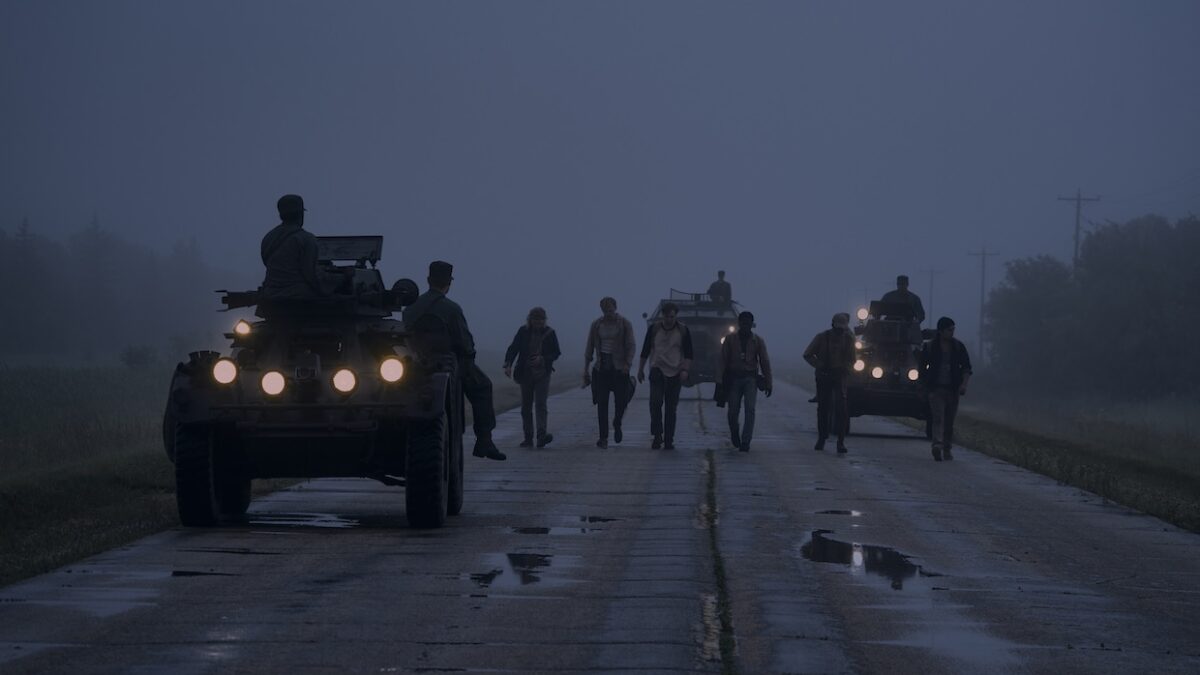
Charlie Plummer, Garrett Wareing, Cooper Hoffman, David Jonsson, Tut Nyuot and Joshua Odjick in The Long Walk. (Credit: Murray Close/Lionsgate)
Though 1974’s Carrie marked Stephen King’s first published novel, The Long Walks holds the distinction of being the earliest opus penned by the horror author. The story of a contest in which 100 teenagers march until only one is left alive, King began The Long Walk as a college freshman at the University of Maine in the late 1960s amid the Vietnam War and the looming threat of its televised draft. He submitted the story to a Random House contest for new novelists, but received only a form letter in response and The Long Walk went into a drawer. Following a run of best-sellers—Carrie, ‘Salem’s Lot, The Shining and The Stand—The Long Walk was dusted off and published in 1979 under King’s pseudonym Richard Bachman.
The film adaptation took an equally circuitous route to screens. George Romero first attempted to mount a version in the 1980s, frequent King adapter Frank Darabont developed the project in the mid-2000s and, most recently, André Øvredal worked on an iteration that fell apart in 2023.
Director Francis Lawrence finally got The Long Walk across the cinematic finish line. Crossing it with him was his longtime collaborator Jo Willems. The Belgian cinematographer has worked with Lawrence for almost 25 years, including on Red Sparrow and a multitude of Hunger Games sequels.
With The Long Walk now out in theaters, Willems spoke to Filmmaker about lensing the film entirely in sequence and using only available light for the many day exteriors.
Filmmaker: I first read The Long Walk in junior high, and it’s been one of my favorite books ever since. So, sincerely, I appreciate you and Francis not messing it up. Were you familiar with the book before he approached you with the project?
Willems: Only to the extent that I knew it was a real passion project for Francis. He’d been talking about it for years, even when other people had the rights. When Francis finally said, “I’m going to make this movie. Would you like to be involved?,” then of course I read the book and really liked it.
Filmmaker: I think you did the story justice, but obviously some changes had to be made or else the movie would’ve been six hours long. For most of the “walk” in the movie, there are no crowds in these small towns that they pass through. That meant one of my favorite scenes didn’t make it in, where a small town throws chunks of watermelon to the boys and they pass them around. It always reminded me of the rooftop beers scene in Shawshank Redemption, this moment of grace amid the brutality.
Willems: That’s true, it became a very desolate walk in the film. It was really just about [the walkers], the road and their journey.
Filmmaker: You shot this around Winnipeg?
Willems: I think we did one scene in Saskatchewan, but outside of that it was all in Manitoba. We traveled all over the [province] and shot in all of these small little towns in the middle of nowhere in Manitoba. The ending was shot right in the center of town of Winnipeg.
Filmmaker: You also shot in continuity. From your end of things, how does shooting in script order make your life easier and how does it make it more difficult?
Willems: The movie is set 100% outside except for two little flashback scenes, so the weather was a constant concern. We also started shooting when there were some forest fires happening, so the air was quite thick. We had hoped for blue skies and didn’t get that at the start of the shoot. We just decided to shoot rain or shine. There are some mismatches in the movie, but you just try to make it work. Sometimes lack of control actually makes things feel more authentic and not so sterile. I think this movie in particular benefits from that.
Filmmaker: Were there any scenes where you strategically brought in rain towers, or did you just let Mother Nature decide?
Willems: We decided very early on to do wet downs everywhere so that if it were to start raining, we could explain it that the roads were wet and it had rained. Funnily enough we got lucky and didn’t get that much rain. The end sequence was the only one all done with rain towers.
Filmmaker: The premise of the book seems like a nightmare just in terms of logistics. There are so many additional issues to contend with when every shot is physically moving forward.
Willems: I decided very early on to use the bare minimum of equipment: no artificial lighting outside during the day, no bounce cards, no overhead frames, no diffusion. We picked most of our roads running east to west, so we would start shooting in the morning and be back-lit until about 11am. So, we would shoot everything looking east in the morning, then start doing some profile work in the middle of the day and, when the sun was a little higher, we’d do some wider shots. Then, as the sun came around, we would go behind the guys and start shooting. The difficulty was in keeping these shots moving for, at times, five or six pages. I think the longest scene we did was seven pages, and we would shoot them top to bottom. We had these two electric vehicles—one that had a jib arm and the other a telescopic arm with a stabilized head—and would just go traveling. The actors were really good at keeping pace. The drivers of the vehicles had to learn how to keep pace too. I mean, we’re going three miles an hour. Steadicam was not really possible most of the time because of the distance. The operator would be exhausted by, you know, take five. It was definitely difficult to figure out the pace, but after a day we saw that this was going to work. We had a good team, people were focused and the actors were all incredibly well prepared. I think for them it was a matter of pride or an honor to be there as part of this group. The performances are amazing.
Filmmaker: Even for typical car work, there’s often a vehicle rigged with monitors to be a mobile village. Did you and Francis use that kind of set-up?
Willems: We had a little convoy. We had two electric vehicles that had the cameras them. We would always shoot with two cameras. One would be a little wider and one a little closer, or it would be two overs, or one would be a profile and one would be straight on. Then we had a video village and sound cart. Francis, myself and one of the producers were in another golf cart. We built this thing that we could put two monitors in for us that was blacked out where we had video playback as well. It got very hot in there at times in the summer in Manitoba. We would get the convoy going, move forward and travel the whole scene. Then as we landed at Point B, we would all get out of the vehicles and walk back with the actors. That was a very communal experience, and Francis would discuss some changes or make some notes to the actors. We all walked back together, however long it was. That made it a very unique and special experience for all of us. Also, the thing that was quite peculiar about shooting in order was that at night, if there were any tickets given [and walkers that were eliminated], we would say goodbye to those actors, and they would not return the next day. Every day the group would get smaller and smaller and there was a real bond between these guys.
Filmmaker: I saw some behind-the-scenes footage where a 1st AC was behind pulled in a rickshaw so he could pull focus.
Willems: That didn’t happen all the time, but there were a few scenes with Steadicam when we needed shorter control if someone in the scene stopped or paused. Doing that with the electric vehicle and crane was very difficult. For those shots the focus puller still needed to travel, so he would sit in that rickshaw.
Filmmaker: In every behind-the-scenes clip I’ve seen, there’s the poor boom operator trudging along on foot. Do you think he got the most steps of all the crew members?
Willems: He probably got the most steps, but our 2nd AC had to be close. He would slate in front of the actors and then walk the whole thing. The electric vehicles already had the focus puller, camera operator, set photographer, driver and the guy who operated the crane. There was a weight limit for these vehicles [so the 2nd AC couldn’t just hop on]. I remember him telling me when we were shooting on the bridge, which was three or four days before we wrapped, “I’ve just hit 500 kilometers [roughly 300 miles].” That must have been about day 35 or so.
Filmmaker: The novel is written from a third-person limited point of view, meaning the reader is only privileged to the inner thoughts of one character. What discussions did you and Francis have about point of view for the film?
Willems: There are the more violent [deaths] where the camera actually stays with that character [as they get their “ticket”], like with the first kill, but I thought some of the most powerful moments of the film are where you stay with Garraty [Cooper Hoffman] and McVries [David Jonsson] as they continue their walk. You just see this blur behind them [as someone gets their ticket] that pretty much disappears as the depth of field [becomes more out of focus]. Those were discussions we had early on. Francis knew exactly which moments we wanted to be with the people experiencing a death and when we wanted to be with the actual kill. We tend to not storyboard things too much. In the morning we’d go for the walk with the actors and Frances and see how people were placed, then talk about where the camera was going to go and what shots we needed. Francis and I have worked together for quite a long time now. We started in 2001 and did our first feature together in 2010, so we have a shorthand and work fairly fast.
Filmmaker: You don’t shy away from the violence. You and Francis made a number of Hunger Games films together and I like those movies well enough, but it always bothered me how sanitized the violence was. In The Long Walk, seeing that brutality is necessary because the indifference with which the soldiers shoot the walkers is an important piece of the story. That said, there are certainly moments, like Hank Olson’s death, that are much more graphic in the book.
Willems: Well, the Hunger Games films are PG-13, so there’s certain rules [we have to abide by in terms of the violence]. In The Long Walk, I don’t think the violence is ever gratuitous. It is brutal and it is hard, but I don’t think it’s ever gratuitous. I think it really puts the audience right in there. As the movie progresses, the violence also becomes more and more emotional every time because these characters have bonded so strongly.
Filmmaker: Walk me through your camera and lens package. It’s a Alexa 35 with Panavision T Series anamorphics, correct?
Willems: That’s right. We also had a couple of anamorphic zooms—a 42-425mm, a 37-85mm and a 70-200mm.
Filmmaker: Did you ever go all the way to 425mm?
Willems: Yeah, a couple of shots. There’s one at night where they’re in front of the military vehicle and a blue sky is coming. The other one was actually a shot that was never planned. We got to this location, it was very misty and I said, “It’s going to clear in about an hour, maybe an hour and a half. We shouldn’t shoot until this mist is gone.” But then I said, “Why don’t we just have them walking in this mist? It looks pretty cool.”
Filmmaker: Did you have the T Series detuned?
Willems: Yeah, there was a little bit of detuning. I had shot those lenses on Red Sparrow, and then again on Finch. On Finch, they were expanded to cover [a larger camera sensor], so they were 1.8x squeeze instead of a 2x squeeze. Since this story was a metaphor for the Vietnam War, my inspiration visually in terms of color and texture was to really lean into that idea. I asked Dan Sasaki at Panavision to detune them slightly and he gave me a couple options. It was pretty light, but it gave me something that was not as clean and sterile. That’s not to say that the Ts are sterile, but they are quite sharp if you shoot them in a certain way. For this project, I wanted something that had a little bit of softness and aberration on the top and bottom of the lens.
Filmmaker: The 2.39 ratio of anamorphic also works well with this ensemble cast, where you can have a large group of walkers in frame with these halftrack military vehicles stalking behind them.
Willems: That’s right. It’s definitely a landscape movie. It’s not a tall movie. There are no tall buildings. It felt like the movie benefited from being as wide as possible and having these very wide landscapes at times. I wanted it to feel real and authentic, but, at the same time, anamorphic does immediately give you something that’s transformative of reality that allows an audience to experience this as a story. Francis and I hadn’t done anamorphic since, I think, 2015. We had gotten into the whole Alexis 65 large format thing for a while, but for this I didn’t want to do that. I used the Alexa 35 because it has an organic feel. It also has great dynamic range, which was important because this movie was going to shoot with available light. The Alexa 35 would hold a lot of the highlights. We also had a lot of different skin tones, and the camera dealt very well with that in uncontrolled situations.
Filmmaker: For the night scenes, you’re largely lighting with practicals that you’ve put on the halftrack vehicles and occasional streetlights. What were those units on the halftracks?
Willems: Creamsource Vortex 4s. We put one truck in the back and one in front. That way I could always have a backlight. That gave us some drama. For the hill scene, I put these towers maybe every hundred feet. I think I had eight of those towers, with two Vortex 8s on each, and I had them in a slightly cooler color temperature. They could be in the frame as well for that scene. I didn’t want any standard moonlight situation where I would light the landscape. I thought they would all become too artificial, too much like a movie. So, I let some of those backgrounds go pitch black, particularly when they come over the hill and it’s just [Garraty and McVries first cresting the top of that incline]. The only other thing I had was a guy with a Chinese lantern LED on a fishing pole to give them their key light when we did the night walks.
Filmmaker: There’s a bridge scene toward the end where it looks like you put some tubes up for the night exterior.
Willems: That’s right. We added all of those. They’re Astera tubes. I think they were eight footers and I put them all along the bridge. It was a disused bridge, so I couldn’t put any big equipment on there and couldn’t put condors up or big back lights. So, I decided to do that technique where I could see all the tubes [in frame]. I didn’t do any other lighting there.
Filmmaker: Let me ask you about two of my favorite shots. One is a blue hour shot where the walkers go past a burning car on the side of the road, which is an image that doesn’t come from the book.
Willems: We looked at photographs for references and there was a lot of Americana stuff. This photograph turned up of a burning car just sitting by the side of the road. I don’t remember who the photographer was. It was this burning car with a cop car next to it, but there’s no cops to be seen. I said, “Let’s shoot it right at dusk so I can have some detail in the sky.” We actually shot the whole thing in, like, 45 minutes. We had a couple of the leading shots, we had the big wide shot from behind and then the push in behind them. We shot it right at sunset and it turned out to be a beautiful moment. A lot of the movie is quite bleak, but [the walkers] do find beauty, humor and some joy and hope in this.
Filmmaker: My favorite shot in the film is another dusk one, but against a warm sunset. There’s only a handful of walkers left, and they’re silhouetted by the halftrack behind them, which gives them a rim light that outlines their bodies.
Willems: That was another shot where we were like, “The sky is really beautiful. Let’s just shoot this.” It was a long lens shot and there was something really graphic about it. I think it was a hot day and then we did our wet down, so there was some steam coming off the road. For the headlights, we started researching things at car shops that people use to put extra lights [on their vehicles]. It was all low voltage stuff. That’s the only lights we used for that, those headlights and the Vortex 4s on the truck, and it’s sort of an iconic shot in the movie. We had a bit of time because we needed to wait for night for the rest of our shots. It’s fun to come up with stuff like that and find some spontaneity.
This was definitely one of my best experiences on a movie. I know people say that every time they do a movie, but it really was the case on this. It wasn’t easy shooting it—we traveled a lot, there were challenges—but seeing these actors doing what they did day after day was pretty special. I think one of the most important things is always respecting the characters and finding what is right for the characters in terms of the movie to make it authentic and be correct for the story. That’s what I always strive for.
Publisher: Source link



Wuthering Heights Review | Flickreel
As far as adaptations go, I’ve never viewed any source material as sacred, including The Bible. While a faithful adaptation is always welcome, I’m open to a filmmaker leaving their signature on a classic story, especially one that’s been told…
Mar 17, 2026
Amy Adams Sinks In Vapid, Misguided Alcoholism Drama By ‘Pieces of a Woman’ Director [Berlin]
For a solid decade, starting in the late 2000s with Disney’s charming fairytale comedy “Enchanted” all the way to Denis Villeneuve’s melancholy sci-fi “Arrival,” it was easy to trust Amy Adams, a six-time Academy Award nominee. Then, somewhere around Ron…
Mar 17, 2026
Mason Gooding & James Van Der Beek’s Bad Night Is Aggressively Dull
Ever since the Scream franchise helped put him on the map, Mason Gooding has been a great talent to watch. The genre-bending slasher Heart Eyes is still his best non-franchise role yet, but he's also branched outside of horror in…
Mar 15, 2026

A Grumpy Nick Offerman Keeps This Fish Tale Swimming Along
Animated fish films have been done. Finding Nemo. Shark Tale. Ponyo. So to hear about another doesn't feel like anything new. However, The Pout-Pout Fish, starring Nick Offerman as a grumpy ocean pout named Mr. Fish, is a little different.…
Mar 15, 2026