“It was Extremely Brutal”: Max Keegan on “The Shepherd and the Bear”
Nov 25, 2025
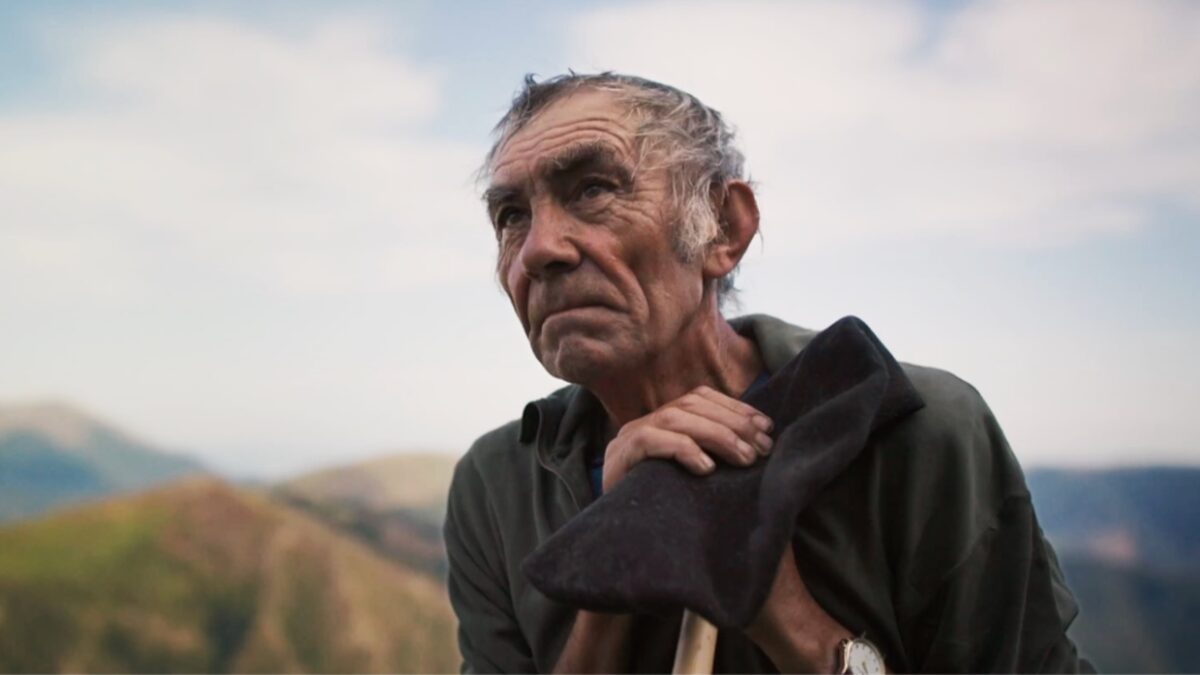
Yves Raspaud in The Shepherd and the Bear
High in the Pyrenees, a centuries-old way of life approaches its twilight amid a controversial rewilding scheme. France’s government has for decades airlifted brown bears from Slovenia to repopulate those hunted out of existence by the region’s hunters. But the bears are apex predators who threaten the flocks of a community of shepherds, whose earth-bound traditions don’t readily coexist with state-mandated policy.
Within this context, British filmmaker Max Keegan illuminates richly human connections with stirring observational portraiture in The Shepherd and the Bear, whose Academy Award-qualifying run begins Friday Nov. 21 at New York City’s Cinema Village. Much more about the shepherds than the bears, the film found Keegan embedded with them fulltime for a couple of years during the thick of the COVID-19 pandemic, something that proved as essential to the production as serious hiking stamina. Writing about the documentary for Filmmaker after its world premiere at the Camden International Film Festival last year I suggested that “Keegan offers a fairly convincing answer to the proposition, ‘What if Frederick Wiseman … but a mountain goat? The often arduous experience of sharing day-to-day existence with these indelible characters permeates the images, which come insistently alive in the high-altitude light.” Most memorable is Yves, “a chain smoking, hard-drinking, scabrous walking legend who appears as if summoned out of another era.”
Earlier this week, Keegan hopped on a Zoom call from his native England to talk about the challenges and rewards of making The Shepherd and the Bear the way he did, and about his deep affinity for the people he came to know.
Filmmaker: At what point did you realize you had a story and how you would shape it?
Keegan: I always had the ambition that it would be a pure vérité film. It’s one of those subjects that could become quite academic and theoretical, and it’s hard to care when something’s theoretical. We wanted to cast characters who actually had lives that intersected with this issue, and who would have a conflict, rather than just people who had opinions about it. We had a really long casting process. I probably met 500 people, and we didn’t meet Yves until six months into the film. The story didn’t really change so much; the articulation of it and the personal stories did. The idea was to use this issue of the bears in a hyper-local setting to pose larger questions that apply to more than just the Pyrenees, and also to showcase and valorize this traditional way of life which will have disappeared in my lifetime. The characters obviously informed what you see in the film in terms of its three-act structure, but we didn’t know what that was going to be until we met them,.
Filmmaker: Can talk a little bit about the protagonists, who each represent a different aspect of this way of life? Obviously, Yves is this absolute icon, someone you could never imagine anyone writing as beautifully as he exists in the film-—this rugged, complex, old-school figure.
Keegan: We settled on two characters who were a little bit more blurry. Yves is not rabidly anti-bear in the way that some local politicians are, but what’s going on in his personal life is more interesting. The reason that we came to that mountain in the first place was that Lisa, the young shepherdess, who—spoiler alert—quits halfway through the film, posted a lot on Facebook. She was 22 at the time, and myself and my field producer there, Eleonore Voisard, who’s now the co-producer of the film, were really taken by the fact that there was this young woman living this extremely rugged life with this ancient shepherd, the two of them living on top of this mountain. We initially came for Lisa, but we stayed for Yves. He’s a man of not many words when he’s not had a drink, but you can always see there’s quite a lot going on under the surface. He’s an incredibly sentimental person. There are things that are really plaguing him in terms of where he’s at physically, and also where his culture is at, knowing that it’s at the end of the road. The village that he lives in, that he was born in, is now a holiday home for someone else. The cottage that his father was born in, which is about a 10-minute walk away from his front door, now has fallen into disrepair and been eaten by ivy. Most of the people in the village aren’t from there anymore. Yves feels that very strongly, and it really bothers him.
Filmmaker: On the other hand, you have Cyril, the young man who is an aspiring nature photographer.
Keegan: He’s just a fascinating kid. The first time we met him, we went there because his father used to be a pro-bear activist. This kid, who was 15 at the time, came out carrying this extraordinary amount of equipment, and he stunk really, really badly. He was wearing camouflage. We said, “Where are you going?,” and he pointed up the mountain. He said, “I’m going up there. There’s this black woodpecker which I’m going to try and see. I’ll be back on Sunday night.” The reason that he stunk was that he believes that if you wash your clothes, the animals will be able to smell you. He never washes any of the clothes. I thought, “Wow, you know, when I was 15, I was trying to buy cider illegally and smoke cigarettes in the park with my friends. Here’s this kid, climbing up a really steep mountain where there are bears and wild boars and all sorts of things, and he’ll be by himself for the whole weekend trying to photograph this woodpecker.” Everything that the bear represents, for Yves, in terms of the loss of his culture and way of life, represents for Cyril the limitless excitement of the natural world and its power and beauty. We didn’t meet a lot of campaigning ecologists. Cyril had such a more genuine and exciting interaction with the natural world—it wasn’t something that was in books or on his laptop—and his relationship with his mother also seemed so special. She’s this really gruff farming woman who’s got everyone in the village licked. She’s the head honcho in that part of the world and really wanted him to become a shepherd, and he didn’t want to become a shepherd. That was interesting to us.
Filmmaker: What the film says about the political aspects of the rewilding project, and how it’s a top-down regulatory action engineered by bureaucrats in Paris with no connection to the geography or the people they’re imposing it on, feels like an important point. The shepherds live a life intrinsically rooted in reverence for the natural world.
Keegan: That really is the joke of this whole thing. Somehow you have ecologists pitted against people who live this deeply ecologically respectful lifestyle. Yves is probably never further than seven or eight kilometers away from where he lives. He doesn’t really drive. He never leaves his valley. The joke that is always made is he knows every animal that he eats. There are no industrial inputs in the way that they’re farming whatsoever. It is a very, very old way of life. The first evidence of the transhumance, which is this [summetime] passage [of livestock] into the mountains, is about 6,000 years old. It’s in cave paintings. Anyone who lives in any city, regardless of what their politics are, is probably living a much more environmentally harmful life than Yves. That tells you a lot about where we are politically, on a lot of levels, at the moment—these farmers absolutely hate ecologists, and feel that ecologists have got it out for them, and that they’re worlds apart in terms of their their view on things, and that ecologists similarly attack someone like Yves and these traditional lifestyles. Really sad.
Filmmaker: The cinematography makes the most of the legitimately stunning vistas of the Pyrenees. I imagine there was an extraordinary amount of sheer grunt work involved.
Keegan: It was extremely brutal. Everything happens around sunrise, so that’s when your working day starts. When we first met Yves, we were living an hour’s drive away from the bottom of the mountain, so we’d have to drive an hour on the motorway and then through little villages, then we’d have to drive an hour off-piste, then park the car and hike, depending on which cabin he was at, between an hour-and-a-half and two hours to get to him. And his day starting at 6 a.m. meant we were waking up at two or three in the morning, then hiking up with all of these batteries and everything that you need to eat for a couple of days. You get water from a stream, your power is whatever you bring with you. It was really, really rough, but I think in many ways it was quite useful in terms of winning the trust and respect of people in the region. Previously, when journalists had come to cover this issue, they’d get out their cars, set up their tripods, do a quick interview and fly the drone up the mountain. The fact that we were willing to get our hands dirty and get stuck in, particularly with Yves, helped gain his trust and respect.
There was another mountain that we had started filming on. Very fortunately, we stopped filming there—not for physical reasons, but they have seven different cabins, and the furthest away one is a six-hour walk, including where you have to climb around the side of a cliff for about 20 minutes. There was one moment I remember: I climbed with the camera—a Canon C70 with a really big, heavy Sigma prime 28 for most of the shoot, on top of a gimbal with a big, ultra-bright monitor on it—for about an hour with one hand, and this really heavy camera in my other hand, then my bag with my sleeping bag, above a one-kilometer drop. I had to sit there the whole night long, with my camera out, without pitching a tent, waiting for the bear to come, which never happened. I was ice cold. I got frost nip on my nose, sitting outside all night waiting for something to happen that never happened, and we had to do that 12 times before we got images of the environmental police firing their flares at the bear.
Filmmaker: Do you think all the suffering made the film better?
Keegan: I don’t think we’d have been able to shoot this in any other way. We were there the whole time for two years of these people’s lives. When you see any of these portraits of Yves, that’s shot on a 28, which means that the camera is this far away from his face [presses an open palm tight to a cheek]. It was already very invasive. If we’d had a larger team, I think it would have been hard to put up with us. Taking the time to live with people and understand their concerns and the way that they felt, rather than arriving with an idea of what this conflict looked like and what these lives look like, felt very important from the get-go.
Publisher: Source link



Wuthering Heights Review | Flickreel
As far as adaptations go, I’ve never viewed any source material as sacred, including The Bible. While a faithful adaptation is always welcome, I’m open to a filmmaker leaving their signature on a classic story, especially one that’s been told…
Mar 17, 2026
Amy Adams Sinks In Vapid, Misguided Alcoholism Drama By ‘Pieces of a Woman’ Director [Berlin]
For a solid decade, starting in the late 2000s with Disney’s charming fairytale comedy “Enchanted” all the way to Denis Villeneuve’s melancholy sci-fi “Arrival,” it was easy to trust Amy Adams, a six-time Academy Award nominee. Then, somewhere around Ron…
Mar 17, 2026
Mason Gooding & James Van Der Beek’s Bad Night Is Aggressively Dull
Ever since the Scream franchise helped put him on the map, Mason Gooding has been a great talent to watch. The genre-bending slasher Heart Eyes is still his best non-franchise role yet, but he's also branched outside of horror in…
Mar 15, 2026
A Grumpy Nick Offerman Keeps This Fish Tale Swimming Along
Animated fish films have been done. Finding Nemo. Shark Tale. Ponyo. So to hear about another doesn't feel like anything new. However, The Pout-Pout Fish, starring Nick Offerman as a grumpy ocean pout named Mr. Fish, is a little different.…
Mar 15, 2026