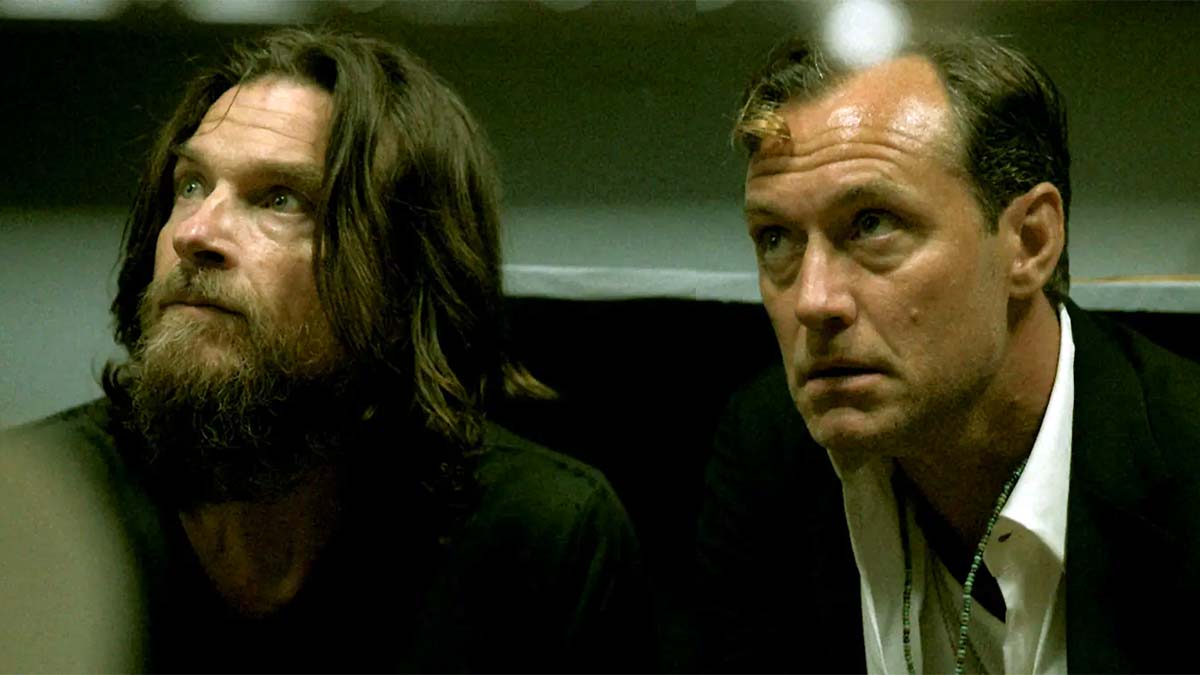
Jason Bateman & Jude Law Descend Into Family Rot & Destructive Bonds In Netflix’s Tense New Drama
Dec 5, 2025
A gripping descent into personal ruin, the oppressive burden of cursed family baggage, and the corrosive bonds of brotherhood, Netflix’s “Black Rabbit” is an anxious, bruising portrait of loyalty that saves and destroys in equal measure—and arguably the drama of the fall.
Created by Academy Award–nominated screenwriter Zach Baylin (“King Richard,” “Creed III”) and Kate Susman (producer on the Jude Law–starring “The Order” directed by Justin Kurzel), and starring Jason Bateman and Jude Law, “Black Rabbit” shares some superifical DNA with Bateman’s “Ozark”—families unraveling, bad business with worse people, cycles of crime and compromise—but it ultimately becomes its own beast, grounded in a grimy, nocturnal New York and a portrait of legacy turned rotten.
READ MORE: Fall 2025 TV Preview: 45 Series To Watch
At the center is the Black Rabbit lounge, a Lower East Side hot spot steeped in allure and menace, and the Friedken brothers who can’t stop poisoning it. Jake (Law) is the sleek co-owner, curating a carefully manicured image of smooth control while fraying underneath, and Vince (Bateman) is the older sibling who crashes back into his orbit: broke, incorrigibly compelled towards shortcuts, and radioactive. Their reunion doesn’t spark reconciliation so much as detonation, and the club becomes both a stage and a crucible for every debt, betrayal, and ghost the family has been avoiding.
“Black Rabbit” opens with chic nightclub seduction—Jake’s place on the verge of a big New York Times review, the staff buzzing with anticipation—but that promise curdles overnight. Vince arrives like a well-timed curse, carrying the weight of a debt nearly ten years old and swollen to $144,000. Once forced out of ownership for his reckless ways, he reappears like unfinished business, and the predators he owes circle back in.
From there, the mask slips. Behind the surface of Lower East Side hipster cool lies decay: Jake is living above his means, a businessman desperate to project sophistication while inching toward insolvency. Vince looks like the anchor returning to drag the Rabbit under, but together they embody something more profound—a family unable to escape the inherited traumas of their upbringing, bound as much by pain as blood.
Orbiting this volatile implosion is a superb ensemble that only accelerates the collapse. Cleopatra Coleman is Estelle, the club’s designer entwined with Wes (played by Sope Dirisu), a onetime musician turned investor with old grievances attached. Amaka Okafor is Roxie, the ambitious chef and Black Rabbit lieutenant who eventually becomes determined to escape the Friedkens’ mess. Troy Kotsur radiates menace as Joe Mancuso, a loan shark tightening the noose around Vince with family history. Dagmara Dominczyk plays Val, Jake’s ex-wife and mother to his son Hunter (played by Michael Cash), while Odessa Young is Gen, Vince’s estranged daughter, all sharp edges and disappointment. Abbey Lee’s Anna, a bartender caught in the Rabbit’s gravitational pull, becomes the tragic axis around which events pivot.
Even the margins matter: Robin de Jesús as Tony in the kitchen, the convincingly scumbaggy Forrest Weber and Chris Coy as Mancuso’s muscle, John Ales as the shady VIP artist Jules Zablonski with Morgan Spector as his fixer Campbell, and Hettienne Park as Detective Ellen Seung, circling as the system begins to close in.
But the gravitational pull belongs to the brothers. Law is excellent, haunted and brittle, a man buckling under debts and history. Yet Bateman lights the series’ fuse, delivering a convincing, career-best turn. You believe this guy is a five-time loser—addict, scammer, liability, a human wrecking ball—but the performance never flattens into caricature. There’s still a pulse of humanity, a trace of vulnerability, that makes you feel for him even as he drags everyone down. That contradiction—repellent yet sympathetic—supercharges the show, ensuring Vince is as magnetic as he is destructive.
It’s also what keeps the show from collapsing under its own weight. The series is relentlessly intense, sometimes bordering on bleak, but the spark between Law and Bateman gives it breath. Bateman, in particular, deploys a sense of disarming humor— puncturing the dread, twisting it to allow air in—that adds a streak of dark comedy and fleeting reprieve. The laughs are bitter, often uncomfortable, but they highlight the perversity of how family wounds warp everything, turning disaster into a grim joke.
Self-destructiveness runs through “Black Rabbit” like a live wire. The Friedkens implode not because they’re cursed, but because they can’t stop replaying the same doomed patterns, unraveling in slow motion. That drive toward ruin—personal, financial, emotional—makes the series gripping even when it’s painful to endure. Every choice feels like another crack in the foundation, every confrontation another countdown, until collapse is no longer avoidable but inevitable.
The filmmaking matches the performances, too. Bateman, Laura Linney, and Ben Semanoff direct with suffocating interiors and an unnerving patience, every silence a trap. By the time Kurzel takes over the final two episodes, the tone sharpens into something more operatic: repression erupting into blood and ruin. The cinematography tracks that descent, neon allure bleeding into shadow, glamour collapsing into claustrophobia.
Support independent movie journalism to keep it alive. Sign up for The Playlist Newsletter. All the content you want and, oh, right, it’s free.
And then there’s the music. Television scores often evaporate into unforgettable wallpaper, but Danny Bensi and Saunder Jurriaans compose one of the most striking TV scores in recent memory. Sinister and doom-soaked, their soundscape of warped strings, metallic pulses, and subterranean bass makes every conversation feel like a countdown. By the back half, “Black Rabbit” isn’t just tense—it’s captivatingly suffocating, an anxiety machine that makes you want to look away even as it draws you closer.
For all its crime-thriller trappings, “Black Rabbit” is about bonds—how brotherhood can sustain yet also poison, how loyalty may offer salvation one moment and burn everything down the next. The weight of family obligation, the way it entangles and smothers, shapes the Friedkens’ story at every turn. But there’s also the stubborn need for affection, a scarred intimacy that survives even as it damages everything around it. These contradictions—love as both anchor and burden—give the series its pulse, infusing the despair with genuine emotional force.
While parts of the story can feel familiar—you sense early on that it won’t end well—the inevitability doesn’t dilute its impact. The series is so absorbing, so sharply executed, that genre conventions fade into the background. What lingers is the raw emotional toll, the unraveling of people bound to make the wrong choices, and the sense of watching lives slowly collapse under pressures they can’t escape.
Not every beat always lands—the middle stretch can circle its ideas a little too insistently—but the overall impact is clear. Between Bateman’s dirtbaggy, persuasive, career-best performance, Law’s weary precision, the suffocating direction, and Bensi and Jurriaans’ unforgettable score, “Black Rabbit” stands as one of Netflix’s most striking originals in recent memory: a family drama wearing the clothes of a crime saga, or maybe the reverse. Dragging you into a dark burrow where family ties tighten like vicious snares, the only truth waiting at the end is that family binds as fiercely as it breaks. [A-]
Publisher: Source link




![Born Again’ Stars Explain Why Bullseye Is So Dangerous in Season 2 [Exclusive]](https://www.filmibee.com/wp-content/uploads/2026/03/Born-Again-Stars-Explain-Why-Bullseye-Is-So-Dangerous-in-1200x675.jpg)
Born Again’ Stars Explain Why Bullseye Is So Dangerous in Season 2 [Exclusive]
Along with Charlie Cox's Matt Murdock and Vincent D'Ofnorio's Wilson Fisk, Daredevil: Born Again Season 1 brought back one of The Man Without Fear's most notorious villains: Wilson Bethel's Benjamin Poindexter, better known as Bullseye. Not only was he back…
Mar 19, 2026
Born Again’ Showrunner Confirms ‘Avengers’ Character Is Key to Street Level MCU [Exclusive]
Ahead of the Avengers' return to the big screen later this year, Marvel Studios will return to street-level storytelling with the second season of Daredevil: Born Again on Disney+. Along with making the show canon to everything that happened in…
Mar 18, 2026

Taylor Sheridan’s Underrated Action Thriller Series Roars to Streaming Success
It’s now been two years since we last saw anything from the underrated action thriller series created by Yellowstone’s Taylor Sheridan, but having finally had some promising word about the new season, the show has now shot up the streaming…
Mar 17, 2026
Netflix’s ‘One Piece’ Fails To Replicate Success of Season 1 on Streaming
It's been a little over two months since Stranger Things came to an epic conclusion on Netflix that left a massive hole in our hearts in more ways than one. However, the show's biggest replacement in terms of sheer production…
Mar 16, 2026