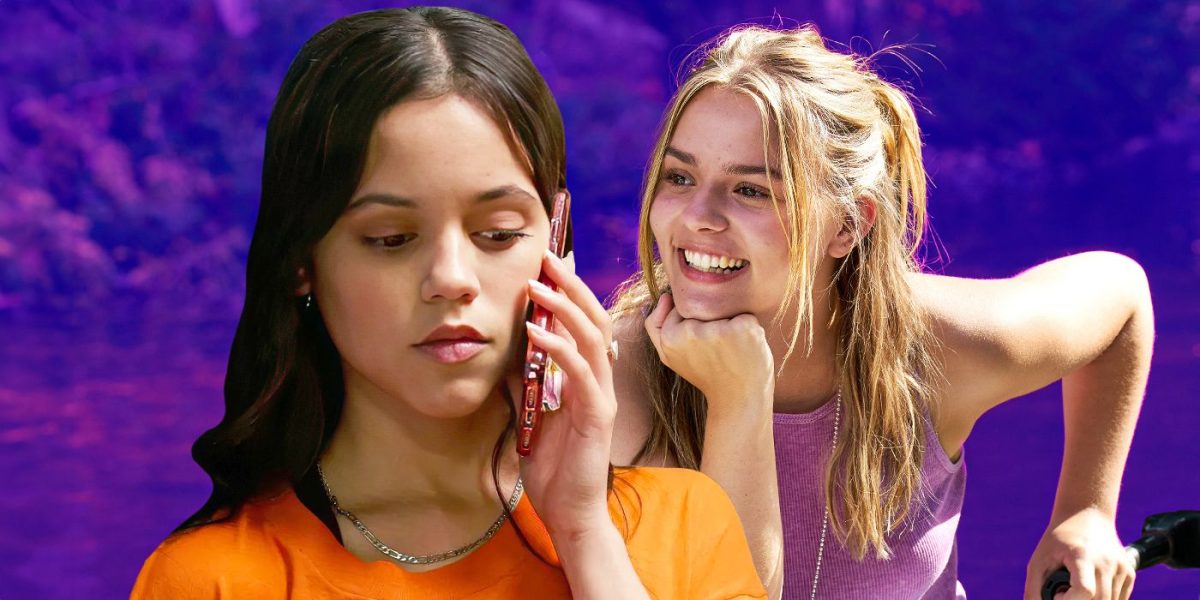
Jenna Ortega’s ‘The Fallout’ Director Has Found the Next Big Thing (Again)
Sep 10, 2024
The Big Picture
Perri Nemiroff sits down with
My Old Ass
director, Megan Park.
My Old Ass
is Park’s second feature as a director after
The Fallout
starring Jenna Ortega, which was released on Max in 2022.
My Old Ass
starring Maisy Stella and Aubrey Plaza hits theaters on September 13th via Amazon MGM.
The moment I walked out of the My Old Ass World Premiere at the 2024 Sundance Film Festival, I knew with certainty it’d be my favorite film of the festival, and possibly a contender for my Top 10 of 2024. Eight months later, I can confirm that remains true. Similar to Strange Darling, I’d be shocked if My Old Ass wasn’t one of my favorite films of the year.
Megan Park is officially two-for-two as a feature film director. She kicked off her run behind the lens in a feature capacity with the phenomenal Jenna Ortega-headliner, The Fallout, a wildly poignant piece about gun violence and navigating the resulting trauma. With My Old Ass, Park shifts gears a bit, delivering a hugely charming coming-of-age tale of a teenager on the cusp of leaving home for college who has an encounter with her “Old Ass.”
Maisy Stella stars as Elliott, a teenager who opts to take mushrooms with her two best friends on her 18th birthday. While tripping, she’s visited by her older self, played by Aubrey Plaza, who tries not to rock the boat too much, but does have a few ideas she’d like to pass along about making the most of her time home sweet home before heading off to college.
With My Old Ass arriving in theaters on September 13th, I got the chance to reconnect with Park after our Sundance chat to dig a little deeper into the making of the movie. Check out the video at the top of this article to hear all about Park’s approach to working with lead actors like Maisy Stella and Jenna Ortega, how she tackled respecting time travel rules but without weighing down her narrative with too many of them, what it was like selling the film at Sundance for a whopping $15 million, and loads more! You can also read the conversation in transcript form below.
How Mushrooms Helped Megan Park Crack the ‘My Old Ass’ Script
“What would I tell my younger self?”
PERRI NEMIROFF: Can you tell me what idea #1 was, the core concept that started it all? But then I also want to know if you had a break story moment, something you came up with along the way that made you think, “It works and it’s whole now?”
MEGAN PARK: I think everyone assumes doing mushrooms was the entry point, but I think doing mushrooms was the story break for me because it started when I was home in Canada during the pandemic. I was so nostalgic. I just had my first baby and I was staying in my childhood bedroom, and I was like, “It’s so weird to think about” — which kind of ended up being a bit of the Chad monologue in the movie where it’s like, “Wait, there was a time when my whole immediate family was all sleeping under the same roof for the last time and I didn’t know it.” But I’m also the type of person where, if I know something’s the last time, I feel like it ruins it for me. I get too anxious and I’m trying to soak it all in. So I’m like, “Maybe it’s a good thing I didn’t know it was ever the last time.” I was also remembering how much I used to love making up dances with my friends in school to Spice Girls and whatever. And then I was like, “Wait, there was a time we did that for the last time. That’s so sad.” And I think that just made me feel really nostalgic and start thinking about, like, “What would I tell my younger self?”
And then I think coming off the heels of The Fallout, that was such a heavy headspace to be in for so long, understandably, obviously, and very much a story I wanted to tell, but I was ready to be in a lighter place mentally, both as a writer and a director on set and stuff. I was like, “I really want to do something about giving your younger self advice,” but ultimately, it being this two-way street and really the Old Ass’s lesson. I couldn’t figure out a way into it that didn’t feel super, I don’t know, sci-fi and butterfly effect-y, which I didn’t want to spend time in that place. I was like, “What about mushrooms?” [Laughs] “What if it’s a mushroom trip, and then the whole time you’re like, ‘Did that happen or did it not happen?’” All of a sudden that clicked for me, and then it was like everything came really fast after that.
Is Maisy Stella the Next Jenna Ortega?
I want to talk a little bit about casting because you already brought up The Fallout. In that movie, you have Jenna Ortega as your lead. I’m pretty sure it’s safe to say she’s one of the biggest stars out there right now.
PARK: It’s so cool.
I think Maisy is on a very, very similar path.
PARK: I got chills when you said that. I’m like her proud second big sister.
I don’t blame you! There’s definitely that special, indescribable screen presence to her that I think is purely her and not necessarily something one can learn.
PARK: Absolutely. She’s got that sparkle, that joie de vivre. I met her in passing through The Fallout because she did a song for the movie with her sister, [Lennon Stella], and I remember feeling that way around her. I was like, “God, she’s so refreshing. There’s something so unique, so special about her.” And then when I was writing the movie, at a certain point, I started to think about her, and I was like, “God, I wonder …” But she wasn’t full-time acting and more doing music and just living her life in Nashville. I didn’t even know if that was something she’d want to do.
It was funny because when we sent her the script, she was like, “I have a boat, too. I got a boat and I don’t have my boating license.” There were all these things that started coming out that were so similar. I mean, the second she sent in a tape, I was like, “Holy …” Because you don’t know if somebody can harness that always and translate it on camera, and I was like, “If she can do that, holy shit.” And not only could she do it, she could do anything, like anything. I’m so excited to just see what she does for the rest of her career now. I’m like obsessed.
Image via Photagonist at the Collider Media Studio
She’s a unique force and so is Jenna, but are there any shared qualities the two of them have that signaled to you they’re good collaborators for you, but they also have that potential to really soar in this industry?
PARK: 100%. I remember meeting Jenna. We went to coffee and her mom came because she was, like, 17 or something when we had this meeting. There was such an intelligence to Jenna. I started acting when I was young, but not as young as they started. Maisy was on Nashville when she was, like, seven, and Jenna has been doing it forever, but there’s definitely an understanding of what that’s like, and how people don’t take young actors — they definitely didn’t when I was acting — very seriously. There was a way that I always hoped to be treated on a set or hoped to be collaborated with, and I really tried to create that kind of environment and that back-and-forth. There was such a maturity to both Jenna and Maisy, but yet such a playful innocence at the same time, which is really rare. And they both had such an incredible intelligence and knowing for somebody their age. They both also really like to not over-rehearse, which is also my vibe as a director. I’d rather just sit and talk about the scenes and talk about what’s happening than run the actual lines, and they’re both very much like that. I was like that as an actor too, so that was an immediate chemistry click in terms of how the actual process of the prep would go and the rehearsal process.
How do you adapt when you’re working with an actor who has a different approach to the work and maybe finds it important to rehearse, rehearse, rehearse?
PARK: Being an actor for so many years, I worked with so many different types of actors. I will say that I think I got used to navigating that. Sometimes you don’t want to sit and run a scene 10 times, but your scene partner needs to do that, and so you have to find a way to do that that doesn’t kill it for you in the process. So, very quickly you have to figure out what each actor needs. But I think for me, it’s always important that the person that I’m working with every day, who’s the center of the movie, has the same approach overall as me because otherwise, it’s just going to be hard. Maybe I’ll have to do that at some point, and I’ll have to figure it out. [Laughs]
But I think one of the reasons why Jenna and I and Maisy and I had so much success was because we had such a similar process and were able to just look at each other and understand what that meant, and just have that unspoken connection through the whole process, like rehearsal and being on set. Because things are always going wrong, and you have to be able to problem-solve. But there is a very similar energy match in how we approach things.
Image via Amazon MGM
I love how there are countless approaches to acting out there. Can you tell me which two actors in My Old Ass have the most polar opposite approaches to the work, where they challenge you as an actor’s director in completely different ways?
PARK: That’s a really good question. I’m gonna talk about two different movies. Jenna has been on sets her whole life. You know, very, very, “I’ll hit my mark.” It doesn’t matter if she finds her light, that kind of experience. Whereas, Maisy hadn’t been on a set in so many years, so there was this rawness to her in that capacity, which maybe technically at the beginning is more challenging, but there’s this kind of freeness to her in that way that’s really fun and refreshing. So that’s always interesting, too, when you have actors that are like [that]. Jenna has a playfulness to her, too, and can obviously do anything, but that was really fun to see the difference in their approaches in that way.
For this movie, I would say both the parents in the movie, [Maria Dizzia and Alain Goulem], came from a theater background, so they were more into the world of wanting to talk through and rehearse more, whereas Maisy and Carter [Trozzolo], who plays the youngest brother in the movie, he’d never been in a movie and this is Maisy’s first movie, so there was sort of like, “Do we have to rehearse? I don’t know. Okay!” [Laughs] It was a completely different kind of approach there. But I also love working with theater actors. I’ve had a lot of fun with that too. So it’s not that I don’t like any process, it’s just that it’s all different.
Maisy and I were busy blabbing about Maria. I’m always thinking she deserves way more credit for her work than what she gets!
PARK: Oh my god, and everything she’s ever in is so incredible. And she’s an incredible director. She’s directing this amazing play right now in New York, [Pre-Existing Condition]. She’s a genius.
I have to see that when I head back east!
Jason Priestley Made a Huge Impression on Megan Park As a Director
The two worked together on the ABC Family series, The Secret Life of the American Teenager.
Image via Photagonist at the Collider Media Studio
I want to go back to your experience as an actor. What is something that a director did for you as an actor that you appreciated and now bring to your actors? But then also, what is something you wished more directors out there did for you that now is important for you to bring to all of your sets?
PARK: That’s a really good question. I feel like more situations than not, I was very much in the world of, you just do as you’re told, you stand on your mark, you say the lines exactly as they’re written. Do not bring up any questions, don’t have an opinion about things, don’t say, “I don’t know if I would say something like this.” It was not that environment, which I really didn’t like. So, I think I’m trying to definitely create a world, especially for young actors, but for all ages, where it’s like, if you’re embodying the character, you should have an opinion on that. You should be able to say, especially for young people, “I wouldn’t say a joke like this,” or even, “I wouldn’t wear an outfit like this.” I think that’s all really important to me to create a vibe on set where people can say that, especially young actors, especially young female actors. It’s so important to me because that was a rarity when I was in front of the camera. I just remember feeling so uncomfortable in wardrobe so much. It just throws you. I know that feeling, and it’s so hard to get through the scene when you feel that way.
But I worked with a lot of actors-turned-directors when I was doing TV, which was interesting, and they were all really inspiring to me to pursue that path. I remember Jason Priestley did so many episodes of the show that I was on and he was so encouraging to just try, “Hey, sit on the dolly. Do you want to try operating the camera? Do you want to try this?” I didn’t think I was allowed to do that sort of thing. He was really encouraging of all the actors, like, “Hey, do you want to sit in on the writers’ room?” He was very open to allowing the actors to experience the other side of the camera and see if they liked it, which I think definitely piqued my interest, which was cool.
I don’t think it’s a necessity, but I am a big believer that anybody on a film set, if they know even the tiniest bit about other people’s jobs, the whole production is better off.
PARK: There shouldn’t be this hierarchy of, “Everyone stay in your own corner.” I hated that vibe when I was on sets, and I think that’s the opposite of creating a creative, healthy environment.
Image via Amazon MGM
You mentioned that on a set there are always challenges to overcome. Can you name a time on the set of My Old Ass when things weren’t going to plan, you found a way to pivot, and now a scene is actually better off for it?
PARK: Oh, interesting. That happens literally every day on a film set, especially when you’re outside filming on boats, filming with bears. I would say that all the boat stuff was really interesting because how much can you storyboard and shit for shooting out on boats and what you’re going to get behind it? And for so much of the movie, when Elliott’s just driving the boat and carefree, first of all, I would lose my reception on the monitor. I couldn’t even see what was going on, so to have to just be like, “Go for it, and let me know how it looks.” But I think when we were just able to be like, “You know what? Just fucking take that boat and go out there. I don’t know what’s happening. Just go for it and have fun,” are some of my favorite moments between the three actors and between her and Chad, and all the Elliott solo stuff. There was a freeness, especially at the opening montage when we were all just screaming and having fun. So much of that stuff was just kind of on the fly. A lot of it was on the fly, which was scary to surrender to, but at the same time, I think that’s when you got so much magic.
It was so authentic, too. That authenticity makes it so that the second the movie begins, the world instantly feels real and whole.
PARK: Thank you. I love movies like that where you’re like, “Was that scripted?” That’s the best.
Of all the scenes of the movie, which would you say changed the most from script to screen?
PARK: The closing shot of the movie was the opening shot of the movie.
Interesting!
PARK: So that was a pretty drastic [change]. The movie opened, originally, with Elliott driving the boat by herself. I think at one point I wanted a Shania Twain song, and it was like a totally, totally different opening. [Laughs] So once we got in the edit, it changed quite drastically. That would be probably the biggest switch.
I think there was a cranberry dick in the bog, too. That’s how it used to end, which has to be somehow in the special [features]. [Laughs] It was like, her and her brother make a giant dick out of the cranberries.
Amazing.
Image via Amazon MGM
Maisy also just told me what it said on her necklace.
PARK: What did it say?
It’s something like, “Kiss me …
PARK: Oh, “Kiss me where I pee!” I didn’t realize she was wearing that the whole movie.
Apparently, I’m the only person who’s asked about it, too.
PARK: Did you notice it in the movie?
I saw the movie on the big screen at Sundance and now, prepping for these interviews, I’ve abused my screening link, so I’ve watched it too many times at home and tried to pause it and zoom in, but I couldn’t quite read what was on it.
PARK: That’s so funny! I know who that designer is. I think I have one of those necklaces.
I have these necklaces that I wear all the time and they mean so much to me, so whenever anybody has something like that in a movie, I need to know what it means to the character.
PARK: There’s this artist named Porous Walker who makes that who makes that. There’s a shirt that Jenna wears in The Fallout that says “butthole.” It’s a bright orange shirt that became one of the posters, and it sold out afterward. We have a bunch of his art hidden all over in The Fallout and in Elliott’s room. He makes those boob pajamas that she’s in. I don’t know if you noticed those.
I was busy looking at all the art, and then I got really distracted by the Saoirse Ronan wall. Brilliant. Absolutely brilliant.
How Does Time Travel Work in ‘My Old Ass’? Does It Even Matter?
Image via Sundance
Now is when I get into all of my specific rules and world-building questions. And I’ll preface these questions by saying, it’s not necessary. I do think you hit the pitch-perfect balance between giving enough but not over-explaining to the point of ruining the reality of the situation.
First, performance-wise, how did you settle on this particular reaction for the two Elliotts when they first see each other? It feels like the possibilities are endless with a moment like that.
PARK: I wanted older Elliott to be more chill because she’s technically the sober one, and Maisy’s having this whole, “Am I high?” freak-out, and she’s on mushrooms. But I really leaned into it once I knew it was Aubrey because it was like, how could you not imagine the camera panning over and she’s like, “Sup, bitch,” or whatever? That’s just so her, and I wanted to lean into that. That was always the dynamic between older and younger Elliott. She’s kind of watching her little Young Ass being an idiot.
What do you picture Older Elliott’s experience being like when using this ability? Is what happens to her, blip and she’s gone from her reality and suddenly appears here?
PARK: We forced ourself to never ask ourself that question. We had fun with it in post. We added in some stuff where she’s on the phone and she hears the siren, and she’s like, “Basement, basement!” That was all ADR that we added later.
Interesting!
PARK: Once we had it there, and sometimes people were like, “We could probably get away with wanting to know a little bit more about what’s happening in Older Elliott’s world.” So we found places to sneak it in. But especially when I was writing, I was like, “If I even start thinking about how this is affecting that butterfly effect of her or where she is or what she’s doing, I feel like I’m gonna lose the plot.” So I forced myself to not go there.
What inspired you to add those elements in post?
PARK: We almost felt like we had the space for it. Once we locked in the dynamic and we had the cut of the movie, it felt like there were little moments in the right way comedically that we could get away with sometimes sneaking it in, so we tried a few different moments. There was the joke about the Penelope Disick thing and little things like that that we were able to kind of put in, but we were very specific with how much and what. If it got too serious, then you wanted to know more, and then there wasn’t room to do it. Then it’s like a whole other movie. It was a very delicate dance.
I’ll lean into that a little bit more with this question. What is a rule for what’s happening that you knew you needed to hold tight to and respect, but then also, can you give us a specific example of something that you knew wasn’t important to explain away so you just didn’t?
PARK: I don’t know how much to give away with the you-know-what because that was the North Star. You know what I’m talking about.
I do know what you’re talking about. That’s fair.
PARK: In terms of that dynamic and when that dynamic changed, and how long it’s been since that all went down, that whole thing was very tricky and also very tricky not to give away. There was a whole scene with Maisy and Aubrey in the lake in addition to the mushroom trip thing where they talk about that a lot more. It was interesting because, in the edit, we were like, “Fuck, it gives away way too much.” It was a big risk to cut the whole thing because it also helped set up a bunch of other things, and so we actually had to reverse engineer.
My favorite thing is that the point of this interview is to make sure everybody out there goes to see My Old Ass, and after they see it, they’re going to come back and know exactly what you’re talking about.
PARK: I know, it’s tricky! It’s tricky because everything from the marketing to the posters, you have to be so careful in how much you’re revealing.
Image via Photagonist at the Collider Media Studio
Is there anything about the response to the movie that’s surprised you? Perhaps something about it that has touched people in a way that makes something in the movie more powerful than even you ever realized?
PARK: It’s, hands down, old dudes’ reaction to the movie. I was never in a million years expecting that. I mean, I hoped that young people would like the movie — it’s about young people — and I hoped that women my age would. You always hope everyone’s gonna love it. I never expected the amount of old — not to be mean, I’m not trying to be like, “Old!” — but just men over the age of 60 who have watched it and been like, “I was so moved by this movie and cried and felt something.” I just never in a million years would have thought that this movie would speak to them in that way. It’s been such an incredible surprise, but an honor. That’s a tricky demo with a movie called My Old Ass to get that kind of reaction.
My friend brought her husband to Sundance. He’s an actor, kind of well known and a little bit hard around the edges. She was like, “He was like, ‘What’s the movie about?’” She was like, “I think it’s like a time travel movie about doing mushrooms or something,” and he cried for, like, eight hours after the movie, and he’s somebody that I never would have expected to have that reaction, and he’s still texting me, “I just thought about this scene and cried.” I’m like, “What?” So that’s been really, really amazing. And just the amount of people that are like, “I went home and called my mom.” That’s really wild to me.
Doesn’t surprise me to hear that. I love how I’m about to review your movie to your face, but I feel like one of the most special things about the film is that it’s so respectful of Elliott’s specific situation and what she’s going through, but it also has a universal quality because I think the core concept is so smart that it will inspire anyone to take that idea and apply it to their own life. You get the best of both worlds that way.
PARK: It’s been really cool, also, just to hear when they do these test screenings and stuff for the movie, the takeaway from it is so universal in terms of just time passing and nostalgia and all that kind of stuff. But to hear what younger people take away versus what we’ve been calling “the Young Asses” and “the Old Asses,” there is a different heaviness to the messaging for the Old Asses, I would say.
I don’t want to lock you into making this concept over and over, but it is something that I have thought about. I feel like this concept is so damn smart and could really thrive as an anthology series. If you had the opportunity to explore another story with another Young Ass and Old Ass, maybe at a different point in their lives, a different type of situation, what might you choose?
PARK: That’s so interesting. I feel like it’s so universal. There are so many different ways you can go. I feel like it would just be fun to see Aubrey as the Young Ass, you know? Who wouldn’t want to see that?
I would want that, or a sister movie where it’s the same thing, but from Aubrey’s perspective.
PARK: Totally. Like what is happening in Aubrey’s world. It’s endless possibilities.
I’ve clearly thought about this a lot.
PARK: You pitch to me! [Laughs] It sounds great.
Image via Photagonist at the Collider Media Studio
I also wanted to talk a little bit about getting distribution at a film festival because I feel like that’s something we don’t talk about nearly enough. I can apply this to My Old Ass or The Fallout, for that matter. What would you say is the most surprising thing you learned about what it takes to sell a film at a film festival?
PARK: South By with The Fallout was totally a different experience because it was all during COVID, so it was all virtual. It was my first movie. I had no idea what to expect. I was sitting at home, and the festival director called and was like, “You won the Grand Jury Prize. You won Best Director. You won the audience …” and I was like, “What?” Then it was like, “Congratulations! We’ll send you the trophies in the mail,” and then that was it. Then, basically, I got a call the next day and it was like, “HBO Max wants to buy your movie.” So I was totally removed from that process, I think just because of circumstance and the whole situation. It was incredible that it turned out that way.
And so this was really crazy because not only was it my first time seeing a movie I’d made with an audience — I’ve still, to this day, never seen The Fallout on a big screen with an audience. It was so weird. We did a special screening in LA with some people who worked on the movie, but that’s it. I’ve never just seen it with a random audience, which would be incredible. I would love to do that. But to see [My Old Ass] with an audience and to get to experience that whole thing and then to be in those meetings with those sales conversations and to hear people talking about why they want to buy the movie was really interesting and educational. I kind of just relied on the producers, who, obviously, that’s their job. But it was really also important to have a gut check and be like, “Who understands what the movie is and understands how to get it to the people that are gonna enjoy it?” We found the perfect home for the film. I’m so grateful.
But it was definitely a whole different, very business-y crazy experience seeing that side of the industry because I’ve never been a part of that before. And then everyone kept saying to me, “This is like the dream Sundance experience that you’re going through. Soak it in because this may never happen again.” And I was like, “Wow, this is really the true thing.” People are coming in one door, leaving the other and not seeing each other. It was very secretive.
What you had at Sundance this year was something very special. I know it’s not about the money, but I feel like it’s well worth saying it right now because the film deserves it, and it’s a huge accomplishment to sell a film for $15 million out of Sundance. The joy it brought me to see my favorite film of the festival be one of the biggest sales of the festival. Hopefully it speaks to how special it is so everybody rushes out and watches it.
PARK: You just gave me chills.
Now I’m gonna be greedy because at Sundance you mentioned you were working with LuckyChap again. Are you able to tell me anything about the next film you’re making with them?
PARK: I will say I’m working with the exact same team, Indian Paintbrush and LuckyChap, who were so amazing on this movie, on another movie. And I will say with that one, what’s really exciting is it’s very different than The Fallout and My Old Ass, but there is a music element to it that I think is gonna be really fun and different. So I’m excited about that. And then I’m also working with my great partners at LuckyChap and Amazon on another project, so I’m very excited about that, too. I’m not allowed to say yet, but I’m really excited and it’s the one we’ll know more about very soon.
I like hearing that. You keep working with good people.
PARK: When you find your people and you love them and you trust and they have great creative chemistry, hold ‘em tight.
My Old Ass arrives in theaters on September 13th. Find showtimes below:
Get Tickets
Publisher: Source link




Eggs – Film Threat
In writer-director-star James Clair’s short drama Eggs, a man struggling to rebuild his life finds his quiet mornings turning into strange conversations with the very eggs he is meant to cook. I mean, they want him to eat them. So…
Mar 11, 2026
Ethan Hawke Elevates A Rugged, Predictable Gold-Run Survivalist Western[Sundance]
As far as one can tell, Murphy (Ethan Hawke), a father, WWI veteran, and avid car mechanic, has never encountered an insurmountable challenge. Living in Eugene, Oregon, in 1933, four years into the Great Depression, Murphy and his young daughter,…
Mar 11, 2026
The Moment Review | Flickreel
Brat Summer was a cultural phenomenon that I didn’t understand at all. I knew that it was connected to an album that Charli XCX had released. Whenever I asked what Brat is, though, nobody could seem to give a straight…
Mar 9, 2026
Cillian Murphy’s Netflix Crime Hit Delivers a Brutal, Bleak Finale
It’s been four years since we last saw Cillian Murphy play Tommy Shelby, but seven have passed in the world of Peaky Blinders, with The Immortal Man taking place in 1940, in the middle of World War II. Tommy’s gone…
Mar 9, 2026