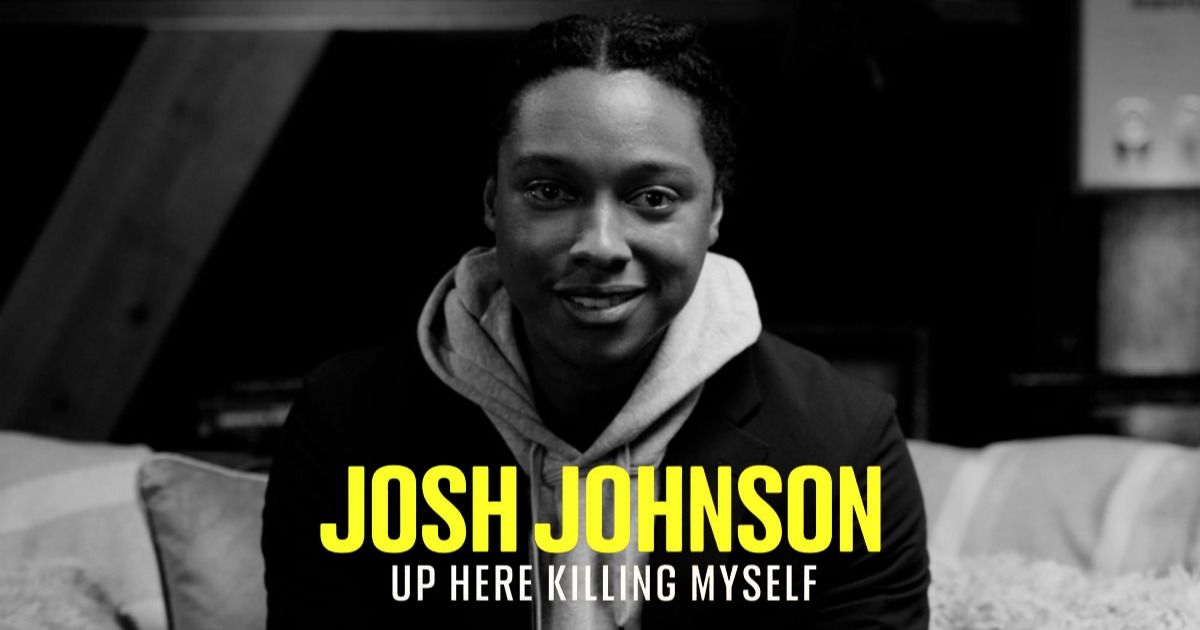
Josh Johnson Talks New Comedy Special Up Here Killing Myself
Feb 21, 2023
Out of practically any other genre, comedy is perhaps the most subjective while simultaneously being the most universal. If you don’t like horror or sci-fi, then you just don’t like those genres; essentially everyone likes to laugh, though, despite some having a much higher threshold for a chuckle. There are many ways to laugh, however, and a vast chasm of difference between Charlie Chaplin and Louis C.K.
Josh Johnson seems to know this, and toes an interesting line across different kinds of humor, though he ensures that the line remains distinctly his. He has a somewhat confessional manner similar to Jerrod Carmichael or Hannah Gadsby, mixed with the sometimes scatological humor of the aforementioned C.K. and Silverman; his work resembles the reenactment style of Richard Pryor and the ability to mine profound moments from profane humor like Dave Chappelle. At the same time, he’s not really like any of these comedians. He’s entirely himself.
That’s partially because he has begun to view comedy as therapy, and therapy is nothing if not personal. In fact, his new special on Peacock, Up Here Killing Myself, explicitly mimics the process of a therapy session, using editing to splice together a fictional bit of analysis with his stand-up comedy. Johnson spoke with MovieWeb about this tactic in his new special, the similarities between comedy and therapy, and the state of stand-up in the age of so-called ‘cancel culture.’
Josh Johnson Goes to Therapy on Stage
Like most hour-long stand-up specials, Up Here Killing Myself covers a lot of topics, but they’re mostly united by Johnson’s personaI life and struggles. He uses humor to basically tell a truncated autobiography, from the poverty of his childhood to his life in New York, his father, his stalker, and everything in between, turning his answers in therapy into stand-up jokes.
“I think the parallels are there,” said Johnson about the connection between comedy and analysis. “The reason we went with the way that we did is because that’s kind of the trajectory of the job. It sort of starts in therapy in the way that I don’t know how I feel about something, or I’m troubled by something. Then it ends up on stage when I’m done with it, I processed it, I’m ready to share it. And so that was the clearest way that [director Jacob Menache] and I felt would convey the message.” Johnson continued:
As far as the parallels, I think that both of them require bearing most of your thoughts and being vulnerable with your perspective, whether that makes sense to people or not, which is something that you’re not going to know until you try it, until you tell them. Unlike with therapy, stand-up has its own fair share of rejection if the ideas or the jokes don’t hit, or people don’t get what you’re saying, or they don’t like what you’re saying. Whereas, therapy’s this very honest place to, without being dramatic, bear your soul.
Laughter Is the Best Medicine
Peacock
Bearing one’s soul isn’t always pretty. That’s another interesting connection between stand-up and therapy — there is a kind of freedom to discuss things that wouldn’t necessarily be polite or acceptable elsewhere. “Not everything that starts in the therapist’s office ends up being a heavy thing,” said Johnson.
It’s interesting how one could swap the word ‘therapy’ with ‘stand-up’ in what Johnson says. “Therapy isn’t just this place to sort of figure out all of your childhood trauma. It’s also a place to be petty. It’s a place to complain. It serves so many purposes outside the grounded drama that we think of it being, and I think that’s what makes it healthy […] It’s a place to air out things that you don’t feel like you can, or that maybe you shouldn’t say to other people. That’s one of the reasons why I think most people can benefit from even a session or two.”
Peacock
Most people could benefit from stand-up comedy as well, and it can sometimes be as therapeutic for the audience as it is for the comedian. “I do think that if someone is expressing ideas that you’ve also felt and thought, then it is a sense of relief and a sense of community to hear them say the things that you’ve been feeling, especially if it’s done in an articulate way,” said Johnson.
Related: Here Are Some of the Funniest Stand-Up Comedians Netflix Has to Offer
He’s experienced that same sense of relief and resonance with some of his favorite comedians. “Growing up and watching Chris Rock, watching Bill Burr, or watching Maria Bamford, all these people talk about wide arrays of topics and unapologetically be themselves […] There’s something really, really engaging and really memorable about someone who perfectly put something into words in a way that you have been feeling. You can finally exhale through that person, if that makes sense.”
Josh Johnson on Cancel Culture and Comedy
Peacock
Sometimes, putting a certain thought into words upsets people; that’s part of the whole ‘comedy is subjective’ jive. Many comedians have spoken out about what they perceive to be a ‘cancel culture’ problem in society. However, the fact that their opinions have been broadcast about this paradoxically contradicts the thesis. Bill Maher or Adam Carolla have bemoaned and bashed cancel culture for multiple years now, and yet they haven’t seemed to go anywhere. Similarly, it’s not something that has touched Johnson’s life at all, though he couldn’t be more different.
Related: Exclusive: Crispin Glover on Cancel Culture and Why He Won’t Digitally Release His Films
“Oh, I don’t I don’t think about it that often, necessarily, because I think that for me, it’s really just a matter of saying what I need to say and then sharing it with people, and people are going to receive it however they receive it,” explained Johnson. “I think that, while there are definitely bad actors […] there are also people who get off on overblowing a situation. I think that ‘being canceled’ is like a murky and interesting thing because when you look at people who have been canceled, they’re doing great.” Johnson elaborated:
And don’t get me wrong, I don’t think ‘doing great’ means we can do whatever we want to them. I think that’s also a mismatched message. There are people that are like, ‘Oh, they’re doing great,’ so they weren’t affected at all. And then there are people that are like, ‘Okay, they’re doing great, but they had to go through hell.’ Two things can kind of be true.
Peacock
“I think that for the most part.” added Johnson, “when you talk about being canceled and stuff like that. I’m not saying it doesn’t happen. I’m just saying that the people who you really need to worry about when it comes to cancel culture are regular people. Regular people are the people that don’t recover, right? Celebrities, especially celebrities we love, always tend to find their way back. Do you remember the dentist [who shot Cecil the lion]? Yeah, that guy’s not probably doing great. I don’t imagine his business is doing better than it was before. So it’s like, you have to look at it the way that things actually end up, despite how we feel about them.”
“Luckily for me,” concluded Johnson, “I haven’t really encountered those things, and if I ever encounter them, then I’ll deal with them accordingly when the time comes. But I always try to show people that I have good intentions, and it’s not really worth it to try to egg people on. I’m not trying to troll anybody. I’m just trying to make everybody laugh.”
Johnson certainly does that, but then again — it’s all subjective. Josh Johnson’s comedy special, Up Here Killing Myself, is now streaming on Peacock.
Publisher: Source link





Sarah Michelle Gellar Urges ‘Buffy’ Fans to Avoid Reading Leaked Reboot Scripts
Buffy the Vampire Slayer fans have had a rough few days after Hulu officially pulled the plug on a revival of the series, which would have brought star Sarah Michelle Gellar back as the titular heroine. Described as a continuation…
Mar 20, 2026
Born Again’ Stars Explain Why Bullseye Is So Dangerous in Season 2 [Exclusive]
Along with Charlie Cox's Matt Murdock and Vincent D'Ofnorio's Wilson Fisk, Daredevil: Born Again Season 1 brought back one of The Man Without Fear's most notorious villains: Wilson Bethel's Benjamin Poindexter, better known as Bullseye. Not only was he back…
Mar 19, 2026
![Born Again’ Showrunner Confirms ‘Avengers’ Character Is Key to Street Level MCU [Exclusive]](https://www.filmibee.com/wp-content/uploads/2026/03/Born-Again-Showrunner-Confirms-Avengers-Character-Is-Key-to-Street-1200x675.jpg)
Born Again’ Showrunner Confirms ‘Avengers’ Character Is Key to Street Level MCU [Exclusive]
Ahead of the Avengers' return to the big screen later this year, Marvel Studios will return to street-level storytelling with the second season of Daredevil: Born Again on Disney+. Along with making the show canon to everything that happened in…
Mar 18, 2026

Taylor Sheridan’s Underrated Action Thriller Series Roars to Streaming Success
It’s now been two years since we last saw anything from the underrated action thriller series created by Yellowstone’s Taylor Sheridan, but having finally had some promising word about the new season, the show has now shot up the streaming…
Mar 17, 2026