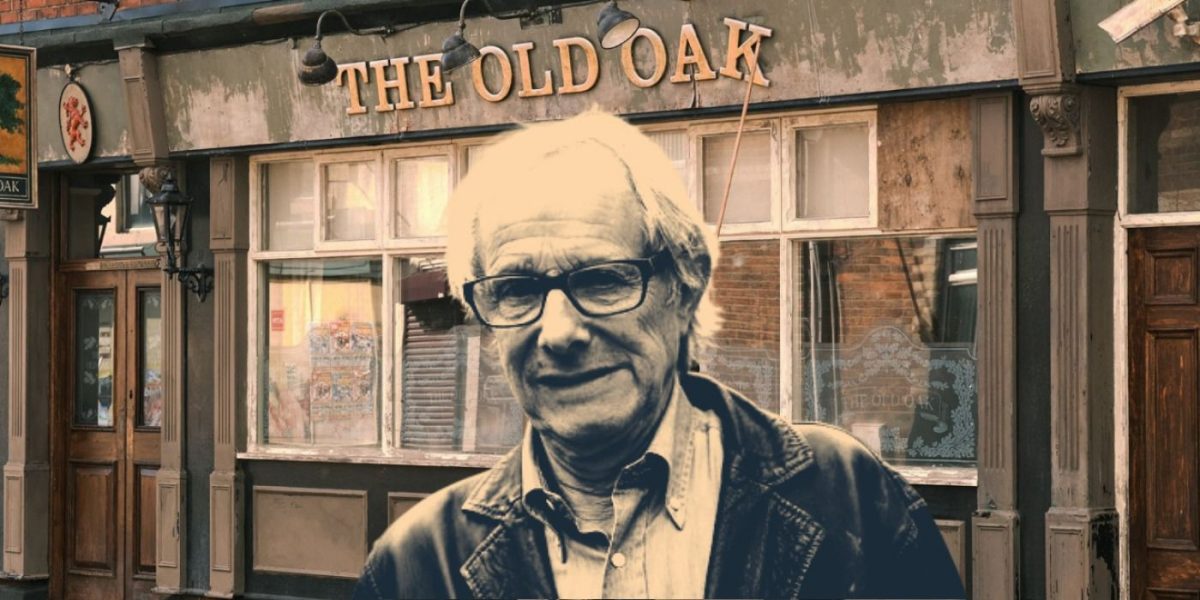
Ken Loach on The Old Oak and Retiring After 60 Years of Protest Movies
Apr 5, 2024
Film can be a powerful political tool, whatever the intentions may be. At its best, cinema is an empathy machine that allows us to understand and relate to other people and broaden our perception of humanity. It can instill important principles and create a sense of history for people, using aesthetics to make ideology more manageable. For six decades, Ken Loach and his team have disseminated important films into the body politic, creating realist character studies that have the impact of a perfect pamphlet and the beauty of fine art. The Old Oak may be his final one.
The great Ken Loach will be 88 this year, and has essentially announced his retirement. Film Forum in New York will be screening more than 20 of his films, including The Old Oak, as a phenomenal retrospective of the artist’s long career. He’s been advised not to travel, but he’ll be present through the power of his movies. The Old Oak is a great swan song for the filmmaker, uniting him once again with favorite collaborators like writer Paul Laverty, producer Rebecca O’Brien, composer George Fenton, and cinematographer Robbie Ryan.
The Old Oak concludes their Northeast Trilogy, a masterful study of late capitalism and failed bureaucracy. The film is set in 2016 and explores a small, economically distraught town that receives some of the first refugees from Syria, who quietly move in and try to survive. Dave Turner plays the melancholic owner of the titular pub who works with a young Syrian woman (Ebla Mari) to try and bring the town together in the face of racism and alienation.
Loach spoke with MovieWeb about the film and the Northeast Trilogy, how politics and his films have changed over six decades, and if he still has hope for the working class under late capitalism. Watch our interview above or read on for more.
Ken Loach Knew There Was More to Film in the Northeast
The Old Oak 4.5/5 Release Date September 29, 2023 Cast Dave Turner , Ebla Mari , Claire Rodgerson , Trevor Fox , Chris McGlade Runtime 143 Minutes Writers Paul Laverty Studio(s) StudioCanal UK , Sixteen Films , Why Not Productions Distributor(s) Zeitgeist Films
Loach’s previous two films were the Palme d’Or-winning I, Daniel Blake and the underrated Sorry We Missed You, both set in Northeast England and both exploring the bureaucratic systems that entrap people, either in unemployment or insecure employment. Loach and his comrades felt that something was missing from their Northeast films, something which would round out their portrait of an England suffering the consequences of unfettered capitalism and right-wing politics. And so they made The Old Oak. But that feeling of there being ‘more story’ to be told has always propelled Loach forward.
“Well, I think it’s always the case,” said Loach, detailing his dialectical process. “In every film, Paul [Laverty] and I — particularly Paul, because he confronts a blank sheet of paper, really — try to find a simple story with maybe half a dozen characters that contains a contradiction or a conflict. And as you unravel it and get to know the people, you shine a light right to the heart of the whole background, the whole social issue that you want to say something about. So it’s not just about the people, they are true to themselves, and they’re all individuals, but nevertheless, their conflict and their story and the resolution of it says something about the much wider issue. So that’s always the aim.”
“So, of course, there are always whole areas of the subject that you think, ‘Well, there’s another story here, and another story there.’ I think more particularly about
The Old Oak
, was that this is one small group centered around a pub in a village that had been abandoned, the mining community abandoned, and two communities are thrown together, and could they live together?”
“And there are so many issues,” continued Loach. “There’s the neglect of those communities that led to the far right, and we could do a whole film about that. You could do, obviously, many films about the Syrians, and we were aware that we were just touching on their plight and their trauma, and the role of the West, of the international community and other countries in allowing that conflict to happen, or allowing the traumas to be inflected on millions of people, as we’re seeing now in Gaza. So there’s always many, many elements that you could pick. Finding this the right one is a big, big question.”
The Northeastern Trilogy and The Old Oak Portray the Consequences of Neoliberalism
Loach went on to detail how The Old Oak fits into the trilogy as a whole, and what his films from the past eight years have been speaking to. “Well, we did Daniel Blake about the cruelty of the Social Security system, where people are denied the rights they’ve contributed to and the payment they’re entitled to by a bureaucratic system that sets traps for them. And then we thought there’s a matching one about work. Daniel Blake is about people without work. [Sorry We Missed You] is a matching one about the gig economy and the insecurity of work.” He continued:
“And then you can’t be up there [in the Northeast] and notice that it’s an old industrial area built on three big industries that are now gone — shipbuilding, coal mining, and steel, all gone, nothing put in its place. So in a way, looking back,
they’re about the consequences of neoliberalism, the consequences of an economic system that began with Reaganomics and Thatcher and the Chicago School
and the economists that said, ‘Capitalism must be unfettered, because that will be efficient.'”
Related 10 International Movies About Class Consciousness These 10 international movies on class politics are worth adding to your to-watch list.
“And the human consequences are a conscious cruelty against those who sell their labor, weakening them, impoverishing them, leaving them vulnerable, weakening unions, and so on,” continued Loach. “And these are the human consequences of that shift in the ’80s. And Thatcher was the one who carried the torch in Britain, and it spread across Europe. And neoliberalism is now intensifying the damage to the climate catastrophe and environmental damage, is causing poverty, hunger, starvation — in Britain, never mind elsewhere in the world. And these are the consequences.”
This is the harvest for Reaganomics, Thatcherism, neoliberalism, gross wealth for a few, and exploitation and sometimes extreme poverty for many.
Ken Loach on Retirement and Making Films with ‘No Social Hierarchy’
Ken Loach has said that The Old Oak will likely be his final film. If that’s the case, it’s a beautiful and moving swan song to go out on. He’s still as thoughtful and passionate as ever, but time is catching up with him.
“You hate to say never,” said Loach of retirement, “because making films is such a privilege. But the reality of the years catches up with you. I don’t think I’m going to do any directing from behind the monitor, you know, you’re on your feet 12 hours a day or more.” The director explained the unique film sets that Loach and his team create, and why it’s difficult to maintain these special productions at his increasing age:
“You’ve got to know everyone’s name, even — well, we try not to call them extras or walk-ons, but the industry calls them that. You need to know their names so they feel part of it and welcome, and
there’s no social hierarchy
. There has to be a real sense of unity and friendship and ease and enjoyment, of laughter, even in the darkest scenes.”
Related: The 24 Best British Directors of All Time
“You have to create a culture in which everyone feels safe,” added Loach. “You never bring conflict onto the set. Never, ever, ever, because you want people to be vulnerable, and they can only be vulnerable if they’re confident and they know that whatever they do, they can’t make a mistake. And generating that is keeping you on your toes all the time, making certain everyone’s okay, as well as, where do we put the camera, and what do I need to say just the trigger the right response, and how do you develop it?”
“So the emotional commitment is pretty high. They’re generous now, they give me five days a week now, not six,” laughed Loach. “We shoot for six weeks usually. To do that, for that length of time, and to lead it is… I mean, the last one was really knackering, and I’m not sure I can get around the course again, to be honest.”
From Censorship in the 1960s to Starvation Today
Loach began making television broadcasts for the BBC in the countercultural ’60s before breaking through with his surprisingly successful film, Poor Cow (1967), and then his acclaimed first masterpiece, Kes (1969). But success and critical praise didn’t dilute the social realism and passionate class consciousness of his work; if anything, his work and understanding of art’s revolutionary potential has gotten more political.
“I knew the principle of what would be censored on television in broadcasting back in the ’60s, you know, as a matter of political principle. In our country, the BBC is an arm of the state and commercial television followed suit. And you know that sort of principle,” explained Loach. “But having lived through the ’80s and having our work censored over and over again, just taken, not allowed to be broadcast, I mean, that brought it into perspective. The theory became reality, then. That principle was demonstrated in front of our eyes.” He elaborated:
“The old adage we learned in the ’60s, that
the ruling class will survive any crisis as long as the working class pays the price
, we learned that in the ’60s, and it was demonstrated in the ’80s and every decade since. And now we have 140,000 children without a home. They have nowhere to live. The rise in children and families needing gifts of food, or they will starve — I think there are half a million kids in that list, and parents and adults.”
“You know, this is extraordinary,” added Loach. “I was brought about before the war, the Second World War, and lived through it. I was nine, I remember, in the post-war period of rationing, and we didn’t have much money. Nobody starved! Everybody had somewhere to live. And now we are one of the richest countries in the world — hunger, starvation, homelessness. It’s rife. So it demonstrates that they will defend the economic system of profit being the only motive for production or public services, no matter what the human cost.”
Related The 13 Best British Movies About World War II, Ranked From The Dam Busters to Darkest Hour, here are some of the best World War II films from the British perspective.
Things Are Getting Worse, but Ken Loach Says ‘People Will Always Resist’
Zeitgeist Films
However, as The Old Oak demonstrates, Loach still has faith in the potential power of the people, so long as they can work together. The politicians will not save us. “They’re bought and paid for,” said Loach. It’s up to people to save themselves. Loach explained:
People will always resist, and that’s one of the things that people say in
The Old Oak
, that people say themselves. Solidarity is our greatest weapon. If we let them divide us by racism, by blaming immigrants, by fighting amongst ourselves, that’s their weapon. Our weapon is solidarity, real unity, understanding you have common interests.
“It’s the same people that impose zero-hour contracts, or no security work, or lower wages, it is the same people that do that for their profit that demand more use of fossil fuels, because that’s where they make money, too,” added Loach. “It’s two symptoms of the same malaise, of the same problem. And so, learning to link those struggles is very important.” He continued:
“In the end, it’ll come down to organization, principles, and not being misled. Trusting the evidence of your own eyes and experience and not being misled by propaganda. And I know, obviously, in the States, racism and disunity is dangled very hard by the right in the coming election. And we have two neoliberal parties now.
We don’t have a party of the left anymore
.”
“So I mean, on the surface, the political odds are against us. But people are living the reality, and resisting. So that’s the hope.”
Film Forum is pleased to present the US theatrical premiere of Ken Loach’s The Old Oak on Friday, April 5. The run will be followed by a retrospective of over 20 films by Loach, the two-time Palme d’Or-winning director, at Film Forum from Friday, April 19 through Thursday, May 2. You can find more information below:
The Old Oak Tickets and Showtimes
Publisher: Source link






Prime Video’s ‘God of War’ Casts ‘Lost’ Star Sonya Walger as Freya
Amazon's upcoming God of War series that is currently in production is also one of the most anticipated of the next couple of years. Film and television adaptations of popular video games have been on the rise, with creative teams…
Mar 28, 2026
Paramount+ Renews ‘Criminal Minds: Evolution’ for Season 19
The start of its new season is still weeks away, but fans of Criminal Minds: Evolution won't have to wait that long to learn the fate of the long-running hit crime procedural. Execs at Paramount+ have already decided what the…
Mar 27, 2026
‘A Tale of Two Cities’ First Look Reveals Kit Harington in MGM+ Series
The BBC and MGM+ are teaming up with a new four-part limited series adaptation of Charles Dickens' classic 1859 novel A Tale of Two Cities. Game of Thrones veteran Kit Harington will play Sydney Carton, a cynical English lawyer who…
Mar 26, 2026
HBO ‘Harry Potter’ Series Image Reveals Dominic McLaughlin in Title Role
The first official look at HBO's upcoming reboot of Harry Potter has finally arrived, and it is already teasing a magical trailer release. As we inch closer to the show's expected 2027 release, the network has begun to reveal more…
Mar 25, 2026