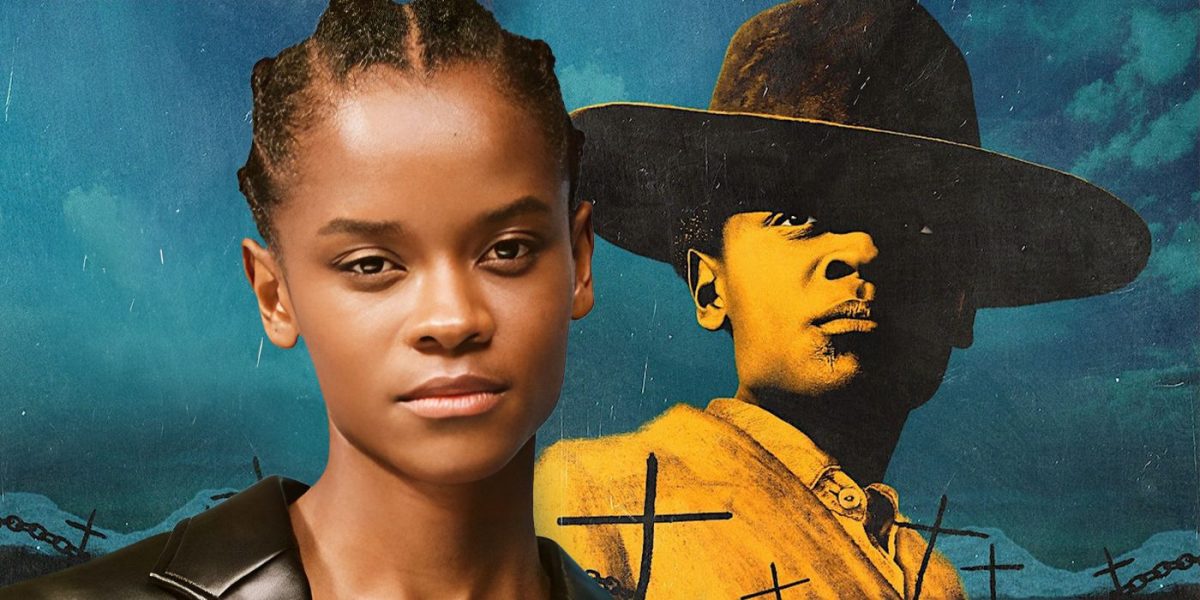
Letitia Wright on ‘Surrounded’ and the Success of ‘Black Panther’
Jun 21, 2023
From director Anthony Mandler, the 1870s Western tale Surrounded follows former Buffalo Soldier Mo Washington (Letitia Wright), a freedwoman who’s just trying to survive her journey west to lay claim to the gold mine that she’s more than earned. When she finds herself in the path of notorious bandit Tommy Walsh (Jamie Bell), they find themselves in the position of having to rely on each other for survival, all while never forgetting the threat they also pose.
During this 1-on-1 interview with Collider, Wright talked about the type of characters she’s drawn to, why she wanted to play Mo Washington, the real-life inspiration she drew from for this character, continuing to build on her career as a producer, how the success of Black Panther has led to more opportunities, what she most enjoyed about bring directed by Mandler, exploring the complicated dynamics with co-star Bell, being honored to share scenes with Michael K. Williams, and the filmmakers who have challenged her to try her own hand at directing.
COLLIDER VIDEO OF THE DAYSCROLL TO CONTINUE WITH CONTENT
Collider: The choices in roles and projects that you make is so interesting. You play characters that seem very specific to their time and to their story, and that you really need to throw yourself completely into. Are you drawn to character first? Does it have to just leap off the page for you? Does something about the character have to speak to you?
LETITIA WRIGHT: That’s a good question. Yes, I would say so. I don’t wanna waste time doing something I don’t really care about, so I always try to find intriguing characters and also try to redefine what it means to be an artist, for myself, as well as just thinking outside the box and trying to do something different and that would challenge me. This fits right into the type of roles that I love to do. I love to stretch myself with stuff like this.
Image via MGM
What was it about this character that really made you want to dig into this story and who she was? Were there things that you were most intrigued about getting to explore by playing someone like this?
WRIGHT: Yeah. I found out that there were Buffalo Soldiers back then, who predominantly had Black men alongside them fighting, and that there was a woman called Cathay Williams. For the reasons that seem so sad today, a woman has to hide herself, in order to protect herself, and she had to take those necessary steps. She was actually a part of the Buffalo Soldier troop in the Army, and she hid as a man for many years, until they figured it out. She was brave enough to protect herself and to chase after this dream of having better for herself, after the Civil War was over. That [inspired me with this character] and was something that I’d never seen before. I wanted to be a part of portraying a character like that.
A character like this is always interesting to center a story around because you never quite know what to make of her, or how she’ll react or respond in a situation. It really makes it harder to guess what the outcome might be. How did you view her? Did you see her as a hero? Do you see her as the hero of her own story? Do you see her as a survivor?
WRIGHT: Those are good words to use, and I agree with you. I connect with those words because I saw her as someone who, simply put, had a dream that she wanted to achieve, just like most of us. Everybody has something they wanna do and to fulfill that. But what are you willing to do to get that? What obstacles are you willing to overcome to get it? Some people overcome those obstacles, but unfortunately, some people don’t. I just saw her as someone that redefined what she felt success was for her, in comparison to what society was saying success would be for her.
When I spoke to you for The Silent Twins, which you had also produced, you told me that you wanted to seek out more opportunities as a producer, but that you also wanted to earn that title. What did that mean for you, on this film? What were the aspects of the filmmaking process that you wanted to get more involved with, when it came to Surrounded?
WRIGHT: The opportunity to produce Surrounded was the first opportunity I had been given to co-produce, alongside my acting. It was actually before The Silent Twins. It was just an opportunity to have a creative voice behind the camera, as much as I do in front of the camera. It really helped me to establish my taste, what I like and what I don’t like, and the ways I want to improve in the future. That led to my experience for The Silent Twins because I had already gained a little bit of experience on this one. I was able to work even more with the team and to exercise my voice and to advocate for what was right for the film, as a producer. I feel like step by step and project by project, I’m earning that title a little bit more, but there’s a lot of work to do still.
Image via MGM
It’s no secret that having Marvel-level success and being a part of something like Black Panther opens doors and allows you to tell stories that you might not have been able to tell without having that spotlight. What does it mean to you to be in a position where you can bring stories to life that we might not otherwise get to see?
WRIGHT: It’s a positive. Prior to Black Panther, I was always playing characters that were a little bit of the outlier or the people in society who are fighting for something greater than themselves. That’s been following me, so it’s just an extension and a continuation of that. This time, it’s just more eyes on it, really, in comparison to pre-Black Panther. It’s definitely led to more opportunities to use the platform for projects that I really love and I wanna champion. I’ll keep doing that because it’s a formula that works really well for me.
Your director on this film, Anthony Mandler, is someone who gained experience as a director by doing a lot of music videos. I find music videos so interesting as a medium because they really have to tell a full story and convey a very clear vision, in about five minutes or less, so it seems like a director with that experience would then know how to very effectively convey the vision they would want. How did you find the experience of working and collaborating with him on this? What did you like about working with him, as a director?
WRIGHT: I definitely love the way that he comes from that background of just fast-paced creativity. I really loved Monster, which he did with Kelvin Harrison Jr. I thought that was a beautiful film with a beautiful character at the center. I just loved that he trusted me to make the character my own and fly with her, not really messing with the process of what I had to do to bring Mo to life. And he also listened to me, in terms of script changes and what I felt she would say and what was necessary for her to do. I was just given the space to really get this character moving and going, and to prove myself, at each point, especially with learning how to shoot the gun and changing my appearance and persona to fit what we wanted her to be. He allowed me to find those things on my own and bring them to life, so I was really happy about that.
The dynamic between Mo and Tommy is fascinating because there are so many levels at play between them and you really explore all those levels. What was it like to explore that relationship? What did you most enjoy, as an actor, about what you got to dig into with that dynamic, and what Jamie Bell gave back in those scenes?
WRIGHT: It was really nice to work with someone who is as dedicated as you are. I love that you have two characters who are the complete polar opposite of each other. You wouldn’t put them in the room together, and if you did, they wouldn’t stay in the same room because they couldn’t handle it. But the situation in this film forces them to look at each other and see similarities and differences. That’s what’s really fun about the dynamic of the characters. It’s easy to say, “This one is good, and this one is bad.” But who is good and who is bad? What does that mean? Your fight could be different from mine, but there’s the similar motive of trying to survive. I love the dynamic of those two characters, and Jamie was the perfect co-lead to help us get through that together. It was really good.
Image via MGM
He seems like an actor who’s not afraid to go to dark and scary, if there’s a reason to go to dark and scary. And then, there’s something so interesting about watching your characters because they do feel like they’re each the hero in their own story, but the villain to each other.
WRIGHT: Yeah, that’s a really good point.
What was it like to share screen time with Michael K. Williams? What most stands out to you about having worked with him?
WRIGHT: I’m just really honored that I got the opportunity to work with him and to see him work. I’ve always been a fan of his craft, especially in The Wire, but also The Night Of. That one just hit me. It was just really beautiful to share moments with him on set. There was a lot of laughter, in between takes, and a lot of advice and encouragement and quality acting. It was just three people, going back and forth, and just acting our packs off, really, to give the best to the project. Seeing someone that had so many years of experience, still come on set and give 100%, I’m honored to have worked with him and to share the screen with him.
You’re exploring acting and you’re exploring producing. Are you thinking about adding directing to that, at any point?
WRIGHT: I got challenged by two really cool people. I got challenged by Ryan Coogler, and then Denzel [Washington]. They were like, “You’re thinking about directing, huh? You’re gonna do it.” I think it’s something that will happen in the future, but who knows? It might be closer than I think it will be. I definitely wanna learn and study the craft of that. I think it’s a beautiful craft, and it’s great leadership to be able to do that. For now, producing has my focus, and some writing, as well – concept writing and coming up with ideas. I’m staying in that pocket and still trying to continue to master my craft, as an actress, to be versatile and different, and to hit you with something different every time. That’s the pocket I’m staying in. But when I’m directing, you’ll know about it.
Surrounded is available on digital.
Publisher: Source link


New ‘Wheel of Time’ Animated and Video Game Adaptations Are in the Works
Amazon might be finished with The Wheel of Time, but we haven't seen the end of the story when it comes to adaptations of Robert Jordan's bestselling high fantasy saga. Fans were left blindsided when Amazon abruptly pulled the plug…
Mar 22, 2026
‘Off Campus’ Teaser and Release Date Revealed by Prime Video
No one expected a love story between rival hockey players to become one of the most talked-about TV shows of 2025, but there's a lot more where Heated Rivalry came from, as a new teaser for Prime Video's foray into…
Mar 21, 2026
Sarah Michelle Gellar Urges ‘Buffy’ Fans to Avoid Reading Leaked Reboot Scripts
Buffy the Vampire Slayer fans have had a rough few days after Hulu officially pulled the plug on a revival of the series, which would have brought star Sarah Michelle Gellar back as the titular heroine. Described as a continuation…
Mar 20, 2026
Born Again’ Stars Explain Why Bullseye Is So Dangerous in Season 2 [Exclusive]
Along with Charlie Cox's Matt Murdock and Vincent D'Ofnorio's Wilson Fisk, Daredevil: Born Again Season 1 brought back one of The Man Without Fear's most notorious villains: Wilson Bethel's Benjamin Poindexter, better known as Bullseye. Not only was he back…
Mar 19, 2026